
GUIMARÃES · MARCH · NORTHERN PORTUGAL
Portugal’s first capital spends March warming up without clearing the sky. Average highs reach 62.6°F (17°C), the day passes twelve hours on the 15th, and rain still reaches the gauge on 9.9 days out of 31. It makes a walking month in a town built for walking: the World Heritage core covers 94.4 acres (38.2 hectares), small enough to cross on foot before lunch and again after it.
What the month withholds is certainty. March carries more rain in total than February or April, 3.98 inches against 3.85 and 3.76, and nights average 47.8°F (9°C). Bring a shell, a mid-layer and shoes that grip wet granite, and you get light until 6:42 p.m. and an itinerary that never has to wait out the summer heat.
THE MONTH AT A GLANCE · GUIMARÃES · MARCH
March buys you twelve hours of daylight and 62.6°F afternoons at the cost of nine or ten wet days, which makes it a strong month for walking a stone town and a poor one for anyone chasing heat.
AVERAGE HIGH 62.6°F · 9.9 WET DAYS · 11 H 59 MIN OF DAYLIGHT ON MARCH 15 · INLAND, NO COAST
Go for: the 94.4-acre World Heritage core on foot, the castle end and the monastic end in one day, and the Couros tanneries with daylight running to 6:42 p.m.
Think twice before: promising anyone a dry week. March averages 3.98 inches, more than February or April, and 3.2 days bring 0.39 inch or more.
Climate: IPMA station 545, Porto Pedras Rubras, 1991–2020 · Heritage: UNESCO file 1031bis · full sources at the end
On this page
- Guimarães weather in March62.6°F days, 3.98 inches of rain, 9.9 wet days
- How cold are March nights in Guimarães?A 47.8°F average low, and what we know about frost
- Crowds, prices and the lodging taxWhat we verified, and what we could not
- Things to do in Guimarães in MarchThe castle, the monastic end, the Couros tanneries
- A two-day plan built on 12 hours of daylightDay one and day two, hour by hour
- Guimarães in March vs February and AprilHow the three months compare, degree by degree
- Is March a good time to visit Guimarães?Our verdict, and the month to shift to
The normals below come from one station and one 30-year period, and every place named carries what we could verify about it. For what does not move with the calendar, the city guide holds it, February and April sit either side of this month, and the 12-month verdict for Portugal puts March in its national context.
Guimarães weather in March: average highs, lows and rain days
| March normal, 1991–2020 | Figure |
|---|---|
| Average high | 62.6°F (17°C) |
| Average low | 47.8°F (9°C) |
| Day to night gap | 14.8°F |
| Rainfall | 3.98 in (101 mm) |
| Days with 0.04 in or more | 9.9 |
| Days with 0.39 in or more | 3.2 |
| Daylight on March 15 | 11 h 59 min |
| Sunrise and sunset, March 15 | 6:43 a.m. · 6:42 p.m. local |
Every figure here comes from IPMA, the national weather service, and from one real thermometer: station 545 at Porto Pedras Rubras, Porto’s airport, 222 feet (67.7 m) above sea level on the coast. Its 1991–2020 March normals run 62.6°F (17°C) by day, 47.8°F (9°C) at night, 3.98 inches of rain. Guimarães sits inland from that gauge, so treat these as regional normals: inland afternoons run hotter in summer and inland nights colder in winter than the coast records.
Rain reaches the gauge on 9.9 days in an average March, roughly one day in three, and 3.2 of those deliver 0.39 inch or more. Those counts use IPMA’s own thresholds, 0.04 inch and 0.39 inch, not the 0.10-inch threshold American tables use, so they do not swap with a US almanac. Spread across the month, 3.98 inches over 9.9 wet days averages 0.40 inch per wet day: enough to soak a morning and move on.
Fourteen point eight degrees separate the 62.6°F afternoon from the 47.8°F night, and both land inside the same 24 hours. One layer decides the trip: a shell that beats rain and wind, a warm mid-layer for the first and last hours outside, and soles that hold on wet granite paving. Our packing guide handles the rest of the suitcase.
On March 15 the sun rises at 6:43 a.m. and sets at 6:42 p.m. local time, 11 hours and 59 minutes of daylight. That is a full afternoon of walking still available after a late lunch, and it means a flight landing mid-afternoon leaves an hour or two in the old town before the light goes. Compare it with the dark end of the year in February.
How warm is Guimarães in March?
The month averages 62.6°F (17°C) by day against 47.8°F (9°C) overnight, a spread of 14.8°F between the warmest and coldest hours. Neither end is extreme and neither is summer. Read those as coastal-station air: the same March day inland tends to sit a little colder once the sun is down.
In practice, an early start wants a jacket and a coffee before the castle, while a sunny 62.6°F afternoon walks fine in a sweater alone. The old town climbs and drops between its two medieval poles, and the climbing does some of the heating for you. Keep the shell in the day bag rather than back at the hotel.
We could not verify a frost-night count for Guimarães: IPMA’s March normals give a mean low of 47.8°F and no frost tally, and a coastal station would understate inland cold in any case. Plan for cold rather than freezing, and if you are booking a rural house outside town, ask the owner about heating before you pay.
How busy is Guimarães in March? Crowds, prices and booking
We found no occupancy series and no month-by-month room-rate series for Guimarães, so we crown no month cheap and none expensive. What is fixed is the calendar: March falls before the Portuguese summer, daylight has only just crossed twelve hours, and school holidays elsewhere in Europe do not yet run the town. The national picture on spending sits in our trip-cost guide.
Without lead-time data we will not name a number of weeks. Two things do steer the booking: transatlantic airfare and the weather. Our flights guide covers the first. For the second, with 9.9 wet days in play, a refundable room costs little and buys the right to swap a day trip for an indoor afternoon.
We could not verify a lodging-tax rate for Guimarães, so we give no percentage and no nightly amount. Ask the property directly when you book, and ask whether it is collected at checkout rather than in the online price, because that is where a small per-night charge usually appears.
The one upgrade that changes this month is where you sleep. The protected perimeter covers 94.4 acres (38.2 hectares) inside a buffer zone of 319.8 acres, and most of the building stock within it is privately owned, so rooms exist in the old houses themselves. A bed inside that boundary turns a rainy hour into a five-minute retreat instead of a soaked walk back.
Things to do in Guimarães in March: the castle and the Couros tanneries
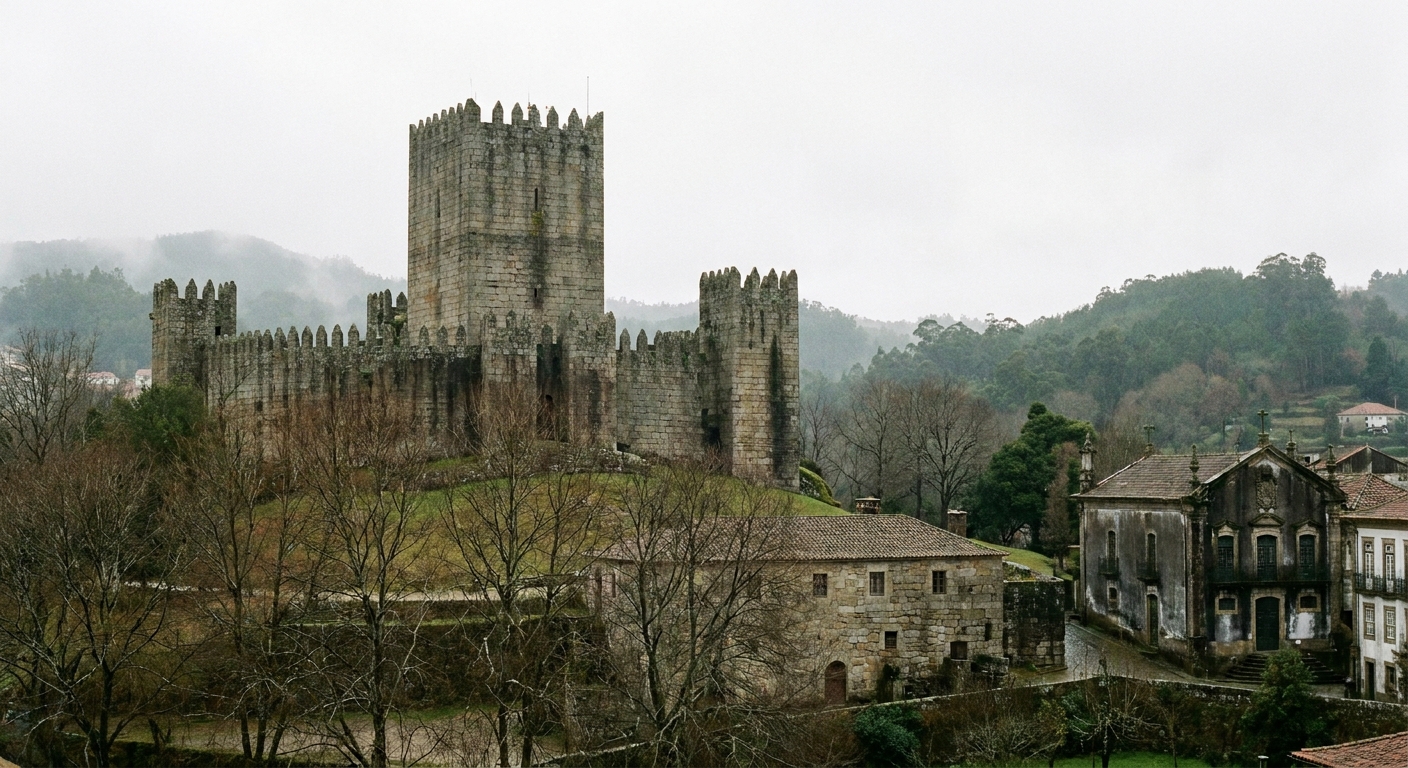
March hands over the whole outdoor town at a temperature you can walk in for eight hours straight. Summer afternoons inland run hotter than the coastal gauge admits, and February still holds 10.0 wet days and 44.2°F nights. With the sun up from 6:43 a.m. to 6:42 p.m., both medieval poles fit into one day and the tanneries still get the good light after lunch.
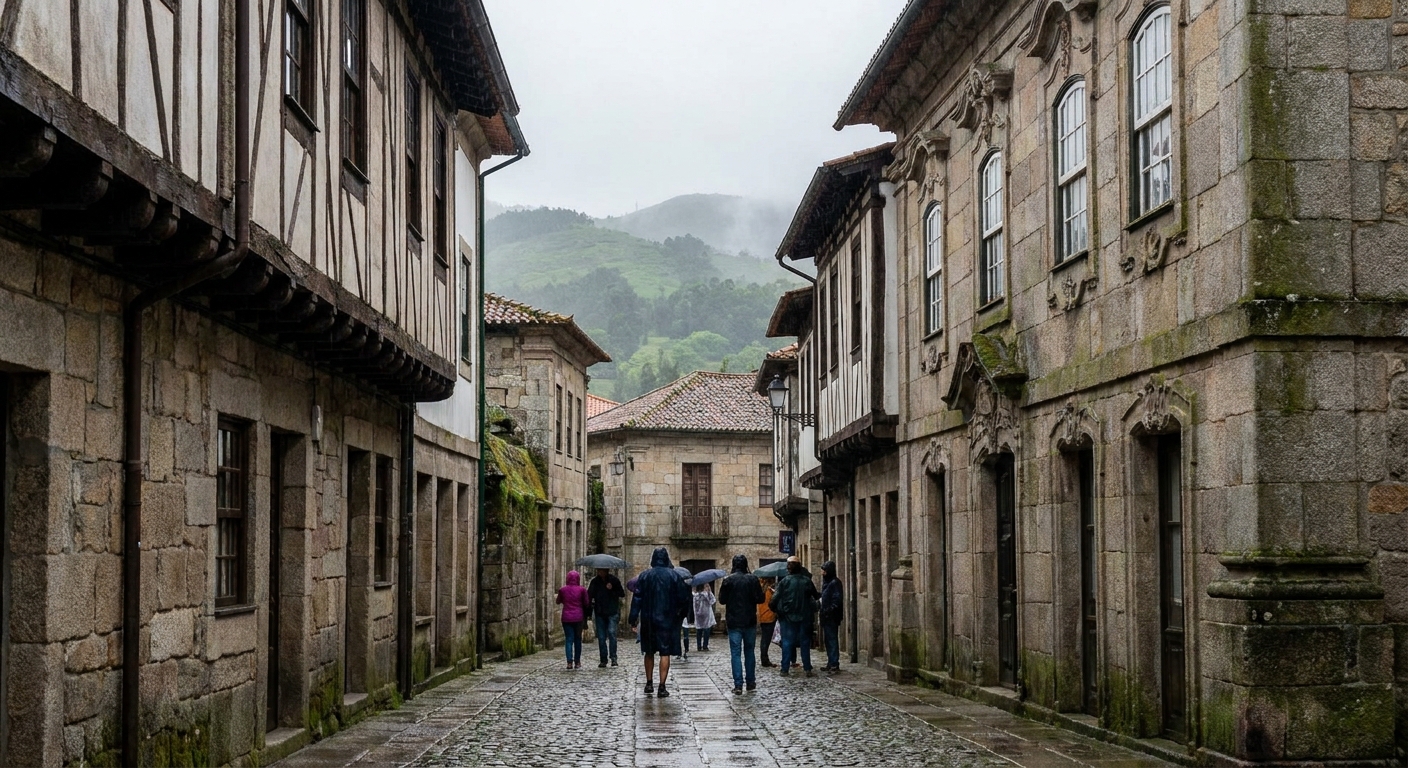
Inside the walls, the town grew around two poles, both standing from between 950 and 1498: the castle to the north, the monastic complex to the south. Nineteen properties within the perimeter hold legal protection, ten as National Monuments and nine as properties of Public Interest. We could not verify a single opening hour or admission fee for the castle, the palace or any other monument here, so we publish none: check each operator before you go.
The building method itself is the sight: a granite ground floor carrying a half-timbered story above, a technique that traveled from here to Portuguese colonies in Africa and the New World. None of that shifts with the season. The air does. A 62.6°F afternoon lets you stand still and read a facade. A January wind or an August afternoon does not.
Walking costs nothing, and the public spaces belong to the municipality: the squares laid out between 1498 and 1693 over a street plan older than all of them, and the Couros Zone outside the walls, named for the leather tanning once practiced there, with its tanneries and workers’ houses from the 19th and early 20th centuries. UNESCO flags Couros as needing an urgent conservation strategy and names tourism-driven gentrification as a pressure on it, so walk it as the living quarter it is.
Guimarães in March: a two-day itinerary
Day one starts at 8, with coffee while the air is still near its 47.8°F overnight mark, then the castle end of the walled town before the morning warms. Midday goes to the southern, monastic pole, with lunch indoors if the rain is doing its 0.40-inch turn. From 2 p.m. until sunset at 6:42 you have four and a half hours for the squares and the 94.4-acre core, which is about two slow crossings of it.
Day two runs outside the walls: Couros first, then the Franciscan and Dominican ends the town spread toward once it outgrew its perimeter. If the weather turns, and 3.2 days a month bring 0.39 inch or more, flip the order, keep the afternoon for interiors, and let our getting-around guide decide whether Braga or Porto takes the wet half-day.
Guimarães in March vs February and April
| Measure | February | March | April |
|---|---|---|---|
| Average high | 59.0°F (15°C) | 62.6°F (17°C) | 64.6°F (18°C) |
| Average low | 44.2°F (7°C) | 47.8°F (9°C) | 50.2°F (10°C) |
| Rainfall | 3.85 in | 3.98 in | 3.76 in |
| Days with 0.04 in or more | 10.0 | 9.9 | 10.4 |
| Rain per wet day | 0.39 in | 0.40 in | 0.36 in |
Across the three months the air climbs steadily: 59.0°F, 62.6°F, 64.6°F by day, 44.2°F, 47.8°F, 50.2°F at night. Rain refuses to follow that line. March carries the most total rain of the three at 3.98 inches on the fewest wet days, 9.9, which works out at 0.40 inch per wet day against April’s 0.36. On water temperature there is nothing to compare: Guimarães is inland, and we hold no sea reading for it.
Shift four weeks forward and April gives you 2.0°F more by day, 2.4°F more at night and 0.22 inch less rain, in exchange for half a wet day more. Shift four weeks back and February takes 3.6°F off both ends of the day for a near-identical rain count. March sits between them with heavier individual falls and the shortest wet-day tally of the three.
Is March a good time to visit Guimarães?
Yes for walkers, for anyone whose trip is built on stone streets, a castle hill and a long lunch, and for travelers who would rather add a sweater than lose an afternoon to heat. No for anyone who wants beach days out of it: this is an inland town, we carry no water temperature for it, and the coast is a separate trip on the northern itinerary.
If the answer is no, take April: 64.6°F days, 50.2°F nights, 3.76 inches of rain, the lowest total of the three, plus more daylight on top. Our April page runs the same station’s numbers. And if you want the colder, darker version of exactly the same walk, February holds 59.0°F days and 44.2°F nights.
What March alone delivers is the crossover point: daylight passes twelve hours on the 15th while the wet-day count sits at its lowest of the three months, 9.9.
The last word
Book the room inside the walls, pack the shell, and give the castle your first morning while the air is still at its overnight 47.8°F. Guimarães was founded in the 10th century and became the first capital of Portugal in the 12th, and the rules that keep its medieval street layout intact come from a master plan of 1994, revised in 2015. That plan is why the lanes under your feet in March are still the ones drawn before 1498.
Sources & data for this guide
- March normals, rain-day counts and thresholds · IPMA, 1991–2020 climate normals, station 545 Porto Pedras Rubras, altitude 222 ft (67.7 m) · checked Sep 24, 2026
- February and April normals used in the comparison · same IPMA station and same 1991–2020 period, not estimates · checked Sep 24, 2026
- Daylight, sunrise and sunset on March 15 · sunrise-sunset.org, converted to local time · checked Sep 24, 2026
- World Heritage perimeter, 2001 inscription with 2023 boundary change, 38.2 hectares (94.4 acres) and a 129.4-hectare buffer, the nineteen protected properties, the Couros Zone and the 1994 master plan revised in 2015 · UNESCO World Heritage Centre, file 1031bis · checked Sep 24, 2026
- Our own caveat: the thermometer sits at Porto’s airport on the coast, not in Guimarães, and inland winter nights run colder than it records
- We could not verify any opening hour or admission fee for Guimarães monuments, nor a lodging-tax rate, nor any dated March event · check operators and your property before you book