
GUIMARÃES · APRIL · THE MONTH-BY-MONTH FILE
Guimarães was founded in the 10th century and was the first capital of Portugal in the 12th, and the walled core that came out of it covers 38.2 hectares: a morning’s walk, if the weather cooperates. In April it mostly does. The average afternoon reaches 64.6°F, the average night drops to 50.2°F, and on the 15th the sun is up for 13 hours 24 minutes.
The rain comes with it. An average April delivers 3.76 inches over 10.4 wet days, less water than March and spread across more of them. Most trips reach the town from Porto. The thermometer behind these normals sits out at Porto’s airport, and our getting-around guide has the trains.
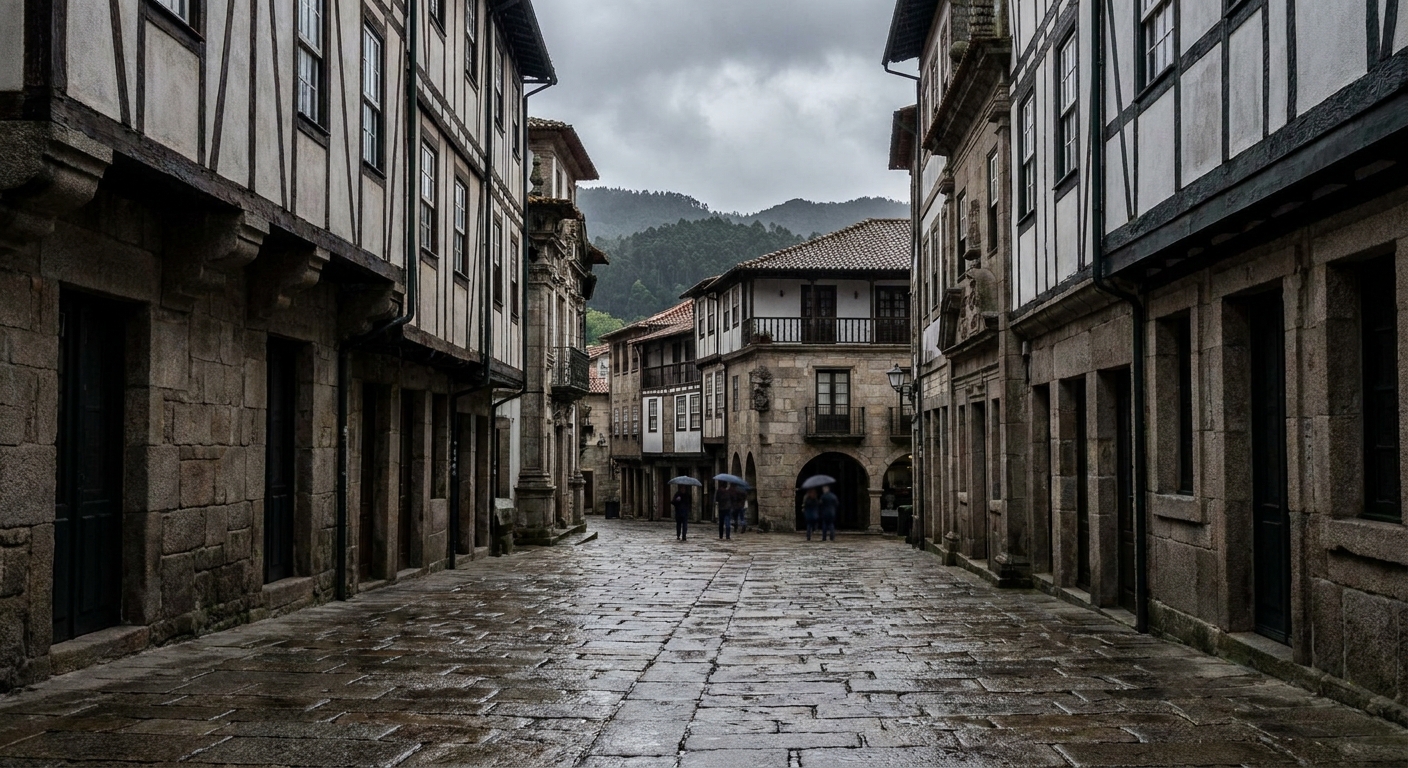
THE MONTH AT A GLANCE · GUIMARÃES · APRIL
April gives a 38.2-hectare walled center 13 hours 24 minutes of daylight and 64.6°F afternoons, at the cost of 10.4 wet days.
AVG HIGH 64.6°F · AVG LOW 50.2°F · 10.4 WET DAYS · NO COASTLINE
Go for: walking the whole UNESCO perimeter on foot, with light to 8:16 p.m. and afternoons sitting 3.9°F below May’s.
Think twice before: locking a dry-weather itinerary: 10.4 days of an average April record rain, and 3.4 of them bring 0.39 inch or more.
Normals: IPMA station 545, Porto Pedras Rubras, 1991–2020 · Perimeter: UNESCO file 1031bis · full sources at the end
On this page
- Guimarães weather in April, in numbersHighs of 64.6°F and 10.4 wet days
- How cold the mornings getLows of 50.2°F, and no sea reading
- Crowds, booking and the tourist taxWhat we verified and what we could not
- What to do in the historic centerThe castle, the monastic pole, Couros
- A two-day plan built on April lightSunrise 6:52 a.m., sunset 8:16 p.m.
- April against March and MayHow the three months compare
- Is April a good month to go?Our April verdict
Every figure here comes from two places: IPMA’s 1991–2020 normals at station 545, Porto Pedras Rubras, and UNESCO’s file on the historic center.
Guimarães weather in April: average highs, lows and rain days
| April measure (1991–2020) | Figure |
|---|---|
| Average high | 64.6°F (18.1°C) |
| Average low | 50.2°F (10.1°C) |
| Precipitation | 3.76 in |
| Days with 0.04 in (1 mm) or more | 10.4 |
| Days with 0.39 in (10 mm) or more | 3.4 |
| Daylight on April 15 | 13 hours 24 minutes |
The thermometer behind these normals stands at Porto Pedras Rubras, station 545, at 67.7 meters (222 feet), and IPMA runs it: a real instrument, not a model grid cell. It reads 64.6°F for the average April high, 50.2°F for the average low and 3.76 inches of rain. It also sits on the coast, while Guimarães sits inland, where winter nights run colder and summer afternoons hotter. Treat April’s figures as a close neighbor of the town’s own weather.
Rain on 10.4 days out of thirty works out to something measurable roughly one day in three, and 3.4 of those deliver 0.39 inch or more, about one day in nine. IPMA counts at its own thresholds, 0.04 inch and 0.39 inch. American tables usually count at 0.10 inch, so these totals do not swap with the ones in a US almanac.
Between the average low and the average high sits 14.4°F. You leave at 50.2°F in granite shade and peel down to 64.6°F in an open square a few hours later, so whatever comes off has to fit in a daypack. A light rain shell belongs in the same bag, given those 10.4 wet days, and our packing guide handles the rest of the suitcase.
On April 15 the sun rises at 6:52 a.m. and sets at 8:16 p.m. local time, 13 hours 24 minutes apart. Portugal runs an hour ahead of UTC in April, and sunrise-sunset.org publishes those moments as 05:52 and 19:16 UTC. The last hour of light therefore lands after 7 p.m., which means the squares laid out between 1498 and 1693 are still lit at dinner.
How warm is Guimarães in April?
The month averages 64.6°F by afternoon and 50.2°F at night, a spread of 14.4°F, and every one of those readings is air. Guimarães has no coastline, and we found no water temperature for the town or its river, so we give none. Coastal sea tables published for Portugal are averages of daily maxima, a touch warmer than a 24-hour mean, and none of them describe an inland town anyway.
Mornings want a sweater with a jacket over it, because 50.2°F in stone shade reads colder than 50.2°F in open country. By early afternoon the jacket is in the bag and shirt sleeves do the climbing. Pull it out again after seven: the light holds until 8:16 p.m., the warmth does not. Salt water means a trip out to Porto and the coast beyond it.
Nothing in the normals counts frost nights, and we could not verify a count for April, so we give none. The monthly mean low of 50.2°F sits 18 degrees above freezing, though a monthly mean hides its coldest nights, and the town lies inland of a coastal station that reads milder after dark. Pack for chilly rather than freezing, then check a forecast the week you travel.
How busy is Guimarães in April: crowds, booking lead time and lodging tax
We found no occupancy series and no monthly room-rate series for Guimarães, so we crown no month expensive and none cheap. What the calendar does say is that April is a spring month in a town whose protected core covers 38.2 hectares, with a 129.4-hectare buffer around it. The whole property walks in a day, and arrivals concentrate into the same lanes in any season.
Fix the dates before the bed. Most of the building stock inside the perimeter is privately owned, per UNESCO’s file, and rooms inside a 38.2-hectare center are finite in any month. We could not verify lead times or nightly rates, so we quote neither: book the center first if sleeping inside the walls matters to you. Where to stay in Portugal and what a week costs carry the country-level budget.
We could not verify whether Guimarães levies a municipal tourist tax, or at what nightly rate, so no percentage and no euro figure appear anywhere above. Ask the property what it adds at check-in when you book, rather than borrowing a rate from another Portuguese city. Know before you go covers the rest of the small print, cards and tipping included.
Pay up for the address, not for the extras. Light holds until 8:16 p.m. in mid-April, and a room inside the walls turns that last hour into a walk instead of a drive back in. Everything else, the meals and the day trips out to Braga or into the north, costs what it costs in March or May.
Things to do in Guimarães in April: the castle, the monastic pole and the Couros tanneries
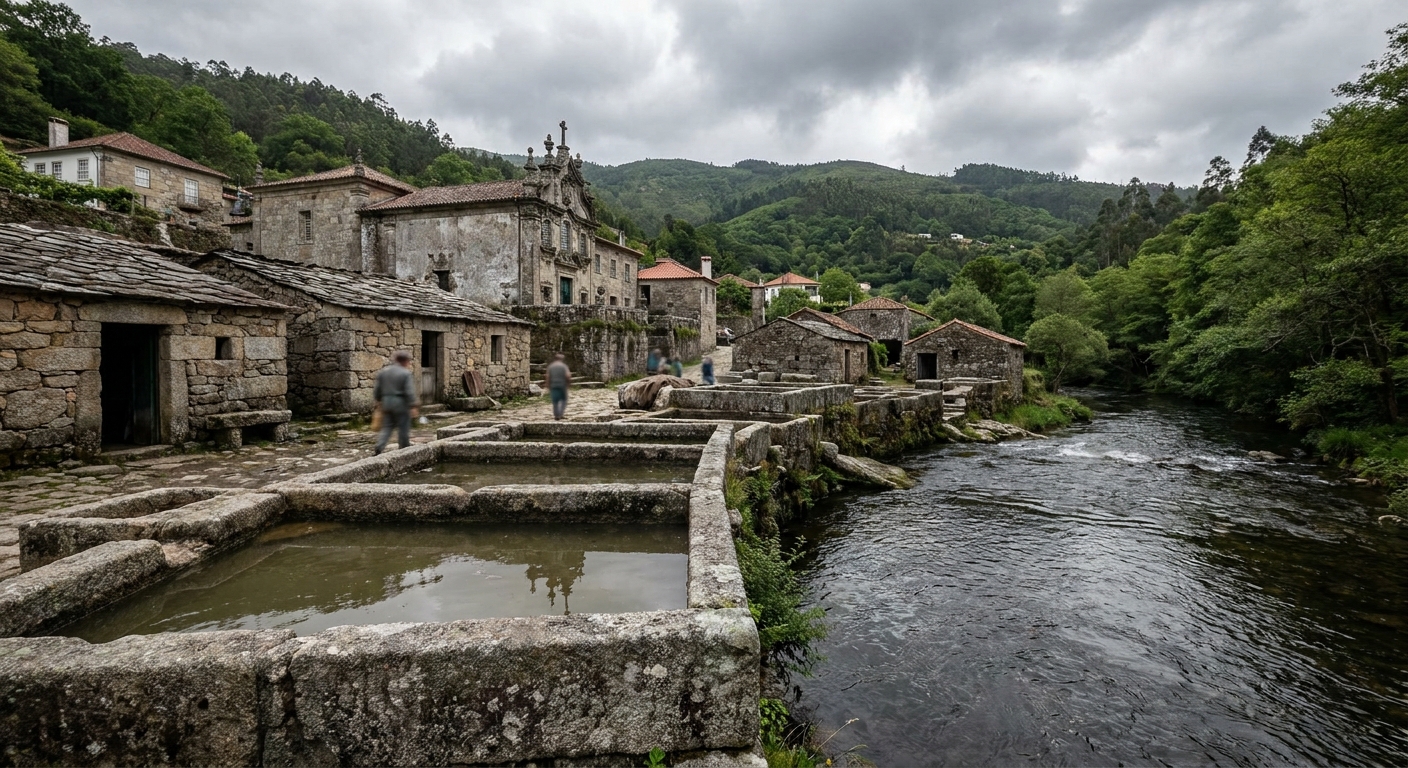
April hands the walking town its working conditions: afternoons at 64.6°F, 2.0°F above March, and 13 hours 24 minutes of daylight to spend on cobbles. Inland summer afternoons run hotter than the coastal station reads, and April does not. That combination is what makes a full day on foot inside the old perimeter plausible instead of punishing.
Intra-muros, the town grew around two poles, both standing from between 950 and 1498: the castle to the north and the monastic complex to the south. Walking the line between them gives you the medieval plan whole. Outside the walls the town spread around the Franciscan and Dominican complexes, and nineteen properties inside the perimeter hold legal protection, ten as National Monuments and nine as properties of Public Interest.
Stone does not change from month to month. The air around it does, and April puts 14.4°F between the morning low and the afternoon high, so the open ground of the Couros Zone suits the warm middle of the day and an indoor hour suits the cold start. We could not verify opening hours or admission at the castle, the palace or any other monument in town, so we quote no time and no fee: confirm each site directly before building a morning around it.
The streets and squares cost nothing. Public space belongs to the municipality, the medieval street layout survived every later rebuild, including the grand houses and civic buildings of 1498 to 1693, and the granite ground floors carrying half-timbered stories above them are a method invented here and carried to Portuguese settlements in Africa and the New World. A slow lap of the walled core is the free half of any April day.
Guimarães in April: a two-day itinerary
Start day one at nine, once the 50.2°F morning has lifted. Take the castle end first, work south toward the monastic pole, and let the walk between them fill the late morning. Lunch indoors around one. Give the afternoon to the Couros Zone and its tanneries while the thermometer is at its 64.6°F best, then climb back up to a square for the long evening, because the light holds to 8:16 p.m. in mid-April.
Day two belongs to the streets outside the walls, around the Franciscan and Dominican complexes, plus whichever of the nineteen protected properties you skipped. If the sky turns, and it turns on 10.4 days in an average April, invert the order: the palace and a two-hour lunch during the wet stretch, the open ground when it passes. April spreads less water over more days than March does, so waiting it out usually beats canceling.
Guimarães in April vs March and May
| Month | Average high | Average low | Precipitation | Days at 0.04 in or more |
|---|---|---|---|---|
| March | 62.6°F | 47.8°F | 3.98 in | 9.9 |
| April | 64.6°F | 50.2°F | 3.76 in | 10.4 |
| May | 68.5°F | 54.1°F | 3.37 in | 8.9 |
The temperature line climbs steadily across the three: 62.6°F, 64.6°F and 68.5°F on the average high, with lows tracking at 47.8, 50.2 and 54.1. Rain runs the other way, 3.98 inches in March, 3.76 in April, 3.37 in May, and yet April counts the most wet days of the trio, 10.4 against 9.9 and 8.9. No sea temperature belongs in the comparison, since the town is inland and all three readings are air.
Move four weeks forward and May pays you 3.9°F on the afternoon, 0.39 inch less rain and 1.5 fewer wet days, which is the strongest argument for waiting. Move four weeks back and March takes 2.0°F off the high, 2.4°F off the night and adds 0.22 inch of rain. Both neighbors carry the same IPMA series: March and May.
Is April a good time to visit Guimarães?
Yes for walkers. The month offers 13 hours 24 minutes of daylight, 64.6°F afternoons and a center small enough to cross on foot twice in a day, and that is the trip most people come here for. No if your itinerary needs dry weather locked in months ahead: 10.4 days record rain, 3.4 of them a real soaking, and no forecast that far out says which ones.
When dry matters more than cool, take May instead: 8.9 wet days, 3.37 inches and afternoons at 68.5°F, the driest and warmest of these three months. March offers nothing April lacks and adds 0.22 inch of rain on top. For the other nine months, our best-time guide to Portugal lines the whole year up.
What April holds alone in this trio is the middle ground: nights at 50.2°F that still ask for a jacket, afternoons 3.9°F short of May’s, and daylight from 6:52 a.m. to 8:16 p.m. to spend on 38.2 hectares of protected town.
The last word
Book the bed inside the walls, keep one morning loose for weather, and give a slow hour to the Couros Zone rather than only to the castle hill. UNESCO’s own file flags that quarter as needing an urgent conservation and rehabilitation strategy, and names tourism-driven gentrification as a pressure on the property. The management plan behind it dates from 1994 and was revised in 2015, and the boundaries themselves were redrawn in 2023. Walk the tannery end before the light goes at 8:16 p.m.
Sources & data for this guide
- April normals (64.6°F, 50.2°F, 3.76 in), wet-day counts and the station altitude of 67.7 m · IPMA (Instituto Português do Mar e da Atmosfera), 1991–2020 normals, station 545 Porto Pedras Rubras · checked Sep 24, 2026
- March and May normals used in the comparison table · same IPMA 1991–2020 series, station 545 · checked Sep 24, 2026
- Daylight of 13h 24m, sunrise 05:52 UTC and sunset 19:16 UTC on April 15, converted to local time · sunrise-sunset.org · checked Sep 24, 2026
- 38.2-hectare property, 129.4-hectare buffer, 2001 inscription under criteria (ii), (iii), (iv), 2023 boundary change, the two poles of 950–1498, the Couros Zone, the nineteen protected properties and the 1994 plan revised in 2015 · UNESCO World Heritage Centre, file 1031bis · checked Sep 24, 2026
- We could not verify opening hours or admission at the castle, the palace or any other Guimarães monument, nor a municipal tourist-tax rate, and we found no occupancy or room-rate series, so we quote no ticket price, no percentage and crown no month expensive · reading note, Sep 23, 2026
- The normals are measured at Porto’s coastal airport; inland Guimarães runs colder at night and hotter on summer afternoons · hours and fees change, confirm with each site when you book.