
GUIMARAES · FEBRUARY · 41.4° N
February in Guimarães averages a high of 59.0°F (15.0°C) and a low of 44.2°F (6.8°C), with 3.85 inches of rain falling across ten days. That is 2.09 inches less than January, in a town whose historic core covers 38.2 hectares and can be crossed on foot in an afternoon.
Guimarães was founded in the 10th century and became the first capital of Portugal in the 12th, and the medieval street plan is still the one you walk. What February decides is not whether the granite is worth seeing, but how many hours of dry daylight you get to see it in, and what you carry when the temperature drops after dark.
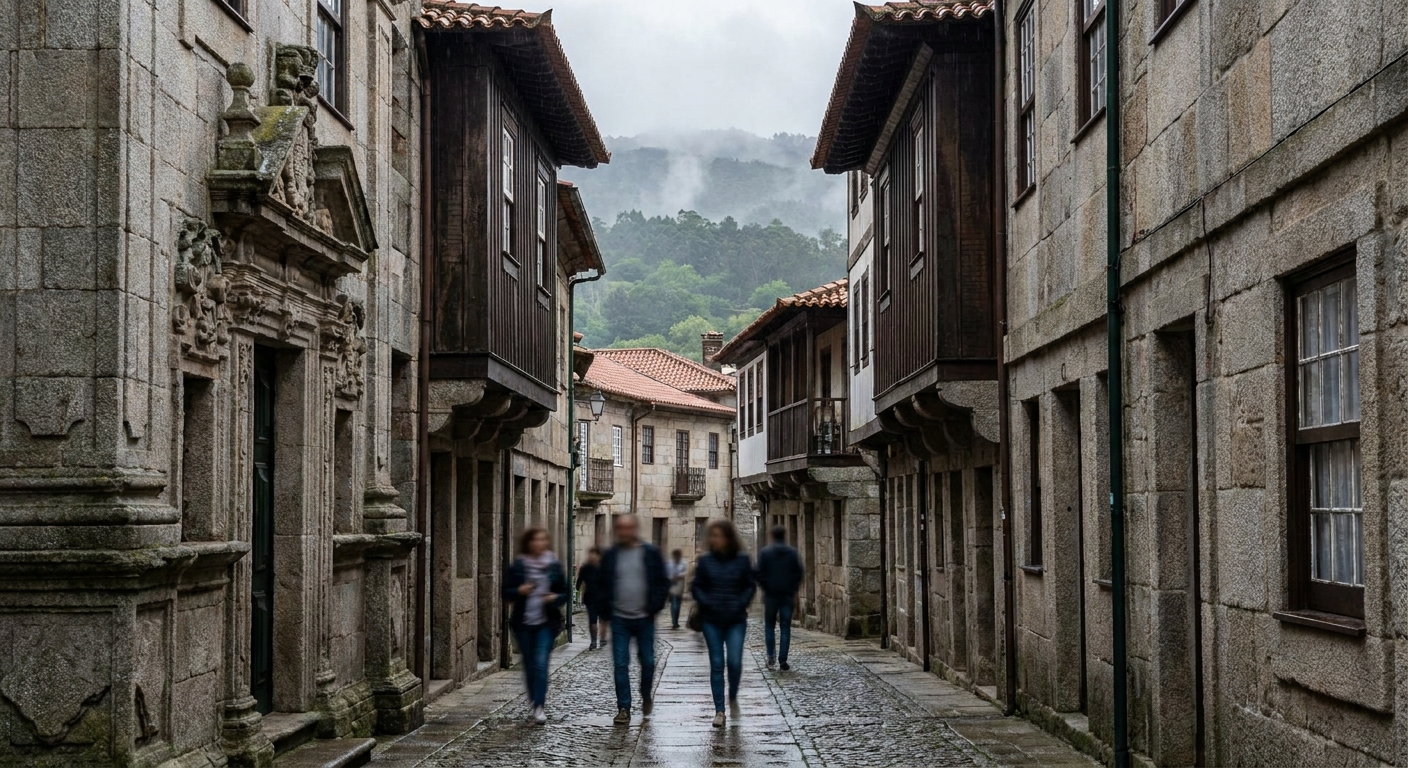
THE MONTH AT A GLANCE · GUIMARAES · FEBRUARY
February is the driest of the three winter-into-spring months at 3.85 inches, and with 10 hours 41 minutes of daylight on the 15th it supports a two-night walking visit to a 38.2-hectare historic center, provided you pack for 44.2°F nights.
AVG HIGH 59.0°F · 10 RAIN DAYS · 10H 41M OF DAYLIGHT ON FEB 15
Go for: a compact walking town at its driest winter month, with the castle at one end of the walled core, the monastic complex at the other, and the Couros tanneries outside the walls.
Think twice before: planning outdoor evenings. The sun is down at 6:09 pm on the 15th and the average night falls to 44.2°F, colder inland than the coastal thermometer reads.
Normals: IPMA station 545 · Daylight: sunrise-sunset.org · Heritage: UNESCO 1031bis · full sources at the end
On this page
- February highs, lows and rain daysThe IPMA 1991-2020 normals
- What to wear in FebruaryA 14.8°F gap between day and night
- Crowds, prices and lodging taxWhat we verified and what we did not
- Things to do on a wet dayThe castle, the monastery and Couros
- A two-day plan built on February lightTwo days, 7:28 am to 6:09 pm
- February vs January and MarchHow the three months compare
- Is February a good time to go?Our verdict, and the month to shift to
February brings 3.85 inches of rain over ten days, and on the 15th the sun sets at 6:09 pm. Those two facts shape everything in the plan below. For the town outside of any one month, start at our Guimarães guide; for the whole calendar, the 12-month verdict for Portugal ranks the seasons.
Guimarães weather in February: average highs, lows and rain days
| February normal | Value |
|---|---|
| Average high | 59.0°F (15.0°C) |
| Average low | 44.2°F (6.8°C) |
| Total rainfall | 3.85 in |
| Days with 0.04 in or more | 10.0 |
| Days with 0.39 in or more | 3.3 |
| Daylight on Feb 15 | 10h 41m |
Every figure here comes from IPMA, Portugal’s national weather service, 1991-2020 normals recorded at station 545, Porto Pedras Rubras, at 67.7 meters (about 222 feet). That is a real thermometer, not a model grid cell. It also sits at Porto’s airport, on the coast, while Guimarães lies inland: expect afternoons close to the reading and nights a little colder than 44.2°F. Higher ground in the north is colder again and far wetter, so do not pack for a mountain trail on a coastal number.
Ten days out of twenty-eight record at least 0.04 inch, which works out to measurable rain roughly one day in three. Only 3.3 days reach 0.39 inch or more, about one day in eight, and those are the ones that cancel a walk rather than interrupt it. Note the yardstick: IPMA counts from 1 mm, while American tables usually count from 0.10 inch, so these totals are not interchangeable with the rain-day figures in a US almanac.
Between the average afternoon and the average night sits 14.8°F. In practice that means one bag holding two outfits at once: a warm mid-layer plus a rain shell for the morning, something lighter underneath for a 59.0°F afternoon in the squares, and shoes with real grip, because wet granite paving is the surface underfoot all day. Our packing guide sorts the rest.
On February 15 the town gets 10 hours 41 minutes of daylight, sunrise at 7:28 am and sunset at 6:09 pm, local time being UTC in winter. Light is gone before dinner, so the castle hill and the outdoor half of the visit belong to the middle of the day, and the evening belongs to whatever has a roof and a heater.
How warm is Guimarães in February?
The month’s average maximum is 59.0°F (15.0°C) and its average minimum is 44.2°F (6.8°C), a spread of 14.8°F between the warmest and coldest hours of a normal day. That is mild by the standards of a February at 41 degrees north, and it is nothing like beach weather.
Mornings want a jacket you can zip: at 7:28 am the thermometer is still near its overnight floor. By two in the afternoon a sweater and a shell will do, and in a sheltered square with sun on the granite it can feel warmer than the 59.0°F on paper. Reverse the order at about five, before the 6:09 pm sunset takes the last of it.
We could not verify a count of nights at or below freezing for Guimarães, so we give no frost-day figure. What we can say is directional: the 44.2°F average low is a coastal airport reading, and an inland valley town runs colder on clear winter nights than the station that measured it.
How busy is Guimarães in February? Crowds, prices and the demand peak
We found no occupancy series and no monthly room-rate series for Guimarães, so we crown no month cheap and no month expensive. What is measurable is the shape of the day: 10 rain days and darkness at 6:09 pm are not what fills a northern Portuguese town, and the summer travel season is built on the opposite conditions. For the cost side of a trip, our Portugal budget guide carries the tiers.
Booking lead times are the same blank: we verified none, so we recommend none in weeks. Two nights covers a 38.2-hectare center properly, three if you fold in more of the north. Because 3.3 days a month bring 0.39 inch or more, a refundable rate is worth more than a saved euro, and if you are still pricing the flight, the gateways from the US are set out separately.
We could not verify a lodging-tax rate for Guimarães, so we give no percentage and no per-night amount. Ask at booking rather than at checkout.
One upgrade genuinely changes February: a heated room inside or beside the walled core. With the light gone at 6:09 pm you will be back indoors by mid-afternoon on wet days, and the walk home matters more than the view. Most of the building stock in the protected area is privately owned, the public spaces belong to the municipality, and the difference between a five-minute walk and a twenty-minute one is the whole evening. Our where-to-stay guide frames the national picture.
Things to do in Guimarães in February: the castle, the monastery and the Couros Zone
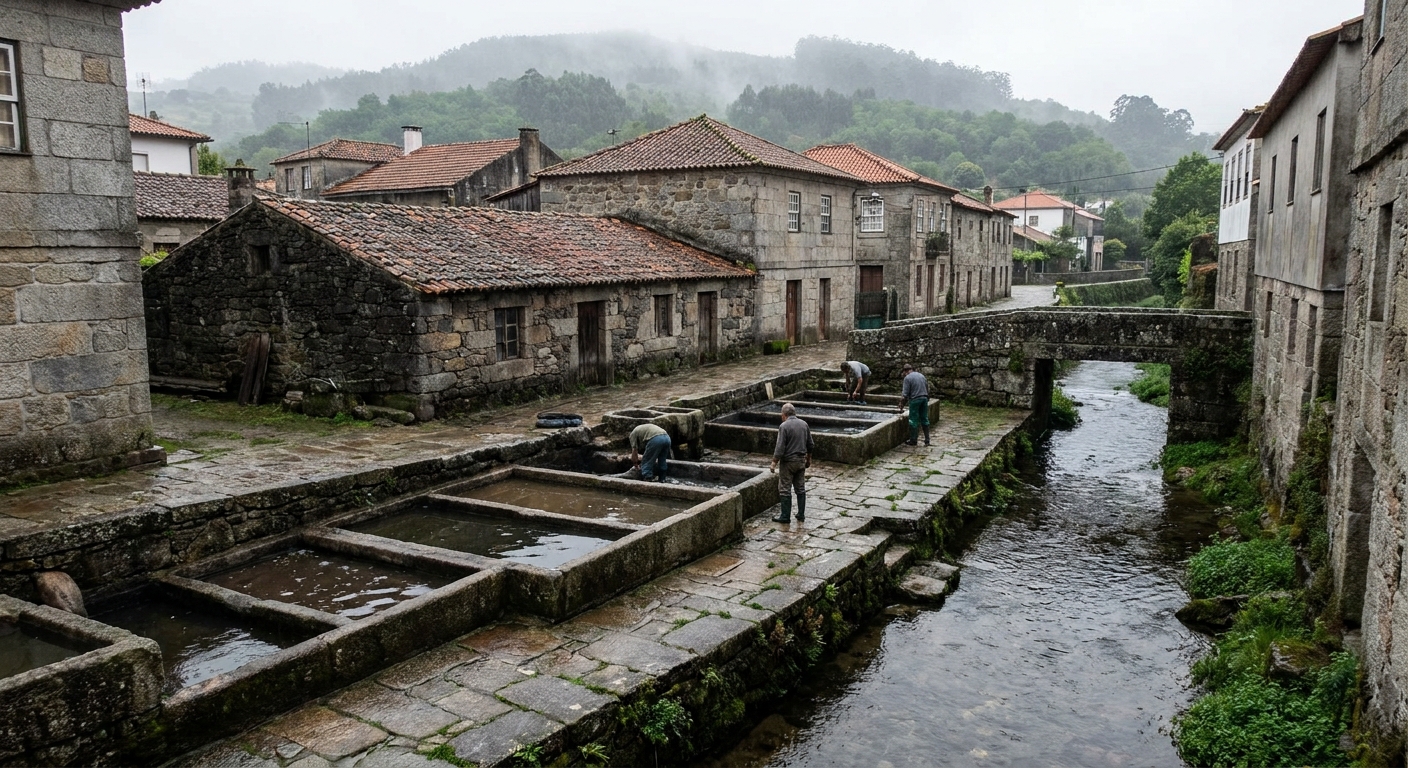
February is the driest of the three months around it, 3.85 inches against January’s 5.94, and with 10 hours 41 minutes of daylight on the 15th a walking day finally fits between showers. The protected area is 38.2 hectares with a 129.4-hectare buffer around it, and nineteen properties inside the perimeter are legally protected, ten of them as National Monuments and nine as properties of Public Interest. You can see the whole shape of it in a day when the rain holds off.
Inside the walls the town grew around two poles, both standing from between 950 and 1498: the castle to the north and the monastic complex to the south. It then spread outside the walls around the Franciscan and Dominican houses. The local building method is the thing to look up at: a granite ground floor carrying a half-timbered structure above, a technique that later traveled with the Portuguese to Africa and the New World. We could not verify opening hours or admission prices for the castle, the palace or any other monument, so we quote none; confirm directly before you climb the hill.
The stone does not change with the season, the air does. The squares laid out between 1498 and 1693 are open ground in any weather, and the medieval street layout survived all that rebuilding, so the route is the same one visitors walked five centuries ago. What February changes is the clock and the comfort: a 59.0°F afternoon is 3.6°F below March and it ends three quarters of an hour earlier in the day than the equinox will allow.
The free half of the visit is the public half. The streets and squares belong to the municipality, and the Couros Zone outside the walls, named for the leather tanning once practised there along with the river, keeps its tanneries, workers’ houses and open spaces from the 19th and early 20th centuries. Walk it with some care for the place: UNESCO singles Couros out as needing an urgent conservation strategy and names tourism-driven gentrification as a pressure on the property.
Guimarães in February: a two-day itinerary
Day one runs on the 10 hours 41 minutes you get. Breakfast indoors while the temperature climbs off its 44.2°F floor, then be on the castle hill at the north end of the walled core by 10:00, when the light is up and the morning chill is off the granite. Midday in the squares from the 1498 to 1693 rebuilding, lunch under a roof, then the monastic complex at the southern pole from about 2:00. Keep the last outdoor hour for 4:30 to 5:30, because the sun is gone at 6:09 pm.
Day two belongs to Couros: the tanneries, the workers’ houses and the river, best walked in the morning before the afternoon showers that make up most of February’s ten wet days. If the forecast carries one of the month’s 3.3 heavy days, invert the plan, take the indoor monuments first and the riverside later, and give the cobbles an extra margin. From here, the rest of northern Portugal takes over.
Guimarães in February vs January and March
| Month | Average high | Average low | Rainfall | Days with 0.04 in+ |
|---|---|---|---|---|
| January | 57.2°F (14.0°C) | 43.5°F (6.4°C) | 5.94 in | 12.8 |
| February | 59.0°F (15.0°C) | 44.2°F (6.8°C) | 3.85 in | 10.0 |
| March | 62.6°F (17.0°C) | 47.8°F (8.8°C) | 3.98 in | 9.9 |
February sits 1.8°F above January by day and 3.6°F below March, with the lows following the same order. Rainfall is where the month wins outright: 3.85 inches against 5.94 in January, a full 2.09 inches less, over 2.8 fewer wet days. March is marginally wetter in total at 3.98 inches yet counts 9.9 rain days, a tenth of a day below February. No sea temperature belongs in this comparison: Guimarães is inland, and we carry no water reading for it, so swimming does not figure in any of the three months.
Shift four weeks forward and you buy 3.6°F on both ends of the day, days that keep lengthening toward the equinox, and a rain total essentially unchanged. Shift four weeks back and January charges you 2.09 extra inches of rain and nearly three more wet days for a 57.2°F afternoon; the January page makes its own case. Within that trio, February is the compromise that costs the least water.
Is February a good time to visit Guimarães?
Yes, if your trip is a walking one and your day ends indoors. A 38.2-hectare core, 59.0°F afternoons and the driest total of the winter months add up to a workable two nights. No, if you want long evenings outside, warm nights or any kind of coast: 44.2°F after dark and a 6:09 pm sunset settle that argument.
If the answer is no, take March. It runs 62.6°F by day and 47.8°F at night, 9.9 rain days against February’s 10.0, and 3.98 inches of rain, which is 0.13 inch more for 3.6°F of extra warmth at both ends. That is the cheapest upgrade in the calendar for anyone who can move dates.
What February alone gives is the year’s first properly walkable dry spell in a town that spends January under 5.94 inches of rain, with daylight already back up to 10 hours 41 minutes.
The last word
Book two nights inside the walls, keep the castle hill for a dry midday, and call the monuments yourself for hours and admission, because we could not verify a single one of them. One thing worth knowing about what you will be walking through: the master plan that protects this center dates from 1994 and was revised in 2015, which is why a 10th-century street pattern and a 2023 boundary change coexist without a single inch of it being staged. Guimarães in February asks for a rain shell and gives back the town at its quietest light.
Sources & data for this guide
- February normals, rain days and thresholds · IPMA (Instituto Portugues do Mar e da Atmosfera), 1991-2020 normals, station 545 Porto Pedras Rubras, 67.7 m · checked Sep 23, 2026
- January and March normals, same station and same period · IPMA 1991-2020 · checked Sep 23, 2026
- Daylight, sunrise 07:28 and sunset 18:09 UTC on February 15 · sunrise-sunset.org · checked Sep 23, 2026
- Historic center perimeter, 38.2 ha property and 129.4 ha buffer, 2001 inscription, 2023 boundary modification, nineteen protected properties, Couros Zone and the granite half-timber method · UNESCO World Heritage Centre, file 1031bis · checked Sep 23, 2026
- The station is at Porto’s airport on the coast; Guimarães is inland, with colder winter nights than the reading · IPMA station metadata · checked Sep 23, 2026
- We could not verify opening hours, admission fees, a lodging-tax rate or any occupancy series for Guimarães, so none appear above · reading note, Sep 23, 2026