
Crete is the largest of the Greek islands, and it feels like a small country of its own. It has mountains and gorges, beaches with pink-tinged sand, Venetian harbors, and tavernas that often send you off with a free dessert. Minoans, Romans, Byzantines, Venetians and Ottomans all left their mark, and you feel that history in the old towns. The island rewards people who like to roam, eat well and swim in very clear water.
Where should you stay in Crete?
Crete is about 170 miles long, and a high mountain range runs across its middle. Driving all the way around the coast would take 10 to 12 hours, so drive times add up faster than the map suggests. Pick a base and take day trips from it. For first-timers, the two old harbor towns of Chania and Rethymno are the easy choice.
Chania
The Old Town is a maze of narrow alleys, hidden squares and pedestrian lanes, with a Venetian harbor, a lighthouse and walls to stroll. Bougainvillea blooms along the lanes, and there are Venetian, Jewish and Turkish quarters, with a restored synagogue in the old Jewish quarter. By day it's pretty. At night it's better: bars fill up, tavernas set out tables, and getting lost becomes the main activity.
Stay inside the Old Town if you can. Boutique hotels, restored Venetian mansions and renovated apartments are plentiful. Casa Delfino, in a 17th-century mansion near the waterfront, is the upscale pick. A room with a harbor terrace, like those at the small Captain Vasilis B&B, is worth the splurge. Harbor-view rooms sell out, so book them well ahead. Just outside the walls, the Nea Chora neighborhood has apartments a 10-minute walk from the Old Town. If you'd rather stay at a beach resort, Platanias, about 20 minutes away, has several adults-only options such as Asterion Suites & Spa. Domes Zeen, a luxury beachfront resort, has views back toward the Old Town.
Rethymno
Rethymno sits about 37 miles (60 km) east of Chania, roughly halfway to Heraklion. Its Old Town is smaller and more relaxed, with cobbled lanes, pottery shops, churches, historic fountains and cozy tavernas. It's busy with holidaymakers but keeps a calm seaside mood. Apartments in the heart of the Old Town have real character, with stone walls and wood-beam ceilings. At Casa Giorgio, four suites in a restored Venetian-Ottoman building on the edge of the Old Town share a rooftop plunge pool. Choose Rethymno for a gentler pace and the shortest drive to the south coast beaches.
Heraklion and the north coast
Heraklion is the island's largest city and the gateway to Knossos and the Archaeological Museum. It's a big port city, and it lacks Chania's charm. Visit it for the ruins, not as a romantic base. East along the north coast, Hersonissos and Malia offer many resort hotels, from big family all-inclusives like Creta Maris to adults-only retreats like Stella Island. The area is central, so it works well if you want beach time plus day trips to ruins, wineries and villages. Farther east, Elounda is a luxury resort area with views over the lagoon and the island fortress of Spinalonga.
What are the best things to do in Crete?
Knossos is the big ancient site, the Minoan palace just outside Heraklion. Arthur Evans, who excavated it, rebuilt large parts of it, and that still divides opinion. Even so, the reconstructed walls, stairs and columns help non-archaeologists picture the place. In 2025 the Minoan Palatial Centres, including Knossos, Phaistos and Malia, were added to the UNESCO World Heritage List. Go early or late in the day to dodge the worst heat and the tour groups.
Admission to Knossos is €20, or €10 reduced, and a few days a year are free, including March 6, April 18 and May 18. In summer it is open daily from 8 a.m. to 8 p.m., closing earlier step by step through September and October; from November 1 winter hours run 8:30 a.m. to 5 p.m. Last entry is 15 minutes before closing. Hours change with the season, so check before you go. City bus No. 2 runs from Heraklion to the site.
The old combo ticket with the Heraklion Archaeological Museum is no longer valid, so buy separate tickets. The museum charges €20, and from November through March it is free on the first and third Sundays of the month. Summer hours are 8 a.m. to 8 p.m. (Wednesdays from 1 p.m.). Winter hours are 8:30 a.m. to 3:30 p.m., with Wednesdays running 10 a.m. to 5 p.m. The museum is a 10 to 15 minute walk from much of the old center. It has no parking lot of its own, so drivers should use the paid garages near Eleftherias Square.
The Royal villa at Agia Triada and the site of Tylisos suit people who already love Minoan history. Each costs €5, or €3 reduced. Tylisos is open 8:30 a.m. to 3:30 p.m. (last entry 3:15 p.m.) and closed on Tuesdays. From November 1, Agia Triada can be visited only by arrangement, by calling 28920 91564. Hours change with the season, so check before you go.
The Samaria Gorge is the great hike. Along the way you'll pass sheer rock faces, blue streams, ruins and maybe a wild ibex. The trail runs one way, straight to the Libyan Sea, so you can't get lost. Getting back is the hard part, which is why a guided trip makes sense. Tours from Chania pick you up around 6 a.m., let you hike at your own pace, and bring you back by ferry and bus. Allow about six hours for the hike. Fast walkers have time for lunch and a swim in the village at the bottom before the ferry leaves.
For a shorter walk, try Kourtaliotiko Gorge, near Preveli, which has free parking at the Kantina lot. Two short trails start there, one to the top of the waterfall and one down to the water. A longer 6-mile (10 km) trail links the gorge to Preveli Beach. In the west, Lake Kournas, 29 miles (47 km) from Chania, is said to be the island's only natural lake. The Monastery of Chrysoskalitissa is reached by 90 steep steps.
Out on the water, glass-bottom boats leave from Chania harbor. One two-hour trip loops around Thodorou and Lazaretta islands and passes over the wreck of a plane shot down in World War II. The water is clear enough to spot sea urchins and silvery fish.
Villages are worth a detour if you have a car. Margarites, a 30-minute drive east of Rethymno, is packed with shops selling hand-painted pottery. It also has a few tavernas, one with panoramic countryside views. Bring cash, since phone and internet reception is patchy and card payments may not work. Spili, about 30 minutes south of Rethymno, is a leafy village of around 800 people. Its Lions Fountain pours spring water from a row of stone lions' heads, and it's a handy stop on the way to Plakias and Preveli. Loutro, on the south coast, is a fishing village of white-washed houses with blue shutters, seafood tavernas and a small beach, where life moves at a snail's pace. Boats from Chora Sfakion go there.
What are the best beaches in Crete?
The water here is calm and remarkably clear, and the beaches are why many people come. Several of the best ones have little shade or no facilities, so pack water, food and an umbrella.
Elafonisi
A shallow lagoon stays knee-deep for what looks like miles, and the pink tint in the sand is easy to see along the waterline. It's really a peninsula of several coves, and at certain tides it becomes an island. Arrive early, because thousands of visitors fill it fast. Signs ask you not to take the pink sand home.
The drive from Chania is listed at about 1.5 hours each way, but the winding mountain road can take nearly two, so plan on a full day. If the drive worries you, small-group tours run from Chania and often add Falasarna or other beaches. A night or two nearby makes the visit much easier.
Balos Lagoon and Gramvousa
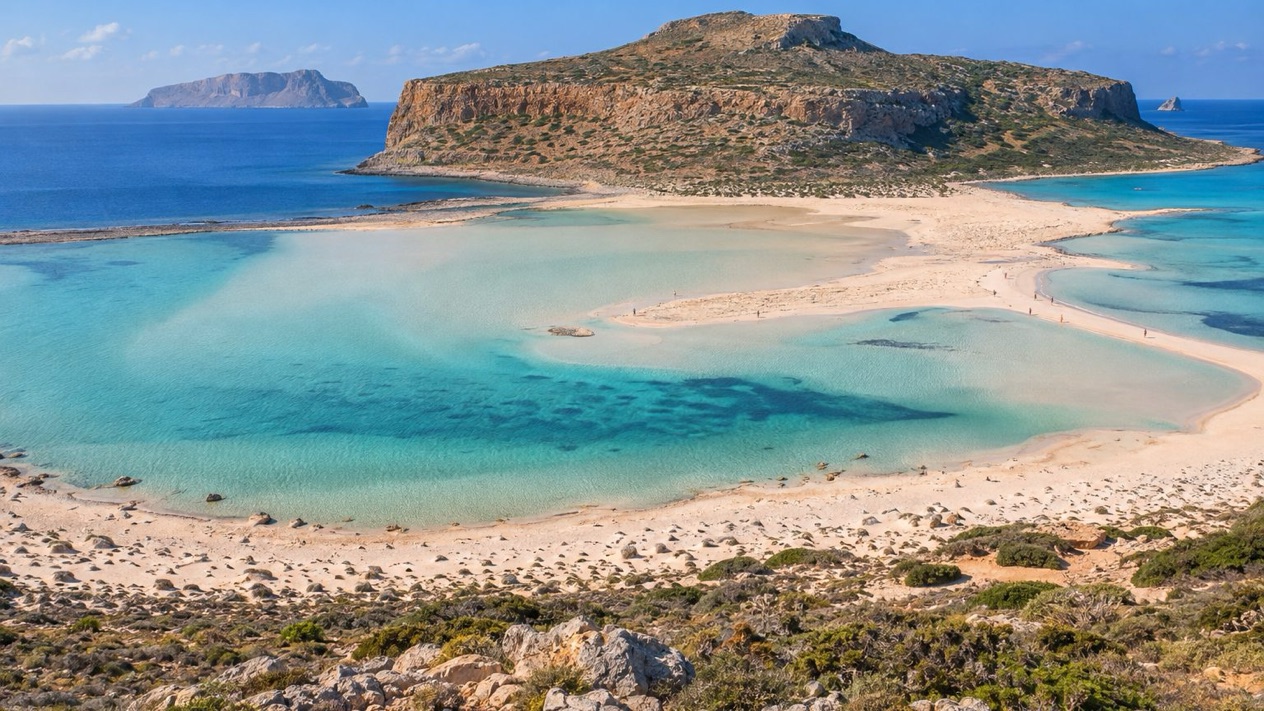
Balos is all swirls of white sand and shallow, bright blue water, some of the loveliest views on the west coast. Most people take a boat from Kissamos, combined with Gramvousa Island, an hour's sail away. On Gramvousa you can climb to a Venetian castle about 500 feet above the sea. Below it, a shipwreck sits just offshore from the beach. The climb is tough in the midday heat, so leave time to get back down before the boat sounds its departure horn.
The ferry can carry around 400 people, but both islands are big enough to find a quiet corner. At Balos, walk away from the umbrellas and chairs to a calmer stretch of the lagoon. For a more relaxed day, a small-group jeep tour stops at Balos for photos, then moves on to Falasarna with lunch and reserved loungers. Driving to Balos yourself takes a 4×4 and a hike down to the beach, and the road has a reputation as a very tough drive. Many rental contracts forbid it, so take the boat or a tour.
Falasarna
Falasarna, on the western tip, is so large that it rarely feels crowded. Bars and sun beds are scattered along the sand. The north end is quieter, with secluded coves and some nude sunbathers.
Seitan Limania
A narrow channel of milky blue water opens onto a tiny beach between cliffs. It's lovely for swimming, sunbathing and watching cliff jumpers. There are no facilities, and the beach is small, so arrive early to claim a spot.
Preveli, Plakias and the south coast
Preveli sits 45 minutes by car from Rethymno, where the turquoise Libyan Sea meets the beach on one side and the green Kourtaliotis River flanks it on the other. You reach it by a steep path with stairs from the parking lot, or by boat tour. Plakias, a 15-minute drive from Preveli, is a small town with sparkling turquoise water and tavernas along the waterfront. Nearby, a narrow cove has a small bridge between the rocks, ledges lined with sun beds and umbrellas, and wonderfully clear water.
Panormos and Kalyves
Panormos is a small sandy beach about 20 minutes from Rethymno and easy to reach. You can rent a beach chair, order drinks to it, and have lunch at Captain's House, a taverna above the harbor. It's ideal for a lazy day. Kalyves, roughly halfway between Chania and Rethymno, is a relaxed sandy beach with facilities and an easy swim stop between the two towns.
What should you eat in Crete?
Locals tend to call their dishes, olive oil and honey Cretan rather than Greek, and the food backs them up. Expect herbs like sage, fennel, cumin, thyme and rosemary, plus local honey. Seafood is a great order: squid, octopus, baked sea bass, pan-fried red mullet and the Cretan version of mixed fried seafood. Lamb is the other star, especially baked in salt. Try loukanika (spicy Cretan sausage), local snails if you're brave, and Cretan moussaka. Don't skip the cheeses, such as myzithra, staka and tyrozouli.
For a cheap lunch, order small plates: tzatziki, bread, saganaki, fried seafood and olives. Tavernas on back streets and in residential areas often give better value than those on the main harbor, so follow the locals. In Chania, Oasis serves quick, cheap gyros, and Moutoupaki fills a quiet square under vines, jasmine and strings of lights, so reserve ahead there. Harbor tavernas such as Taverna Michalis pair the view with good food and warm hospitality. In Rethymno, a row of tavernas lines the cliff's edge at the Old Town with ocean views. The last in the row, En Plo, is a good bet for seafood. For an upscale seafood dinner, 7 Thalasses in Rethymno is worth reserving well ahead.
Many tavernas bring a free dessert at the end of dinner, and often a small bottle of raki. It's a fiery spirit distilled from grape residue, and it takes some getting used to. Rakomelo, a rose-colored version flavored with thyme honey and herbs, goes down easier. Restaurants and cafes often bring free tap water to the table in glass bottles. Boutaris, the largest winery on Crete, near Heraklion, runs tastings and tours you can book ahead. For a cocktail after dinner, Fogotto Jazz Bar, in a Venetian building in Chania's Old Town, comes alive at night with jazz, swing and blues.
How many days do you need in Crete?
A week is a great amount of time, and ten days to two weeks is better still. With only three days, you'll usually do best sticking to Chania and one famous beach. With five, consider basing yourself on the north-central coast around Hersonissos for beach time and day trips, with one longer outing to Chania. The seven-day plan below is a suggestion that focuses on western Crete.
Day 1: Chania
Land, drop your bags in the Old Town and walk. Follow the harbor to the lighthouse, then lose yourself in the alleys. Have dinner at a taverna on a quiet square and stay out late.
Day 2: Elafonisi
Leave early by rental car or small-group tour. Spend the morning in the shallows before the crowds build, and head back to Chania by mid-afternoon.
Day 3: Balos and Gramvousa
Take the early bus or drive to Kissamos for the boat. Climb the castle on Gramvousa, then spend the afternoon on Balos. Come back to Chania for a seafood dinner.
Day 4: A slow day
After two big days, sleep in. Walk the Venetian walls, then take a glass-bottom boat from the harbor in the afternoon.
Day 5: Samaria Gorge
Book a tour with an early pickup. Hike the gorge and finish at the Libyan Sea.
Day 6: Rethymno and the south
Drive east to Rethymno for its Old Town, then continue to Preveli and Plakias for a swim. Alianthos, on the beach at Plakias, makes a memorable lunch stop. Spend the night in Rethymno.
Day 7: Heraklion and Knossos
Drive to Heraklion early and see Knossos while it's cool, then finish at the Archaeological Museum.
With extra days, add the north coast for resorts, wineries and villages, or Spinalonga and Elounda in the east. A night or two on the west coast near Elafonisi and Balos also makes those beach days calmer.
When is the best time to visit Crete?
June through August is high season, with busy beaches and peak hotel prices. The shoulder months of May, September and October bring better prices and fewer crowds. September is usually still warm, while May and October are more hit and miss, and the coasts can be very windy. From November to April you'll avoid the crowds, but it's too cool for the beach and much of the island closes for the season. Whenever you go, the sun is strong, so pack a hat, high-SPF sunscreen and plenty of water.
How do you get to Crete?
Crete has airports at Heraklion and Chania, with direct flights from Athens (about 45 minutes) and from several other European cities. Heraklion is the second busiest airport in Greece. It sits about 3 miles (5 km) from the city center, with buses to town and the port. It's the best arrival point for Knossos, the north coast resorts and the east. Chania's airport, on the Akrotiri Peninsula east of town, is better for the Old Town and the west. Driving between the two takes about two hours, so fly into the one nearest your base, or fly into one and out of the other.
By sea, Crete's ports are Heraklion, Chania, Rethymno, Sitia and Kissamos. Chania ferries dock at Souda, not in the Old Town harbor. Most travelers sail from Piraeus, the port of Athens. Depending on route and vessel, the crossing takes anywhere from just under 8 hours to 17. The Minoan Lines overnight ferry from Piraeus to Heraklion runs year-round, typically leaving at 9 p.m. and arriving around 6:30 a.m.; check the timetable for your date. Ferries to Chania leave from Gate E3 at Piraeus, and the trip takes 9 hours and 25 minutes. Heraklion is also the easier port for a trip to Santorini.
Minoan Lines offers discounts for children, seniors, students and families, plus 20% off if you buy both directions at the same time. Book as early as you can, especially in summer and around holidays, to be sure of seats and cabins.
Do you need a car in Crete?
Rent one if you can. Beaches, gorges and ruins are spread far apart. Mountain roads wind and slow you down, and Greece has one of the highest traffic fatality rates in the European Union, so take it easy. Typical drives: Chania to Rethymno takes about an hour, and Rethymno to Heraklion about an hour and ten minutes. Major rental brands have desks at the airports.
Inside the old centers it's all pedestrian lanes, so you don't need a car for your first nights in Chania. Pick one up when you head out to the beaches and gorges. A scooter works for short hops, and helmets are required by law, but a car is more comfortable over long distances.
What should Americans know before going to Crete?
U.S. citizens can visit Greece for up to 90 days without a visa, and your passport should have at least three months of validity beyond your planned departure date. Greek law requires you to carry both a valid U.S. driver's license and an international driving permit, even if the rental company doesn't ask for the permit. Texting or talking on the phone while driving is illegal, and police run random alcohol tests.
The U.S. State Department rates Greece as generally safe. Petty crime is common in popular tourist spots, and thieves break into rental cars looking for passports and valuables, so take them with you when you park. Strikes and demonstrations can start with little notice and may disrupt ferries, airports and taxis. Forest fires are common in the dry summer months and sometimes close roads, and small earthquakes happen regularly.
Sources
- bucketlistbums.com (https://bucketlistbums.com/single-post/crete/), checked October 17, 2026
- rtwin30days.com (https://rtwin30days.com/crete-greece-5-perfect-days/), checked October 17, 2026
- thewanderbug.com (https://thewanderbug.com/crete-travel-guide/), checked October 17, 2026
- onegirlwholeworld.com (https://onegirlwholeworld.com/europe/guide-to-crete-greece-7-day-itinerary/), checked October 17, 2026
- tammytourguide.wordpress.com (https://tammytourguide.wordpress.com/2022/06/06/crete-what-the-travel-guides-dont-tell-you/), checked October 17, 2026
- U.S. Department of State (https://travel.state.gov/content/travel/en/international-travel/International-Travel-Country-Information-Pages/Greece.html), checked October 15, 2026
- minoan.it (https://www.minoan.it/en/routes-fares-timetable-minoan-lines/timetable-ferry-piraeus-heraklion), checked October 15, 2026
- Hellenic Ministry of Culture, Odysseus (http://odysseus.culture.gr/h/3/eh355.jsp?obj_id=2369), checked October 15, 2026
- Hellenic Ministry of Culture, Odysseus (http://odysseus.culture.gr/h/1/eh155.jsp?obj_id=3327), checked October 15, 2026
- anek.gr (https://www.anek.gr/en-gb/destinations/chania), checked October 15, 2026
- Hellenic Ministry of Culture, Odysseus (http://odysseus.culture.gr/h/3/eh355.jsp?obj_id=2386), checked October 15, 2026
- minoan.gr (https://www.minoan.gr/en/ferry-routes/crete), checked October 15, 2026
All our pages
When to go
- Best Time to Visit Crete: Late May, June and September for Sun, Sea and Room to Breathe
- Crete in January: Weather, Crowds and What to Do
- Crete in February: Weather, Crowds and What to Do
- Crete in March: Weather, Crowds and What to Do
- Crete in April: Weather, Crowds and What to Do
- Crete in May: Weather, Crowds and What to Do
- Crete in June: Weather, Crowds and What to Do
- Crete in July: Weather, Crowds and What to Do
- Crete in August: Weather, Crowds and What to Do
- Crete in September: Weather, Crowds and What to Do
- Crete in October: Weather, Crowds and What to Do
- Crete in November: Weather, Crowds and What to Do
- Crete in December: Weather, Crowds and What to Do
Things to do
- Things to Do in Crete: The Best Sights, Beaches and Hikes, Ranked
- Day Trips from Crete: Chania, Rethymno, Arkadi Monastery and Agios Nikolaos
- 3 Days in Crete: Heraklion, Rethymno, Chania and Where to Stay
- 7 Days in Greece: Itinerary Through Crete, Chania, Rethymno and Heraklion
- 10 Days in Greece: Itinerary Through Chania, Rethymno, Heraklion and Sitia
- Cretan Food: Traditional Dishes, the Cretan Diet and What to Order
- Crete Road Trip: A Route, a Rental Car, and How Many Days You Need
Where to stay
- Crete Hotels: Where to Stay for Beaches, Old Towns and Easy Days
- All-Inclusive Resorts in Crete: Where They Are, Which Areas to Compare and What to Check Before Booking
- Villa Rentals in Crete: Where to Base Yourself, Getting There and Driving
Getting there
- How to Get to Crete: Flights, Ferries and What to Book
- Crete Airport: Heraklion (HER) and Chania (CHQ), and How to Get Into Town
- Buses in Crete: The KTEL Network, Main Routes and Paying for Your Ride