
Start in Chania, spend a full day on the pink sand at Elafonisi, walk through Knossos, and hike the Samaria Gorge if your legs are up for it. Crete is larger than most visitors expect, so settle into a base or two and explore the surrounding areas on day trips. A rental car makes the island far easier.
What are the best things to do in Crete?
Here is the short ranking, from "don't skip" to "if you have time."
- Chania old town and its Venetian harbor
- Elafonisi beach
- Knossos and the Heraklion Archaeological Museum
- Samaria Gorge
- Balos Lagoon and Gramvousa Island
- Spinalonga
- Preveli and the southern coves, plus Seitan Limania near Chania
How much of that you fit in depends on your days. A three-day trip usually works best kept to Chania and one famous beach, such as Balos. With five days, a base on the north-central coast around Hersonissos gives you beach time, day trips to ruins, wineries and villages, and a longer outing to Chania. Ten days to two weeks lets the island unfold properly.
Why is Chania the best place to start in Crete?
Chania has one of the prettiest old towns in Greece, and getting lost in it is the plan. Narrow alleys, hidden squares and pedestrian lanes twist around a Venetian port and lighthouse, with bougainvillea draped over the walls and Cretan, Ottoman and Venetian touches in the stonework. Give the Jewish Quarter a slow wander too, and say hello to the well-fed stray cats along the way. In the evening the whole town comes alive: shops glow, bars fill, and tavernas set tables out under vines and string lights.
Go to the harbor around sunset for a drink, then wander in for dinner. Seafood is excellent here, and so are the Cretan classics: dakos (a bruschetta-like dish with tomato and olive oil), boureki and local cheeses. Try bougatsa, the Greek pastry dessert, at Bougatsa Iordanis. Book popular tavernas ahead, and expect a wait at the tiny ones.
Chania also makes a natural base. Restaurants, boutiques and cafes are all within walking distance, and several boutique hotels and apartments sit right in the old town's heart. Four nights in Chania gives you time to visit Elafonisi, Balos Bay and Seitan Limania.
Which beaches in Crete are worth the trip?
Elafonisi
Elafonisi is one of the best-known beaches on the island, and it is easy to see why. White and pink sand, tinted by crushed shells, lines a shallow lagoon, and the water glows a bright turquoise on sunny days. It even had a turn on screen in Captain Corelli's Mandolin. The drive from Chania takes about an hour and a half, and there is no town, just the beach. Walk across the shallow lagoon and keep going along the sand to the far end, where the beach feels wild and undeveloped.
Elafonisi fills up fast, with thousands of visitors in high season. Arrive early, or come in spring or fall, when the crowds and the waves are gentler. Elafonisi is a national park with no town and few comforts, so many visitors bring their own food and water.
Balos Lagoon and Gramvousa Island
Balos, in the northwest, is among the most photographed places on the island. The lagoon is such a pale turquoise that it looks lit from below, and the sand is bone white. Driving there means a rough road, best tackled in a 4×4, and a hike down, though the views on the way make up for it. Many people take a boat from Kissamos or a bus and boat tour from Chania instead.
The boat route also stops at Gramvousa Island, where you can climb to a Venetian fortress and swim at a lovely beach. Balos is often windy, so the swimming tends to be better at Gramvousa.
Seitan Limania
A narrow channel of milky blue water runs between cliffs to a sliver of sand. It is a favorite for swimming, sunbathing and watching the cliff jumpers. The hike down takes around 20 minutes, with big views the whole way. There are no facilities, so pack food, water and an umbrella for shade, and get there early to claim a spot on the tiny beach.
Falasarna
On the western tip, Falasarna is big enough that it rarely feels crowded. Bars and sun beds fill the main stretch. For quiet, walk to the north end and its secluded coves.
Preveli, Plakias and the south
Preveli is a palm-lined beach where a clear river runs into the sea. Boats run from Plakias, but the better approach is a ten-minute bus ride and a twenty-minute hike down, so you see the view from above. Afterward, follow the river upstream on foot for a stretch, then wade or swim back to the sea through a green oasis.
Plakias itself is a chilled-out south coast town with a slow pace. The small beach just west of the main one is nicer, and Myrthios, the village above town, has fantastic views at dinner. Nearby Kleidisi is a hidden cove you can hike to.
Matala and Red Beach
Matala has caves carved into the cliff, thought to have started as tombs and later used as homes. Inside you can see carved bed platforms, seats and tables. Hippies lived here in the 1960s and 70s, Joni Mitchell and Cat Stevens among them, and the village still has a laid-back feel. The beach is modest, but the water is clear enough to swim out to the rocks below the caves. Then take the short, steep trail over to Red Beach, where the sand is closer to bright orange. Carry plenty of water in summer.
Chrissi Island
Chrissi sits 9 miles (15 km) south of Crete and is reached by day trip from Ierapetra. The beaches have powdery white sand and light turquoise water. August brings extreme heat, little shade and crowds, so save it for the shoulder season.
Which ancient and historic sites in Crete are worth seeing?
Knossos
Knossos is the one to prioritize. The Minoans were Europe's earliest recorded civilization, and walking the palace grounds, with the Throne Room and the Minotaur legend attached, makes the past feel close. In 2025 the Minoan Palatial Centres, Knossos and Phaistos among them, were added to the UNESCO World Heritage List.
2026 prices: full admission is €20 and reduced admission is €10. Free days include March 6, April 18 and May 18. From November 1 it is open daily from 8:30 a.m. to 5 p.m., with last admission at 4:45 p.m. It closes on a handful of holidays, including Christmas, New Year's Day and Easter Sunday.
Heraklion Archaeological Museum
Pair Knossos with this museum, one of the most important in Europe and packed with Minoan artifacts. Admission is €20. The old combo ticket with Knossos is no longer valid, so buy each separately. The museum shares the Knossos free days and adds the last weekend of September, October 28 and the first and third Sundays of winter. In summer it is open 8 a.m. to 8 p.m., though on Wednesdays it opens at 1 p.m. In winter and again in April, hours are 8:30 a.m. to 3:30 p.m., with a later 10 a.m. to 5 p.m. schedule on Wednesdays. It closes on the same major holidays as Knossos.
Gortyna, Agia Triada and smaller sites
Gortyna was the Roman capital of the island, with ruined baths, theaters and temples, an acropolis with a commanding view, and the Basilica of Agios Titos, lovely at golden hour. Phaistos is another Minoan palace worth adding. Agia Triada's royal villa is a smaller site near Tympaki, with full admission at €5. It is closed on Tuesdays, and from November 1 you can visit by arrangement by phone (+30 28920 91564) or email ([email protected]) within its hours of 8:30 a.m. to 3:30 p.m. Tylisos is similar, also €5 and closed Tuesdays.
Spinalonga
Spinalonga, a small island in the Gulf of Elounda, was a Venetian fortress and later a leper colony, and you can explore the fort and the old colony buildings. It is both scenic and sobering, with a couple of pebbly beaches with very clear water and good views from the high points. It sits a short drive from Agios Nikolaos, and small ferries make the crossing regularly. Bring your own food and water.
What are the best hikes in Crete?
Samaria Gorge
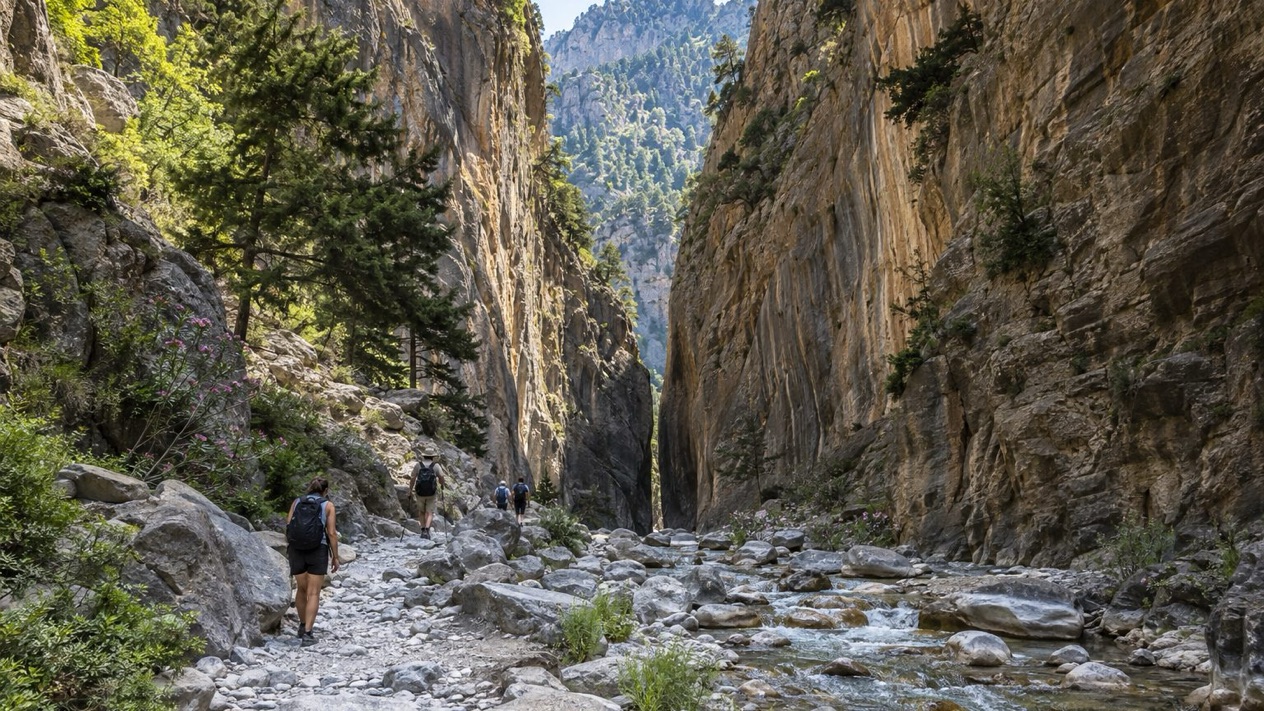
The Samaria Gorge, often called the longest gorge in Europe, stretches 10 miles (16 km) through the White Mountains and a unique biosphere reserve, with narrow passages that rise almost 1,640 feet (500 meters) high. It starts at about 4,000 feet (1,230 m) among pine-covered peaks, drops down stone steps, and follows a river to the sea. Plan on six to eight hours, start early, and pick a cooler day. It gets hotter as the day goes on, though there are plenty of spots to fill your water bottle. Keep an eye out for the shy kri-kri, Crete's wild mountain goats.
A bus drops you at the top, and you finish at Agia Roumeli, a village squeezed between mountains and sea. There you can swim and eat at a taverna, then take a boat along the coast to Sfakia and a bus back. It is a long day, and a great one.
Shorter options
The Imbros Gorge is a smaller, downhill route scented with sage. It ends near Frangokastello, a south coast village with beaches and a ruined Venetian castle. Kourtaliotiko Gorge, near Preveli, has a short trail to a waterfall, and a 6 mile (10 km) trail links it to Preveli Beach for a longer walk.
What else is worth seeing in Crete?
Heraklion
Crete's biggest city is often skipped, but it rewards a wander, with fountains, churches, squares, a waterfront and a lively night scene of open-air dining. Two nights here covers the city, Knossos and the museum.
Rethymno and Margarites
Rethymno has one of the best-preserved medieval centers in Greece, and its buildings are made of honey-colored stone instead of the whitewash you see on other islands. Wander the maze of streets and the harbor, and watch the sunset from the Venetian Fort. Margarites, a mountain village of pottery studios, is a good place for souvenirs and makes a nice day trip with the Monastery of Arkadi.
Lake Kournas
Lake Kournas, 29 miles (47 km) from Chania, is Crete's only natural lake, and it slots easily into a few days in the west.
Lasithi Plateau
The Lasithi Plateau is a flat dish of land ringed by mountains. Its windmills are mostly out of use these days, but the smaller villages are charming, and the Dikhtean cave is the spot where baby Zeus was hidden from his father.
What should you eat and drink in Crete?
Start with the cheeses, especially myzithra, a goat cheese, plus kaltsounia cheese pies and the local honey. Crete is home to more than 30 million olive trees, and its olive oil ranks among the finest anywhere. The island also claims more than 3,500 years of winemaking, and wineries such as Manousakis, Douloufakis, Lyrarakis and Dourakis run tours. Raki is the local drink, and the Kazani Zargianaki holds raki festivities from mid-October.
When is the best time to visit Crete?
July and August are when tourism peaks, so expect crowds then. June is warm and has fewer people than July and August, though hotel prices run high all summer. The shoulder months are cheaper and calmer, with easier hotel availability, and September usually stays warm. Wind is common on the coasts, so pack a layer. In the low season, much of the island closes and the sea is too cold for the beach.
How do you get around Crete?
Crete is about 170 miles long, and driving the full coast road would take 10 to 12 hours, so it helps not to pack too much driving into a single day. Rent a car at the Heraklion or Chania airport, where most major rental brands have desks. The old towns of Chania and Rethymno are pedestrian, but beaches, trails and historic sights beyond them are spread across the island, so a car comes in handy. A scooter works, though a car is far more comfortable over long distances, and public transport and day tours can fill the gaps if you skip driving.
Book hotels early for summer, reserve tours for Samaria and Balos ahead, and check ferry and museum schedules before you go.
Sources
- cntraveller.com (https://www.cntraveller.com/gallery/things-to-do-in-crete-greece), checked October 18, 2026
- bucketlistbums.com (https://bucketlistbums.com/single-post/crete/), checked October 18, 2026
- theworldonmynecklace.com (https://theworldonmynecklace.com/crete-road-trip/), checked October 18, 2026
- onegirlwholeworld.com (https://onegirlwholeworld.com/europe/guide-to-crete-greece-7-day-itinerary/), checked October 18, 2026
- worldwanderingkiwi.com (https://www.worldwanderingkiwi.com/2016/04/greece-top-10-things-crete/), checked October 18, 2026
- Hellenic Ministry of Culture, Odysseus (http://odysseus.culture.gr/h/1/eh155.jsp?obj_id=3327), checked October 15, 2026
- Hellenic Ministry of Culture, Odysseus (http://odysseus.culture.gr/h/3/eh355.jsp?obj_id=2369), checked October 15, 2026
- Hellenic Ministry of Culture, Odysseus (http://odysseus.culture.gr/h/3/eh355.jsp?obj_id=2386), checked October 15, 2026
- Hellenic Ministry of Culture, Odysseus (http://odysseus.culture.gr/h/3/eh355.jsp?obj_id=813), checked October 15, 2026
- anek.gr (https://www.anek.gr/en-gb/destinations/chania), checked October 15, 2026
- Visit Greece (GNTO) (https://www.visitgreece.gr/en/islands/crete), checked October 15, 2026
- anek.gr (https://www.anek.gr/en-gb), checked October 15, 2026