
You step in from the town centre of Heraklion, out of the traffic and the harbor light, into rooms built around the art of the Minoans. Painted frescoes, delicate gold and clay vessels shaped by hands from a vanished island world wait behind the glass. It is a museum for anyone heading to Crete who wants to understand what the ruins outside the city once held.
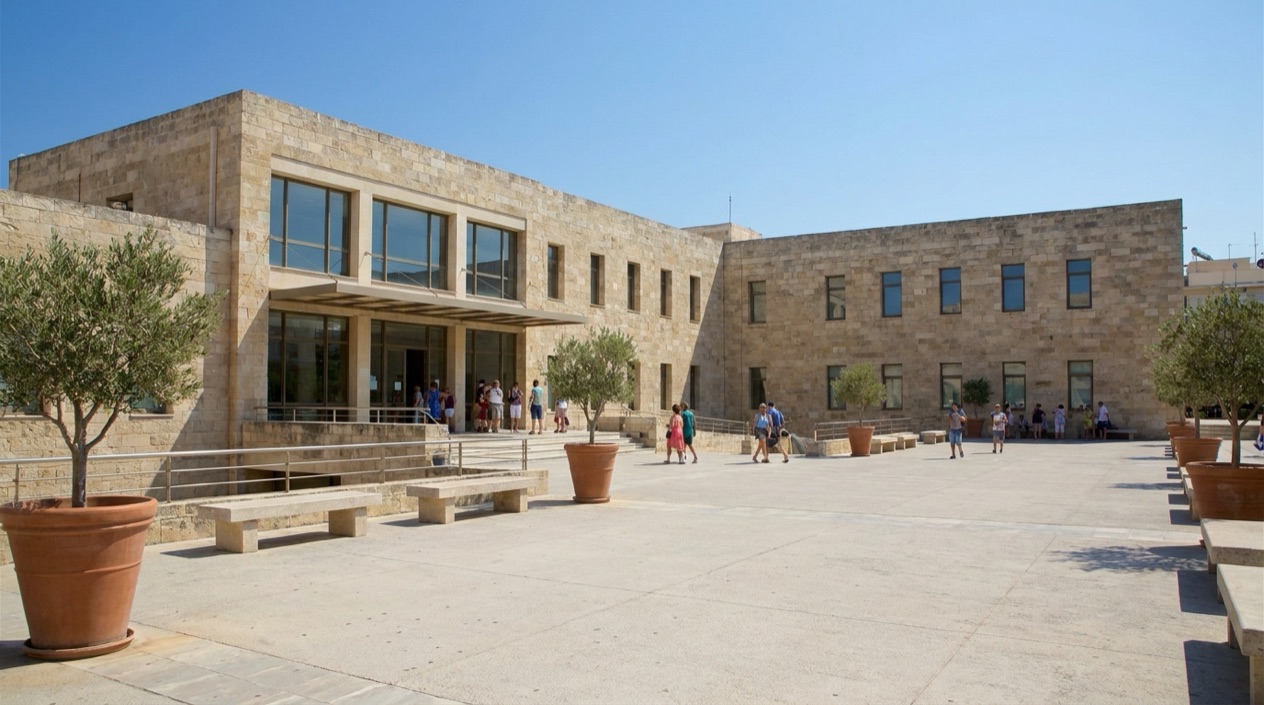
Is visiting the Heraklion Archaeological Museum worth it?
Yes, for almost anyone who is curious about ancient Crete, and especially for travelers who plan to see the Minoan palace of Knossos, which lies just a few kilometres from the centre of Heraklion. The museum holds the most important and complete collection of Minoan civilization artifacts in the world, so it gives the empty stones of the palace their faces, their colors and their daily objects.
What makes it different from other museums you may visit in Greece is its focus. Many museums spread across several eras and cultures. Here, the story of one island civilization is told in depth, and it is one of the largest museums in Greece. You go from one room to the next and watch a single culture unfold, from household pottery to ceremonial objects and wall paintings that once decorated palace rooms.
It also makes a good counterweight to a day of ruins. Visiting a site gives you space, sky and stone, while the museum gives you the details that time has carried off from the site and placed safely indoors.
The building has air conditioning, which matters when Heraklion is hot outside. It reopened in May 2013 after most of it had been closed for renovation since 2006, and the rooms feel arranged for a visitor who wants to take a long, unhurried look.
If you like stories behind objects, you could spend a good stretch of the day here and still leave with questions for the next stop on your trip.
What to see at the Heraklion Archaeological Museum
The Minoan collection as a whole
The collection is the reason to come. It follows the Minoan world through the things people made and used: pottery for the kitchen and the shrine, seals, jewelry, figurines and tools. Look for how the craftsmanship changes from room to room, with simple forms giving way to finer and more playful work.
Take your time with the small pieces. A seal or a bead can tell you as much about Minoan life as a large vessel, and the cases reward a slow walk. Travelers move quickly through the first rooms and then wish they had lingered, so let the early galleries set your pace.
Frescoes from the palaces
The wall paintings are the part of the museum that people remember. They show processions, animals, plants and figures in motion, in blues, reds and ochres that have survived remarkably well. Standing before them, you can picture how the walls at Knossos once looked, filled with color rather than bare plaster.
Many of the paintings are fragments that have been pieced together, and the gaps are part of the story. Look at the outlines and the gestures, and notice how much life the artists put into a few lines. If you plan to visit the palace afterward, these rooms give you a mental picture to carry with you.
Small objects, big stories
Beyond the large displays, the museum rewards attention to everyday things: cups, jars, ritual vessels and ornaments. They show how people ate, worshipped and decorated their homes. Choose a few cases and read them closely instead of trying to see everything.
One practical note: some items cannot be photographed, and signs are usually posted near the restricted pieces. Keep an eye out for them before you raise your camera, and enjoy the objects directly rather than through a screen.
Hours, tickets and rules
The museum keeps two seasonal schedules. In the warmer half of the year the doors open early on most days, with a later start on Mondays, and in the cooler half the museum opens daily and closes earlier in the afternoon. Discounted entry exists for EU students and for senior citizens aged 65 and over.
| Site | Open | Admission |
|---|---|---|
| Heraklion Archaeological Museum, April to September | Monday 12pm to 8pm, Tuesday to Sunday 8am to 7pm | Discounted entry for EU students and seniors aged 65 and over |
| Heraklion Archaeological Museum, October to March | Daily 8am to 5pm | Discounted entry for EU students and seniors aged 65 and over |
The one visiting rule stated for the museum concerns photography: some items cannot be photographed, and signs are usually posted nearby the restricted items. Four exhibits were toppled and damaged during a magnitude 6.2 earthquake on 22 May 2025, so a few pieces you expect to see may look different from older descriptions.
When to visit the Heraklion Archaeological Museum
The museum is a good choice in any month, because it is indoors and air conditioned. Hours do change with the seasons, though. From October through March the museum is open daily from 8am to 5pm, so plan to arrive in the morning and give yourself the daylight hours. From April through September, Tuesday through Sunday run from 8am to 7pm, while Monday begins at noon.
In summer, July in Heraklion brings an average high in the mid-80s with almost no rain, and the museum offers a cool pause from the heat. A visit before heading out to an open-air site, or after, can split the day sensibly. Spring is gentler: April has highs around the upper 60s and a handful of rainy days, and the museum pairs well with a walk around town.
January is cooler and wetter, with highs near 60 and many days of rain, and that is when an indoor collection earns its place on the itinerary. Rain jacket in the bag, and the museum is a dry, rewarding stop.
| Month | Average high (°F) | Average low (°F) | Precipitation (in) | Rain days |
|---|---|---|---|---|
| January | 59.7 | 48.6 | 2.73 | 11.8 |
| April | 68.5 | 54.1 | 1.43 | 5.9 |
| July | 84.9 | 72.7 | 0.10 | 0.8 |
| October | 75.6 | 63.1 | 1.48 | 6.0 |
Tips for your visit
Bring curiosity more than gear. Because the building has air conditioning, the rooms are comfortable even when it is hot outside, though a light layer is useful for anyone who feels the chill indoors. A camera is fine for most of the collection, but leave it in the bag when you see a sign marking a restricted item.
The museum sits in the town centre of Heraklion, which is built on the north coast of Crete, overlooking the sea. That makes it simple to combine with the rest of the city. The Koules Fortress, a Venetian fortress in the harbor, dominates the port area along with the ramparts and arsenal, and it gives a very different layer of the city’s story, from Venetian rule rather than Minoan times.
If you plan to see Knossos, the museum is a natural companion because the palace lies just a few kilometres from the centre. Seeing the objects first lets you recognize what the palace once held. Urban buses in Heraklion serve the city with 39 different routes, which is useful to know when you are moving around town.
If you arrive by air, Heraklion Airport is about 3 miles east of the city, in the area of Alikarnassos, and it runs 24 hours a day. That helps with late arrivals, and the museum is there when you are ready. Pace yourself: choose the rooms that matter most to you, take breaks, and leave time for the cafés of the town afterward.
Good to know before you go
Heraklion is the largest city on Crete and one of Greece’s most significant urban centres, so it has the energy of a working city as well as a visitor destination. Carry some euros for small purchases such as a coffee near the museum. In summer the heat can be strong, and an air-conditioned museum is a welcome break from it.
Sources
- Wikipedia, Heraklion Archaeological Museum (https://en.wikipedia.org/wiki/Heraklion_Archaeological_Museum), checked October 12, 2026
- Heraklion airport information (https://www.heraklion-airport.info/), checked October 12, 2026
- Visit Greece (GNTO), Heraklion (https://www.visitgreece.gr/islands/crete/irakleio/), checked October 12, 2026
- Hellenic National Meteorological Service (HNMS), climatological normals 1991-2020 for Heraklion station (https://www.emy.gr/climatic-data), monthly mean daily maximum and minimum; rain from the ECMWF ERA5 reanalysis, 1991-2020, grid cell of Heraklion (Open-Meteo), checked October 12, 2026
- ECMWF ERA5 reanalysis 1991-2020, grid cell of Heraklion (Open-Meteo), checked October 12, 2026