
Crete is the biggest of the Greek islands, and it rewards a little preparation. Crete is the biggest of the Greek islands, and it rewards a little preparation: a passport in good order, euros in your pocket, a realistic sense of its size and a weather forecast that changes a lot with the season.
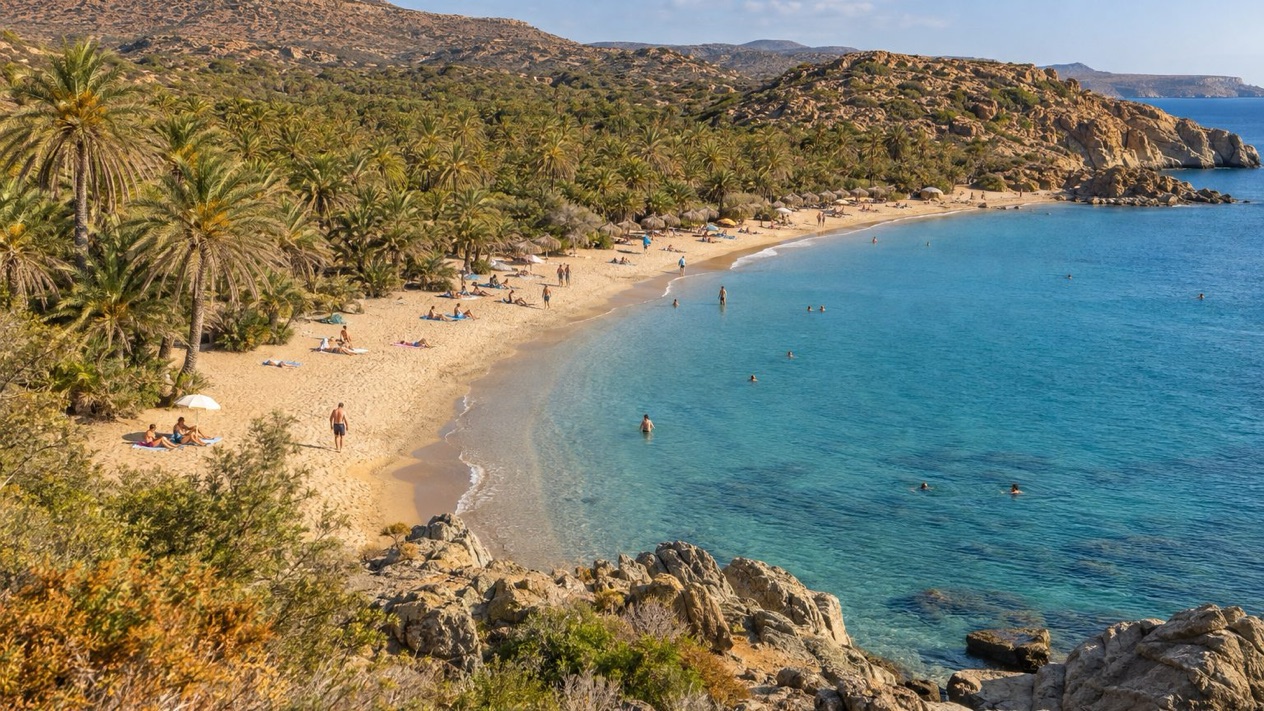
What should you know before visiting Crete?
Four things matter most: the island is far bigger than most first-timers expect, the weather swings widely between winter and summer, the euro is the currency, and your passport needs enough life left in it. Everything else, from the food to the music, falls into place once those are settled.
Size is what surprises people first. Crete is the largest Greek island and the fifth largest in the Mediterranean, after Sicily, Sardinia, Cyprus and Corsica. It stretches 160 miles from east to west, and in places it narrows to a thin waist near Ierapetra. Two airports take international travelers, Nikos Kazantzakis at Heraklion and Daskalogiannis at Chania, so the town where you land says a lot about where your first days will be spent.
The second surprise is that Crete feels like a country of its own. About 650,000 people live here, and the island has its own poetry, its own music and its own dances, all of which you will meet in a taverna or at a village festival.
Mount Psiloritis, the highest peak, rises inland, so the landscape is as much mountain and gorge as beach. The island lies between the Sea of Crete and the Libyan Sea, and that open water shapes its light and its weather.
Last, the food. Dakos, a barley rusk topped with tomato and cheese, gamopilafo, a rich rice dish, and kalitsounia, small cheese or herb pastries, are among the traditional dishes of Crete, and you can build a whole trip around finding the version you like best.
Entry, customs and paperwork
According to the U.S. State Department, U.S. citizens may enter Greece without a visa for tourism or business stays of up to 90 days. That covers a typical vacation on Crete with room to spare, and it applies to Greece as a whole, so you go through entry formalities once, wherever you first land.
The passport deserves a moment of attention. The State Department recommends that U.S. citizens have at least three months of validity beyond your planned departure date for entry into Greece. Greek law itself requires only three months beyond the date you intend to leave, but the longer margin is the safer one to carry, and it is easy to check long before the trip.
One more point matters for anyone who has had a bad moment with their documents. A U.S. citizen traveling on a passport that has been reported lost or stolen will not be permitted entry into Greece and may be returned to the original departure point. If an old passport went missing and later turned up, travel on a new one.
Two local laws are worth knowing for a relaxed trip. Marijuana is illegal in Greece, and photographing military installations is prohibited and may lead to arrest. On an island with defense sites and airports, simply keep your camera pointed at the views, the old harbors and the plates of food.
Money, cards and tipping
Crete uses the euro, the same currency as the rest of Greece, and each euro is divided into 100 cents. You will meet the coins in change at bakeries, kiosks and cafés, and the notes at the cash desk of almost every shop.
Euro banknotes start at €5, and the notes you will handle most on a trip sit in the middle of the range, from €10 to €100. The largest note, €500, is rarely what a small taverna or a village shop wants to see, so smaller bills are the useful ones to carry. Each note is a different size and color, which makes counting change at a busy counter faster than it looks.
Tipping is a gesture rather than a formula. At a taverna it is common to round up the bill or leave a little change on the table for the person who looked after you, and nobody expects a fixed percentage. A shared plate of dakos and a carafe of wine, a long lunch with the waiter bringing a small dessert at the end, is the kind of table where a few coins left behind say thank you well.
Getting around and staying connected
Most visitors reach Crete through one of its two international airports, and Heraklion is the one with the larger flight board. Heraklion Airport, officially named for Nikos Kazantzakis, sits 3.1 miles east of the center of Heraklion, in the area of Alikarnassos. It is the second busiest airport in Greece, after Athens, and it is served by more than 40 airlines, many of them operating on a seasonal basis, so the choice of flights grows and shrinks with the calendar.
The airport has a single main runway and runs 24 hours a day, which is why late-night arrivals are a normal part of its life. Chania has its own airport, Daskalogiannis, and the two together give travelers a choice of where to begin.
The island itself is long and narrow. It measures 160 miles from east to west and about 37 miles at its widest, narrowing to as little as 7.5 miles near Ierapetra.
Read that as a map lesson: towns that look close on a screen can sit at opposite ends of a long island, and a coastline of 650 miles means the shore keeps unrolling. Mountains fill the middle, with Mount Psiloritis as the high point.
Crete is also reached by sea, 62 miles south of the Peloponnese, and private boats arriving in Greek waters must pay the TEPAI boating tax on the day of arrival, with a high fine for not paying. Private boats arriving in Greek waters pay the TEPAI boating tax on the day of arrival.
Health, water and the weather
The weather on Crete changes a great deal from one season to the next, and the figures for Heraklion, on the north coast, show it clearly. July is hot and almost without rain, while January is mild but wetter, with rain on many days. October, the month we are in, sits between the two: still warm in the afternoon, with some rain days beginning to return.
| Month | Average high (°F) | Average low (°F) | Precipitation (inches) | Days with rain |
|---|---|---|---|---|
| January | 59.7 | 48.6 | 2.73 | 11.8 |
| April | 68.5 | 54.1 | 1.43 | 5.9 |
| July | 84.9 | 72.7 | 0.10 | 0.8 |
| October | 75.6 | 63.1 | 1.48 | 6.0 |
What this changes for your suitcase is simple. In July, with highs in the mid-80s and nearly no rain, sun protection matters more than anything else. In January, with rain on many days, a rain jacket belongs in the bag, and warm layers help on the cooler nights. April and October ask for a bit of both.
The island’s mountains and long coast mean conditions can differ from place to place, so Heraklion’s numbers are a guide to the north coast rather than to every village. Afternoons in the hot months suit a slow lunch indoors or under a tree, and a morning on the trail or in a museum.
Local customs and etiquette
Cretans are known for hospitality, and a greeting goes a long way. A friendly kalimera (good morning) when you walk into a shop, a café or a village kafenio, the traditional coffeehouse, is the habit, and a handshake is usual when you are introduced. Conversation is unhurried, and it is normal for a coffee to last an hour.
Meals are social and made to be shared. A table often fills with plates in the middle for everyone: a Greek salad, dakos, fried cheese pastries, a dish of gamopilafo if the kitchen has it. At the end of a long meal a small carafe of raki, the clear local spirit, sometimes arrives with a plate of fruit or sweets, offered as a courtesy from the house.
Music and dance are part of village life. Crete is known for Mantinades poetry, short rhyming verses, which also form the base of its music, usually played on the Cretan lyra, a small bowed instrument, and the laouto, a lute.
The Pentozali is the best-known of the island’s many indigenous dances, and in Western Crete many cultural associations focus on rizitiko singing. If a festival or a family celebration draws you in, watching and clapping along is welcome.
, when the squares come back to life.
Good to know before you go
The U.S. State Department rates Greece Level 1: Exercise Normal Precautions.
Petty crime is common in Greece, especially in popular tourist locations, and Crete’s busiest harbors and old towns are among them, so it is worth keeping an eye on your belongings. Heat arrives in earnest in summer, while the rainy days gather in the cooler months, so pack for the season you will actually land in.
One practical habit is to keep your passport details and a few euros in small bills in separate places from your wallet. Then a long lunch in Rethymno’s medieval town or a stroll through the old streets of without a second thought, can be enjoyed without a second thought.
Sources
- Heraklion airport information (https://www.heraklion-airport.info/), checked October 12, 2026
- Visit Greece (GNTO), Crete (https://www.visitgreece.gr/islands/crete/), checked October 12, 2026
- Wikipedia, Crete (https://en.wikipedia.org/wiki/Crete), checked October 12, 2026
- Wikivoyage, Crete (https://en.wikivoyage.org/wiki/Crete), checked October 12, 2026
- U.S. Department of State, Greece travel information, local laws and special circumstances (https://travel.state.gov/content/travel/en/international-travel/International-Travel-Country-Information-Pages/Greece.html), checked October 12, 2026
- Wikipedia, Euro (https://en.wikipedia.org/wiki/Euro), checked October 12, 2026
- Wikivoyage, Greece (https://en.wikivoyage.org/wiki/Greece), checked October 12, 2026
- U.S. Department of State, Greece travel advisory (https://travel.state.gov/content/travel/en/international-travel/International-Travel-Country-Information-Pages/Greece.html), checked October 12, 2026
- U.S. Department of State, Greece travel information, entry and exit requirements (https://travel.state.gov/content/travel/en/international-travel/International-Travel-Country-Information-Pages/Greece.html), checked October 12, 2026
- Hellenic National Meteorological Service (HNMS), climatological normals 1991-2020 for Heraklion station (https://www.emy.gr/climatic-data), monthly mean daily maximum and minimum; rain from the ECMWF ERA5 reanalysis, 1991-2020, grid cell of Crete (Heraklion) (Open-Meteo), checked October 12, 2026
- ECMWF ERA5 reanalysis 1991-2020, grid cell of Crete (Heraklion) (Open-Meteo), checked October 12, 2026