
SPACE COAST · FLORIDA · BREVARD COUNTY
Three federal agencies hold overlapping ground on one stretch of the Atlantic in Brevard County. NASA runs the John F. Kennedy Space Center. The US Fish and Wildlife Service runs Merritt Island National Wildlife Refuge, all 140,000 acres of it. The National Park Service runs Canaveral National Seashore, where a private vehicle pays $25.00 at the gate. Someone who drove out for a rocket, for salt marsh or for an empty beach is standing on the same soil, and the order of priority between those three is written down.
Orlando International is the nearest large airport, Brevard County adds 5.0% to a lodging bill, and the Kennedy Space Center Visitor Complex opens 9 a.m. to 5 p.m. on the days it opens at all. One figure resisted verification, the amount of the Merritt Island refuge pass, and we leave it blank rather than fill it in. The rest comes from the Park Service, the Fish and Wildlife Service, the FAA and the Florida Department of Revenue.
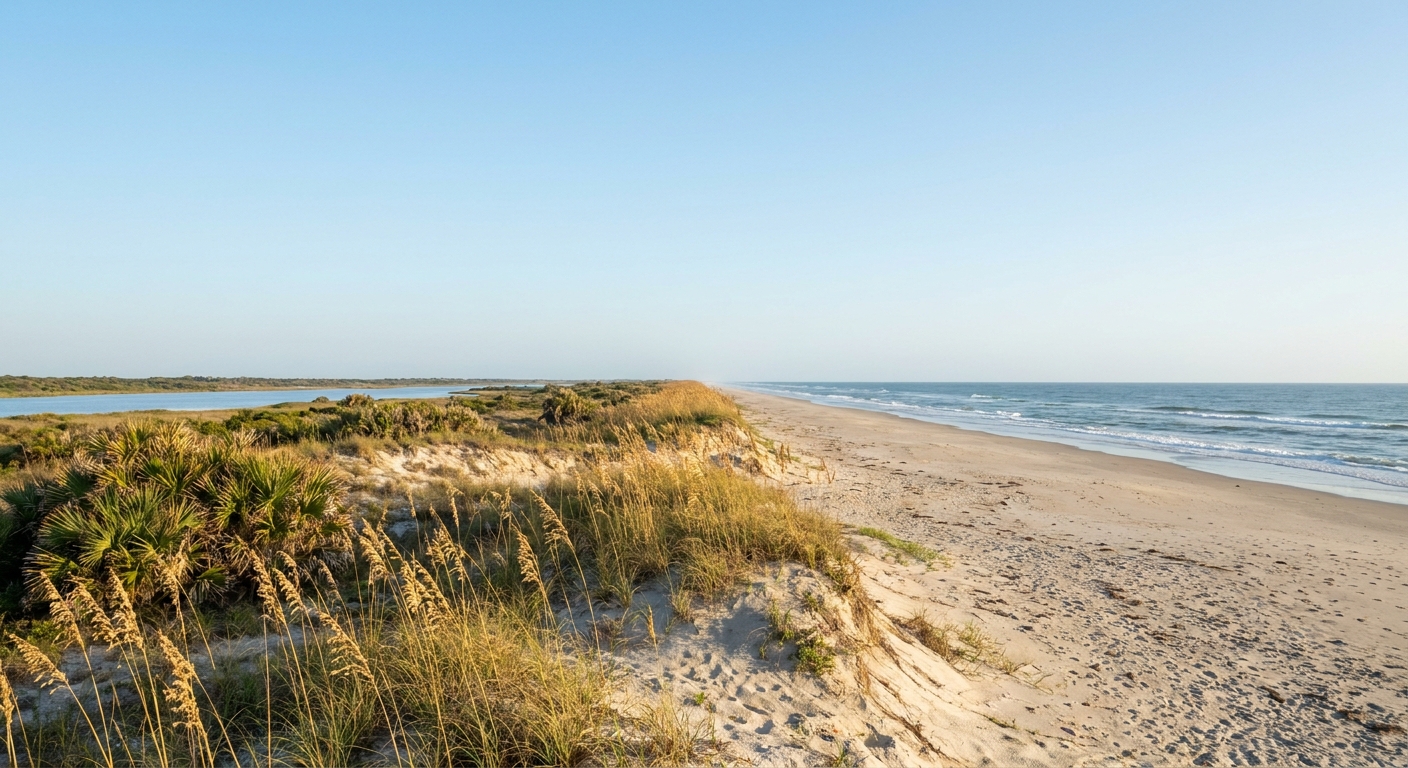
THE SPACE COAST AT A GLANCE · BREVARD COUNTY
Canaveral charges $25.00 per private vehicle and its Apollo and Playalinda booths take cards only, so the Space Coast rewards a card in the wallet and a launch day you can afford to lose.
VISITOR COMPLEX: 9 A.M. TO 5 P.M. · SEASHORE: $25.00 PER VEHICLE, 7 DAYS · REFUGE: 140,000 ACRES
Go for: Space Shuttle Atlantis and the bus tour to the Apollo/Saturn V Center, the Black Point Wildlife Drive, and seven days of beach on a single $25.00 vehicle pass.
Think twice before: building the week around a launch date. The visitor complex can close at short notice on launch days, and we hold no primary source on the schedule itself.
Fees: NPS Canaveral · Overlay and acreage: US Fish and Wildlife Service · Boardings: FAA CY2024 · full sources at the end
On this page
- Which of the three areas to visitNASA first, wildlife second: the agreement in writing
- Kennedy Space Center hours and ticket price9 a.m. to 5 p.m., and a price we could not confirm
- Canaveral National Seashore entrance fee$25.00 per vehicle, seven consecutive days
- Black Point Wildlife Drive passWhere the Refuge Pass is sold
- Watching a launch from the coastWhat we can and cannot confirm
- Getting there from Orlando airportMCO, Eastern time and the 5.0% county tax
- Best month for the Space CoastDry season November to April, hurricane peak September 10
Brevard County holds all three areas, and one rental car serves all of them. Readers coming from the theme parks will find the coast in our weekend getaways from Orlando, while the state-level picture sits in the Florida guide. Siesta Key and South Walton are separate trips on the Gulf side.
Kennedy Space Center vs Merritt Island refuge vs Canaveral National Seashore
| Area | Who runs it | Designation | What it costs at the gate |
|---|---|---|---|
| Kennedy Space Center Visitor Complex | NASA | Not a park unit | Dated tickets, around $77.00 adult (unconfirmed) |
| Merritt Island National Wildlife Refuge | US Fish and Wildlife Service | National Wildlife Refuge · 140,000 acres | Refuge Pass required for Black Point Wildlife Drive (amount not verified) |
| Canaveral National Seashore | National Park Service | National Seashore · one of Florida’s eleven NPS units | $25.00 per private vehicle, 7 consecutive days |
Merritt Island National Wildlife Refuge was established as an overlay of NASA’s John F. Kennedy Space Center. The refuge boundary lies over the space center’s land. The same acreage carries a rocket program and a wildlife designation at once, and the Fish and Wildlife Service is the agency that states which of the two comes first.
The refuge quotes the arrangement on its own pages: “According to the agreement with NASA, the lands and waters of the Kennedy Space Center are primarily to serve the space program and secondarily to serve as a wildlife refuge or park.” Primarily and secondarily are the agency’s own words, not our summary of them.
The refuge consists of 140,000 acres and provides a wide variety of habitats, in the same agency’s description, and it shares a boundary with the launch complex. For a visitor, that hierarchy is a scheduling fact rather than a legal curiosity. Roads and gates on this ground answer to the space program first, so a morning planned here needs a fallback that does not depend on the same causeway.
None of the three carries the National Park designation. In Florida that title belongs to Everglades, Biscayne and Dry Tortugas. Canaveral is one of the state’s eleven National Park Service units, and the practical difference is in how a day gets spent: the seashore is a beach with a fee booth at the end of a causeway, while the Everglades is a full day with its own drive at each end. Our Florida parks overview sorts the eleven.
Kennedy Space Center Visitor Complex: 9 a.m. to 5 p.m., and the launch-day risk
The Kennedy Space Center Visitor Complex opens 9 a.m. to 5 p.m. Standard admission is commonly described as including Space Shuttle Atlantis, the Shuttle Launch Experience, Heroes & Legends, the Rocket Garden, IMAX films and the bus tour out to the Apollo/Saturn V Center. Budget most of a day if that bus tour matters to you, since it runs into restricted ground and back.
No single admission price appears on the complex’s public pages, which sell dated tickets instead. Reseller listings for 2026 put adult entry around $77.00 and children aged 3 to 11 around $67.00, with under-3s free. We could not confirm any of those figures at the primary source, so take them as an order of magnitude and never as an official tariff. For how a day like this lands in a week’s budget, see our Florida trip cost guide.
On launch days, the complex can close at short notice. That sentence is the whole extent of what we can state, because we hold no primary source on the launch calendar. A ticket bought for one fixed date therefore carries a risk we cannot size. Buy the date you are able to move, and check the complex the morning of.
Canaveral National Seashore fees: $25 per vehicle, card only at the gate
| Pass | Price | Valid |
|---|---|---|
| Private vehicle | $25.00 | 7 consecutive days, all park entrances |
| Motorcycle | $20.00 | 7 consecutive days · admits up to 2 non-commercial motorcycles, 4 passengers total |
| Per person, on foot or bicycle | $15.00 | 7 consecutive days, all park entrances |
| Annual pass | $45.00 | 12 months from the month of purchase, one vehicle per visit |
A private vehicle pays $25.00, a motorcycle $20.00, and anyone arriving on foot or by bicycle $15.00. All three are good for seven consecutive days at every park entrance, so one payment covers a week of returns rather than a single afternoon. The annual pass costs $45.00 and runs twelve months from the month of purchase, admitting one vehicle per visit.
The Apollo and Playalinda Beach entrance stations only accept credit or debit for payment. A wallet of twenties will not get a car through either one, so carry a card on the beach day even if the plan was to leave the phone and the plastic in the room.
Merritt Island refuge and Black Point Wildlife Drive: the pass required, and where to buy it
A Refuge Pass is required to enter the Black Point Wildlife Drive, the refuge’s wildlife driving route. Passes are sold in person at the refuge Visitor Center, and the Merritt Island Annual, Daily and Foot/Bicycle passes can also be bought online at Recreation.gov before you leave the hotel.
We could not read the amount of that pass at the source, so no number appears here. Plan on paying at the Visitor Center or on Recreation.gov, and expect to learn the price at the point of sale rather than from us.
That pass buys access to part of 140,000 acres of varied habitat sitting against the fence line of an active launch complex. What is showing in any given week, and where, is posted by the Fish and Wildlife Service itself, and we carry no seasonal wildlife list of our own for this refuge. Manatee encounters as a planned activity belong further west, in the springs covered by our manatee guide.
For someone who came for a rocket and has a car, the refuge is the easiest addition to the day: it shares the ground you already drove to, and it asks for a pass rather than a dated ticket. Skip it if the schedule is already committed to the bus tour, and skip it outright without a vehicle, since the drive is built for cars.
Rocket launches on the Space Coast: short-notice closures and viewing areas
The visitor complex can close at short notice on launch days. That formulation is the one the complex itself uses, and it is the only claim about launch operations we are prepared to put in print.
What we do not have: a primary source on the launch schedule, a primary source on whether Playalinda Beach closes for a given launch, and a primary source naming official public viewing areas. All three were checked on September 8, 2026 and left unresolved. An unverified viewing spot is worth less than none at all when it costs a two-hour drive to find out.
Anyone building a trip around a launch should book what can be moved: refundable lodging, a visitor-complex ticket with a changeable date, and a second reason to be in Brevard County that week. On the day itself, the agencies’ own channels are the authority, and the Park Service page for the seashore is the one to read before driving to a beach gate. Treat a viewing as a bonus rather than the purpose of the week.
Getting to the Space Coast: Orlando airport and the 5.0% county tax
Orlando International (MCO) is the nearest large airport and the busiest in Florida, with 27,859,783 passenger boardings in 2024. Both Orlando and Brevard County run on Eastern time, which matters to anyone matching a window quoted in ET. Nothing connects the three areas on foot, so plan on a rental car: see getting around Florida, and price the flight with our Florida flights guide.
Brevard County levies a 5.0% transient rental tax, filed and paid with the 6% state sales tax. On a lodging bill that is 11% before any resort or parking charge the property adds on its own. Run the total through our trip cost breakdown, and compare the base with the options in where to stay in Florida.
The best time to visit the Space Coast, and the hurricane months
Statewide, the dry season runs November through April. The Atlantic hurricane season runs June 1 to November 30 and peaks on September 10, with most activity between mid-August and mid-October. November sits inside both windows at once, dry on the calendar and still within the hurricane season until the 30th. Our month-by-month verdict works through the remaining ten.
Florida’s beach warning flags read as follows: double red means the water is closed, red high hazard, yellow medium hazard, green low hazard and exercise caution, and purple dangerous marine life, flown alongside another flag rather than on its own. No law compels a beach to fly any of them, and the absence of flags does not assure safe water. Our Florida safety guide takes that further.
With a week in hand, one day goes to the visitor complex, one morning to the wildlife drive, and two or three unhurried days to the seashore, where the seven-day vehicle pass does the work twice over. Add St. Augustine to the north if the group wants a change of century, and see what realistically fits in our seven-day itinerary.
For someone set on seeing a launch, the planning unit is a week rather than a date, since we cannot tell you when a window opens. September and October bookings deserve refundable rates on the hurricane grounds alone, and November pairs the opening of the dry season with the last thirty days of the storm season.
When to go. The month-by-month case for the Space Coast — what the normals say, when the sea is warm enough to swim and which weeks fill up — sits on the best time to visit the Space Coast.
The last word
If the week includes two passes through a Canaveral gate, the $45.00 annual pass beats paying $25.00 twice, and it holds for twelve months from the month of purchase. Motorcyclists do better still: $20.00 admits up to two non-commercial motorcycles with four passengers in total. Decide that with a card in hand, because Apollo and Playalinda take nothing else, and build the rest of the week knowing the space program holds first call on this ground.
Sources & data for this guide
- Overlay status, the NASA agreement wording, 140,000 acres and the Refuge Pass · US Fish and Wildlife Service, Merritt Island NWR · checked Sep 11, 2026
- Entrance fees ($25.00 / $20.00 / $15.00 / $45.00 annual) and the card-only entrance stations · NPS Canaveral National Seashore, Fees · checked Sep 11, 2026
- Visitor complex hours, 9 a.m. to 5 p.m. · Kennedy Space Center · checked Sep 11, 2026
- Ticket price of roughly $77.00 adult and $67.00 child aged 3 to 11 · reseller listings, NOT confirmed at the primary source · checked Sep 11, 2026
- Standard admission contents and short-notice launch-day closures · concurring secondary sources · checked Sep 11, 2026
- MCO boardings, 27,859,783 in 2024 · FAA CY2024 passenger boardings · checked Sep 11, 2026
- Eastern time for Orlando and Brevard County · 49 CFR 71.5(f) · checked Sep 11, 2026
- Brevard County 5.0% transient rental tax with the 6% state sales tax · Florida Department of Revenue, form DR-15TDT · checked Sep 11, 2026
- Hurricane season dates and the September 10 peak · NOAA National Hurricane Center · checked Sep 11, 2026
- Beach warning flag meanings · Florida Statutes s. 380.276 and Volusia County Beach Safety · checked Sep 11, 2026
- Editorial admission: we could not verify launch schedules, launch-day beach closures, official public viewing areas, or the amount of the Merritt Island passes · verification incomplete as of Sep 8, 2026 · check the agencies on the day.