
ST. AUGUSTINE · FLORIDA · TWO FEDERAL FORTS
St. Augustine sells itself as a costume drama, then charges almost nothing for the two best things in it. The Castillo de San Marcos, a Spanish fort with a gun deck over the bay, asks $15 of anyone aged 16 or older and nothing at all of children. Fort Matanzas, its smaller relative down the coast, asks nothing of anyone, the boat ride included.
So the city plans best by its gates rather than its streets. Three of them decide a visit: a fort whose $15 ticket stays valid for a week, a fort whose free boarding pass has to be collected at the right desk, and an 1874 lighthouse tower with a height rule that settles whether a child climbs. Sort those out and the hours between them fall into place.
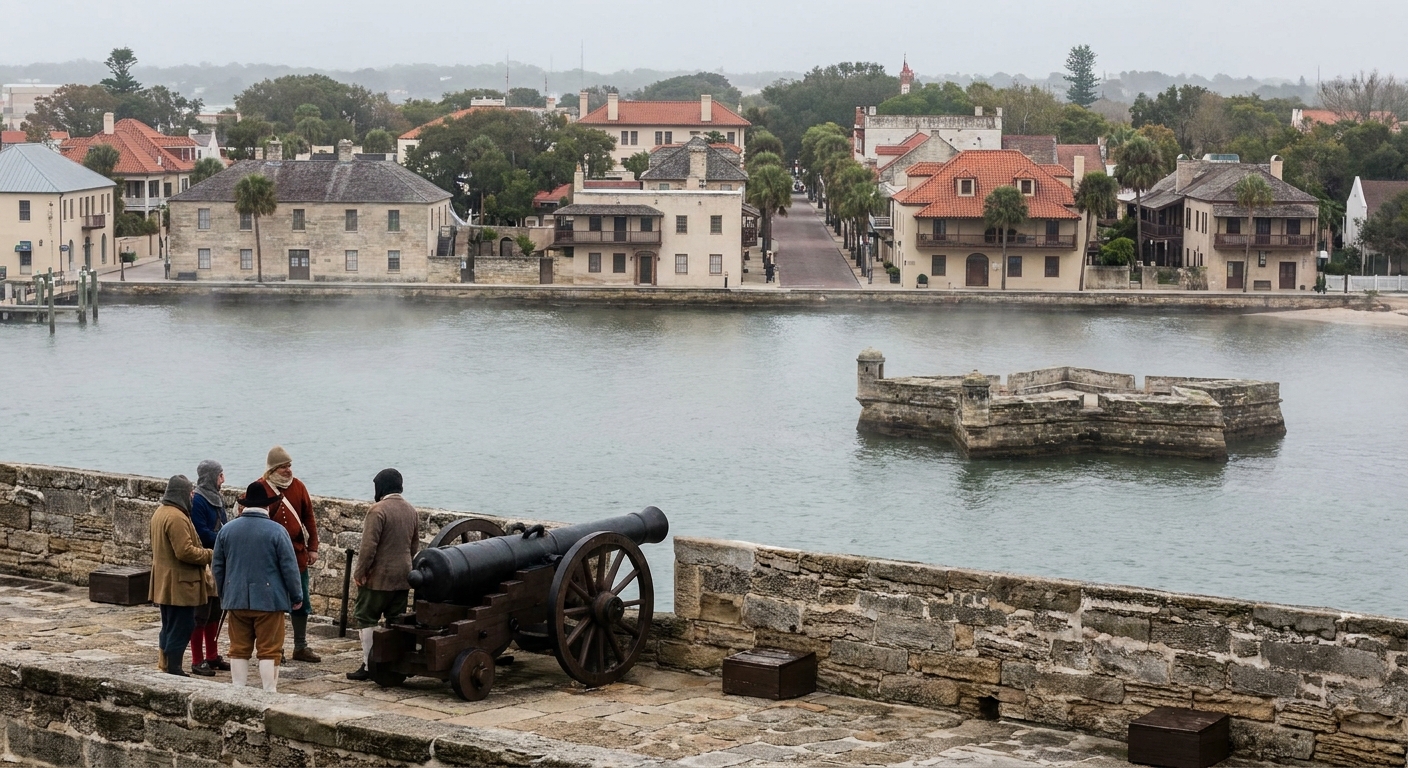
THE CITY AT A GLANCE · ST. AUGUSTINE
Buy one $15 Castillo ticket, use it twice inside seven days, and pay nothing at all for Fort Matanzas and its ferry, provided you pick up the pass at the fort’s own visitor center.
CASTILLO $15, FREE UNDER 16 · FORT MATANZAS FREE · EASTERN TIME
Go for: two National Park Service forts inside one town, a 5:15 p.m. gun deck at closing time, a free ferry to a coquina watchtower finished in 1742, and a founding date the Park Service actually puts in writing: 1565.
Think twice before: driving south to Matanzas without the boarding pass, or arriving at the Castillo after 5:00 p.m., when the last admission has already gone.
Forts, fees and dates: National Park Service · Lighthouse hours: St. Augustine Lighthouse & Maritime Museum · Taxes: Florida Dept. of Revenue · full sources at the end
On this page
- Castillo de San Marcos tickets and hours$15, free under 16, out by 5:15 p.m.
- A fort that costs nothing, ferry includedFort Matanzas, and the pass desk
- Climbing the lighthouse tower with kidsSeason hours and the 44-inch rule
- The founding date, and what Matanzas means1565, and a Spanish word for slaughters
- Nearest airport and the lodging taxJAX, plus 5% in St. Johns County
- Beach flags, and where public sand endsFive flags, and the high-water line
- Best months, and hurricane season datesNovember through April
Two of Florida’s eleven National Park Service units sit in this one town, which is why the numbers below are firm ones (the eleven, compared). Hotels, restaurants, St. George Street and the private museums are missing for the opposite reason: we found nothing on them we could source, and we would rather say so than fill the gap with atmosphere.
Castillo de San Marcos: $15, free under 16, and the 5:15 p.m. exit
| Ticket or hour | What it means |
|---|---|
| $15.00 | Per person, ages 16 and above |
| Free | Ages 15 and under, accompanied by an adult |
| 7 days | One ticket, seven consecutive days |
| 9:00 a.m. | First admission |
| 5:00 p.m. | Last admission |
| 5:15 p.m. | Castillo closes, visitors must exit |
| 2 days a year | Closed on Thanksgiving Day and Christmas Day only |
The Park Service calls it the oldest masonry fortification in the continental United States, built by the Spanish here to defend Florida and the Atlantic trade route. That word continental is theirs and it is doing work: it holds the door open for the older Spanish fortifications of Puerto Rico. One more piece of vocabulary we leave where we found it: coquina appears on the Fort Matanzas pages, not on the Castillo pages we read.
Entry is $15.00 for anyone aged 16 and above, and free for ages 15 and under with an adult along. The number that changes a visit, though, is the validity: seven consecutive days. Pay once on a Tuesday morning, walk the gun deck with everyone else, then come back Thursday at four o’clock for the version with light on the bay and space to lean on a parapet.
First admission is 9:00 a.m., last admission 5:00 p.m., and at 5:15 p.m. the fort closes and everybody walks out. Plan a 4:00 p.m. arrival and you have an hour and a quarter, not an evening. It runs seven days a week with exactly two exceptions in the year, Thanksgiving Day and Christmas Day, which makes it one of the few dependable indoor-outdoor hours in a Florida December.
Fort Matanzas: free entry, free ferry, and where to get the boarding pass
Every area of Fort Matanzas National Monument is free of charge, and that includes the ferry out to the fort. No entrance fee, no boat fare, no upsell. What waits at the other end is a coquina watchtower completed in 1742, built to guard the southern approach to the Spanish military settlement of St. Augustine.
The catch is a desk. You collect the free boarding pass at the Fort Matanzas Visitor Center, on site, and not at the St. Augustine city visitor center in town. Every member of the family needs a pass of their own, at any age, infants included. Two adults who assume one pass covers the party are two adults with a problem at the dock.
The Fort Ferry Service runs a season dated October 1 to September 30. Daily departure times are the one detail we could not read at the source, so we print none of them here. Check the monument’s own page or call on the morning you plan to go, and build the crossing around whatever they tell you rather than around lunch.
For anyone who has already paid at the Castillo, this changes the arithmetic of a two-fort day. Two adults and two children under 16 hand over $30 in town, then $0 at Matanzas with the boat thrown in. A second fort, a second century of construction and a short water crossing, for the price of nothing added to a ticket that is still valid for six more days.
It earns the drive south if you like a boat, a small garrison room and a beach walk with almost no one on it. It does not earn a half-day visit: with four hours in St. Augustine, spend them at the Castillo and skip the pass desk entirely. Families with a toddler should weigh the crossing, since a pass is required for the smallest passenger too.
St. Augustine Lighthouse hours, and the 44-inch rule for the tower
From October 1 to February 28 the lighthouse opens 9:00 a.m. to 6:00 p.m. daily, with the last ticket sold at 5:30 p.m. From March 1 to September 30 it runs 9:00 a.m. to 6:30 p.m., last ticket at 6:00 p.m. Half an hour separates the two seasons, and it is the half hour people miss when they drive over after the fort closes at 5:15.
Then the rule that decides your afternoon if you have children. Under 44 inches, no tower: the restriction is stated for safety, and it applies to animals as well. Above 44 inches, a child has to climb under their own power, which rules out shoulders and carrying at the top of a stairwell. The tower dates from 1874 and general admission includes the climb.
One gap we will name rather than paper over: we could not read the general admission price at the source. The only figure that surfaced was $500 per person for a Lens Room Tour, a special visit, and quoting that as the door price would be flatly misleading. Budget for a paid ticket, confirm the amount with the museum, and note that the two forts are where the fixed numbers live.
Why St. Augustine is old: 1565, and what Matanzas means
The date the Park Service puts in writing is 1565: “The first conflict goes back to 1565, the year of the founding of St. Augustine.” That is the number to carry around town, and it predates Jamestown and Plymouth by a comfortable margin without anyone needing to embroider it.
The river’s name records what happened next. The Park Service ties it to “the massacre of the French Huguenots, the incident that led to the naming of the river, Matanzas, the Spanish word for slaughters.” You cross that water on a free ferry today, which is a strange and useful thing to know while standing on the dock.
The strategy behind both forts follows from geography: whoever controlled Florida controlled the rich shipping lanes coming up from the Spanish Caribbean. Hence a masonry fortification guarding the town and the trade route, and hence a coquina watchtower finished in 1742 covering the back door to the south, where a small boat force could slip in unseen.
And the claim we will not make. St. Augustine is routinely called the oldest continuously occupied city in the United States, and that superlative appears on none of the National Park Service pages we read. We serve 1565, because 1565 is sourced. If a guide tells you the rest, ask where the sentence comes from.
Getting to St. Augustine: Jacksonville airport and the 5% county tax
The nearest large airport is Jacksonville (JAX), a medium hub that boarded 3,749,791 passengers in 2024. Orlando is the state’s giant at 27,859,783 boardings, and it is also a much longer drive, so JAX wins on both counts unless the fare gap is severe (how Florida’s airports price out). The town sits east of the Apalachicola River, which puts it on Eastern time with Orlando, Tampa and Miami.
On the bill, St. Johns County levies a 5.0% transient rental tax, filed and paid alongside the 6% state sales tax. Stack them and a short stay carries 11% before any property adds its own line items, which is the sort of thing worth folding into a budget early (what a Florida trip costs) rather than discovering at checkout.
St. Augustine beaches: reading the flags, and where the dry sand is private
Florida uses five beach warning flags: double red means the water is closed, red high hazard, yellow medium, green low hazard with caution still advised, and purple dangerous marine life, flown alongside another flag rather than on its own. Learn them once and they work statewide. Also learn the limit: no law compels a beach to fly any flag at all, so an empty pole tells you nothing (more on Florida’s safety rules).
Where the towel goes matters too. Under Florida Statutes s. 163.035(2), a local government may not adopt or keep a customary-use rule covering any beach above the mean high-water line without a judicial declaration. Wet sand below that line is public. Dry sand above it can be private, and on a narrow stretch at high tide the public part is the part your feet are getting wet in.
The best time to visit St. Augustine, and the hurricane months
Statewide, the dry season runs November through April. Atlantic hurricane season runs June 1 to November 30, peaks on September 10, and concentrates most of its activity between mid-August and mid-October. Those two calendars overlap for a month at each end, which is exactly where the bargains and the refundable-booking arguments live (the twelve-month view).
For a weekend built on three gates, the season matters less than you would think. The Castillo keeps the same 9:00 a.m. to 5:15 p.m. window all year and closes only twice, and the Matanzas ferry season covers October 1 to September 30. The lighthouse is the piece that shifts: winter’s last ticket at 5:30 p.m. versus 6:00 p.m. in the March-to-September stretch.
Our pick is November, once the storm peak is two months gone and the humidity has broken (where else November works). The trade is daylight: you are inside the October-to-February hours, so the tower stops selling tickets at 5:30 p.m. and the fort empties at 5:15 p.m., which leaves one usable afternoon slot rather than two. Do the lighthouse first, the Castillo second.
The last word
The decision that shapes a St. Augustine day is whether to buy that $15 Castillo ticket on the morning you arrive, because seven consecutive days of validity turns one visit into two: the first with the crowd, the second at four in the afternoon with the ticket already in your pocket. Both forts here are national monuments, not national parks. In Florida that designation belongs to Biscayne, Dry Tortugas and the Everglades, each of them a full day with a drive or a boat at both ends. This is 1742 and 1565 inside a town you were already walking, plus a ranger clearing the gun deck at 5:15 sharp.
Sources & data for this guide
- Castillo fee, $15 for ages 16+, free under 16, valid 7 consecutive days · National Park Service · checked Sep 14, 2026
- Castillo hours, 9:00 a.m. first admission, 5:00 p.m. last, 5:15 p.m. exit, closed Thanksgiving and Christmas · National Park Service · checked Sep 14, 2026
- “Oldest masonry fortification in the continental United States” · NPS Castillo de San Marcos · checked Sep 14, 2026. The word coquina appears on the Fort Matanzas pages, not on the Castillo pages we read, so we do not apply it to the Castillo.
- Fort Matanzas free entry and free ferry, boarding pass at the Fort Matanzas Visitor Center, one per person at any age · National Park Service · checked Sep 14, 2026
- Coquina watchtower completed 1742; founding date of 1565; Matanzas as “the Spanish word for slaughters”; Spanish Caribbean shipping lanes · NPS Fort Matanzas · checked Sep 14, 2026
- Fort Ferry Service season, Oct 1 to Sep 30 · NPS Fort Matanzas · checked Sep 14, 2026. Daily departure times were not readable at the source and are deliberately absent here.
- Lighthouse hours for both seasons and last-ticket times; the 44-inch tower restriction; 1874 tower · St. Augustine Lighthouse & Maritime Museum · checked Sep 14, 2026
- Lighthouse general admission price: not read at the source. The only figure found was a $500-per-person Lens Room Tour, which is a special visit and not the door price · noted Sep 8, 2026
- JAX 3,749,791 and MCO 27,859,783 boardings, CY2024 · Federal Aviation Administration · checked Sep 14, 2026
- St. Johns County 5.0% transient rental tax with the 6% state sales tax · Florida Department of Revenue, form DR-15TDT · checked Sep 14, 2026
- Eastern time boundary at the Apalachicola River · 49 CFR 71.5(f) · checked Sep 14, 2026
- Beach warning flags · Florida Statutes s. 380.276 and Volusia County Beach Safety · checked Sep 14, 2026
- Customary use above the mean high-water line · Florida Statutes s. 163.035 · checked Sep 14, 2026
- Hurricane season dates and the Sep 10 peak · NOAA National Hurricane Center · checked Sep 14, 2026
- Our cards on the table: we hold no verified data on hotels, restaurants, St. George Street or the private museums, and the “oldest continuously occupied city” superlative appears on no NPS page we read. Hours and fees change · confirm with each site before you go.