
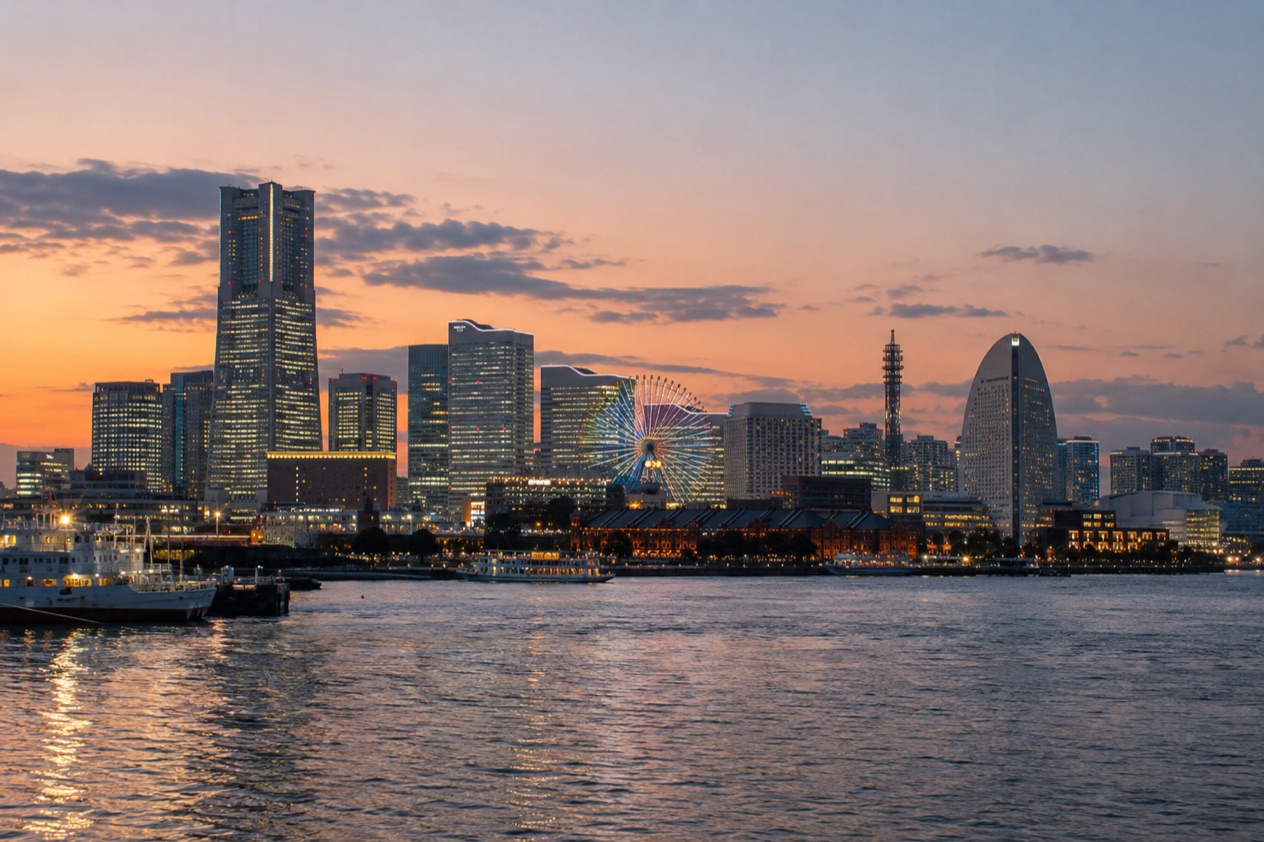
On a spring afternoon in Yokohama, petals drift onto the paths of the waterfront parks while ferries slide across Tokyo Bay and the Ferris wheel turns over Minato Mirai. In July the air turns thick and the harbor lights glitter late into the evening.
By November the breeze off the water feels crisp, and steamed buns in Chinatown taste even better. Yokohama is a port city with four clear seasons, and each one gives the harbor a different mood.
When is the best time to visit Yokohama?
Late March through April and October through November are the best months for travelers, because the air is mild enough for long walks along the water and the city has its two great seasonal displays, cherry blossoms in spring and maple color at the very end of autumn. Winter is a good third choice for anyone who likes cold, bright days, and summer suits travelers who plan around the heat.
For sightseeing on foot, spring is the clear favorite. The usual date for first cherry blossoms in Yokohama is March 25, and full bloom follows about a week later.
From one spring to the next those dates move by a couple of weeks, so a trip that is planned around the blossoms is a gamble on timing, though the days around them are pleasant either way. A light jacket or a simple sweater is enough for most spring outings.
For food and city life, almost any month works, since Chinatown, the harbor restaurants and the covered shopping streets do not depend on the weather. Autumn adds the pleasure of eating outside without sweating, and winter is the season for hot noodles and stews after a windy walk on the waterfront. For nature, the gardens and parks are at their richest when the cherry trees bloom in spring and the maples turn in December.
Travelers who want less heat and less rain should be wary of June through September, when humidity is high and showers are frequent. Families with younger children often find the milder months of May, October and November the most comfortable.
Yokohama also works as a base or a day trip from Tokyo. A JR or private line train from central Tokyo to Yokohama Station takes about an hour, and Haneda Airport is a short hop away by the Keikyu line.
Yokohama weather by month
Yokohama has a cool, bright winter, a hot and damp summer, and two mild shoulder seasons in between.
| Month | Average high (°F) | Average low (°F) | Precipitation (in) | Days with 1 mm or more of precipitation | Hours of sunshine | Daylight on the 15th |
|---|---|---|---|---|---|---|
| January | 50.4 | 36.9 | 2.55 | 5.1 | 193 | 10 h 00 min |
| February | 51.4 | 37.6 | 2.55 | 5.4 | 167 | 10 h 53 min |
| March | 57.2 | 42.8 | 5.49 | 10.0 | 169 | 11 h 54 min |
| April | 66.0 | 51.3 | 5.63 | 9.5 | 181 | 13 h 03 min |
| May | 73.6 | 59.9 | 6.01 | 9.8 | 187 | 14 h 00 min |
| June | 77.9 | 66.4 | 7.43 | 11.9 | 136 | 14 h 32 min |
| July | 84.9 | 73.2 | 7.19 | 10.3 | 171 | 14 h 21 min |
| August | 87.8 | 75.7 | 5.47 | 7.5 | 206 | 13 h 32 min |
| September | 81.1 | 69.8 | 9.51 | 11.5 | 141 | 12 h 27 min |
| October | 71.6 | 60.3 | 9.46 | 10.7 | 137 | 11 h 21 min |
| November | 62.8 | 50.2 | 4.24 | 7.7 | 151 | 10 h 20 min |
| December | 54.5 | 41.4 | 2.61 | 5.5 | 178 | 9 h 47 min |
The cold months bring the fewest wet days, and the sky is often bright, so December through February call for a warm coat, gloves and a scarf rather than an umbrella. From March the number of wet days doubles, and the rain that comes with it is a mix of soft spring showers and longer gray spells.
Summer is hot at both ends of the day, with warm nights that make an evening walk by the bay comfortable only in light clothes. June is the grayest month, with the least sunshine of the year. August is the sunniest and has fewer wet days than the months around it.
September and October carry the heaviest rainfall, so a rain jacket belongs in the bag then. The light also matters: in early summer the evenings stay long, while in December the sun sets early and the lit-up waterfront starts its show soon after the afternoon ends.
What is there to do in Yokohama in each season?
Spring: cherry blossoms and the first warm days
Spring is for the parks and the waterfront. Cherry trees bloom around the city, and a stroll through Yamashita Park, along the harbor and through the Minato Mirai district combines the blossoms with the ships, the brick warehouses and the towers. In the weeks before the cherry blossoms, plum trees open their flowers in gardens such as Sankeien, a traditional landscape garden of ponds, teahouses and old buildings.
Days grow longer fast, with more than eleven hours of daylight by mid-March and over thirteen a month later. Rain is part of the season, so a compact umbrella earns its place, and the gray days suit museums such as the Cup Noodles Museum.
Early summer rain and the hot months
June is the rainy season, with humid air and frequent showers, and it is the month to keep for indoor Yokohama: museums, aquariums, the covered arcades of Chinatown and long meals. Hydrangeas flower in gardens and temple grounds during these weeks, and wet stone paths and umbrellas make a fine subject for a camera.
July and August are hot and sticky, and the sea breeze along the bay is the main relief. Days are best spent in air-conditioned places, with the waterfront saved for the evening, when the Ferris wheel and the ships are lit. Cold noodles, shaved ice and iced coffee fit the weather. Sea-level swimming is not something to plan around here, since Yokohama is a harbor city rather than a beach resort.
Autumn color, winter light and the cold months
Yokohama’s maple leaves change late, with a usual date around December 14, so the color comes when much of the rest of the Kanto region has already shed its leaves. Gardens and parks are the places to see it.
Winter is the season of clear, cold days, with the lowest rain totals of the year and plenty of sun. It is a good time for the harbor, for hot pots and ramen, and for the illuminations that light up the waterfront through December. The Red Brick Warehouse holds a Christmas market, and in the new year, shrine visits and the first sunrise over the bay mark the start of the Japanese year.
When is Yokohama least crowded?
The calmest months for a visit are the cold ones, January and February, and the wet stretch of early summer, when the weather rather than the calendar sets the pace. These are the months to expect easier moments in the museums and cafés, with shorter waits at the places everyone talks about.
The busiest weeks follow the Japanese holiday calendar. Golden Week, the string of national holidays from late April into early May, sends families to the waterfront and to the Tokyo Bay area. Obon in mid-August and the New Year break are the other times when the whole country travels, and the harbor attractions feel it.
The blossom weeks in late March and early April and the maple weeks in December are the seasons when the gardens and parks draw the most interest, since a good bloom brings people out for picnics and photographs. Weekends fill the waterfront more than weekdays in nearly any month, so a midweek day at the harbor gives more room to wander.
For rooms and sights, the quieter months make it simpler to choose where to stay and what to see, while the holiday weeks and the bloom weeks ask for more planning. A day trip from Tokyo in the cold months can be an easy way to see the city without the crowds of the holiday season.
Which months should you avoid in Yokohama?
No month is off limits, but June, September and October are the ones that ask for patience, along with the hottest weeks of July and August. The figures explain why: June has the most rain days and the least sun of the year, and September and October bring the heaviest rainfall.
It does not close the city, but it limits outdoor plans, and the gray skies do little for views over the bay. Pack a rain jacket and plan museum and food days around the showers.
July and August bring real heat and thick humidity, with warm nights that give little relief. Sightseeing on foot works in short stretches, with long breaks indoors. September and October are wet and rain can return in heavy bursts, so keep plans flexible and carry a jacket.
The cherry blossoms and maple leaves have usual dates but move from one year to the next, so a trip aimed at them can land a week or two early or late.
Festivals and events in Yokohama through the year
Winter and early spring: New Year, Setsubun and Lunar New Year
The Japanese year opens with hatsumode, the first shrine or temple visit of the year, when people line up in warm coats to ring a bell, make a wish and draw a fortune slip. Shrines across the Yokohama area fill with worshippers in the first days of January, and stalls sell hot sweet drinks and grilled snacks.
On February 3, Setsubun marks the turn toward spring. Families and temples throw roasted soybeans to chase away bad luck, shouting that demons should go out and fortune come in. Around the same season, Yokohama Chinatown celebrates Lunar New Year with lanterns, lion dances and festive food, which gives the neighborhood a different feel from the rest of the city. The date moves from year to year with the lunar calendar.
Spring and summer: blossoms, port anniversary and fireworks
Hanami, the custom of picnicking under blooming cherry trees, starts in late March and carries into April. Friends and coworkers spread tarps under the trees with bento boxes and drinks. The port opened on June 2, 1859, and the city marks its harbor heritage around early June with events along the waterfront.
Summer brings matsuri, local festivals with food stalls, drums and portable shrines. Tanabata on July 7 celebrates a story of two stars with paper strips hung on bamboo branches. In August, fireworks over the bay are a regular fixture of the summer calendar, and Obon in mid-August is the season when families return home to remember their ancestors, with lanterns and dances in many neighborhoods.
Autumn and December: moon viewing, leaves and lights
Autumn is the season of harvest foods, chestnuts, sweet potatoes and persimmons, and of tsukimi, moon viewing, when people admire the full moon with rice dumplings. Shrine and community festivals appear on weekends in October and November, with portable shrines carried through the streets.
December ends the year with the late maple color in the gardens, illuminations along the waterfront and Christmas markets, then moves on to the year-end temple bells on December 31. In Yokohama, ships in the harbor sound their horns at midnight, a custom of a port city that has been welcoming vessels for a long time.
Sources
- Japan Meteorological Agency (JMA), Normal values 1991-2020, monthly (https://www.data.jma.go.jp/stats/etrn/view/nml_sfc_ym.php?prec_no=46&block_no=47670), station Yokohama, elevation 39 m, checked October 11, 2026
- Computed from the date and the latitude of the place (sunrise equation, solar elevation -0.833 degrees), October 11, 2026
- Japan National Tourism Organization, Yokohama (https://www.japan.travel/en/destinations/kanto/kanagawa/yokohama-and-around/), checked October 11, 2026
- Wikipedia, Yokohama (https://en.wikipedia.org/wiki/Yokohama), checked October 11, 2026
- Wikivoyage, Yokohama (https://en.wikivoyage.org/wiki/Yokohama), checked October 11, 2026
- Japan National Tourism Organization, autumn in Japan (https://www.japan.travel/en/guide/autumn-guide/), checked October 11, 2026
- Japan National Tourism Organization, spring in Japan (https://www.japan.travel/en/guide/spring-guide/), checked October 11, 2026
- Japan Meteorological Agency, cherry blossom first-bloom dates 2021-2026 and 1991-2020 normal (https://www.data.jma.go.jp/sakura/data/sakura003_07.html), checked October 11, 2026
- Japan Meteorological Agency, cherry blossom full-bloom dates 2021-2026 and 1991-2020 normal (https://www.data.jma.go.jp/sakura/data/sakura004_07.html), checked October 11, 2026
- Japan Meteorological Agency, maple color-change dates 2025-2026 with difference from the 1991-2020 normal (https://www.data.jma.go.jp/sakura/data/phn_014.html), checked October 11, 2026