
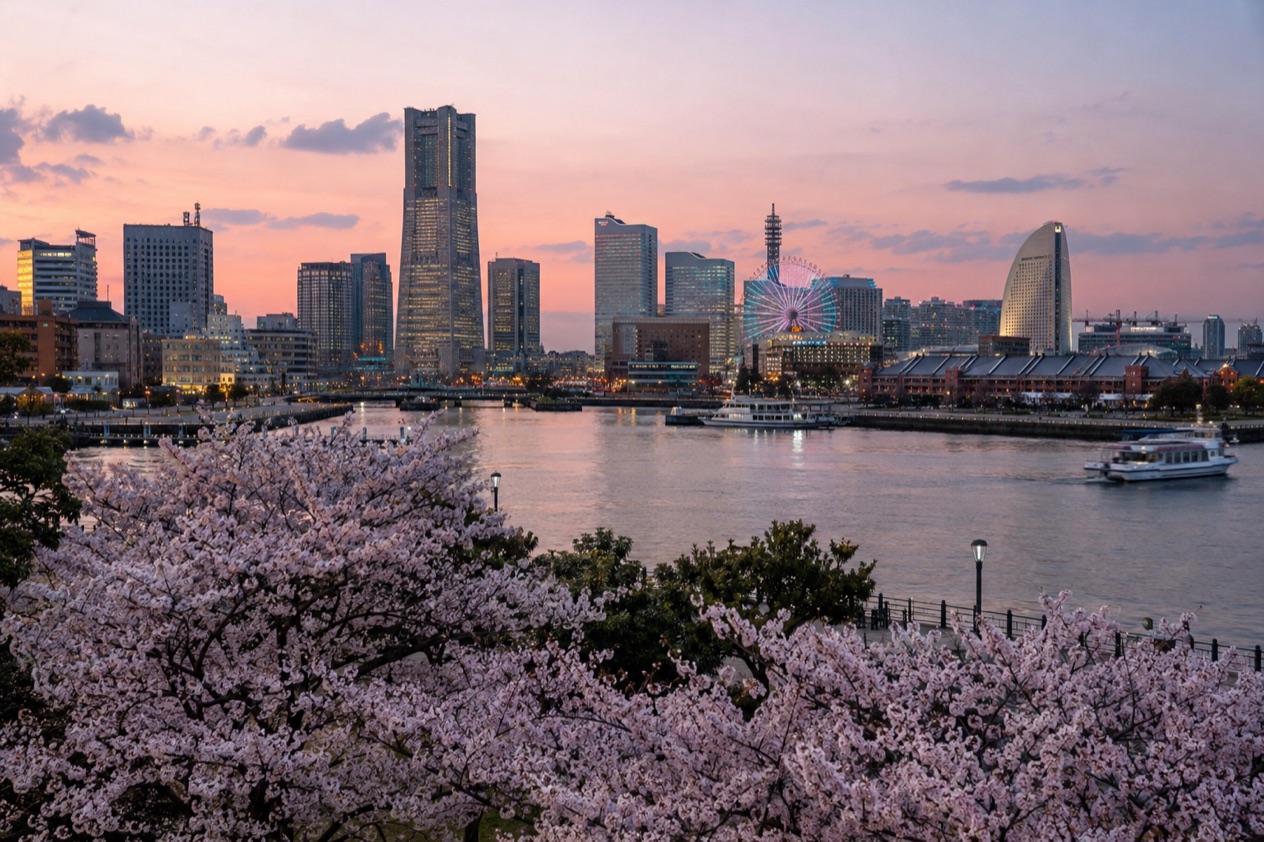
In April, the cherry petals in Yokohama have started to let go. They collect along riverbanks and on the stone paths of the parks, and families who spread picnic mats a few days earlier are now sitting under fresh green leaves.
Out on the harbor, the ships and the Ferris wheel on the waterfront look sharper in the longer light. This is a month for strolling the bayside promenades, eating your way through Chinatown and enjoying a spring that has settled in.
What is the weather like in Yokohama in April?
April in Yokohama is mild and properly spring-like, clearly warmer than March and still well short of the sticky weather of early summer.
| Month | Average high (°F) | Average low (°F) | Precipitation (in) | Days with 1 mm or more of precipitation | Hours of sunshine | Daylight on the 15th |
|---|---|---|---|---|---|---|
| March | 57.2 | 42.8 | 5.49 | 10.0 | 169 | 11 h 54 min |
| April | 66.0 | 51.3 | 5.63 | 9.5 | 181 | 13 h 03 min |
| May | 73.6 | 59.9 | 6.01 | 9.8 | 187 | 14 h 00 min |
Afternoons are warm enough for a shirt with a light jacket or a simple sweater over it, which fits the general rule for spring in Japan. Nights still call for that extra layer, especially if you linger on the waterfront after dinner. Snow is a distant memory by now. A trace of sleet is possible in an average April, but you can leave the winter coat at home.
Rain falls on roughly one day in three. It comes as gray, drizzly spells more often than as a long deluge, so a compact umbrella or a light rain shell earns its place in the bag. Dry hours between showers are common, and the sun still has a good share of the month.
The humidity creeps up a little as the month goes on, a first hint of the heavier air that arrives with the rainy season. In April it is just enough to make a sunny afternoon feel soft rather than sharp.
What to do in Yokohama in April
The big seasonal event is the end of the cherry blossom. In Yokohama the first flowers usually open in the last days of March, and full bloom usually falls around the beginning of April. In recent years full bloom has landed anywhere from the last week of March to the first week of April.
By the time you arrive, you may catch the last good days of blossom, then the falling petals that the Japanese love just as much. Cherry trees around the city, along rivers and in parks, turn into pink-edged carpets, and a walk beneath them is a pleasure in itself.
Hanami, the custom of picnicking under blooming trees, winds down through the month, but the habit of sitting outdoors with a bento box and a drink does not. Sakura-flavored sweets and drinks appear in shops and cafés in spring, and pink-tinted rice cakes wrapped in a salted leaf (sakura mochi) are typical of the season.
Minato Mirai and the harbor
Yokohama lies on Tokyo Bay, and the port, opened as a gateway to the outside world in 1859, still defines the city’s character. The waterfront district of Minato Mirai is a stretch of towers, shopping complexes, a Ferris wheel and open promenades, with the old brick warehouses nearby giving a more historic counterpoint. In April the paths are lined with spring planting, and the breadth of the harbor gives you wide open sky.
Yamashita Park, laid out along the water, suits a slow walk with the ships in view. Cafés and bakeries nearby give you somewhere to sit when a light shower passes. The mix of old port buildings and new glass makes this a good place for photographs, whether you like the architecture or the harbor life.
From central Tokyo, Yokohama Station is about 1 hour away by JR train or one of several private lines, and it is more central than Shin-Yokohama Station.
Chinatown and the food of the season
Yokohama’s Chinatown is a dense grid of restaurants, snack stalls and shops under painted gates. Steamed buns stuffed with pork, fried dumplings, sesame balls and long-grain rice dishes are the sort of food you eat standing up or at a crowded table, and spring weather suits an afternoon of grazing from stall to stall.
Beyond Chinatown, the city has its own noodle culture. Ramen in Yokohama is often a rich, soy-based bowl with thick, straight noodles, and a cool, damp April evening is a natural moment for one. In shops and markets you will also find spring produce such as strawberries and bamboo shoots, and the usual sakura treats from bakeries and tea rooms.
If you want a break from the Chinese and Japanese classics, the harbor district has Western-style cafés and bakeries, a reminder that Yokohama was one of the first Japanese cities to meet foreign cuisine. A cup of coffee and a pastry with a view of the water is a pleasant pause.
Gardens and the green side of spring
Sankeien is a traditional Japanese garden with ponds, bridges and historic buildings set among trees. In April, with the cherry petals fading, you see the garden shift to new leaves and other spring flowers, and the pace of a visit is slow. Wisteria is a spring flower in Japan and usually follows the cherry blossom, though its timing varies by place.
Elsewhere in Yokohama, parks and riversides carry on the spring mood. Shops in urban areas of Japan are generally open from 10:00 a.m. to 8:00 p.m. every day, so a shopping detour fits easily into an April evening.
A two-day itinerary for Yokohama in April
Day 1 belongs to the waterfront. Start in the morning at Yamashita Park and walk the harbor edge toward the brick warehouses, with a coffee along the way. Spring leaves are fresh on the trees and the petals underfoot are a reminder of the season you just caught the end of. Take your time, because the longer days of April let you stretch the schedule.
At midday, move into Chinatown for lunch, grazing from a steamed bun to a bowl of noodles. In the afternoon, cross to Minato Mirai for the towers, the shopping complexes and the Ferris wheel, and stay until the lights come on across the water. Dinner can be ramen or a seafood meal at an izakaya, the casual pub-style place that suits a spring evening.
Day 2 turns to gardens and noodles. Spend the morning at Sankeien among the ponds, bridges and historic buildings, where the green of April takes over from the pink of March. After a lunch of ramen, spend the afternoon at one of the city’s noodle museums, which doubles as your rain card if the weather turns.
In the late afternoon, browse the shopping streets, pick up sakura sweets as gifts and end the evening with a quiet izakaya dinner. If the rain is steady, replace the garden with covered arcades and museums, and keep the harbor walk for a drier moment.
Is Yokohama busy in April?
April brings spring visitors to Yokohama, with the end of the cherry blossom at the start of the month and a long holiday week at the end of it.
The blossom usually peaks around the beginning of April, so the city’s parks and riversides are most popular for hanami just before and during that moment. As the petals fall, the mood shifts from picnic crowds to calmer strolls under the new green leaves.
Golden Week begins on April 29 with Showa Day and runs to May 5. Four of its days are officially public holidays: Showa Day, Constitution Memorial Day, Greenery Day and Children’s Day. Japanese families travel and go on outings in this stretch, so the last days of April feel different from the first three weeks.
Public holidays that fall on a Sunday are followed by a substitute day off, and a day sandwiched between two holidays also becomes one. These rules can stretch the break further. For a calmer visit, aim for the middle of the month, between the end of the blossom and the start of Golden Week.
What to pack for Yokohama in April
Pack for a mild spring with passing showers, and plan for a lot of walking on the waterfront and in the gardens.
- A light jacket or simple sweater, which is what suits spring across Japan and handles cooler evenings by the harbor.
- A compact umbrella or light rain shell for the gray drizzly spells.
- Comfortable walking shoes for Sankeien’s paths and the long waterfront promenades.
- A few thin layers that you can add or remove from morning to evening.
- A small tote or daypack for bakery finds and sweets from Chinatown.
Good to know before you go
The main thing to plan around in April is the end of the month. Golden Week brings a run of public holidays, and the first signs of the early-summer humidity appear as the month goes on.
Shops in urban areas are generally open from 10:00 a.m. to 8:00 p.m. every day, so you can count on evening browsing. The cherry blossom is nearly finished by the time April begins, so if the flowers are your main reason to come, think of March instead.
Yokohama in April vs March and May
Move the trip a month earlier and you land in the blossom itself. You would trade comfort for the flowers, and the days are shorter by more than an hour.
Move a month later and May is clearly warmer, greener and longer in daylight, with a bit more humidity and a similar share of rainy days. The blossom is long gone, and the first part of the month still carries the Golden Week holidays. It suits those who prefer T-shirt weather and long evenings over a light jacket.
April sits between the two. Choose March if the blossom is the point, May if warmth and daylight matter most, and April if you want mild weather, the last petals and fresh green leaves without the heavier air of early summer.
Is April a good time to visit Yokohama?
Yes, for anyone who likes to walk, eat and see a city in a gentle spring mood. April is good for travelers who enjoy the waterfront and gardens, who want mild days with room for a rain shower, and who like the idea of catching the tail end of cherry season.
It is less right for anyone who has come only for full-bloom blossom, since the peak has usually passed by then. It is also less right for those who dislike the odd gray, drizzly day, though a museum or covered arcade solves that quickly.
On arrival, start with the harbor. Walk the waterfront from Yamashita Park, find a café with a view of the ships and let the city introduce itself before you plan the rest. What sets April apart is the way petals, new leaves and a bright harbor share the same afternoon.
Sources
- Japan Meteorological Agency (JMA), Normal values 1991-2020, monthly (https://www.data.jma.go.jp/stats/etrn/view/nml_sfc_ym.php?prec_no=46&block_no=47670), station Yokohama, elevation 39 m, checked October 11, 2026
- Computed from the date and the latitude of the place (sunrise equation, solar elevation -0.833 degrees), October 11, 2026
- Japan Meteorological Agency, cherry blossom first-bloom dates 2021-2026 and 1991-2020 normal (https://www.data.jma.go.jp/sakura/data/sakura003_07.html), checked October 11, 2026
- Japan Meteorological Agency, cherry blossom full-bloom dates 2021-2026 and 1991-2020 normal (https://www.data.jma.go.jp/sakura/data/sakura004_07.html), checked October 11, 2026
- Japan Meteorological Agency, sakura2020.pdf (https://www.data.jma.go.jp/sakura/data/sakura2020.pdf), checked October 11, 2026
- Japan National Tourism Organization, spring in Japan (https://www.japan.travel/en/guide/spring-guide/), checked October 11, 2026
- Japan National Tourism Organization, flowers by season: cherry blossom, plum, wisteria, hydrangea, where and when (https://www.japan.travel/en/see-and-do/flowers/), checked October 11, 2026
- Wikipedia, Wisteria (https://en.wikipedia.org/wiki/Wisteria), checked October 11, 2026
- Japan National Tourism Organization, shop and attraction hours, national holidays (https://www.japan.travel/en/plan/business-hours-and-holidays/), checked October 11, 2026
- Wikipedia, Golden Week (Japan) (https://en.wikipedia.org/wiki/Golden_Week_(Japan)), checked October 11, 2026
- Wikipedia, Public holidays in Japan (https://en.wikipedia.org/wiki/Public_holidays_in_Japan), checked October 11, 2026
- Japan National Tourism Organization, Yokohama (https://www.japan.travel/en/destinations/kanto/kanagawa/yokohama-and-around/), checked October 11, 2026
- Wikipedia, Yokohama (https://en.wikipedia.org/wiki/Yokohama), checked October 11, 2026
- Wikivoyage, Yokohama (https://en.wikivoyage.org/wiki/Yokohama), checked October 11, 2026