
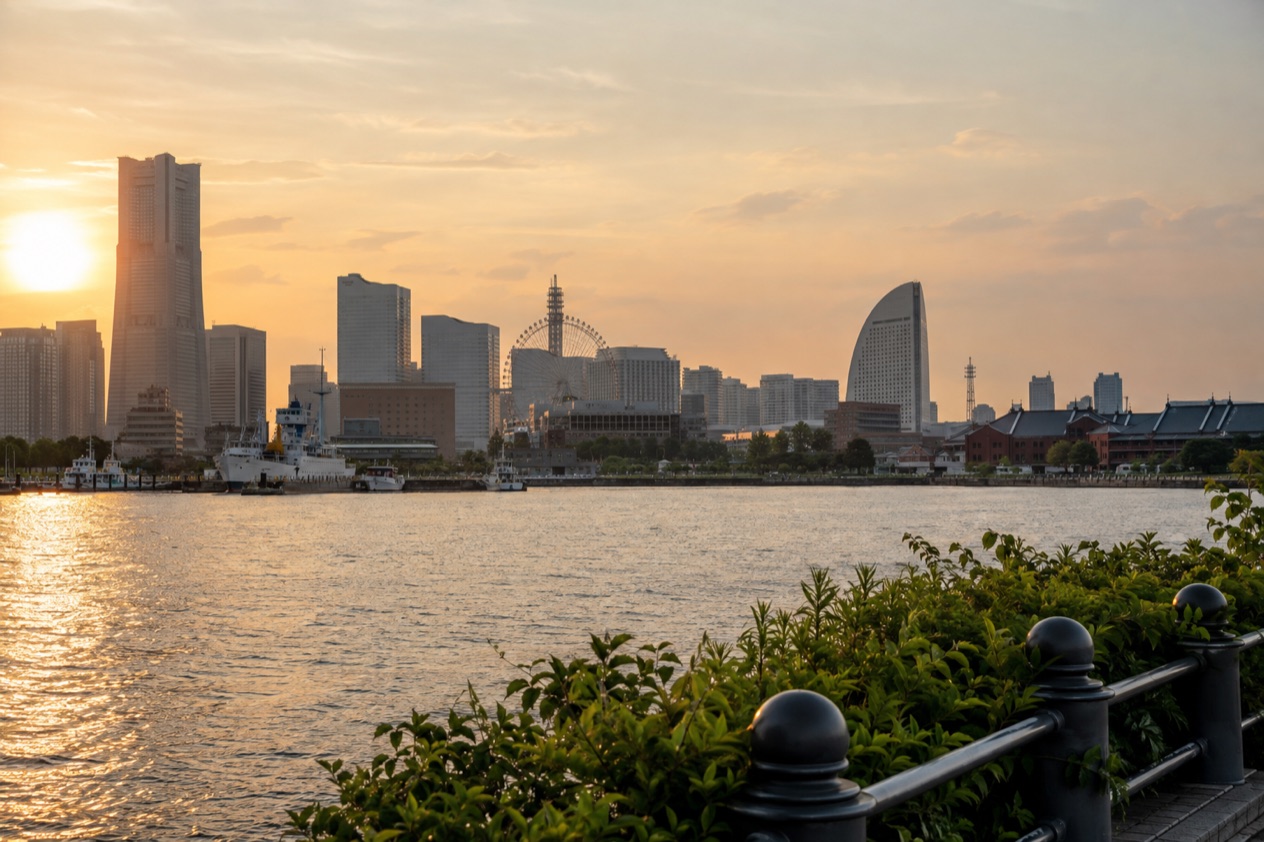
In August the harbor at Yokohama hums with cicadas by day, and ferries and sightseeing boats keep crossing the water as the towers of Minato Mirai light up one window at a time. Cold noodles, shaved ice and iced barley tea show up at every table, and families in light summer kimono (yukata) turn up wherever a festival or a fireworks night is on. It is the hottest, most humid stretch of the year in this port city south of Tokyo, and the one that rewards slow afternoons indoors and long evenings by the water.
What is the weather like in Yokohama in August?
August in Yokohama is hot, humid and mostly sunny, the sunniest of the three summer months and drier than the weeks on either side of it.
| Month | Average high (°F) | Average low (°F) | Precipitation (in) | Days with 1 mm or more of precipitation | Hours of sunshine | Daylight on the 15th |
|---|---|---|---|---|---|---|
| July | 84.9 | 73.2 | 7.19 | 10.3 | 171 | 14 h 21 min |
| August | 87.8 | 75.7 | 5.47 | 7.5 | 206 | 13 h 32 min |
| September | 81.1 | 69.8 | 9.51 | 11.5 | 141 | 12 h 27 min |
What the table means on the ground: nights never really cool down, so you sleep and walk in summer clothes from dusk to dawn, and the humidity makes the afternoons feel heavier than the thermometer suggests. Honshu summers are described as very humid, hot and sultry, and Yokohama fits that picture. Sea air along the waterfront moves things a little, but nobody confuses it with a cool breeze.
Rain is less of a daily nuisance than in July. When it comes it tends to arrive as a shower or a stormy spell rather than a gray week, and a small folding umbrella covers most of it. Plenty of sunshine means the harbor views are bright and the sky often stays wide open over the bay, which also means sun protection counts as much as rain gear.
Days are long, with daylight stretching well into the evening, so dinner by the water feels unhurried and there is time for a second outing after the heat of the afternoon eases. Plan the day in two parts: sights under cover when the sun is high, and open-air walks when the light softens.
What to do in Yokohama in August
The month belongs to summer rituals. Obon is the Buddhist custom of honoring the spirits of one’s ancestors, when people return to ancestral family places and clean the graves of their families, and it lasts three days.
In a city like Yokohama, that means some residents leave for their home towns while others stay, and you may notice temples and cemeteries tended with extra care. It is a good moment to look at Japanese family life from the outside, without joining any ceremony.
Summer also means hanabi, the Japanese word for fireworks. Across Japan, August nights are the season for fireworks displays and for matsuri, the local festivals with food stalls, lanterns and yukata.
If you see a poster or a crowd of people in cotton robes heading toward the water, follow them. On August 11, Mountain Day, a national holiday, adds a long weekend feel in some years, so you may find more local families out and about.
Minato Mirai and the waterfront
Minato Mirai is the district of glass towers, shopping malls, a ferris wheel and wide promenades along Tokyo Bay. It is the most direct way to understand why Yokohama calls itself a port city: the Port of Yokohama officially opened on June 2, 1859, and the harbor has shaped the neighborhood’s character ever since. In August the district suits a split day, with malls and museums for the hottest hours and the waterfront for the evening.
Bring a bottle of water and take your time. The wood decking and open sky give the pier a different feel from the towers, and the boats passing by give you something to watch while you rest.
Landmark Tower and the nearby malls give you somewhere to retreat when the afternoon sun is strong, and the Red Brick Warehouses, old customs buildings now holding shops and cafés, make a pleasant stop with a cold drink. The waterfront shows its best summer face once the sky turns and the lights come on across the bay.
Chinatown and summer food
Yokohama Chinatown is a dense grid of gates, restaurants and stalls, and August is the month to eat cold. Look for hiyashi chuka (chilled ramen noodles with strips of egg, ham and cucumber), steamed buns (nikuman), shumai dumplings and sweet almond jelly. Many shops sell fruit shaved ice (kakigori), which suits the humidity better than any hot dish. Stalls and counters make it easy to graze rather than sit down for a long meal.
In urban areas shops are generally open from 10:00 a.m. to 8:00 p.m. every day, so you can browse and snack through a long afternoon and still be home for dinner. Around the area you will also find Yokohama’s own takes on ramen, rich pork-bone broth with thick noodles, which many locals eat even in warm weather. Pair it with a cold barley tea or a cold beer for a very Japanese summer meal.
Gardens, parks and green breaks
Yamashita Park runs along the harbor with beds of roses and benches facing the water, and the historic ship moored nearby, the Hikawa Maru, gives the park an old-fashioned seaside mood. The shade of the trees and the sea air make a quiet stop between meals. Sankei-en, a traditional garden with ponds and old buildings gathered from other parts of Japan, offers a greener, slower contrast to the towers.
August garden walks are about shade and water: lotus leaves on the ponds, the sound of cicadas and the green tunnels of old trees. Wear a hat, carry a towel for your neck and treat the garden as a long, slow loop with plenty of pauses. When the sun gets too heavy, a teahouse or a bench in the shade is the right call.
If a museum day suits you better, the Cup Noodles Museum, the harbor-side museums and the shopping arcades near Yokohama Station offer entertainment that does not depend on the sky. These are places where you can spend a few cool hours and then go back out for an evening stroll.
A two-day itinerary for Yokohama in August
Day 1 is about the waterfront and the heat. Start in the morning at Yokohama Station with a coffee and a light breakfast, then head to Minato Mirai and walk the harbor edge before the sun is high. Spend the late morning in the Red Brick Warehouses, browsing shops and stopping for a cold drink, then head into the malls and towers around Landmark Tower for lunch in the cool.
In the afternoon, when the highs near the upper 80s, slip into a museum or a café with a view over the bay. Later, take the waterfront promenade toward Osanbashi Pier and let the long August daylight carry you into the evening. Dinner can be a seafood counter or an izakaya (a Japanese pub with small plates), and the lights over the bay finish the day.
Day 2 turns to Chinatown and the green spaces. Begin at the gates of Chinatown with steamed buns and tea, then follow the side streets for dumplings and shaved ice. Move to Yamashita Park for a slow walk by the water and a look at the Hikawa Maru, then settle in for a long lunch of cold noodles or ramen.
In the afternoon, travel to Sankei-en for its ponds and old buildings, and take it slowly with pauses in the shade. If rain moves in, switch to the Cup Noodles Museum or the covered arcades around the station. Finish with a last dinner in Chinatown or back at the harbor, and watch the evening settle over the bay.
Is Yokohama busy in August?
August is a summer month in a big port city, and Yokohama keeps its usual rhythm, with the added pull of Obon and the school holidays that send many residents toward their home towns and others out to the waterfront.
Obon is when people return to ancestral family places, so you may feel the city loosen a little during those three days, with some neighborhoods emptier and the stations and highways busier with travelers. On the other hand, the harbor, Chinatown and Minato Mirai are places that keep people coming through summer, and an evening fireworks night or matsuri elsewhere in the region can draw crowds toward the water.
Shops and malls in urban areas are generally open every day, so the pace of the city does not stop for the holiday. What changes is the mood: long weekends mean families, couples in yukata and groups of friends out for dinner, and the waterfront at dusk is where much of that life gathers.
For a visitor, that means the main sights are lively rather than empty, but the heat itself thins the crowds in the middle of the afternoon and sends people indoors. A rhythm of indoor stops at midday and open-air walks in the evening matches how the city itself moves in summer.
What to pack for Yokohama in August
Think light, breathable and quick to dry, since the days are hot, the air is humid and a shower can pass through at any hour.
- Lightweight cotton or linen clothes, because the humidity makes heavier fabric cling.
- A hat and sunglasses, for the open harbor promenades and garden paths.
- A compact umbrella, which doubles as shade and as cover for sudden showers.
- A small towel or handkerchief, which locals carry to wipe the neck in the heat.
- Comfortable sandals or breathable sneakers, for long days on foot around the waterfront and Chinatown.
- A refillable bottle, for the garden and harbor walks.
Good to know before you go
August sits in the hot, humid core of the Japanese summer, and Honshu is known for sultry days. Plan indoor stops through the middle of the day and keep water close. Obon lasts three days and sends people back to their family places, so expect busier trains and roads around those dates and a slightly different feel in some neighborhoods.
Mountain Day, on August 11, is a national holiday. When a national holiday falls on a Sunday, the next working day becomes a public holiday, so a long weekend can appear in the calendar. Shops in urban areas are generally open every day, and malls and Chinatown keep going through the holidays.
Yokohama in August vs July and September
Moving the trip four weeks earlier brings you to July, when the rainy tail of early summer still lingers and the sky is grayer. Days are even longer, and the heat is a notch lower, but showers are more frequent and the sunshine is thinner. It suits travelers who prefer a bit less heat and do not mind carrying an umbrella through the day.
Moving four weeks later brings September, with cooler highs and lows, longer evenings and the wettest of the three months. The light is shorter and the summer rhythm of Obon and fireworks fades, so the harbor feels more like a regular city again. Outdoor time becomes more comfortable, but the rain asks for more flexibility in your plans.
If you want the brightest skies and the full summer mood of yukata, cold noodles and long evenings by the bay, stay with August. If you would rather trade some of that sunshine for a bit less heat, July or September can work, as long as you accept a wetter itinerary and plan more indoor stops.
Is August a good time to visit Yokohama?
Yes, for travelers who like summer in a port city and are happy to slow the day down around the heat, with indoor breaks and long evenings outside.
It will suit people who love cold noodles, shaved ice and a walk by the water after sunset, and those curious about Obon and the summer festival season. It is less comfortable for anyone who finds hot, humid weather hard to bear, or who wants to spend long hours outdoors at midday. For them, the cooler weeks of September are a gentler fit.
On arrival, start with the waterfront at Minato Mirai: orient yourself along the harbor edge, find a cool café, and learn where the shade and the shops are. Then add Chinatown and the gardens as the days go on, with a rainy-day plan of museums and arcades in your pocket. What stays with you from August in Yokohama is the harbor after dark: the long summer light fading over Tokyo Bay, the towers lit across the water, and a bowl of something cold in your hands.
Sources
- Japan Meteorological Agency (JMA), Normal values 1991-2020, monthly (https://www.data.jma.go.jp/stats/etrn/view/nml_sfc_ym.php?prec_no=46&block_no=47670), station Yokohama, elevation 39 m, checked October 11, 2026
- Computed from the date and the latitude of the place (sunrise equation, solar elevation -0.833 degrees), October 11, 2026
- Japan National Tourism Organization, shop and attraction hours, national holidays (https://www.japan.travel/en/plan/business-hours-and-holidays/), checked October 11, 2026
- Wikipedia, Obon (https://en.wikipedia.org/wiki/Obon), checked October 11, 2026
- Wikipedia, Public holidays in Japan (https://en.wikipedia.org/wiki/Public_holidays_in_Japan), checked October 11, 2026
- Japan National Tourism Organization, summer in Japan (https://www.japan.travel/en/guide/summer-guide/), checked October 11, 2026
- Japan National Tourism Organization, festivals and events (https://www.japan.travel/en/see-and-do/festivals-and-events/), checked October 11, 2026
- Wikipedia, Hanabi (https://en.wikipedia.org/wiki/Hanabi), checked October 11, 2026
- Japan Meteorological Agency, Emergency Warnings (https://www.jma.go.jp/jma/en/Emergency_Warning/ew_index.html), checked October 11, 2026
- Japan National Tourism Organization, safety information (https://www.japan.travel/en/japan-safe-travel-information/), checked October 11, 2026
- Japan National Tourism Organization, weather and seasons in Japan (https://www.japan.travel/en/plan/weather/), checked October 11, 2026
- Wikipedia, Awa Odori (https://en.wikipedia.org/wiki/Awa_Odori), checked October 11, 2026
- Wikipedia, Climate of Japan (https://en.wikipedia.org/wiki/Climate_of_Japan), checked October 11, 2026
- Japan National Tourism Organization, Mount Fuji guide (https://www.japan.travel/en/fuji-guide/), checked October 11, 2026
- Official website for Mt. Fuji climbing, about the climb (https://www.fujisan-climb.jp/en/about/), checked October 11, 2026
- Wikipedia, Nebuta (https://en.wikipedia.org/wiki/Nebuta), checked October 11, 2026
- Wikivoyage, Yokohama (https://en.wikivoyage.org/wiki/Yokohama), checked October 11, 2026
- Japan National Tourism Organization, Yokohama (https://www.japan.travel/en/destinations/kanto/kanagawa/yokohama-and-around/), checked October 11, 2026
- Wikipedia, Yokohama (https://en.wikipedia.org/wiki/Yokohama), checked October 11, 2026