
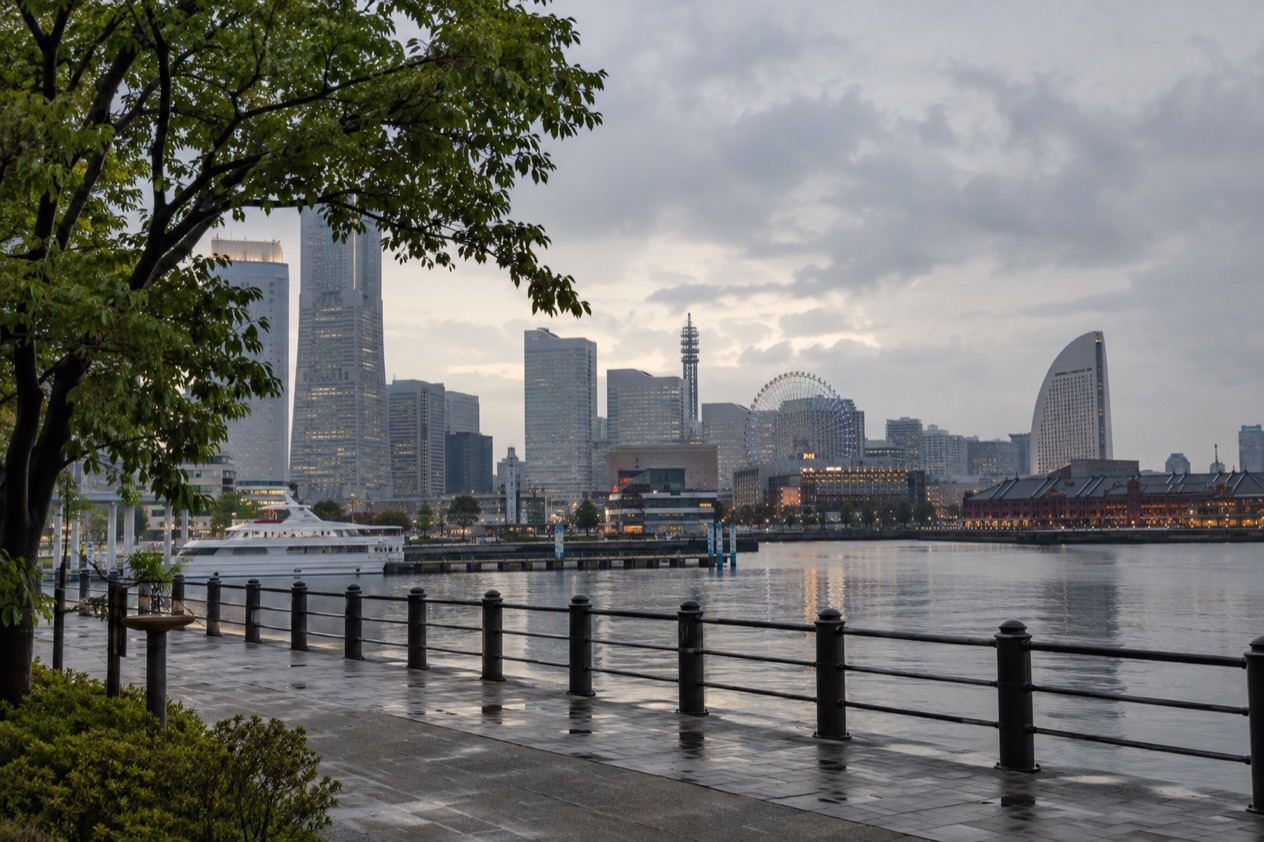
In June the harbor at Yokohama turns soft and silvery, with rain hanging over the cranes and the lights of the Cosmo Clock wheel glowing in the damp air at dusk. Umbrellas drift along the waterfront promenades, and steam rises from bamboo baskets in the lanes of Chinatown. Yokohama sits on Tokyo Bay, and June is the month for its brick warehouses, noodle counters and harbor views in a gray, humid mood, with evenings that stretch late.
What is the weather like in Yokohama in June?
June in Yokohama is warm, humid and wet, a clear step up in heat from May, with rain falling on roughly every third day and the sun showing itself less than in the weeks before.
| Month | Average high (°F) | Average low (°F) | Precipitation (in) | Days with 1 mm or more of precipitation | Hours of sunshine | Daylight on the 15th |
|---|---|---|---|---|---|---|
| May | 73.6 | 59.9 | 6.01 | 9.8 | 187 | 14 h 00 min |
| June | 77.9 | 66.4 | 7.43 | 11.9 | 136 | 14 h 32 min |
| July | 84.9 | 73.2 | 7.19 | 10.3 | 171 | 14 h 21 min |
In practice, that means a light shirt with a thin layer over it is enough for most of the month. The nights stay mild, so you can eat outside along the waterfront without a jacket, though a thin cardigan is welcome in air-conditioned trains and shopping malls. Rain gear matters more than warm clothes, and a compact umbrella or a light rain shell will see regular use.
Humidity is the thing you feel most. The air is heavy enough that a walk across the park-lined waterfront leaves you ready for a cold drink, and fabrics that dry slowly, such as thick denim, are a poor match. Quick-drying cotton or linen and comfortable shoes that can handle wet pavement make the days pleasanter.
The light is long in June, and the sun is up well before most people have finished breakfast, so evenings stretch on after dinner. Skies are often a flat pearly gray, which softens the colors of the brick warehouses and flatters the harbor lights once dusk arrives. It is good weather for photography of wet streets and reflections, less so for a postcard blue sky.
What to do in Yokohama in June
June in Yokohama is a month to follow the water and duck into the city’s indoor corners when the rain thickens. The port was officially opened on June 2, 1859, and that date still colors the city’s sense of itself, since everything the visitor comes to see, from the foreign-influenced architecture to the Chinatown kitchens, grew out of that harbor.
Hydrangeas, a flower native to Japan, are the plant most tied to this damp stretch of the year, and Japanese gardens and temple grounds often play them up. In Japan the leaves of one species, Hydrangea serrata, are even used to make ama-cha, a naturally sweet herbal tea. Look for it as a curiosity in tea shops in the region.
Minato Mirai and the harbor front
Minato Mirai is the glass-and-steel waterfront district with the Landmark Tower, the Cosmo Clock wheel and a long promenade over the bay. It is the part of Yokohama that looks most like the future, and in June its walkways with their covered stretches and big malls give you places to shelter between showers. Yokohama Station is about an hour from central Tokyo by JR train or one of several private lines, which makes this a natural day trip for people staying in the capital.
Go in on a gray day and the towers lose their tops in the clouds, while the lights of the wheel glow brighter against the dim sky as evening comes. Pair the district with a stroll along the water and a coffee in one of the harbor-side cafes, and keep indoor stops, such as a museum or a department store, in reserve for heavier rain.
Chinatown, noodles and dumplings
Yokohama Chinatown is a grid of lanes packed with restaurants, steamed bun stalls and shops selling sweets, tea and trinkets, entered through ornate painted gates. In the damp air of June the smell of frying and steaming food seems to hang lower in the lanes, which suits the cooking: pork buns, sesame dumplings, fried rice and dishes in rich, glossy sauces.
Beyond Chinatown, the city has its own noodle traditions. Yokohama is known for a style of ramen with a pork-bone and soy broth, and for old Western-influenced dishes such as Napolitan spaghetti, cooked with ketchup, peppers and sausage, that came out of the port’s early restaurants. A hot bowl on a wet evening is one of the month’s quiet pleasures, and a cold glass of local beer fits the humid weather just as well.
Brick warehouses, parks and gardens
The red brick warehouses by the water have been turned into shops, galleries and food halls, and the open spaces around them host markets and events through the year. Walking from the warehouses to Yamashita Park, the broad green strip along the bay, you pass ships moored at the quay and rows of benches that look across the water.
June’s wet weather brings out the green in the parks, and gardens such as Sankeien, with its ponds and traditional buildings, are lovely places to see rain on leaves and water. Bring a light rain jacket rather than relying on an umbrella, since the paths and bridges can be tight when other visitors are also holding theirs.
For a wet afternoon, the Cup Noodles Museum, the museums around Minato Mirai and the malls around Yokohama Station keep you busy under a roof. Plan a few of these in reserve, and treat the dry spells as the moments for the harbor and the gardens.
A two-day itinerary for Yokohama in June
Day 1 belongs to the waterfront. Start in the morning at the brick warehouses, which are good for a first coffee and a look at the harbor before the day warms up. Walk along the water to Yamashita Park, and spend the late morning on its promenade, where ships and ferries pass by in the bay.
Lunch goes to Chinatown, a few minutes’ stroll from the park, with a table at a dumpling restaurant or a snack from a steamed bun stall. Give the middle of the afternoon to the Minato Mirai district, where the covered walkways and malls give you shelter if the rain arrives. Stay for dinner and for the lights of the Cosmo Clock as the long June evening finally darkens.
Rain card for Day 1: swap the park for the museums and the shops of the warehouses, and keep the dumplings for a long indoor lunch. Day 2 moves away from the water. Take the morning at Sankeien garden, where the ponds, the old buildings and the June greenery reward a slow walk with an umbrella. Come back toward the center for lunch, and look for a bowl of Yokohama-style ramen, a counter with a plate of Napolitan spaghetti, or a classic old-port cafe.
Spend the afternoon at the Cup Noodles Museum or around Yokohama Station, where the department stores and the food floors keep you dry and well fed. Finish with a drink or a quiet dinner back near the harbor. If you are heading back to Tokyo, the trip takes about an hour, so the evening can be as long as you like.
Is Yokohama busy in June?
June is not the month people build a trip around in Yokohama, and the damp weather gives the city a slower, more local pace than the brighter weeks of spring or the heat of high summer.
Yokohama is a place that many visitors treat as a day trip from Tokyo, and in June the people on the waterfront are a mix of locals out for a walk with umbrellas, shoppers in the malls of Minato Mirai and diners in Chinatown. The weather does the sorting: on a wet afternoon the promenades empty out a little while the covered malls and museums fill, and the lanes of Chinatown stay busy with people looking for a hot meal.
What the month does bring is a distinct mood. The gray skies and the hanging humidity give the harbor a softness that the clear days of other months lack, and that suits the long evening walks along the water. The visitor who accepts a bit of rain is rewarded with the city at an unhurried pace, and with tables at the noodle counters and dumpling houses that are part of the everyday life of the place.
As always in Yokohama, the weekends belong to the people of the wider Tokyo region, so the waterfront and Chinatown have a livelier feel on days off. If you can choose, a weekday gives you a calmer mood on the promenades, and the rain only adds to it.
What to pack for Yokohama in June
Pack for warm, humid days with regular rain, and for evenings that stay mild enough to eat out.
- A compact umbrella or light rain shell, because showers come on roughly one day in three.
- Quick-drying shirts in cotton or linen, since the air is humid and fabric dries slowly.
- A thin layer for air-conditioned trains, malls and museums.
- Comfortable shoes that can handle wet pavement, for the waterfront and garden paths.
- A small towel or handkerchief for the humidity on the promenade walks.
- A bag or sleeve that keeps a phone and camera dry in sudden rain.
Good to know before you go
Honshu summers are humid, hot and sultry, and June is the doorstep of that stretch, with the wet weather arriving before the full heat. Plan the days with a rain card at hand: the malls of Minato Mirai, the museums and the food floors around Yokohama Station are the easy places to move indoors when a shower sets in. Because the daylight is long, you can start late and still have a full evening along the harbor, and the harbor lights are most pleasant when the sky has cleared after a day of rain.
Yokohama in June vs May and July
Moving the trip four weeks earlier, to May, gives you cooler days, more sunshine and a drier feel, so the promenades, the park and the gardens are easier to enjoy without an umbrella. The nights are cooler too, which suits long walks, though you lose some of the mild warmth that lets you linger outdoors late in June.
Moving four weeks later, to July, brings real heat and thicker humidity, with rain still falling on roughly one day in three, and more sun between the clouds. The harbor feels more like a summer place, and cold noodles and iced drinks come into their own. July is also when Mount Fuji’s climbing season typically begins, so it can suit travelers who want to pair Yokohama with a mountain trip.
Choose May if you want the brightest weather for walking and gardens. Choose July if heat and a summer mood suit you. Stay with June if gray, humid harbor evenings, hot bowls of ramen and a slower city appeal to you more than clear skies.
Is June a good time to visit Yokohama?
Yes, for travelers who like cities with a soft, moody atmosphere and plenty of places to duck indoors, and no for anyone who wants bright blue skies for every hour of the trip.
June will suit people who enjoy food above all, since Chinatown, the ramen counters and the old-port restaurants are all at their most comforting in the damp air. It also suits photographers, who get wet pavement, reflections and harbor lights, and anyone who likes a gentler pace along the water. Travelers who plan around outdoor views or long days on foot may be happier in a drier month.
On arrival, head first to the waterfront at Minato Mirai and the brick warehouses, then keep Chinatown for the first evening, so a wet day finds you with something warm in front of you. What is special about June here is the harbor itself: the cranes in the mist, the glowing wheel, the long evening light and the steam rising in the lanes of Chinatown.
Sources
- Japan Meteorological Agency (JMA), Normal values 1991-2020, monthly (https://www.data.jma.go.jp/stats/etrn/view/nml_sfc_ym.php?prec_no=46&block_no=47670), station Yokohama, elevation 39 m, checked October 11, 2026
- Computed from the date and the latitude of the place (sunrise equation, solar elevation -0.833 degrees), October 11, 2026
- Japan National Tourism Organization, weather and seasons in Japan (https://www.japan.travel/en/plan/weather/), checked October 11, 2026
- Wikipedia, Climate of Japan (https://en.wikipedia.org/wiki/Climate_of_Japan), checked October 11, 2026
- Japan National Tourism Organization, flowers by season: cherry blossom, plum, wisteria, hydrangea, where and when (https://www.japan.travel/en/see-and-do/flowers/), checked October 11, 2026
- Wikipedia, Hydrangea (https://en.wikipedia.org/wiki/Hydrangea), checked October 11, 2026
- Japan National Tourism Organization, summer in Japan (https://www.japan.travel/en/guide/summer-guide/), checked October 11, 2026
- Wikipedia, Yokohama (https://en.wikipedia.org/wiki/Yokohama), checked October 11, 2026
- Wikivoyage, Yokohama (https://en.wikivoyage.org/wiki/Yokohama), checked October 11, 2026
- Japan National Tourism Organization, Yokohama (https://www.japan.travel/en/destinations/kanto/kanagawa/yokohama-and-around/), checked October 11, 2026