
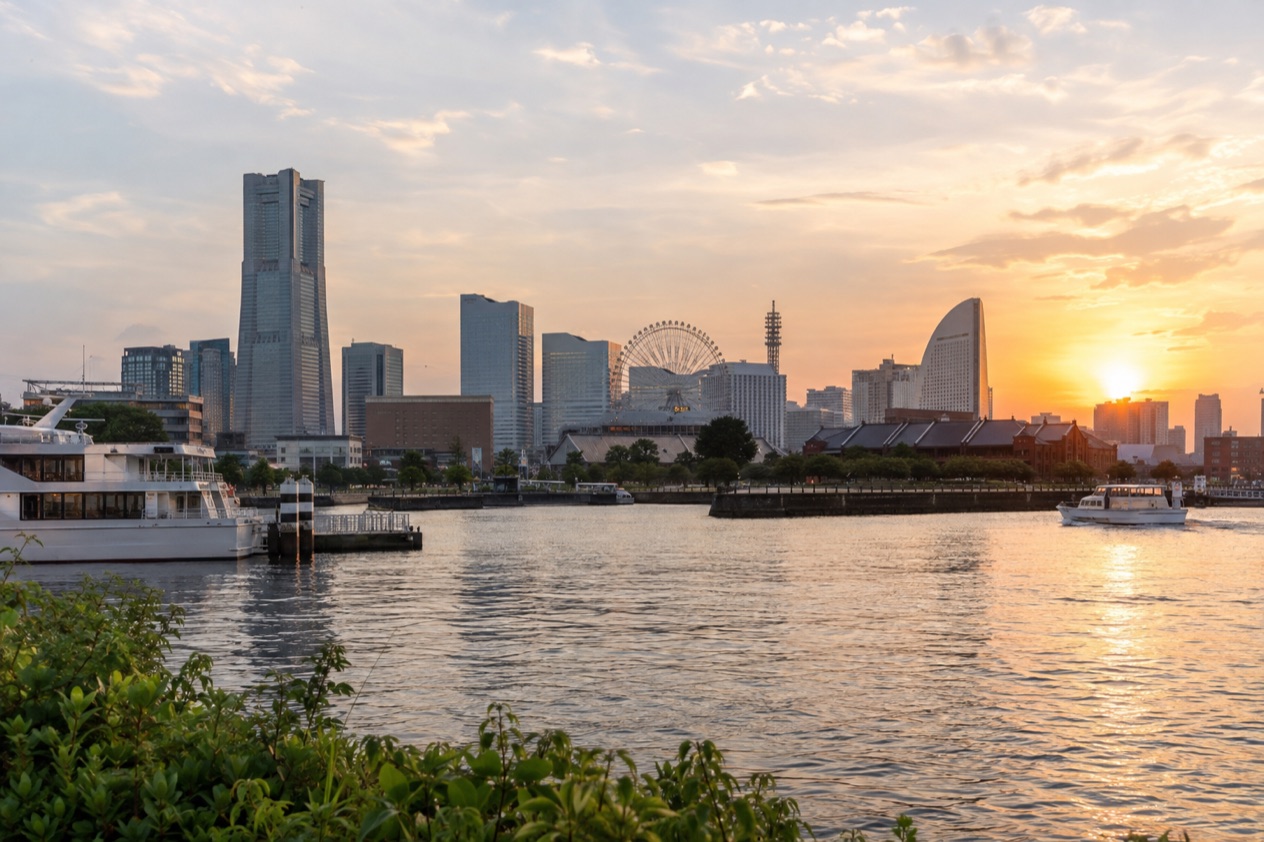
On a July evening in Yokohama, the heat lets go a little once the sun drops behind the city, and the harbor fills with strollers carrying cold drinks along the waterfront. Steam rises from the bun stalls in Chinatown, ferries slide past the glowing wheel at Minato Mirai, and the air smells of salt and warm pavement. This is Yokohama in midsummer, a port city on Tokyo Bay that suits slow days, cool interiors and long evenings outside.
What is the weather like in Yokohama in July?
July in Yokohama is hot, humid and bright, a clear step up from June, with the rains easing and the sun showing itself far more often.
| Month | Average high (°F) | Average low (°F) | Precipitation (in) | Days with 1 mm or more of precipitation | Hours of sunshine | Daylight on the 15th |
|---|---|---|---|---|---|---|
| June | 77.9 | 66.4 | 7.43 | 11.9 | 136 | 14 h 32 min |
| July | 84.9 | 73.2 | 7.19 | 10.3 | 171 | 14 h 21 min |
| August | 87.8 | 75.7 | 5.47 | 7.5 | 206 | 13 h 32 min |
What this means on the ground is a day that begins warm and gets properly hot, with nights that never really cool down. Humidity sits high all month, so a shirt that feels fine at the hotel can feel damp after an hour along the waterfront. Light, loose fabrics that dry quickly are the sensible choice, and you will want to plan the heaviest walking around the shade, the shops and the museums.
Rain still falls on about one day in three, and it often arrives as a gray, drizzly spell or a heavy shower rather than a single long downpour. A compact umbrella earns its place in the bag. The summer sun can feel strong between showers, so a hat and sunscreen matter as much as rain gear.
Days are long, which stretches the evening far past dinner. Light lingers over the bay well into the evening, giving you time for a late stroll along the piers once the worst of the heat has passed. Evenings stay warm enough that a jacket is unnecessary, though air conditioning in trains, malls and museums can be cold enough to make a thin layer welcome.
What to do in Yokohama in July
July in Yokohama is a month for pairing air-conditioned stops with waterfront evenings. Yokohama sits on the western shore of Tokyo Bay, directly south of Tokyo, and it is the second largest city in Japan, so the day rarely runs out of things to do.
Across Japan this is also the season of summer festivals and fireworks, and the Japanese word for fireworks, hanabi, is one you will see on posters and in shop windows. The season on Mount Fuji’s trails also opens at the beginning of July, a reminder that the high country is now accessible even while the lowlands swelter.
Chinatown, in the heat of the day
Yokohama Chinatown is the largest Chinatown in Japan, larger than the ones in Kobe and Nagasaki. Its gates are painted in red and gold, and its narrow lanes are lined with restaurants, tea shops and stalls selling steamed buns, sesame dumplings and mango pudding. In July the place suits a late lunch, since many dining rooms are cool and a plate of cold noodles or a bowl of hot, spicy soup both feel right in humid weather.
The streets can feel close and sticky between showers, so use the shops and teahouses as breathers. Souvenir stalls sell fans, tea and sweets, and a cold bubble tea or a shaved ice dessert is a good excuse to sit down. Come hungry, because sampling several small dishes in different places is what Chinatown is for.
Minato Mirai and the waterfront
Minato Mirai 21, whose construction began in 1983, is the district of towers, shopping complexes, museums and promenades along the bay. It is a good rain-day base because malls and galleries link up under one roof, and a good evening base because the waterfront opens onto the water and the lights. The great wheel and the harbor-side parks fill with couples and families once the heat fades.
The CupNoodles Museum Yokohama is one of the two CupNoodles museums in Japan, the other being in Osaka Ikeda. Nearby, the old red brick warehouses and Yamashita Park give you more waterfront to wander when the sky clears.
Summer tastes and the port
The Port of Yokohama officially opened on June 2, 1859, and the city still tells its story through the harbor, the foreign-influenced architecture on the hillside and the food. July is the time for cold dishes: chilled noodles, shaved ice with syrup, iced tea and beer at an outdoor table. Ramen shops stay busy even in the heat, and a steaming bowl in an air-conditioned room is its own summer pleasure.
If you want a green break, the city has gardens and parks where the shade and the sound of cicadas set the summer mood. Evenings are better for the waterfront, and the harbor lights give the bay a different character from the daytime haze. Take your time and let the heat set the pace.
A two-day itinerary for Yokohama in July
Day 1 belongs to the old harbor and Chinatown. Start early in Yamashita Park while the air is still gentle, walking the waterfront and the red brick warehouses before the humidity builds. By late morning, move into Chinatown, where the lanes of shops and tea houses give plenty of reasons to duck indoors, and have a long lunch of dumplings, noodles and steamed buns in a cool dining room.
In the afternoon, when the heat is highest, take shelter in the shops and cafés of Motomachi or the hillside streets, stopping for shaved ice or iced tea. Return to the water as the light softens and have dinner at a harbor-side restaurant or an izakaya, the casual pub where small plates arrive one after another.
The long summer evening leaves time for a final walk along the pier. If rain sets in, the museums and covered arcades of the area become the plan.
Day 2 moves to Minato Mirai. Spend the morning at the CupNoodles Museum Yokohama, then browse the malls and galleries of the district while the sun climbs, with lunch at a noodle counter or a food court. These indoor stops make the hottest hours easy to bear, and on a wet day they become the whole itinerary.
Once the afternoon begins to cool, head outside to the promenades along the bay and the big wheel, and stay for the evening when the towers light up. Finish with dinner by the water, perhaps ramen or a set meal, and a last slow loop along the harbor with the long summer dusk overhead. If a heavy shower arrives, shelter in a café and wait it out, since July showers often pass.
Is Yokohama busy in July?
July in Yokohama is a summer month shaped more by heat than by any single rush, and the city keeps its usual rhythm of commuters, shoppers and harbor strollers. Honshu’s summers are very humid, hot and sultry, and that tends to drive daytime activity indoors, so malls, museums and restaurants with air conditioning are where you will find people during the afternoon.
Evenings are when the waterfront comes alive. The long daylight and the warm air bring families and couples to the promenades of Minato Mirai and the park along the harbor, and the restaurants of Chinatown and the surrounding streets keep a steady flow of diners. Because Yokohama is a large city with many neighborhoods, there are always quieter corners to retreat to when one area feels full.
Summer festivals and fireworks are part of the Japanese July, and the festival season elsewhere in the country, such as Kyoto’s Gion Festival with its float processions, draws travelers across the nation. For Yokohama itself, the practical point is the pace: mornings are the most comfortable for outdoor sights, afternoons slow down, and the evening brings the most life to the streets.
What to pack for Yokohama in July
Plan for heat, humidity and the chance of rain, with a thin layer for the cold air conditioning indoors.
- Light, breathable, quick-drying clothes, because the air stays humid all day and into the night.
- A compact umbrella or light rain jacket for the showers that can arrive on any day.
- A hat and sunscreen for the bright stretches between rain, especially along the open waterfront.
- Comfortable shoes that cope with wet pavement, since you will walk between Chinatown, the harbor and Minato Mirai.
- A thin cardigan or scarf for chilly trains, malls and museums.
- A small towel or handkerchief to wipe away sweat on humid afternoons.
Good to know before you go
July sits in the hot, humid part of the Japanese summer, and the wet weather of June is easing but not gone, so a day can turn from sunny to showery quickly. Build the day around the heat, with outdoor sights early or in the evening and museums, malls and long lunches in between. Drink often, rest in the shade and treat air-conditioned stops as part of the plan, not a detour.
Yokohama is connected to Tokyo by JR trains and several private lines to Yokohama Station, and the Nozomi Shinkansen stops at Shin-Yokohama Station for travelers coming from western Japan. That makes the city simple to pair with a Tokyo stay, though the heat is worth keeping in mind when you move between stations with luggage.
Yokohama in July vs June and August
Moving the trip four weeks earlier puts you in June, when the rain is heavier and falls on more days, and the sun appears less often. The days are a touch longer and the heat is gentler, which some travelers prefer for long walks, but you will need to plan more around gray skies and wet pavement.
Moving four weeks later puts you in August, which is hotter, brighter and drier, with the strongest sun of the three months and fewer days of rain. The evenings are shorter, though still warm. Early August also brings festivals elsewhere in Japan, such as the Sendai Tanabata Festival from August 6 to 8, but the heat makes midday sightseeing a real effort in Yokohama.
July sits between the two, with the wet season easing and the heat still short of its peak. Travelers who dislike rain should lean toward August, while those who want a little less heat and do not mind showers may choose June. If you want a balance of long evenings, more sunshine than June and a slightly softer heat than August, July is the middle path.
Is July a good time to visit Yokohama?
Yes, for travelers who enjoy summer evenings, indoor attractions and a waterfront city, and who can accept heat and humidity. Those who dislike sticky air or struggle with strong sun in the middle of the day should choose another month.
July rewards people who like food: cold noodles, shaved ice, dumplings in Chinatown and a bowl of ramen after a rainy afternoon. It also suits those who enjoy museums, malls and cafés, since Yokohama has plenty of shelter when the sun or the rain gets too much. Evening strollers will find the long daylight and the lights on the bay especially satisfying.
On arrival, start with the harbor and Chinatown while your energy is fresh, then keep the hottest hours for indoor stops. What makes July special here is the evening, when the heat softens, the towers of Minato Mirai light up over the water and the city turns out along the bay with something cold in hand.
Sources
- Japan Meteorological Agency (JMA), Normal values 1991-2020, monthly (https://www.data.jma.go.jp/stats/etrn/view/nml_sfc_ym.php?prec_no=46&block_no=47670), station Yokohama, elevation 39 m, checked October 11, 2026
- Computed from the date and the latitude of the place (sunrise equation, solar elevation -0.833 degrees), October 11, 2026
- Japan National Tourism Organization, weather and seasons in Japan (https://www.japan.travel/en/plan/weather/), checked October 11, 2026
- Wikipedia, Climate of Japan (https://en.wikipedia.org/wiki/Climate_of_Japan), checked October 11, 2026
- Japan National Tourism Organization, summer in Japan (https://www.japan.travel/en/guide/summer-guide/), checked October 11, 2026
- Japan National Tourism Organization, festivals and events (https://www.japan.travel/en/see-and-do/festivals-and-events/), checked October 11, 2026
- Wikipedia, Hanabi (https://en.wikipedia.org/wiki/Hanabi), checked October 11, 2026
- Wikipedia, Gion Matsuri (https://en.wikipedia.org/wiki/Gion_Matsuri), checked October 11, 2026
- Japan National Tourism Organization, Mount Fuji guide (https://www.japan.travel/en/fuji-guide/), checked October 11, 2026
- Official website for Mt. Fuji climbing, about the climb (https://www.fujisan-climb.jp/en/about/), checked October 11, 2026
- Wikipedia, Tanabata (https://en.wikipedia.org/wiki/Tanabata), checked October 11, 2026
- Japan National Tourism Organization, Yokohama (https://www.japan.travel/en/destinations/kanto/kanagawa/yokohama-and-around/), checked October 11, 2026
- Wikipedia, Yokohama (https://en.wikipedia.org/wiki/Yokohama), checked October 11, 2026
- Wikivoyage, Yokohama (https://en.wikivoyage.org/wiki/Yokohama), checked October 11, 2026
- Wikipedia, CupNoodles Museum (https://en.wikipedia.org/wiki/CupNoodles_Museum), checked October 11, 2026
- Wikipedia, Minato Mirai 21 (https://en.wikipedia.org/wiki/Minato_Mirai_21), checked October 11, 2026