
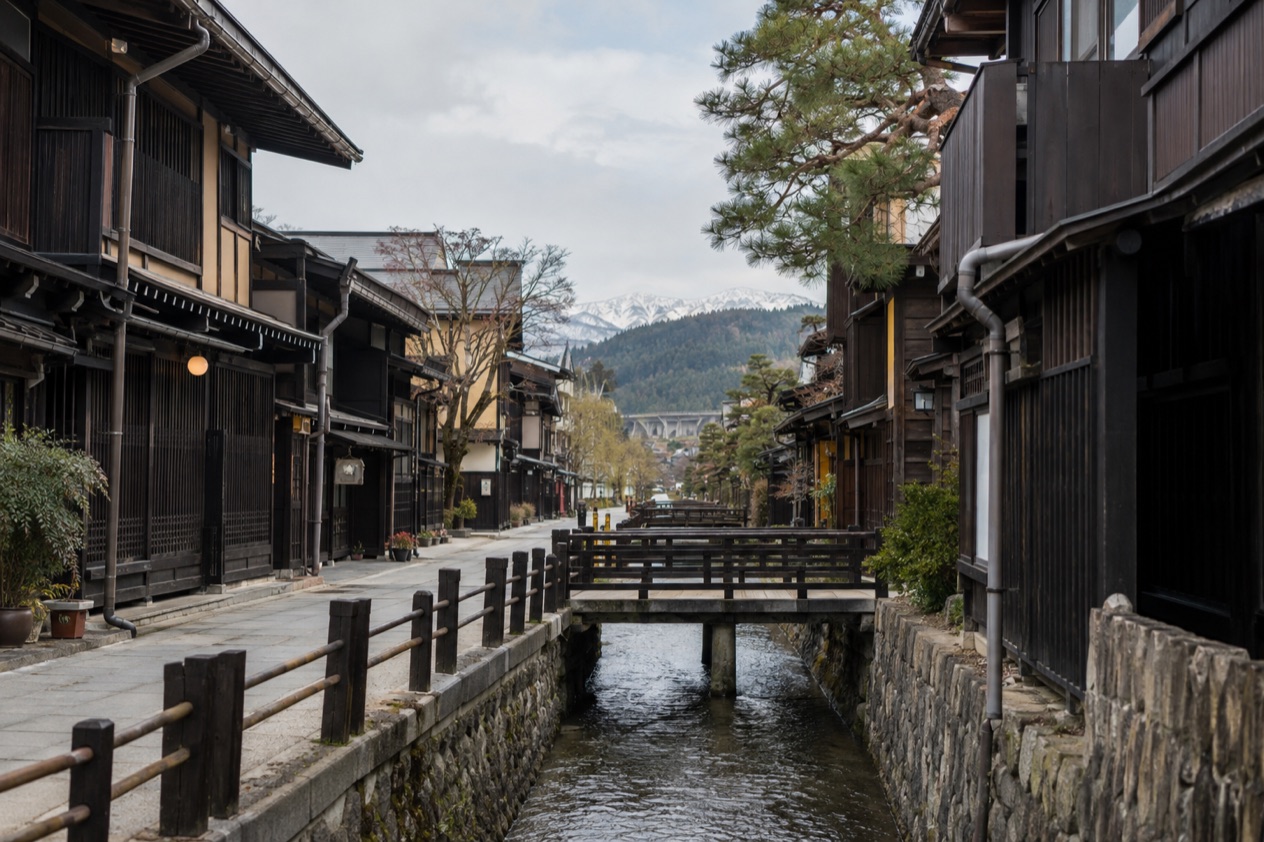
In spring the carved festival floats of Takayama roll out of their storehouses and pass through the old merchant streets while cherry trees open along the river. By midsummer the same lanes are warm and damp, in November the hills turn red and gold, and in January snow settles on the dark roof beams of the old town. Takayama, called the Little Kyoto of Hida for its Edo-style streets, gives each season its own reason to come, from blossoms and floats to autumn color and deep winter snow.
When is the best time to visit Takayama?
Mid-April and the weeks of autumn color from mid-November into early December suit most travelers best, and deep winter is the right answer for anyone who wants snow on the old town. Takayama sits in the heart of the Japan Alps, in Gifu Prefecture, and its seasons are sharper than those of the cities on the plain. The right month depends on what you want to do there.
For sightseeing, April is hard to beat. Cherry blossoms in Takayama come from the middle to the end of April, about three weeks later than in Nagoya, so a trip that misses the bloom in the big cities can still catch it here.
The days are long enough to fill with the old quarter, the river and the open-air museums, and a light jacket or a sweater is all you need. Autumn is the other sightseeing high point, with moderate temperatures that suit walking and trees turning red, yellow and orange.
For food, cold weather has the edge. Hida beef, hot bowls of Takayama ramen, grilled rice skewers brushed with sweet soy glaze and the sake from the town’s old breweries all taste better after a walk in the cold.
Autumn adds mushrooms and chestnuts to the menus. For nature, May and June bring green hills, while the high summer months are hot and humid, and the heavy rains of July can shut out the view.
If you want room to breathe, look at the months with no blossom, no color and no festival attached, such as May or the early weeks of autumn. Families usually find May and September the easiest months for long days on foot, with warm weather and no snow to manage.
Winter has its own pull for children, since snow in Takayama is a real event, not a flurry. Ski season in Japan generally runs from December to April, and the high mountains of Nagano see their peak in January and February.
Takayama weather by month
Takayama has four distinct seasons, with cold, snowy winters and hot, humid summers.
| Month | Average high (°F) | Average low (°F) | Precipitation (in) | Days with 1 mm or more of precipitation | Hours of sunshine | Daylight on the 15th |
|---|---|---|---|---|---|---|
| January | 37.8 | 23.4 | 4.01 | 14.6 | 93 | 9 h 57 min |
| February | 40.5 | 23.2 | 3.68 | 11.7 | 116 | 10 h 51 min |
| March | 49.6 | 29.1 | 4.82 | 13.0 | 154 | 11 h 54 min |
| April | 62.6 | 38.1 | 4.88 | 11.0 | 174 | 13 h 05 min |
| May | 73.2 | 48.9 | 4.93 | 10.6 | 189 | 14 h 03 min |
| June | 79.0 | 58.8 | 6.71 | 11.7 | 144 | 14 h 36 min |
| July | 85.1 | 66.9 | 10.27 | 14.1 | 147 | 14 h 24 min |
| August | 87.8 | 68.2 | 7.79 | 11.6 | 177 | 13 h 35 min |
| September | 79.0 | 60.6 | 8.89 | 12.0 | 132 | 12 h 28 min |
| October | 67.8 | 48.6 | 6.12 | 10.3 | 129 | 11 h 20 min |
| November | 55.6 | 37.2 | 3.72 | 10.4 | 101 | 10 h 17 min |
| December | 43.2 | 28.9 | 4.11 | 13.4 | 82 | 9 h 43 min |
The count of wet days is surprisingly even across the year, and winter has as many of them as the rainy season. The difference is in what falls. From December to February the precipitation comes as snow and sleet, with gray skies and few hours of sun. Summer brings heavier rain, and July is the wettest month, followed by September. April and May have the fewest wet days and a good amount of sun.
For packing, winter calls for a real coat, a hat, gloves and boots with grip. March and November sit in between and need layers you can add or shed.
April through May asks for a light jacket or sweater, and an umbrella earns its place from June to September. In summer the nights stay warm and damp. Daylight is generous from May to July and short in December and January, so winter sightseeing has to fit into a compact stretch of light.
What is there to do in Takayama in each season?
Spring blossoms and the rainy season
Spring in Takayama starts late and then arrives all at once. Snow lingers into March, and by mid-to-late April the cherry trees are open. This is the season for strolling the old merchant streets with their dark lattice fronts, stopping at sake breweries and sweet shops, and walking beside the river under the blossoms. The Spring Festival also falls in mid-April, with its decorated floats.
May is mild and sunny, a month for the hills and the open-air museums. June brings the rainy season, when green deepens, the stone and wood of the old town turn dark with water, and the mood slows. It suits indoor visits to museums, breweries and noodle shops, with an umbrella always ready. Outdoor plans work best if you leave room to shuffle them around.
Summer heat and autumn color
July and August are hot and humid, and July is the rainiest month of the year. Summer is the time for festivals in Japan generally, and the town takes part in Obon in mid-August. Warm evenings suit lantern light and a cold drink after dinner. The hills are fully green, but heavy afternoon storms are part of the pattern, so keep plans flexible.
Autumn turns the town into a place for long walks. Temperatures moderate after summer, and across Japan the trees display red, yellow and orange from mid-November to early December. Takayama’s wooden streets and hillside temples suit the season well, and the menus turn to mushrooms, chestnuts and warming bowls of noodles. Leave October for the first cool days and save November for the color.
Winter and snow
Winter is a season in its own right. In an average January 46.1 inches of snow falls, and snow or sleet comes on most days of the month. Roofs and lanes turn white, the old houses look like woodblock prints, and the town feels more inward, with the pull of a hot bath and a bowl of ramen. Hot springs fit the season, and this part of Gifu has plenty of them.
Japan’s ski season generally opens in December and runs until April, with exact dates set by each resort. Snow is frequent from January into February, and by March it is fading. Winter days are short, and gray skies are common, so the plan is simple: a few outdoor hours, then warm indoor stops. Winter is the time to leave the hills and the open-air sights for another trip.
When is Takayama least crowded?
The calmest stretches tend to be the months with no bloom, no leaf color and no ski season attached, mainly May and the weeks around the rainy season and early autumn. Visitors travel for the big calendar events, so the quieter months are those without one. Takayama is not a place that depends on any single peak.
The seasons that come with a clear reason to travel are mid-April, when cherry trees bloom and the Spring Festival takes place, the weeks of autumn color from mid-November into early December, and the ski months from December to April. Golden Week at the turn of April and May, Obon in mid-August and the New Year holiday are Japan’s national travel periods, and the town takes part in each. Those are weeks to plan around.
June and early autumn offer a more open calendar. Rainy-season days leave streets and museums with more room, and in September the heat of summer eases. The trade-off is weather, with heavier rain in July and September. A trip in one of these in-between months suits visitors who value flexibility and a slower pace over the postcard season.
Which months should you avoid in Takayama?
No month is off-limits, but July and the deep winter months ask the most of a traveler, and the choice depends on what you want to see and what weather you can accept.
July is the wettest month of the year, and its humid heat makes sightseeing on foot less pleasant. September also brings a lot of rain, often in heavy spells, and the leaves have not yet turned. June is the rainy season, so it is a month for flexible plans.
Winter is a different kind of demand. From December to February the days are short and cold, and snow on most days can slow movement. For some travelers that is the appeal. For others who want long walks and mountain views, April, May or autumn is a better match.
If blossoms are your goal, aim for mid-to-late April, not March, when the bloom is still ahead. For autumn leaves, mid-November to early December is the window across Japan, while October is warmer and earlier. Outside those weeks you still have the old town, the food and the baths, only without the seasonal color. The same holds for any heavy rain day. It dampens a plan without ending it.
Festivals and events in Takayama through the year
Takayama’s festival calendar follows the seasons, and its biggest events are tied to spring and autumn. Japan-wide holidays add their own rhythm on top.
Spring: floats and blossoms
The Takayama Spring Festival, known as Sanno Matsuri, takes place in mid-April, in step with the cherry blossoms. Ornate wooden floats, called yatai, are pulled through the old town, and some carry mechanical puppets, called karakuri, that perform for the crowd. It is a festival for people who like craft, music and parade, and it places the town at its most photographed.
Golden Week, at the turn of April and May, is Japan’s string of national holidays, when many in the country travel. For you it falls just after the blossoms, in the mild and sunny weeks of late spring.
Summer: Obon and Tanabata
Tanabata, on July 7, is the star festival, when people write wishes on paper strips and hang them from bamboo branches. It falls in the middle of the rainy season, so it is a gentle evening event, not a big outing.
Obon in mid-August honors the spirits of ancestors. Families return to their home towns, lanterns are lit, and bon-odori dances are held in the evening. It is one of Japan’s main travel periods. In a mountain town like Takayama it pairs with the warmest nights of the year.
Autumn and winter: the second floats, color and the new year
In early October the Hachiman Festival brings the autumn floats to the streets, a counterpart to the spring event. Then, from mid-November, the leaves take over the season, with hills and temple grounds turning red and gold. It is a time for walks and quiet meals of mushrooms and chestnuts.
New Year, with its first temple and shrine visits, comes in the heart of winter, with snow on the old roofs. Setsubun, on February 3, marks the start of spring in the old calendar, when beans are thrown to chase away bad luck. For winter-sports visitors, ski season runs through these weeks, and peaks in January and February in the high mountains.
Sources
- Japan Meteorological Agency (JMA), Normal values 1991-2020, monthly (https://www.data.jma.go.jp/stats/etrn/view/nml_sfc_ym.php?prec_no=52&block_no=47617), station Takayama, elevation 560 m, checked October 11, 2026
- Computed from the date and the latitude of the place (sunrise equation, solar elevation -0.833 degrees), October 11, 2026
- Wikipedia, Takayama, Gifu (https://en.wikipedia.org/wiki/Takayama,_Gifu), checked October 11, 2026
- Wikivoyage, Takayama (https://en.wikivoyage.org/wiki/Takayama), checked October 11, 2026
- Japan National Tourism Organization, autumn in Japan (https://www.japan.travel/en/guide/autumn-guide/), checked October 11, 2026
- Japan National Tourism Organization, spring in Japan (https://www.japan.travel/en/guide/spring-guide/), checked October 11, 2026
- Japan Meteorological Agency, cherry blossom first-bloom dates 2021-2026 and 1991-2020 normal (https://www.data.jma.go.jp/sakura/data/sakura003_07.html), checked October 11, 2026
- Japan Meteorological Agency, cherry blossom full-bloom dates 2021-2026 and 1991-2020 normal (https://www.data.jma.go.jp/sakura/data/sakura004_07.html), checked October 11, 2026
- Japan Meteorological Agency, biological season observations (https://www.data.jma.go.jp/sakura/data/index.html)
- Japan Meteorological Agency, maple color-change dates 2025-2026 with difference from the 1991-2020 normal (https://www.data.jma.go.jp/sakura/data/phn_014.html), checked October 11, 2026
- Japan National Tourism Organization, skiing guide (https://www.japan.travel/en/guide/skiing/), checked October 11, 2026
To plan your stay
- Things to Do in Takayama: Old Town Streets, Morning Markets, Hida Beef and Festival Floats
- Where to Stay in Takayama: Station Area, Old Town Streets, Morning Market and Ryokan
- Takayama from Nagoya: The Hida Limited Express, Ways to Go and a Day in the Old Town
- Takayama Festival: Yatai Floats, Lantern Processions and Spring and Autumn Dates