
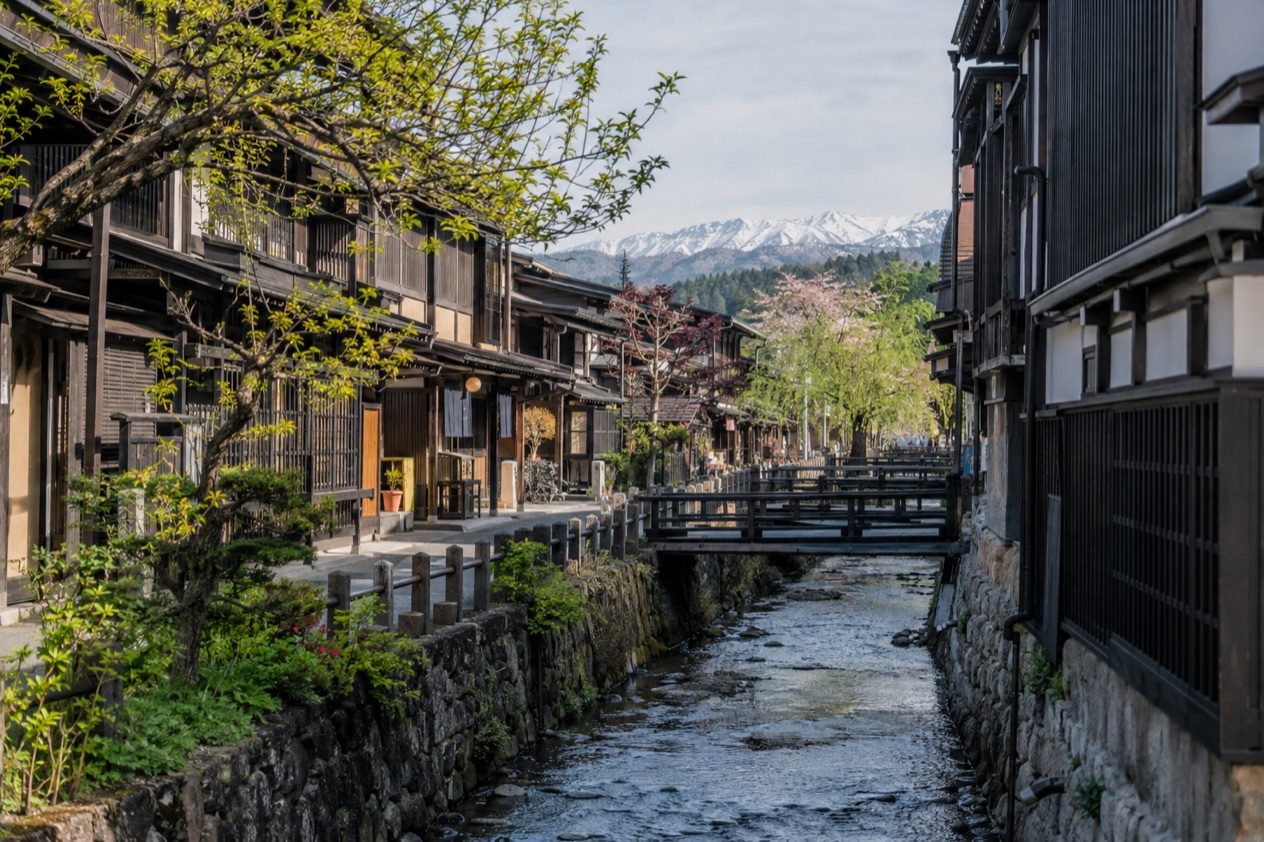
In May, the wooden eaves of Takayama’s old merchant streets stand against green mountains, and the smell of grilled rice crackers and soy sauce drifts from the stalls. The cherry petals are gone, the spring festival floats are back in storage, and the town settles into a long stretch of mild days. It is a month for slow walking in Hida’s old quarter, for sake-brewery doorways hung with cedar balls, and for lunches of local beef.
What is the weather like in Takayama in May?
May is mild and pleasantly warm in Takayama, with sunny stretches broken by a rainy day every few days. It is a clear step up from April and still a notch below the heavier, warmer June.
| Month | Average high (°F) | Average low (°F) | Precipitation (in) | Days with 1 mm or more of precipitation | Hours of sunshine | Daylight on the 15th |
|---|---|---|---|---|---|---|
| April | 62.6 | 38.1 | 4.88 | 11.0 | 174 | 13 h 05 min |
| May | 73.2 | 48.9 | 4.93 | 10.6 | 189 | 14 h 03 min |
| June | 79.0 | 58.8 | 6.71 | 11.7 | 144 | 14 h 36 min |
The gap between daytime and night is wide, so dress in layers. Afternoons in town feel like early summer, warm enough for a short-sleeved shirt while you stroll the old streets. Nights drop back to sweater weather, and a light jacket or a simple sweater, the kind of layer Japan’s spring travelers carry, covers most evenings.
Rain arrives on roughly a third of the days, in the form of passing showers or an occasional gray day, and May is the sunniest of the three months in the table. A compact umbrella or a light rain shell is worth having, since the old town is a place you explore on foot and outdoors. Days are long now, which leaves room to fit an indoor stop between showers and still be out in the evening light.
What to do in Takayama in May
May is the month after the Spring Takayama Festival, which takes place on April 14 and 15, so the big parade of floats is not on the calendar. What May gives instead is the town itself, in green leaf and without the festival’s weight. The first days of the month fall inside Golden Week, Japan’s run of public holidays, which adds a holiday mood to the streets.
The place sometimes called the Little Kyoto of Hida earns the nickname through its well-preserved quarter of Edo-style streets. The pace is that of a town you cross on foot, stopping at shopfronts, tasting along the way and ducking into a cafe when a shower passes.
The old town streets
The heart of a visit is the quarter of dark timber merchant houses, with latticed fronts, low eaves and narrow channels of water running along the lanes. Many of the houses are sake breweries, announced by a ball of cedar boughs hung above the door, and others are shops selling Hida woodwork, lacquerware and pickles.
May’s green backdrop and mild air suit the slow loop of these streets. Stop at the stalls for skewers of Hida beef, rice dumplings brushed with soy glaze and the town’s cold sake tastings, then drift into a teahouse when rain comes. The old houses are just as interesting from the street as from inside, so a wet afternoon does not spoil the walk.
Morning markets and Hida food
Takayama’s riverside and square markets are stalls of mountain vegetables, pickles, fresh produce, flowers, handmade crafts and snacks. In late spring, look for sansai, the wild mountain greens that appear on tables around now, served as tempura or in small side dishes.
The local specialties are worth planning meals around: Hida beef, grilled over charcoal, served as sushi or cooked at the table on a magnolia leaf over miso, and a bowl of Takayama ramen with its dark, clear soy broth. Pair any of them with a local sake. The cooler evenings of May make a warm bowl welcome after the day’s walking.
Hida Folk Village and the quieter corners
An open-air museum of old farmhouses gathers thatched buildings from the Hida region on a hillside, with ponds, rice fields and workshops among them. Spring green gives the grounds a soft color, and the interiors, with their sooty beams and open hearths, show how families lived in the mountains.
Back in town, the old government house, the Takayama Jinya, shows how the region was administered, and small shrines and temples along the hillsides break up the day. Together with the museum, these give you something indoors and under cover when showers move in.
Takayama Station sits on the JR Takayama Line, and the station does not accept IC cards, so local line tickets are bought with cash. It is a small thing, but worth knowing before you reach the ticket machine.
A two-day itinerary for Takayama in May
Day 1 belongs to the old town. Begin with a market stroll and a coffee, then move into the quarter of merchant houses before the day warms up, browsing the craft shops and stopping at a brewery for a small cup of sake. Midday suits a sit-down meal of Hida beef, either grilled at the table or served on rice, and a pause is welcome while the afternoon sun is at its strongest.
In the afternoon, visit the Takayama Jinya and wander the side streets and shrines. Evenings call for a sweater. Dinner in a small izakaya, a Japanese pub serving skewers, pickles and local sake, rounds off the day, and the long May daylight leaves time for a last walk along the river afterward. If it rains, the brewery counters, cafes and the government house keep you covered.
Day 2 moves out to the Hida Folk Village. Spend the morning among the thatched houses, ponds and workshops, taking time in the farmhouse interiors. The green hillsides are at their freshest, and the cooler morning air makes it comfortable to linger outdoors.
Return to town for a bowl of Takayama ramen at lunch, then spend the afternoon on the things you skipped: a museum, a craft shop for Hida woodwork or lacquer, or a second tasting at another brewery. Finish with a final dinner of mountain vegetables and grilled beef. On a gray day, put the museum and a long teahouse stop first and save the outdoor walking for any break in the clouds.
Is Takayama busy in May?
May begins busy and settles down, since the first days of the month fall inside Golden Week, the holiday period that runs from April 29 to May 5. Four of those days are public holidays: Showa Day, Constitution Memorial Day, Greenery Day and Children’s Day.
Japanese holiday travel gives those first days a festive feel in the streets and at the markets. When a holiday lands on a Sunday, the next working day becomes a holiday, and a day between two holidays also becomes one, so the break can stretch a little further in some years.
After Golden Week, the pace of the town changes. The spring festival is long over, the cherry blossoms, seen from the middle to the end of April, have finished, and the autumn festival is months away, on October 9 and 10. May sits between these big draws. That gives the visit a settled rhythm of long lunches, sake tastings and unhurried walks.
Shops in urban areas of Japan are generally open from 10:00 a.m. to 8:00 p.m. every day, while in rural areas they often close earlier. Takayama is a city that covers a very large area, so the old quarter and the countryside can follow different rhythms.
What to pack for Takayama in May
Pack for warm afternoons, cool nights and showers that come and go. A light jacket or sweater is all most spring travelers need, and everything else is about handling a damp day on foot.
- A light jacket or sweater, for evenings that turn cool after a warm afternoon.
- Short-sleeved shirts, for sunny afternoons in the old town.
- A compact umbrella or light rain shell, for the showers that pass on about a third of the days.
- Comfortable walking shoes, for the old streets and the folk village grounds.
- Cash in yen, since local line tickets at Takayama Station are bought with cash.
Good to know before you go
The first days of May fall inside Golden Week, so the holidays of April 29 and May 3 to 5 shape the opening stretch of the month. When a holiday falls on a Sunday, the next working day becomes a holiday as well. Rain comes in showers and gray spells, and June is the wetter month, with more rain than May.
Takayama Station, on the JR Takayama Line, does not take IC cards, so local line tickets are paid for in cash. Bring yen for that, and for market stalls and small shops.
Takayama in May vs April and June
It also brings the Spring Takayama Festival on April 14 and 15 and cherry blossoms from the middle to the end of the month. Those are the reasons to choose April, and the price is cold evenings and a chance of wintry showers.
Four weeks later is June: warmer, more humid and the rainiest of the three months, with the least sunshine. Days are at their longest, which is pleasant for evening walks, but the gray weather weighs on a trip built around outdoor wandering. The green is deeper, and the old town takes on a damp, mossy look.
May suits travelers who want mild days, plenty of sun and no festival crowds after Golden Week. Choose April for the floats and the blossoms, and June for those who do not mind rain in return for a deep green landscape.
Is May a good time to visit Takayama?
Yes, for travelers who like to explore on foot in pleasant weather, taste local food and drink, and see an old Hida town without a major festival. It is a month for unhurried wandering, sake counters, markets and farmhouse interiors under green hills.
It suits less well anyone who has come for the festival floats or the cherry blossoms, both of which belong to April. Anyone who expects a cold, snowy mountain town will also find May warmer than that picture.
On arrival, begin with the old town streets, where you can see the merchant houses, the breweries and the food stalls in one go and get a feel for the town. Then add the folk village and the government house as the weather allows.
What is special about May in Takayama is its balance. The air is warm without being heavy, the hills are green, the festival crowds have gone home, and the streets of dark wood and flowing water are there for you to enjoy.
Sources
- Japan Meteorological Agency (JMA), Normal values 1991-2020, monthly (https://www.data.jma.go.jp/stats/etrn/view/nml_sfc_ym.php?prec_no=52&block_no=47617), station Takayama, elevation 560 m, checked October 11, 2026
- Computed from the date and the latitude of the place (sunrise equation, solar elevation -0.833 degrees), October 11, 2026
- Japan National Tourism Organization, shop and attraction hours, national holidays (https://www.japan.travel/en/plan/business-hours-and-holidays/), checked October 11, 2026
- Wikipedia, Golden Week (Japan) (https://en.wikipedia.org/wiki/Golden_Week_(Japan)), checked October 11, 2026
- Wikipedia, Public holidays in Japan (https://en.wikipedia.org/wiki/Public_holidays_in_Japan), checked October 11, 2026
- Japan National Tourism Organization, flowers by season: cherry blossom, plum, wisteria, hydrangea, where and when (https://www.japan.travel/en/see-and-do/flowers/), checked October 11, 2026
- Wikipedia, Wisteria (https://en.wikipedia.org/wiki/Wisteria), checked October 11, 2026
- Japan Meteorological Agency, sakura2020.pdf (https://www.data.jma.go.jp/sakura/data/sakura2020.pdf), checked October 11, 2026
- Japan National Tourism Organization, spring in Japan (https://www.japan.travel/en/guide/spring-guide/), checked October 11, 2026
- Wikipedia, Kanda Matsuri (https://en.wikipedia.org/wiki/Kanda_Matsuri), checked October 11, 2026
- Wikipedia, Sanja Matsuri (https://en.wikipedia.org/wiki/Sanja_Matsuri), checked October 11, 2026
- Japan National Tourism Organization, festivals and events (https://www.japan.travel/en/see-and-do/festivals-and-events/), checked October 11, 2026
- Wikipedia, Gion Matsuri (https://en.wikipedia.org/wiki/Gion_Matsuri), checked October 11, 2026
- Wikipedia, Takayama, Gifu (https://en.wikipedia.org/wiki/Takayama,_Gifu), checked October 11, 2026
- Wikivoyage, Takayama (https://en.wikivoyage.org/wiki/Takayama), checked October 11, 2026
- Wikipedia, Takayama Festival (https://en.wikipedia.org/wiki/Takayama_Festival), checked October 11, 2026
To plan your stay
- Things to Do in Takayama: Old Town Streets, Morning Markets, Hida Beef and Festival Floats
- Where to Stay in Takayama: Station Area, Old Town Streets, Morning Market and Ryokan
- Takayama from Nagoya: The Hida Limited Express, Ways to Go and a Day in the Old Town
- Takayama Festival: Yatai Floats, Lantern Processions and Spring and Autumn Dates