
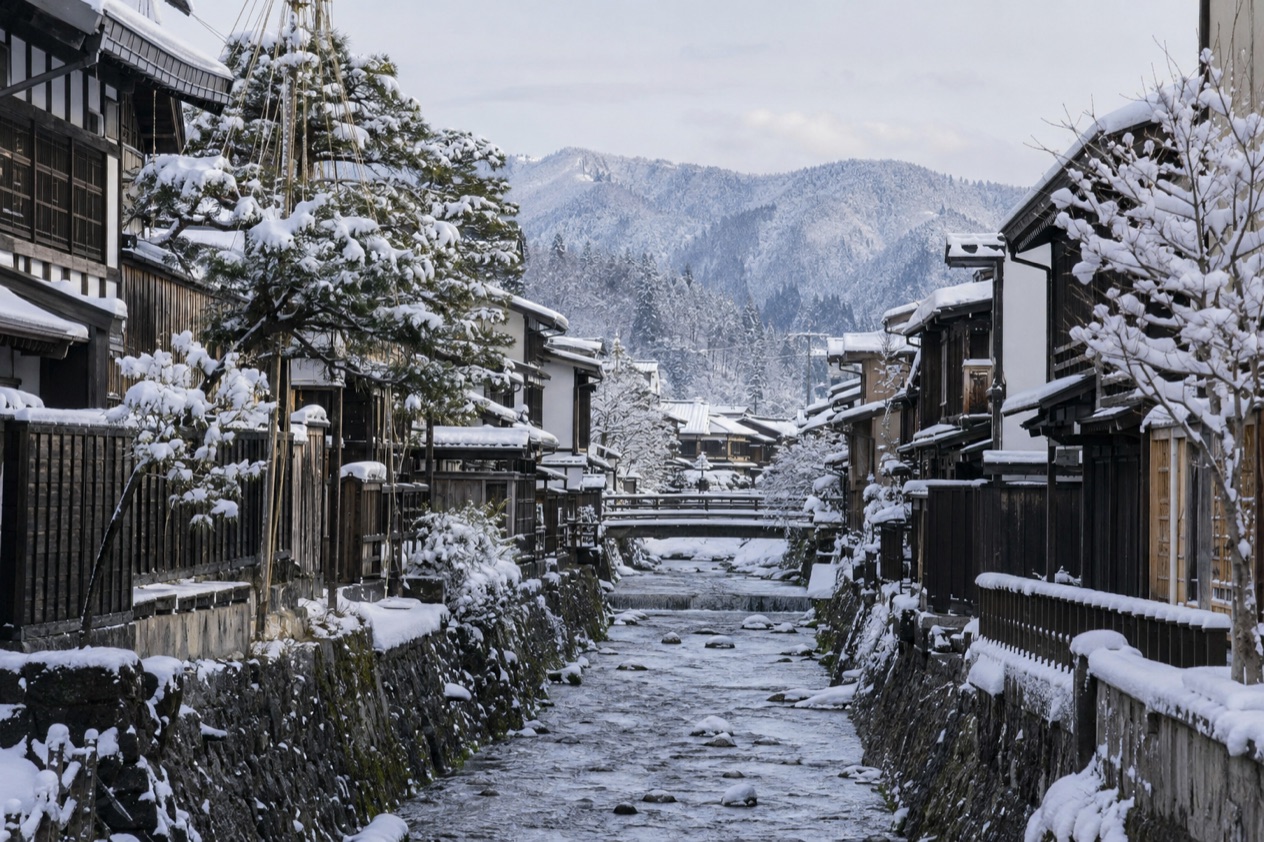
In February, snow settles on the dark wooden eaves of Takayama’s old merchant quarter, and the narrow lanes along the canals take on a hush broken only by boots crunching and the clatter of a shop door. Steam rises from street-side stalls and from bowls of hot noodles in small dining rooms. This is the month to see Hida-Takayama as a mountain town under winter, a place for slow walks, warm food and a hot bath at the end of the day.
What is the weather like in Takayama in February?
February in Takayama is a cold, snowy month, with afternoons just above freezing and nights well below it, though the days are lengthening and the sun appears more often than in January.
| Month | Average high (°F) | Average low (°F) | Precipitation (in) | Days with 1 mm or more of precipitation | Hours of sunshine | Daylight on the 15th | Snowfall (in) |
|---|---|---|---|---|---|---|---|
| January | 37.8 | 23.4 | 4.01 | 14.6 | 93 | 9 h 57 min | 46.1 |
| February | 40.5 | 23.2 | 3.68 | 11.7 | 116 | 10 h 51 min | 35.4 |
| March | 49.6 | 29.1 | 4.82 | 13.0 | 154 | 11 h 54 min | 11.4 |
Most of what falls in February falls as snow, on more than twenty days of the month, so a gray, flaky sky is as normal as a bright cold one. Snow and sleet mix on the milder days, and the streets can turn slushy at midday and slick again after dark. Humidity stays high, which makes the cold feel damp at the edges of the day.
Dress in layers: a warm base, a fleece or light down jacket, and a waterproof outer shell. Boots with a real grip matter more than anything else, since the old quarter’s lanes are walked, not driven. Gloves and a hat earn their place in the evening, when the temperature sits well below freezing.
The light is a quiet gain over January. Daylight stretches past ten and a half hours by mid-month, and the added sunshine hours mean a few more clear afternoons when the snow on the roofs glows white against the mountains.
What to do in Takayama in February
Takayama is called the Little Kyoto of Hida for its well-preserved quarter of Edo-style streets, and snow suits it. Dark latticed merchant houses, sake breweries marked by cedar balls hung under the eaves, and small canals make up the core of a February visit. Much of the pleasure is simply walking from one lane to the next and stopping when something smells good.
The old town in the snow
The old merchant quarter is where you spend the first half of a day. Wooden storefronts hold sake tasting rooms, craft shops selling carved Hida woodwork, and small cafés where you can warm your hands around a cup of tea. Snow on the lattices and the rooflines makes the narrow streets look like an old print.
Walk slowly, and duck into a brewery or a shop whenever your fingers go numb. In a snowy month, the habit of the town is to go in and out of warm interiors rather than to cover a long distance in one go. Boots with a good tread make a real difference on the packed snow.
A morning stroll followed by a long lunch is a sound rhythm for the month. The streets are prettiest when fresh snow has just fallen, and the light changes quickly between gray and bright, so keep a camera handy.
Hida beef, noodles and hot dishes
February food in a mountain town is about warmth. Hida beef turns up grilled, in hot pots and on skewers from street stalls. Ramen in a clear soy broth is a local favorite in the cold, and miso-based dishes, grilled river fish and pickled mountain vegetables fill out the tables of small restaurants.
Sake is the drink of the town, and the breweries pour small cups for tasting. A cup of warm sake after a cold walk fits the season, and sweet bean snacks and hot green tea round out an afternoon stop.
Early in the month, Setsubun brings a bit of ritual to households and shrines. People throw roasted soybeans out the front door or at someone in an oni mask, shouting that devils should go out and fortune come in. Afterward, it is customary to eat one bean for each year of your age, plus one for the year ahead.
Hot springs and quiet evenings
Winter is the season of the onsen, the hot spring bath, and a mountain town in the snow is a natural place to lean into it. Soaking in hot water while snow falls around you is one of the signature pleasures of Japan in winter, and a ryokan stay adds a multi-course dinner and futon bedding on tatami.
Evenings are for early dinners, a lantern-lit stroll if the snow is light, and an early night. The town settles down quickly after dark, which suits the cold.
Beyond the town itself, February is peak ski season in the mountains of Nagano and Hokkaido, when snowfall is most frequent. For plum blossoms, the season in East Asia runs from January into late February, a first hint of spring that is still far from Takayama, where cherry blossoms come in the middle to end of April.
A two-day itinerary for Takayama in February
Day 1 begins in the old merchant quarter, since the daylight is short and the snow looks best when the streets are fresh. Start with a slow walk along the canals and the lanes of dark wooden houses, then step into a sake brewery or a craft shop whenever the cold bites. Daylight lasts a bit more than ten and a half hours at mid-month, so the morning and early afternoon are the time for outdoor walking.
For lunch, choose a small restaurant serving Hida beef or a bowl of hot ramen. In the afternoon, go back to the lanes for tea and sweets, and browse the woodcraft shops. Dinner can be a hot pot or grilled dishes, followed by an early evening in a warm room.
Day 2 starts later and slower. A late breakfast, then a walk through streets you did not reach the day before, with stops at cafés and shops. If snow is falling heavily, spend more of the day inside, among breweries, craft studios and tea rooms.
Take the afternoon for an onsen soak, either at your ryokan or at a bathhouse, and let the heat do its work after the cold. Finish with a long dinner of local dishes. If the weather turns wet and slushy, rely on indoor stops and make the bath the main event of the day.
Is Takayama busy in February?
February is a winter month in Takayama, and the snow sets the pace of the town. The cold keeps the streets in a slower rhythm than in warmer seasons, and the day naturally shifts toward warm interiors, meals and baths.
What draws visitors in February is the winter scenery itself: snow on the old wooden houses, steaming food stalls and the mountains behind the town. Ski season in the Japanese mountains also peaks in January and February, when snowfall is most frequent, so the broader region sees winter travelers.
The cherry blossoms come much later, in the middle to end of April, so February has none of the crowds that a bloom brings. The mood is one of a mountain town going about its winter, with visitors fitting into its routines of meals, sake and hot baths.
What to pack for Takayama in February
Pack for snow, wet pavement and cold evenings, with layers you can shed when you step into a warm restaurant or brewery.
- Waterproof boots with a strong grip, for packed snow and slush on the old town’s lanes.
- A warm waterproof jacket, because snow and sleet fall on most days.
- Thermal base layers, for evenings well below freezing.
- Gloves, a hat and a scarf, for long walks between stops.
- A fleece or sweater, easy to take off in heated interiors.
- Cash in yen, since Takayama Station does not accept IC cards for local line tickets.
Good to know before you go
Snow is the main thing to plan around in February. It falls on most days of the month, so allow for slower walking and treat any outdoor plan as flexible. Wear footwear made for ice.
At Takayama Station on the JR Takayama Line, local line tickets must be bought in cash, because the station does not accept IC cards. February is outside the New Year holidays, when many restaurants and attractions close, though small family-run places can keep their own winter rhythm.
Takayama in February vs January and March
Going four weeks earlier, in January, means more snow, more days of snowfall and fewer hours of daylight. It is the deepest part of the winter, and the town is most wintry, with the short days leaving less time outdoors.
Going four weeks later, in March, brings milder afternoons, much less snow and longer daylight, at nearly twelve hours by mid-month. The slush replaces the powder, and the town begins to loosen up. Cherry blossoms still wait until the middle to end of April, so March is a month of transition without the bloom.
Travelers who want the full snowy look of the old town, with hot food and baths as the main pleasure, should choose January or February. February adds a bit more light and sun. Those who prefer to walk longer outdoors with less cold should lean toward March.
Is February a good time to visit Takayama?
Yes, February is a good time for travelers who like winter, slow days and warm food, and who are happy to spend part of every day indoors with a cup of sake or in a hot bath.
It suits people who want the old merchant quarter under snow, a ryokan dinner and an onsen soak. It suits less well anyone who wants long outdoor days, flowers or mild air, who would be happier in late March or in April when the cherry trees open.
On arrival, start with a walk through the old town while the light lasts, then settle in for a warm meal. February in Takayama is snow on dark wooden eaves, steam from a bowl of noodles and the quiet of a mountain town in winter.
Sources
- Japan Meteorological Agency (JMA), Normal values 1991-2020, monthly (https://www.data.jma.go.jp/stats/etrn/view/nml_sfc_ym.php?prec_no=52&block_no=47617), station Takayama, elevation 560 m, checked October 11, 2026
- Computed from the date and the latitude of the place (sunrise equation, solar elevation -0.833 degrees), October 11, 2026
- Wikipedia, Setsubun (https://en.wikipedia.org/wiki/Setsubun), checked October 11, 2026
- Japan National Tourism Organization, festivals and events (https://www.japan.travel/en/see-and-do/festivals-and-events/), checked October 11, 2026
- Sapporo Snow Festival official website (https://www.snowfes.com/english/), checked October 11, 2026
- Wikipedia, Sapporo Snow Festival (https://en.wikipedia.org/wiki/Sapporo_Snow_Festival), checked October 11, 2026
- Japan National Tourism Organization, winter in Japan (https://www.japan.travel/en/guide/winter-guide/), checked October 11, 2026
- Japan National Tourism Organization, skiing and snowboarding in Japan: regions, resorts, seasons (https://www.japan.travel/en/sports/snow/), checked October 11, 2026
- Wikipedia, Climate of Japan (https://en.wikipedia.org/wiki/Climate_of_Japan), checked October 11, 2026
- Japan National Tourism Organization, flowers by season: cherry blossom, plum, wisteria, hydrangea, where and when (https://www.japan.travel/en/see-and-do/flowers/), checked October 11, 2026
- Wikipedia, Prunus mume (https://en.wikipedia.org/wiki/Prunus_mume), checked October 11, 2026
- Japan National Tourism Organization, skiing guide (https://www.japan.travel/en/guide/skiing/), checked October 11, 2026
- Wikipedia, List of ski areas and resorts in Japan (https://en.wikipedia.org/wiki/List_of_ski_areas_and_resorts_in_Japan), checked October 11, 2026
- Japan National Tourism Organization, weather and seasons in Japan (https://www.japan.travel/en/plan/weather/), checked October 11, 2026
- Japan Meteorological Agency, cherry blossom first-bloom dates 2021-2026 and 1991-2020 normal (https://www.data.jma.go.jp/sakura/data/sakura003_07.html), checked October 11, 2026
- Japan Meteorological Agency, cherry blossom full-bloom dates 2021-2026 and 1991-2020 normal (https://www.data.jma.go.jp/sakura/data/sakura004_07.html), checked October 11, 2026
- Japan Meteorological Agency, biological season observations (https://www.data.jma.go.jp/sakura/data/index.html)
- Wikivoyage, Takayama (https://en.wikivoyage.org/wiki/Takayama), checked October 11, 2026
- Wikipedia, Takayama, Gifu (https://en.wikipedia.org/wiki/Takayama,_Gifu), checked October 11, 2026
To plan your stay
- Things to Do in Takayama: Old Town Streets, Morning Markets, Hida Beef and Festival Floats
- Where to Stay in Takayama: Station Area, Old Town Streets, Morning Market and Ryokan
- Takayama from Nagoya: The Hida Limited Express, Ways to Go and a Day in the Old Town
- Takayama Festival: Yatai Floats, Lantern Processions and Spring and Autumn Dates