
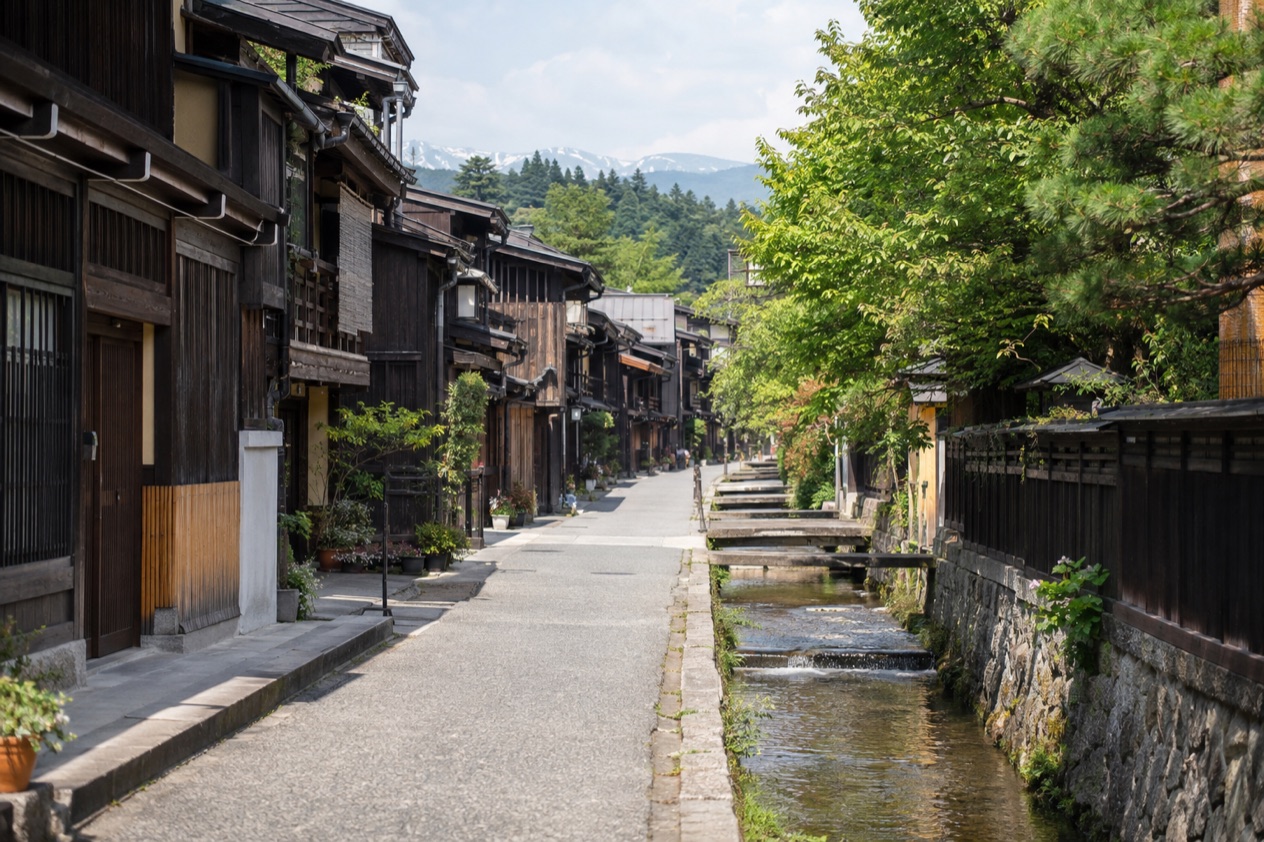
In July, the wooden lattice fronts of Takayama’s old town darken with rain, and the small canal beside the morning market runs fast under umbrellas. Cedar balls hang green over brewery doorways, cold noodles and grilled skewers come out in the food stalls, and the mountains around town sit under low cloud. This is Takayama in the thick of summer, a wet, green and humid month for travelers who like to wander the Edo-style streets of the Japanese Alps at an unhurried pace.
What is the weather like in Takayama in July?
July in Takayama is hot, humid and the wettest of the summer months, with rain falling on more than half the days.
| Month | Average high (°F) | Average low (°F) | Precipitation (in) | Days with 1 mm or more of precipitation | Hours of sunshine | Daylight on the 15th |
|---|---|---|---|---|---|---|
| June | 79.0 | 58.8 | 6.71 | 11.7 | 144 | 14 h 36 min |
| July | 85.1 | 66.9 | 10.27 | 14.1 | 147 | 14 h 24 min |
| August | 87.8 | 68.2 | 7.79 | 11.6 | 177 | 13 h 35 min |
What the figures change for you is mostly about moisture. July here is a month of rain showers and gray stretches, and the air stays damp, with humidity near the top of the summer range. Plan on a compact umbrella or a light rain jacket every day, and expect that a day of sightseeing may be interrupted by a shower or reshaped by a steady rain.
The heat is real, with afternoons in the mid-80s that feel warmer in the humidity, so cotton or quick-drying clothes make more sense than anything heavy. Nights stay mild compared with June, mild enough that a thin layer is usually all you want for an evening stroll or a late dinner. Sunshine is limited compared with August, so the old town often looks silvery and soft rather than bright.
Light stretches well into the evening, which gives you room for a slow dinner and a walk afterward along the river. Those long evenings are the best reason to treat a rainy day as a pause rather than a loss, since a clearing sky late in the day can still leave time for the streets.
What to do in Takayama in July
Takayama’s two big festivals, the Spring Takayama Festival on April 14 and 15 and the Autumn Takayama Festival on October 9 and 10, both fall outside July, and the cherry blossoms belong to the second half of April. So July offers no headline event in town. What it offers instead is the old town itself in its summer mood: green, wet and fragrant, with rain dripping from the eaves of the merchant houses.
Takayama is sometimes called the Little Kyoto of Hida for its well-preserved quarter of Edo-style streets, and walking those streets is the core of a July visit. Dark timber houses, lattice windows, sake breweries and small shops selling local crafts line the lanes, and a drizzle makes the wood look richer than it does in dry weather. An umbrella and a slow pace are all this part of the day needs.
The old town and its breweries
The merchant streets are the place to spend a day of mixed weather, because you can duck in and out of doorways. Sake breweries announce themselves with a sugidama, a ball of cedar sprigs hung under the eaves. In summer the ball is fresh and green, and it turns brown over the months as the new sake matures, an old signal that a brewery is ready to pour.
Inside, you find tasting counters, shelves of local sake and sometimes sweets made from sake lees. Shops nearby sell lacquerware, carved wood and small pottery, and the craft shops are good rainy-day browsing. Pair this with a walk along the river for the old town in its summer greens, and keep the cameras under cover when the showers pass through.
Morning markets and summer food
Takayama’s morning markets are where the season shows. Farm stalls pile up with summer vegetables, pickles, fruit and flowers, and the food sold on the spot, rice dumplings glazed with soy sauce, grilled skewers and sweets, is meant to be eaten as you walk. In the damp air, the smell of grilled soy and charcoal is part of the street.
At a sit-down meal, Hida beef is the regional star, served as grilled slices, in a hot pot or on a skewer. Local ramen in a clear soy broth, mountain vegetables, and hoba miso, a paste grilled over a magnolia leaf, round out the regional table. Cold soba or a lighter set meal suits the humid afternoons better than a heavy hot pot.
Museums, merchant houses and rainy days
With rain on more than half the days, the town’s indoor sights matter. The old merchant houses, the former government buildings and the small museums of crafts, festival floats and local history can fill a wet morning, and each one gives you something concrete to look at: carved beams, lacquered floats, tools and tatami rooms. They pair well with a hot cup of tea afterward.
Because the April and October festivals are not happening, the festival floats are what you can still see indoors, preserved and displayed. Takayama is also the base for travel into the surrounding Alps, where the green is at its deepest in July, and a rainy day in town can become a clear day in the hills, or the other way around.
In the evening, the small izakayas and restaurants of the old town fill with lantern light, and a plate of grilled skewers with a glass of local sake is a fitting end to a humid day. Takayama Station on the JR Takayama Line does not accept IC cards, so local line tickets there must be bought in cash.
A two-day itinerary for Takayama in July
Day 1 belongs to the old town. Start at the morning market by the river, where stalls of vegetables, pickles and rice dumplings give you breakfast while the air is at its coolest. From there, move into the merchant streets and look into the craft shops and the sake breweries, keeping the umbrella handy for the afternoon showers that July tends to bring.
At midday, sit down for Hida beef or a bowl of local ramen, then spend the afternoon indoors in a merchant house or a festival float museum while the heat peaks. When the light softens, go back out to the lanes for a walk along the river, then finish with dinner in a small restaurant where grilled skewers and local sake make the evening.
Day 2 widens the circle. Take the early hours for the part of town you skipped, the former government buildings and the quieter lanes beyond the main streets, and stop for coffee or a sweet in a converted wooden house. As the day warms, look for shade, cold noodles and a cold drink before the afternoon.
Rain card: if the sky turns heavy, stay under a roof. Museums of local crafts, breweries with tasting counters and cafés in old buildings can fill a gray day. If it clears by late afternoon, you will still have long evening light for a last walk, a final bowl of ramen and the lit lanterns of the old town.
Is Takayama busy in July?
July is not tied to a major event in Takayama, which sets it apart from the weeks of the spring and autumn festivals. The town’s calendar puts its big gatherings in April and October, and the cherry blossoms in the second half of April, so July does not carry any of those draws.
What July brings is summer weather, and with it a different kind of visit. The streets are green, the humidity is high, and the town works at the pace of a rainy summer month rather than a festival weekend. Visitors who come now are mostly there for the old town, the food and the mountains around it, not for a single date on the calendar.
The broader summer in Japan is very humid, hot and sultry across Honshu, and Takayama is part of that. If you arrive with a flexible plan, you can move your outdoor time around the rain, and the indoor sights give the day a second option.
What to pack for Takayama in July
Pack for heat, humidity and rain at the same time, and keep the bag light enough to carry through the old town.
- A compact umbrella or light rain jacket, since rain falls on more than half the days.
- Breathable, quick-drying clothes for the humid afternoons.
- A thin layer for evenings, when the air cools a little after a warm day.
- Walking shoes that can handle wet pavement along the old town streets.
- A sun hat and a small towel for the hot, muggy hours between showers.
- Some cash in yen, since local tickets at Takayama Station on the JR Takayama Line must be bought in cash.
Good to know before you go
July sits in the humid, hot summer that marks Honshu, and in Takayama it is the wettest of the three summer months, so plan every day with the rain in mind. Keep an indoor option ready for each part of the day, whether that is a museum, a brewery counter or a café, so a shower becomes a change of plan rather than a lost afternoon.
One practical detail matters at the station: Takayama Station on the JR Takayama Line does not accept IC cards, so local line tickets must be bought in cash. Keep yen on hand for that and for market stalls.
Takayama in July vs June and August
Moving the trip four weeks earlier brings you to June, which is cooler and noticeably less wet, with lighter evenings and a little more daylight at both ends. The old town is gentler in that weather, and walking is more comfortable. Neither June nor July has a major festival date in Takayama, so the choice is about weather alone.
Moving four weeks later brings you to August, which is hotter, sunnier and less wet than July, with the highest temperatures of the three months. The daylight shortens a little, and the sunshine hours rise well above July. August suits travelers who would rather have heat and more sun than steady damp, while July is greener and rainier.
If you dislike rain, shift to June or August. If you prefer lush scenery, dripping eaves and the feel of a true rainy-season month in the Alps, July is the one to keep. Anyone who wants festival floats in motion should look at April or October instead, since those are the dates Takayama’s two festivals occupy.
Is July a good time to visit Takayama?
Yes, for travelers who enjoy a green, humid, rainy town and who are happy to organize their days around the weather. July suits people who want old streets, sake breweries, morning markets and Hida beef more than they want sunshine or a festival, and who are comfortable carrying an umbrella as a daily companion.
It is a harder fit for anyone who wants dry weather for long outdoor days, or for travelers whose main goal is the spring or autumn festivals or the cherry blossoms. Those people will find April or October a better match for what they came to see.
On arrival, start with the morning market and the old town, then fit the indoor sights around the showers. What is special about July in Takayama is the way the town looks in the wet: dark timber glistening, cedar balls fresh and green above the brewery doors, and a plate of grilled skewers waiting at the end of the lane.
Sources
- Japan Meteorological Agency (JMA), Normal values 1991-2020, monthly (https://www.data.jma.go.jp/stats/etrn/view/nml_sfc_ym.php?prec_no=52&block_no=47617), station Takayama, elevation 560 m, checked October 11, 2026
- Computed from the date and the latitude of the place (sunrise equation, solar elevation -0.833 degrees), October 11, 2026
- Japan National Tourism Organization, weather and seasons in Japan (https://www.japan.travel/en/plan/weather/), checked October 11, 2026
- Wikipedia, Climate of Japan (https://en.wikipedia.org/wiki/Climate_of_Japan), checked October 11, 2026
- Japan National Tourism Organization, summer in Japan (https://www.japan.travel/en/guide/summer-guide/), checked October 11, 2026
- Japan National Tourism Organization, festivals and events (https://www.japan.travel/en/see-and-do/festivals-and-events/), checked October 11, 2026
- Wikipedia, Hanabi (https://en.wikipedia.org/wiki/Hanabi), checked October 11, 2026
- Wikipedia, Gion Matsuri (https://en.wikipedia.org/wiki/Gion_Matsuri), checked October 11, 2026
- Japan National Tourism Organization, Mount Fuji guide (https://www.japan.travel/en/fuji-guide/), checked October 11, 2026
- Official website for Mt. Fuji climbing, about the climb (https://www.fujisan-climb.jp/en/about/), checked October 11, 2026
- Wikipedia, Tanabata (https://en.wikipedia.org/wiki/Tanabata), checked October 11, 2026
- Wikipedia, Takayama, Gifu (https://en.wikipedia.org/wiki/Takayama,_Gifu), checked October 11, 2026
- Wikivoyage, Takayama (https://en.wikivoyage.org/wiki/Takayama), checked October 11, 2026
- Wikipedia, Takayama Festival (https://en.wikipedia.org/wiki/Takayama_Festival), checked October 11, 2026
To plan your stay
- Things to Do in Takayama: Old Town Streets, Morning Markets, Hida Beef and Festival Floats
- Where to Stay in Takayama: Station Area, Old Town Streets, Morning Market and Ryokan
- Takayama from Nagoya: The Hida Limited Express, Ways to Go and a Day in the Old Town
- Takayama Festival: Yatai Floats, Lantern Processions and Spring and Autumn Dates