
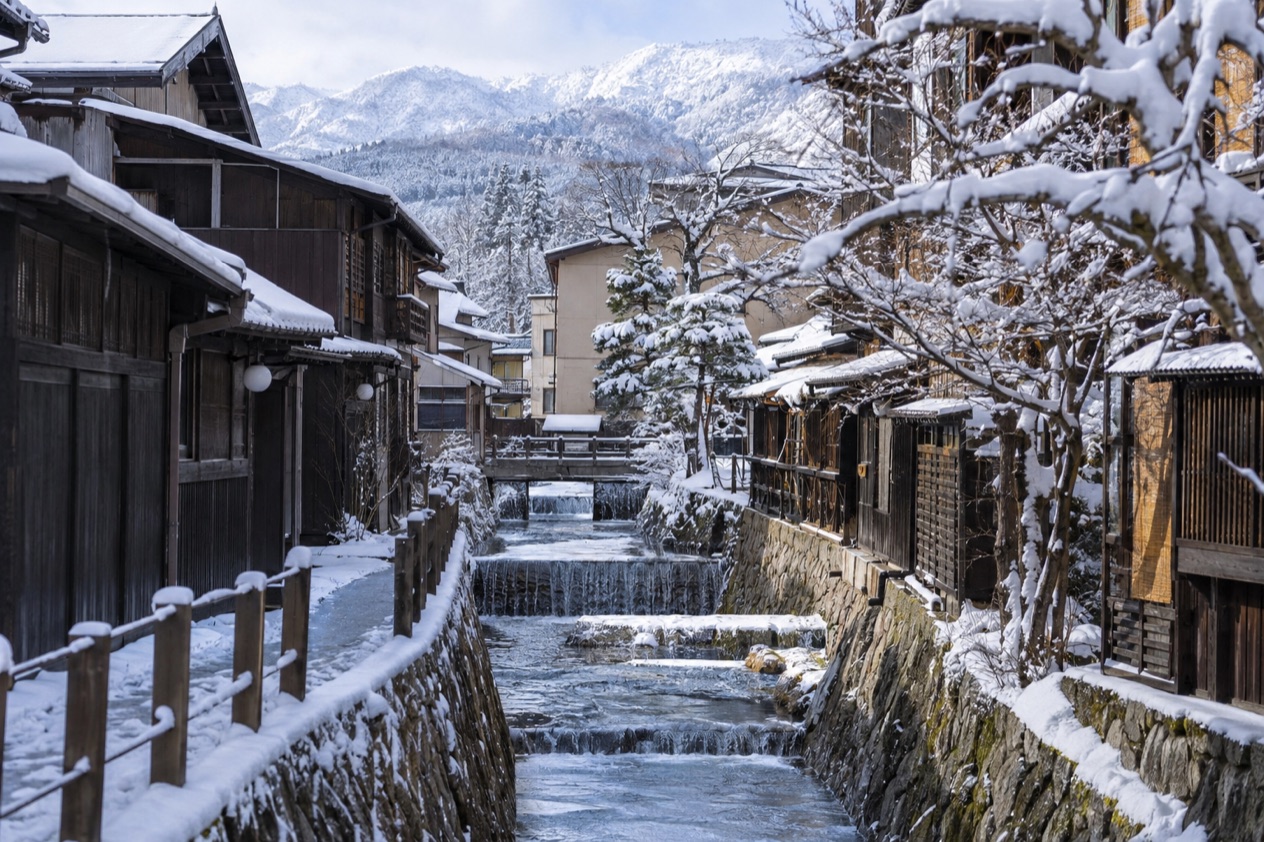
Snow settles on the dark wooden eaves of Takayama’s old merchant houses, and cedar balls hang green above the doors of the sake breweries. Steam rises from bowls of ramen and from skewers of dango grilled over charcoal.
January turns this Japanese Alps town into a place of white roofs, warm interiors and slow walks between one hot drink and the next. It suits travelers who want the Edo-style streets in winter, with food that tastes better in the cold.
What is the weather like in Takayama in January?
January in Takayama is cold and snowy: highs stay just above freezing, nights fall well below it, and snow or sleet shows up on most days of the month.
| Month | Average high (°F) | Average low (°F) | Precipitation (in) | Snowfall (in) | Days with 1 mm or more of precipitation | Hours of sunshine | Daylight on the 15th |
|---|---|---|---|---|---|---|---|
| December | 43.2 | 28.9 | 4.11 | 26.0 | 13.4 | 82 | 9 h 43 min |
| January | 37.8 | 23.4 | 4.01 | 46.1 | 14.6 | 93 | 9 h 57 min |
| February | 40.5 | 23.2 | 3.68 | 35.4 | 11.7 | 116 | 10 h 51 min |
This is the snowiest of the three months, and the snow here is the real thing: dry flakes that pile up on rooftops, bridges and the edges of the narrow river. Plan on layers you can add and shed, since heated shops, museums and restaurants are a sharp contrast to the street. A warm coat, a hat, gloves and boots with a grip matter more than any single fashion choice.
Precipitation arrives as snow far more than as rain, so a waterproof outer shell and shoes that handle slush are the practical rain gear. Sunshine is limited, and many days are gray and soft, with the town’s wood and white snow turning the same pale tones. When the sky does open, the light on the snow is bright enough to make sunglasses useful.
Daylight is just under ten hours in mid-January and grows noticeably by February, so the day for sightseeing is short. Evenings arrive early and cold, which is when lit windows, izakaya counters and a bath in a hot spring feel most welcome.
What to do in Takayama in January
The month opens with the Japanese New Year. Since 1873 it has been celebrated on January 1, and families eat osechi, a selection of small dishes packed in tiered boxes. During the New Year holidays many restaurants and attractions are closed, so the first days of January are the quietest stretch for what is open in town. After that, Takayama settles into its winter routine.
What January offers is a historic town in snow. Takayama is sometimes called the Little Kyoto of Hida because of its well-preserved quarter with Edo-style streets, and winter gives that quarter its most graphic look: black lattice windows, white roofs and the occasional red bridge. The mountains of the Japanese Alps frame the town on every side.
The old town under snow
The old merchant district is the center of any visit. Lined with dark wooden houses, it holds sake breweries marked by the sugidama, balls of cedar twigs that start the season green and slowly brown. Many breweries pour small tastings of the local rice wine, and a cup of warm sake in the cold is one of the pleasures of the month.
Between the breweries you find craft shops, shops selling pickles and miso, and cafes serving sweet red bean snacks. Wooden lattice, stone lanterns and snow-covered rooftops make the streets a photographer’s setting, and a stroll takes longer than the map suggests because you stop at every doorway. Boots with a grip are a good idea on the packed snow.
Along the river, the morning stalls that run beside the water sell pickles, local vegetables, flowers and hot snacks. In winter the offerings lean toward preserved and warming foods, and the stalls give the town a lively, human start to the day.
Winter food in the Hida mountains
Takayama eats well in January. Hida beef, the local marbled beef, appears grilled, in sushi, on skewers and in hot pots, and it suits the cold weather. Takayama ramen is another winter staple: a thin, curly noodle in a clear, soy-dark broth that arrives steaming and goes down fast on a cold afternoon.
Mountain cooking leans on pickles, tofu, river fish and miso. A signature dish is hoba miso, miso grilled with mushrooms and vegetables on a magnolia leaf over a small flame at the table. Street snacks include mitarashi dango, rice dumplings glazed with sweet soy, and beef croquettes and skewers eaten standing up with gloved hands. Warm sake and hot tea round things out.
Farmhouses and indoor stops
When the weather turns, the town’s indoor sights come into their own. The old government house, with its tatami rooms and long wooden corridors, shows how the region was run in the Edo period. The open-air folk village of Hida no Sato gathers old farmhouses with thick thatched roofs, a sight that looks especially striking weighed down with snow.
Smaller museums in town cover festival floats, folk crafts and local woodwork, and they make good warm-up stops between outdoor stretches. Takayama’s carpentry tradition shows everywhere, in the joinery of the houses and in the carved details of shop signs. Hot springs in the surrounding mountains are a classic winter reward after a day on snowy streets.
Farther afield, Japan’s ski season generally opens in December and runs to April, with exact dates set by each resort. In the high-altitude mountains of Nagano, peak season falls in January and February when snowfall is most frequent. Takayama’s position in the Japanese Alps makes it a base for travelers who are mixing sightseeing with winter mountain scenery.
A two-day itinerary for Takayama in January
Day 1 begins in the old town, since daylight is short and the streets reward the first hours. Start with the stalls along the river, where pickles, vegetables and hot snacks make an easy breakfast. Then walk the merchant district at a slow pace, going into one brewery for a tasting and a craft shop or two.
For lunch, take a bowl of Takayama ramen or a set meal of hoba miso. The afternoon goes to the old government house, whose tatami rooms and corridors are a welcome pause from the cold. Before the light fades, cross the river and wander the lanes beyond the main street.
In the evening, choose an izakaya for grilled Hida beef, pickles and warm sake. If the snow is heavy, the same plan works with more time indoors, and the cafes of the old town are a good place to wait out the worst of it.
Day 2 moves out to Hida no Sato, the open-air village of old farmhouses, where thatched roofs under snow are the main sight. The farmhouses have hearths and wooden interiors you can step into, which make useful shelter. Take your time over the paths, and let the pace follow the snow.
Return to town for a late lunch of Hida beef, sushi or skewers, then spend the afternoon in the smaller museums of floats and crafts. Finish with a hot-spring bath if you are staying at an inn that has one, and a quiet dinner of mountain dishes. If the weather is rough, the museums and the covered shopping lanes carry the day.
Is Takayama busy in January?
January is a winter month in Takayama, and what shapes the pace is the New Year holiday followed by the snow season. During the New Year holidays many restaurants and attractions are closed, so the early days of the month can feel stripped down, with fewer places open to visit.
Takayama’s two big festivals fall in April and October, so January has no festival of that scale to draw crowds. What the month offers instead is winter itself: snow, hot food and the old streets in white. The wider region has a ski season that peaks in January and February, so the mountains of the Alps are in full winter mode around the town.
For visitors, that means the town runs at a winter rhythm. Days are short, evenings come early, and the streets belong to people who are happy to bundle up and walk. The small cafes and breweries make a good place to spend the slow hours.
What to pack for Takayama in January
Snow falls on most days, and temperatures stay near or below freezing, so the packing list is about warmth and grip.
- A warm, waterproof coat, since snow and sleet fall on most days.
- Boots with a good grip for packed snow on the old-town streets.
- A hat, gloves and a scarf for the cold that settles in after dark.
- Thin base layers, so you can adjust between heated interiors and the street.
- Sunglasses for the days when light bounces off the snow.
- Slip-on shoes or clean socks, since shoes come off at the entrance of many inns and farmhouses.
Good to know before you go
January is the heart of Takayama’s snow season, and the New Year holidays at the start of the month close many restaurants and attractions. Public holidays that fall on a Sunday move to the next working day, a rule known as furikae kyujitsu, so a long weekend can shift what is open. On the rail side, Takayama Station on the JR Takayama Line does not accept IC cards, so local line tickets must be bought in cash.
Takayama in January vs December and February
Moving the trip to December means less snow on the ground, though December already sees snow or sleet on most days. Temperatures are a few degrees milder, and the day is shorter by a few minutes. The month sits just before the New Year closures, which makes the early part a different rhythm from January’s.
Moving to February brings more sunshine and a longer day, with fewer days of precipitation. Snow still covers the town, and the light is brighter, which suits photographers. Highs are slightly higher than in January, and the nights are about as cold.
Travelers who want the deepest snow and the heart of winter should choose January. Those who prefer more daylight and brighter skies should lean toward February, and those who want to avoid the New Year closures should look to a later January date or to February.
Is January a good time to visit Takayama?
Yes, for travelers who like winter, snow and warm food. January suits those who want the old streets under white roofs, a sake tasting in a brewery and a bowl of ramen after a cold walk, and who are comfortable in boots and a heavy coat.
It is a poorer fit for anyone who wants long days, mild air or the festivals of April and October. The daylight is short and the cold is steady, so the outdoor stretches are brief and the indoor pauses are frequent.
On arrival, head for the old merchant district first and take a walk through the snow before the light fades. Then settle into a warm place with a bowl of something hot. January in Takayama is the town at its most wintry, where white roofs, cedar balls and the smell of grilled beef set the tone.
Sources
- Japan Meteorological Agency (JMA), Normal values 1991-2020, monthly (https://www.data.jma.go.jp/stats/etrn/view/nml_sfc_ym.php?prec_no=52&block_no=47617), station Takayama, elevation 560 m, checked October 11, 2026
- Computed from the date and the latitude of the place (sunrise equation, solar elevation -0.833 degrees), October 11, 2026
- Japan National Tourism Organization, shop and attraction hours, national holidays (https://www.japan.travel/en/plan/business-hours-and-holidays/), checked October 11, 2026
- Wikipedia, Japanese New Year (https://en.wikipedia.org/wiki/Japanese_New_Year), checked October 11, 2026
- Wikipedia, Public holidays in Japan (https://en.wikipedia.org/wiki/Public_holidays_in_Japan), checked October 11, 2026
- Japan National Tourism Organization, winter in Japan (https://www.japan.travel/en/guide/winter-guide/), checked October 11, 2026
- Japan National Tourism Organization, skiing and snowboarding in Japan: regions, resorts, seasons (https://www.japan.travel/en/sports/snow/), checked October 11, 2026
- Wikipedia, Climate of Japan (https://en.wikipedia.org/wiki/Climate_of_Japan), checked October 11, 2026
- Japan National Tourism Organization, weather and seasons in Japan (https://www.japan.travel/en/plan/weather/), checked October 11, 2026
- Japan National Tourism Organization, skiing guide (https://www.japan.travel/en/guide/skiing/), checked October 11, 2026
- Wikipedia, List of ski areas and resorts in Japan (https://en.wikipedia.org/wiki/List_of_ski_areas_and_resorts_in_Japan), checked October 11, 2026
- Japan National Tourism Organization, flowers by season: cherry blossom, plum, wisteria, hydrangea, where and when (https://www.japan.travel/en/see-and-do/flowers/), checked October 11, 2026
- Wikipedia, Prunus mume (https://en.wikipedia.org/wiki/Prunus_mume), checked October 11, 2026
- Wikipedia, Takayama, Gifu (https://en.wikipedia.org/wiki/Takayama,_Gifu), checked October 11, 2026
- Wikivoyage, Takayama (https://en.wikivoyage.org/wiki/Takayama), checked October 11, 2026
- Japan National Tourism Organization, festivals and events (https://www.japan.travel/en/see-and-do/festivals-and-events/), checked October 11, 2026
- Wikipedia, Takayama Festival (https://en.wikipedia.org/wiki/Takayama_Festival), checked October 11, 2026
To plan your stay
- Things to Do in Takayama: Old Town Streets, Morning Markets, Hida Beef and Festival Floats
- Where to Stay in Takayama: Station Area, Old Town Streets, Morning Market and Ryokan
- Takayama from Nagoya: The Hida Limited Express, Ways to Go and a Day in the Old Town
- Takayama Festival: Yatai Floats, Lantern Processions and Spring and Autumn Dates