
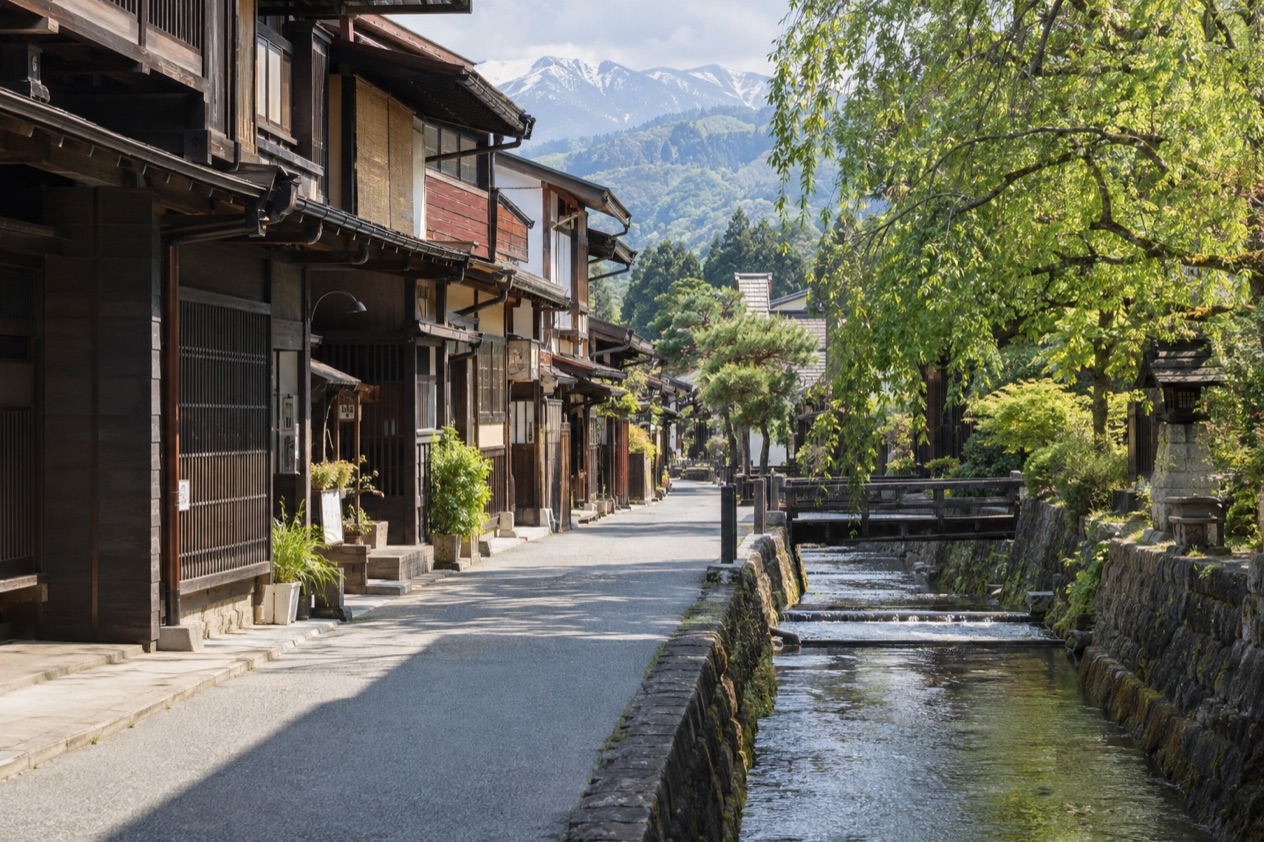
In August the old merchant streets of Takayama are lined with dark wooden eaves, and cedar balls hang green above sake brewery doors. The air under the mountains is warm and heavy, and cicadas sing from the trees along the river.
Rice paddies on the edge of town turn deep green, and the Hida region settles into the family rhythm of Obon. It is a month for the old quarter, for grilled beef and cold noodles, and for slow days in the Japan Alps.
What is the weather like in Takayama in August?
August in Takayama is hot and humid, with the warmest afternoons of the summer and fewer rainy days than July. Showers still come, so an umbrella belongs in the day bag.
| Month | Average high (°F) | Average low (°F) | Precipitation (in) | Days with 1 mm or more of precipitation | Hours of sunshine | Daylight on the 15th |
|---|---|---|---|---|---|---|
| July | 85.1 | 66.9 | 10.27 | 14.1 | 147 | 14 h 24 min |
| August | 87.8 | 68.2 | 7.79 | 11.6 | 177 | 13 h 35 min |
| September | 79.0 | 60.6 | 8.89 | 12.0 | 132 | 12 h 28 min |
The heat is the first thing to plan around. Humidity stays high, around 77 percent, so light cotton or linen clothes that dry quickly suit the old streets better than anything heavy. Nights cool off only a little, so you will not need a sweater, though a thin layer helps in air-conditioned museums, trains and restaurants.
Rain in August comes as summer showers rather than the long gray stretches of July. A compact umbrella or a light rain jacket handles most of it, and the wooden eaves of the old quarter give some cover while you wait. Sunshine is generous this month, so a hat, sunscreen and a water bottle matter as much as rain gear.
Daylight lasts well into the evening. That leaves time for a late walk along the river after dinner, with the lanterns of the old town lit and the stone bridges quiet under the mountains.
What to do in Takayama in August
The month belongs to Obon, the Buddhist custom of honoring ancestors, when people return to their family places and visit and clean the graves of their relatives. It lasts three days, and it gives a mountain town like Takayama a family feel. You may see temple visits, flowers at graves and relatives gathering, and some small shops may keep their own holiday schedule.
Takayama is sometimes called the Little Kyoto of Hida because of its well-preserved quarter with Edo-style streets. In August that quarter is the main stage, and the day goes best in two parts, with the hottest hours spent indoors or in shade.
The old town of Sanmachi Suji
Sanmachi Suji is the old merchant district, three parallel lanes of dark latticed wooden houses with deep eaves. Many of the old houses are now sake breweries, craft shops, small museums and cafés. A cedar ball hanging over a doorway, called a sugidama, marks a brewery, and in summer the new green of the ball is a pleasant sign to look for.
In the heat, treat the quarter as a string of doorways. Step into a shop for the cool of the interior, look at the lacquerware and Hida woodwork, then step out into the next block. Tasting counters at breweries let you try local sake, and many cafés serve cold sweets and iced tea that suit the weather.
Shops in towns generally open from 10:00 a.m. to 8:00 p.m. every day in urban areas, while rural shops often close earlier, sometimes as early as 6:00 p.m. The streets around the old town stay lit in the evening, and the long summer daylight makes a second walk after dinner worthwhile.
Markets, rivers and the Hida table
Takayama has two well-known morning markets, one along the Miyagawa River and one in front of the old government house. In August they are stacked with summer vegetables, pickles, flowers, mountain produce and handmade crafts. Stalls sell skewered rice dumplings brushed with soy glaze (mitarashi dango), and you can eat them walking along the river.
The food of the region suits the heat when you pick well. Hida beef appears as grilled skewers, on a hot stone or in a rice bowl.
Cold soba and chilled noodles with mountain vegetables make good lunches, and a bowl of Takayama ramen, with its clear soy broth, is a fixture of the town. Evenings call for an izakaya, a casual pub, where plates of grilled fish, tofu and pickles arrive with a cold beer or a glass of local sake.
The Miyagawa River itself is a pleasure in summer, with its red bridge and willows. Sitting on the bank with a cold drink is a fine way to spend the late part of the day.
Beyond the old town: Hida folk life and the Alps
Takayama sits near the northern Japan Alps in Gifu Prefecture, and it is the largest city in Japan by area. That is why a day here can mix town streets with mountain scenery. Mountain valleys and farm villages lie within the city limits, so the countryside is part of any visit.
Open-air museums of old farmhouses and the thatched villages of the region are the natural choices for a summer day trip, because rice fields and forests are at their greenest. Farmhouse roofs, hearths and wooden beams show how families lived through the long snowy winters, and walking among them is an easy way to enjoy the season outdoors.
Summer is also the season for walking in the hills. Humid, hot and sultry weather is typical of Honshu in summer, so plan outdoor time around the cooler parts of the day and carry water.
A two-day itinerary for Takayama in August
Day 1 starts at the morning markets, when the river is lined with stalls and the first of the heat has not yet built. Have a mitarashi dango and a coffee, buy some pickles and a handful of summer fruit, then walk the quiet lanes of Sanmachi Suji while the shops open. Go into a brewery for a tasting and into a craft shop for the cool of the interior.
Lunch is cold soba or a Hida beef rice bowl at a small restaurant in the old quarter. In the hot afternoon, move indoors to a museum or a café for iced tea and a rest. When the light softens, return to the river for a stroll over the red bridge, then dine at an izakaya on grilled fish and local sake.
Day 2 is for the countryside. Head out to an open-air museum of old farmhouses, or to a village of thatched roofs, and let the green rice fields and forested slopes fill the morning. Eat a country lunch of mountain vegetables, river fish or noodles, and spend the afternoon on a short ramble, with a hat and water, before the heat peaks.
If rain sets in, use the day for indoor stops: a sake brewery tasting, a craft studio, a museum of festival floats or a long lunch of Hida beef. Come back to the river for the evening, since the light lasts late and the rain often clears by dusk.
Is Takayama busy in August?
August brings a summer pace to Takayama, with Obon adding a family rhythm to the month, and it is a time when many Japanese travelers are on the move. The old town fills with walkers, though its small streets and the daylight hours keep it comfortable.
Obon lasts three days, and it centers on returning to ancestral family places. Visits to graves and family gatherings are the heart of it. For a visitor, that means the month has a quiet, personal side that sits alongside the sightseeing, and you may notice households with relatives in town, flowers at the temples and a slower pace in small neighborhoods.
National holidays follow their own rules. When a holiday falls on a Sunday, the next working day becomes a public holiday, and a day sandwiched between two national holidays becomes one as well. These rules can stretch a weekend, so it is worth looking at the calendar when you set your dates.
Shops in towns generally open from 10:00 a.m. to 8:00 p.m. every day, but rural shops often close earlier, sometimes at 6:00 p.m. In the hills and villages around Takayama, plan lunch and shopping earlier in the day. The city center keeps longer hours, which suits the long evenings of August.
What to pack for Takayama in August
August in Takayama calls for clothes for heat and humidity, plus something for showers and for walking on old streets and country paths.
- Light, breathable clothing in cotton or linen, because the afternoons are hot and humid.
- A compact umbrella or light rain jacket, for the summer showers.
- A hat and sunscreen, since sunshine is generous this month.
- A refillable water bottle for walks in the hills and long days outside.
- Comfortable shoes that slip on and off easily, for temples, ryokan and the lanes of the old town.
- A thin layer for air-conditioned trains, museums and restaurants.
Good to know before you go
Takayama Station on the JR Takayama Line does not accept IC cards, so local line tickets must be bought in cash. Carry some yen for that, and for small shops and market stalls.
The summer is hot and sultry across Honshu, and showers are part of the season, so build rest breaks into the day. Obon lasts three days, and the national holiday rules can add a day off around a weekend, so some small businesses may keep their own schedule.
Takayama in August vs July and September
A month earlier, July is the wetter month, with more rainy days and fewer hours of sunshine. The days are longer, with a little more than fourteen hours of daylight in the middle of the month, but gray skies are more common. If you want rice fields at their greenest with fewer clear days, July suits, though August brings more sun for the same hills.
A month later, September is noticeably cooler, with highs near 79°F and lows near 60°F. Evenings become more comfortable for walking and eating outside, and daylight shortens to about twelve and a half hours. Rain is still frequent, so the umbrella stays in the bag, but the heavy heat of August eases.
Travelers who prefer the longest, brightest days and do not mind the heat should stay with August, and so should families whose summer calendar allows only this month. Those who dislike humid heat should move to September, while those who accept more rain for the lush greens of midsummer can choose July.
Is August a good time to visit Takayama?
Yes, for travelers who enjoy summer warmth, long evenings and a slow look at an old mountain town, and less so for anyone who finds hot, humid days a burden. The sunniest weather of the summer is here, and the markets and streets are most colorful.
Those who love markets, sake, grilled beef and country villages will find a lot to enjoy, and Obon adds a layer of family tradition to the month. Heat-sensitive visitors, or those hoping for crisp mountain air, may prefer a later month.
On arrival, start with the old quarter and the river, then plan the hot hours around museums, breweries and cafés. What stays in the memory from August in Takayama is the sight of cedar balls green above the brewery doors, a cold bowl of soba at lunch and the lamps along the Miyagawa at dusk.
Sources
- Japan Meteorological Agency (JMA), Normal values 1991-2020, monthly (https://www.data.jma.go.jp/stats/etrn/view/nml_sfc_ym.php?prec_no=52&block_no=47617), station Takayama, elevation 560 m, checked October 11, 2026
- Computed from the date and the latitude of the place (sunrise equation, solar elevation -0.833 degrees), October 11, 2026
- Japan National Tourism Organization, shop and attraction hours, national holidays (https://www.japan.travel/en/plan/business-hours-and-holidays/), checked October 11, 2026
- Wikipedia, Obon (https://en.wikipedia.org/wiki/Obon), checked October 11, 2026
- Wikipedia, Public holidays in Japan (https://en.wikipedia.org/wiki/Public_holidays_in_Japan), checked October 11, 2026
- Japan National Tourism Organization, summer in Japan (https://www.japan.travel/en/guide/summer-guide/), checked October 11, 2026
- Japan National Tourism Organization, festivals and events (https://www.japan.travel/en/see-and-do/festivals-and-events/), checked October 11, 2026
- Wikipedia, Hanabi (https://en.wikipedia.org/wiki/Hanabi), checked October 11, 2026
- Japan Meteorological Agency, Emergency Warnings (https://www.jma.go.jp/jma/en/Emergency_Warning/ew_index.html), checked October 11, 2026
- Japan National Tourism Organization, safety information (https://www.japan.travel/en/japan-safe-travel-information/), checked October 11, 2026
- Japan National Tourism Organization, weather and seasons in Japan (https://www.japan.travel/en/plan/weather/), checked October 11, 2026
- Wikipedia, Awa Odori (https://en.wikipedia.org/wiki/Awa_Odori), checked October 11, 2026
- Wikipedia, Climate of Japan (https://en.wikipedia.org/wiki/Climate_of_Japan), checked October 11, 2026
- Japan National Tourism Organization, Mount Fuji guide (https://www.japan.travel/en/fuji-guide/), checked October 11, 2026
- Official website for Mt. Fuji climbing, about the climb (https://www.fujisan-climb.jp/en/about/), checked October 11, 2026
- Wikipedia, Nebuta (https://en.wikipedia.org/wiki/Nebuta), checked October 11, 2026
- Wikivoyage, Takayama (https://en.wikivoyage.org/wiki/Takayama), checked October 11, 2026
- Wikipedia, Takayama, Gifu (https://en.wikipedia.org/wiki/Takayama,_Gifu), checked October 11, 2026
To plan your stay
- Things to Do in Takayama: Old Town Streets, Morning Markets, Hida Beef and Festival Floats
- Where to Stay in Takayama: Station Area, Old Town Streets, Morning Market and Ryokan
- Takayama from Nagoya: The Hida Limited Express, Ways to Go and a Day in the Old Town
- Takayama Festival: Yatai Floats, Lantern Processions and Spring and Autumn Dates