
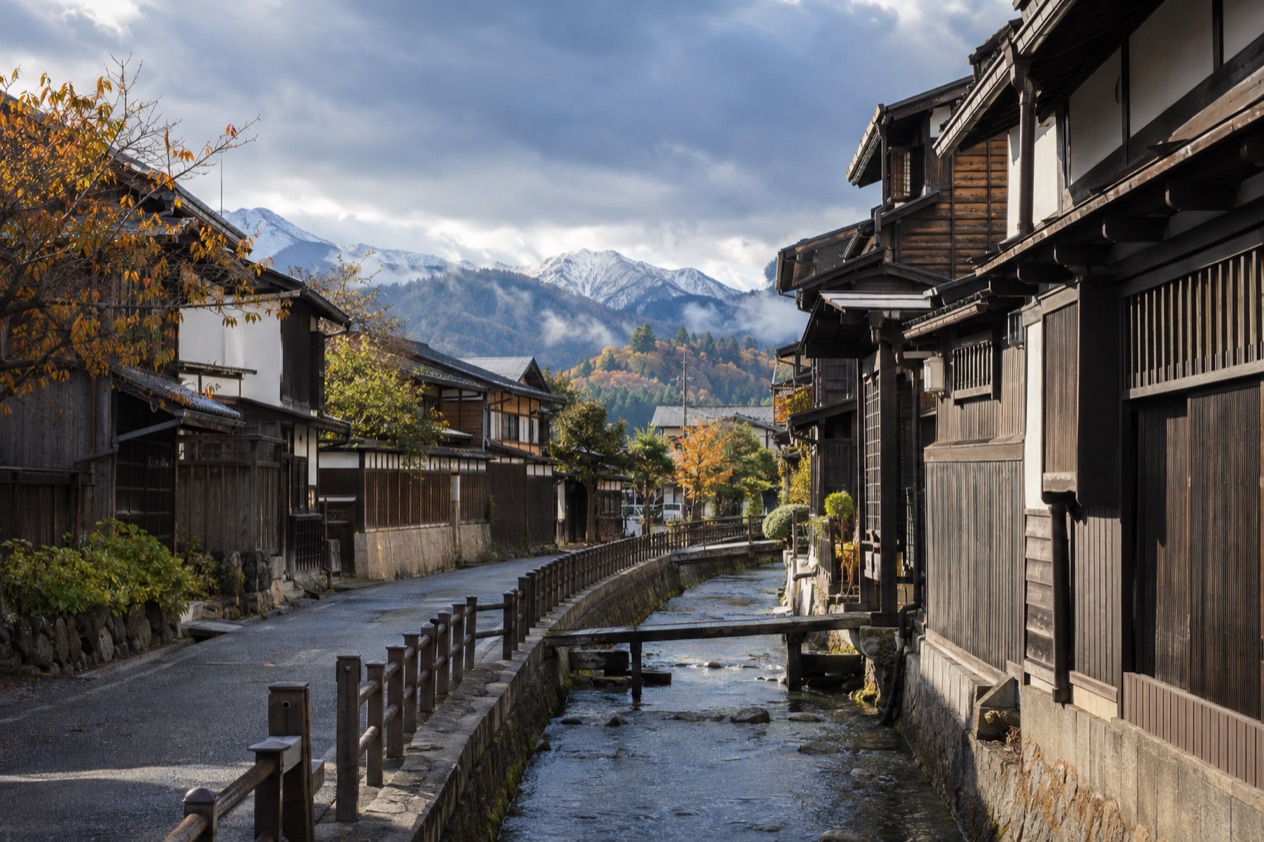
In September, the wooden lattice fronts of Takayama’s old merchant streets stand under a sky that has stopped being summer white, and the sake breweries hang fresh balls of cedar needles under their eaves, the sign that a new brew is on its way. The mountain town in Gifu Prefecture turns toward autumn a few weeks before its big festival. It is a good month for old streets, mountain food and an unhurried look at the Hida region.
What is the weather like in Takayama in September?
September in Takayama is warm and still humid, with the heat of August loosening and a clear step toward autumn, and rain is a regular part of the month.
| Month | Average high (°F) | Average low (°F) | Precipitation (in) | Days with 1 mm or more of precipitation | Hours of sunshine | Daylight on the 15th |
|---|---|---|---|---|---|---|
| August | 87.8 | 68.2 | 7.79 | 11.6 | 177 | 13 h 35 min |
| September | 79.0 | 60.6 | 8.89 | 12.0 | 132 | 12 h 28 min |
| October | 67.8 | 48.6 | 6.12 | 10.3 | 129 | 11 h 20 min |
September is the wettest of the three months, and the sunshine has dropped well below August’s. Plan on gray stretches between brighter ones, and carry a compact umbrella or a light rain jacket every day. The air is damp, so a shirt that dries quickly is more useful than a heavy layer.
Afternoons are comfortable for sightseeing in short sleeves, and the lows are cool enough that a light cardigan or thin sweater earns its place in the evening. The nights are a clear step down from August, which matters if you plan to stroll the old town after dinner or soak in an open-air bath.
The light changes too. Daylight is more than an hour shorter than in August, so the evenings close in earlier and the lanterns and window lights of the old quarter come into play sooner. Count on a slightly shorter sightseeing day than in midsummer.
What to do in Takayama in September
The big date of the Takayama calendar is not in September. The Autumn Takayama Festival is held on October 9 and 10, and the spring one on April 14 and 15. September is the quieter run-up, when the town goes about its everyday business and the mountain kitchen starts to move toward autumn flavors: chestnuts, mushrooms, persimmons and the new rice that follows the harvest.
The setting is the Japanese Alps, and Takayama is sometimes called the Little Kyoto of Hida for its well-preserved quarter of Edo-style streets. It is also the largest city in Japan by area, which explains why its municipal territory reaches far into the mountains around the old town.
Sanmachi Suji and the old town
The three old merchant streets of Sanmachi Suji are the heart of a visit. Dark wooden houses with deep eaves line narrow lanes, and inside them are sake breweries, small shops selling lacquerware and wooden crafts, and cafés serving sweets such as mitarashi dango, grilled rice dumplings brushed with a sweet-salty soy glaze.
In September the cedar balls, called sugidama, hanging at the brewery doors are worth noticing. They start green when hung and fade to brown over the months, so they act as a calendar for the brewing year. Tasting small cups of local sake is part of the pleasure, and many breweries here make it easy to try a few.
Rain suits these lanes well, since wet wood turns darker and the eaves give some shelter between shops. Leave time for a stop in a teahouse or a craft shop whenever a shower passes.
Hida cuisine: beef, miso and mountain vegetables
Takayama eats the food of the mountains. Hoba miso is another local dish, a paste of miso with vegetables and mushrooms heated on a dried magnolia leaf over a small burner, and it is just right on a damp evening.
Look also for Takayama ramen, a light soy-based broth with thin curly noodles, and for pickled and simmered mountain vegetables, called sansai, on set menus at small restaurants. With the arrival of autumn, mushrooms and chestnuts begin to appear in cooking, so a lunch set in September can carry a first hint of the new season.
Hida Folk Village and the festival floats
Hida Folk Village is an open-air museum of old farmhouses, many with the steep thatched roofs of the region, gathered around a pond with the mountains behind. Inside the houses you see low hearths, wooden beams blackened by smoke and tools of mountain farming. September light, softer than in August, flatters the thatch and the surrounding greenery.
In town, the Takayama Festival Floats Exhibition Hall shows the tall carved and lacquered festival floats, the yatai, that are pulled through the streets at the festivals. Seeing them in September gives you a sense of what the October festival looks like and is a dry place to spend an hour if the sky turns gray. One practical detail on arrival: Takayama Station on the JR Takayama Line does not accept IC cards, so local line tickets must be bought in cash.
A two-day itinerary for Takayama in September
Day 1 is for the old town. Begin in Sanmachi Suji, where the shops and breweries are ready to be explored, and take your time in the lanes. Stop for a mitarashi dango or a cup of sake and notice the cedar balls over the doors. Then go on to the Takayama Jinya, the historic government building of the Edo period, to see its tatami rooms and long corridors.
For lunch, choose a restaurant serving Hida beef, either grilled at the table or on a rice bowl. In the afternoon, visit the Festival Floats Exhibition Hall, which doubles as a rain card. After dark, the old town has a soft glow, and an izakaya serving hoba miso, pickles and local sake makes a good end to the day. Evenings come earlier than in summer.
Day 2 starts along the river with the morning market, where stalls sell vegetables, pickles, fruit and crafts. Pick up a snack and see what has arrived with the season. Then continue to Hida Folk Village for the thatched farmhouses and the pond. If the sky is gray, the houses give you shelter under their eaves and inside by the hearths.
Return to town for a bowl of Takayama ramen at lunch, then use the afternoon to visit a sake brewery you passed on Day 1 or to browse the shops for lacquerware and wooden crafts. In the evening, a set meal with mountain vegetables rounds out the day, and a hot bath at your inn is a fitting finish after a damp afternoon.
Is Takayama busy in September?
September falls between Takayama’s two best-known seasons, the cherry blossoms of mid to late April and the Autumn Festival of October 9 and 10, so it is a month without a headline event.
The cherry blossoms in Takayama come about three weeks later than in Nagoya, which gives the town its own spring calendar, and the maple color of the Japanese Alps comes later still. September sits before both. What the month offers is the town as it is on an ordinary day, with the old streets, the markets and the kitchens running at their regular pace.
If you want to see the festival floats in motion, you need to look to the spring and autumn dates. In September you see them on display at the exhibition hall instead, and you see the preparations for the season in the streets, in the shops and at the breweries.
The warm, humid weather of the month shapes the pace more than anything else. Damp afternoons suit slow visits to museums, teahouses and breweries, and when the sun comes out the lanes of Sanmachi Suji and the folk village are pleasant to walk through.
What to pack for Takayama in September
The month mixes warm days, cool evenings and a good share of rain, so pack for layers and for water.
- A light rain jacket or compact umbrella, because rain falls on many days of the month.
- Quick-drying short-sleeved shirts for the warm, humid daytime.
- A thin sweater or cardigan for evenings, which are noticeably cooler than in August.
- Shoes that handle wet pavement, since the old town lanes are paved with stone and wood.
- Slip-on shoes, as shoes come off at the entrance of ryokan, many restaurants and some museum houses.
- Cash in yen for local line tickets at Takayama Station, which does not accept IC cards.
Good to know before you go
September is a wet month in Takayama, and the Japan Meteorological Agency issues Emergency Warnings for natural phenomena of extraordinary magnitude. The Japan National Tourism Organization keeps a Japan Safe Travel Information page with safety tips and government information for visitors. Keep an umbrella in your bag, and keep a free hour or two in each day for the museums and teahouses if a heavy shower arrives.
The Autumn Takayama Festival follows on October 9 and 10, so travelers whose dates can move should know that the month after September holds the town’s big annual celebration.
Takayama in September vs August and October
Moving the trip four weeks earlier brings you to August, which is hotter, brighter and a little drier, with long days and sultry air in the mountains. The islands of Honshu and Kyushu are described by the Japan National Tourism Organization as having very humid, hot and sultry summers. August suits travelers who want the longest days and don’t mind the heat while walking the old streets.
Moving four weeks later brings you to October, which is cooler and has the lowest rainfall of the three months, with the shortest days. It is also the month of the Autumn Takayama Festival on October 9 and 10, which shapes the whole calendar. Pack a warmer layer, since the nights are clearly colder than in September.
Choose September if you want a middle path, with the heat easing, a lot of daylight left and no festival schedule to work around. Choose August for the long summer days, and October if the festival is the reason for the trip.
Is September a good time to visit Takayama?
Yes, for travelers who like old streets, regional food and a slower pace, and who are comfortable with a few wet afternoons.
September rewards those who come for the table and the craft shops: Hida beef, hoba miso, mountain vegetables, small cups of sake and lacquerware. It is also a good month for visitors who want to see the festival floats on display and the folk village in softer light. It is a weaker fit for anyone who wants the festival in motion or the cherry blossoms, which belong to October and April.
On arrival, start in Sanmachi Suji while the day is fresh, then keep the afternoon flexible for indoor stops if rain comes. Buy your local line tickets in cash at the station, and leave the rest of the plan open. What marks September here is the sight of the cedar balls turning from green toward brown over the brewery doors, a quiet sign that the town is already preparing for autumn.
Sources
- Japan Meteorological Agency (JMA), Normal values 1991-2020, monthly (https://www.data.jma.go.jp/stats/etrn/view/nml_sfc_ym.php?prec_no=52&block_no=47617), station Takayama, elevation 560 m, checked October 11, 2026
- Computed from the date and the latitude of the place (sunrise equation, solar elevation -0.833 degrees), October 11, 2026
- Japan Meteorological Agency, Emergency Warnings (https://www.jma.go.jp/jma/en/Emergency_Warning/ew_index.html), checked October 11, 2026
- Japan National Tourism Organization, safety information (https://www.japan.travel/en/japan-safe-travel-information/), checked October 11, 2026
- Japan National Tourism Organization, weather and seasons in Japan (https://www.japan.travel/en/plan/weather/), checked October 11, 2026
- Japan National Tourism Organization, summer in Japan (https://www.japan.travel/en/guide/summer-guide/), checked October 11, 2026
- Wikipedia, Climate of Japan (https://en.wikipedia.org/wiki/Climate_of_Japan), checked October 11, 2026
- Japan Meteorological Agency, maple color-change dates 2025-2026 with difference from the 1991-2020 normal (https://www.data.jma.go.jp/sakura/data/phn_014.html), checked October 11, 2026
- Japan Meteorological Agency, kaede2020.pdf (https://www.data.jma.go.jp/sakura/data/kaede2020.pdf), checked October 11, 2026
- Japan National Tourism Organization, autumn in Japan (https://www.japan.travel/en/guide/autumn-guide/), checked October 11, 2026
- Japan National Tourism Organization, spring in Japan (https://www.japan.travel/en/guide/spring-guide/), checked October 11, 2026
- Wikipedia, Takayama, Gifu (https://en.wikipedia.org/wiki/Takayama,_Gifu), checked October 11, 2026
- Wikivoyage, Takayama (https://en.wikivoyage.org/wiki/Takayama), checked October 11, 2026
- Japan National Tourism Organization, festivals and events (https://www.japan.travel/en/see-and-do/festivals-and-events/), checked October 11, 2026
- Wikipedia, Takayama Festival (https://en.wikipedia.org/wiki/Takayama_Festival), checked October 11, 2026
To plan your stay
- Things to Do in Takayama: Old Town Streets, Morning Markets, Hida Beef and Festival Floats
- Where to Stay in Takayama: Station Area, Old Town Streets, Morning Market and Ryokan
- Takayama from Nagoya: The Hida Limited Express, Ways to Go and a Day in the Old Town
- Takayama Festival: Yatai Floats, Lantern Processions and Spring and Autumn Dates