
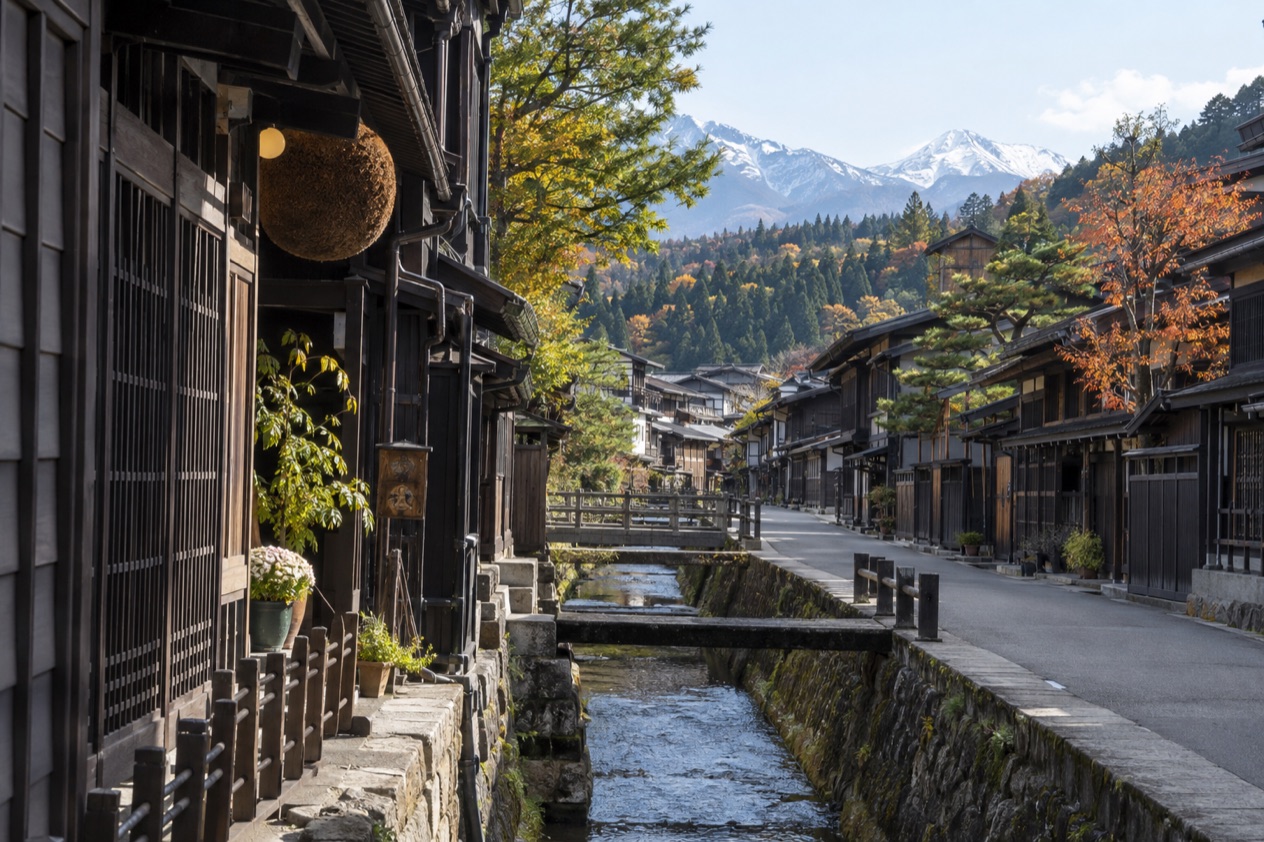
In the first days of October, lacquered floats roll through the streets of Takayama behind teams of men in happi coats, and wooden puppets on top of them perform to the beat of drums and flutes. The old merchant streets, with their dark timber fronts and sake breweries, make a fitting backdrop. The rest of the month settles into a mountain town in autumn, with cool air, mushrooms and persimmons on the menu, and sweater weather for walking.
What is the weather like in Takayama in October?
| Month | Average high (°F) | Average low (°F) | Precipitation (in) | Days with 1 mm or more of precipitation | Hours of sunshine | Daylight on the 15th |
|---|---|---|---|---|---|---|
| September | 79.0 | 60.6 | 8.89 | 12.0 | 132 | 12 h 28 min |
| October | 67.8 | 48.6 | 6.12 | 10.3 | 129 | 11 h 20 min |
| November | 55.6 | 37.2 | 3.72 | 10.4 | 101 | 10 h 17 min |
October in Takayama is cool and often damp, a month of crisp layers rather than summer shirts. Afternoons reach the high 60s, which suits a long walk through the old town in a light jacket, while nights drop into the upper 40s. Takayama sits in the mountains of Gifu Prefecture, and the air feels it.
Rain falls on about one day in three, and the month is far drier than September. Humidity stays high, so a gray, soft-edged day is as likely as a bright one, and a compact umbrella earns its place in your bag. Sunshine totals are close to September’s, even though the days are getting shorter.
The shorter days change the rhythm of a visit. Daylight is already more than an hour shorter than in mid-September, so the old streets are worth seeing while it is light, and evenings belong to warm bowls of noodles and sake. Pack a sweater for dinner and a rain layer for the day.
What to do in Takayama in October
The Autumn Takayama Festival, held on October 9 and 10, is the reason people choose this month. It belongs to the town’s long tradition of float processions, and it gives the old streets a stage that the rest of the year does not. Beyond the festival, the month suits the things Takayama does well: walking its preserved quarter, tasting local sake and Hida specialties, and taking in mountain-town autumn.
The Autumn Takayama Festival
Takayama holds two big festivals a year. The spring one, on April 14 and 15, centers on the Hie Shrine and is held to pray for a good harvest. The autumn one comes with the harvest itself and is centered on the shrine of the upper town, Sakurayama Hachiman. The floats, called yatai, are tall, lacquered and carved, and some carry karakuri, mechanical puppets that move on strings.
Over the festival days the floats are pulled through the streets of the old town, and the neighborhoods that own them turn out in traditional dress. Food stalls set up along the route, and you hear flutes and drums in the lanes. If you arrive after the festival days, the floats are not out on the streets, though the town keeps the pride of the tradition in its shop windows, posters and conversations.
Sanmachi Suji and the old town
The Sanmachi Suji district is the part of Takayama that earned it the nickname Little Kyoto of Hida, thanks to its well-preserved quarter of Edo-style streets. Dark wooden merchant houses with latticed windows line narrow lanes, and many shops sell crafts, pickles, sweets and sake. Sake breweries announce themselves with a ball of cedar branches, a sugidama, hanging over the door.
In October’s cool air, this is a good place to stop often, stepping in and out of shops, and warming up with a snack. Grilled rice dumplings glazed with soy sauce, called mitarashi dango, are the kind of thing you eat standing in the street. Along the Miyagawa river, there is also a daily market tradition of local vegetables, pickles and crafts.
Sake, Hida beef and mountain flavors
Autumn in the Japan Alps is mushroom season, and menus tend to follow it with foraged mushrooms in hot pots and rice dishes. Hoba miso, a sweet-salty paste grilled on a dried magnolia leaf over a small flame, is a Hida habit that suits the cooler weather.
Takayama also has a local style of ramen, with a clear, soy-flavored broth and thin curly noodles, which is just what the damp days call for. The town’s sake breweries, several in the old quarter, pour tastings for visitors. Persimmons and chestnuts show up in sweets, which makes October a good month to eat your way through the streets.
Beyond the old town, the Takayama Jinya, a former government office of the feudal era, and the open-air Hida Folk Village, with its thatched farmhouses, are both sights that fill a half day. Rainy hours go well with them, since much of the visit is under roofs and eaves.
A two-day itinerary for Takayama in October
Day 1 belongs to the old town. Start with the market along the Miyagawa river, where vegetables, pickles and crafts are laid out, and have a coffee or a rice-ball snack. Then walk into Sanmachi Suji, stopping at a sake brewery for a tasting and browsing the craft shops, while the day is still light.
Have lunch at a place that serves Hida beef or Takayama ramen, then spend the afternoon at the Takayama Jinya, whose rooms and storehouses tell the story of the town’s old administration. In the evening, look for an izakaya, a casual pub, that serves hoba miso and local sake, and let the shortened days set the pace.
Day 2 moves out to the Hida Folk Village, an open-air collection of old farmhouses from the mountain region, where you walk between thatched roofs and gardens. Back in town, the afternoon is for the shrines of the upper town, including Sakurayama Hachiman, home of the autumn festival, and for any craft shop you passed on the first day.
If rain sets in, stay under cover. The Takayama Jinya, the sake breweries and the museums and teahouses of the old town are all good ways to spend a damp hour. Finish with a dinner of mushroom hot pot or grilled Hida beef, a fitting meal for a cool October night.
Is Takayama busy in October?
The busiest stretch of October is its first days, when the Autumn Takayama Festival fills the old town with floats, dancers and food stalls. That is the moment the town’s calendar is at its fullest, and a trip planned around the festival is a different experience from one planned for the quiet of the weeks after it.
Once the festival has passed, the month settles into the ordinary rhythm of a mountain town in autumn. The old streets, the markets and the museums go on as usual, and the weather, with its shorter days and cool nights, sets the pace. Mornings in the lanes and evenings in a warm restaurant are the heart of the visit.
Takayama’s cherry blossoms come in the middle to the end of April, about three weeks later than in Nagoya, which marks April as the town’s other big moment. October is the autumn counterpart, with the festival as its high point, and the rest of the month for slower, cooler days.
What to pack for Takayama in October
The days are cool and the evenings cooler, and rain comes often, so think in layers that you can add and remove as you move between streets and interiors.
- A light jacket or fleece, for afternoons in the old town.
- A warm sweater, for evenings when the temperature drops into the upper 40s.
- A compact umbrella or rain shell, since rain falls on roughly a third of the days.
- Comfortable shoes that handle damp pavement, for hours of walking between the market, the streets and the folk village.
- Some cash in your wallet, because Takayama Station on the JR Takayama Line does not accept IC cards and local line tickets are bought in cash.
Good to know before you go
October in Takayama is a rainy month by degrees, wetter than November but a good deal drier than September, so showers are part of the plan rather than a surprise. The Autumn Takayama Festival falls on October 9 and 10 each year, and the dates matter if you want to see the floats on the street.
Takayama is in the Chubu region of Japan, near the northern Japan Alps, and the mountain setting makes the evenings noticeably cooler. If you plan to take a local train out of Takayama Station, bring cash for the ticket, since IC cards are not accepted there.
Takayama in October vs September and November
Moving the trip four weeks earlier brings warmer, wetter weather. September has the heaviest rain of the three months and the longest days, with highs near 80 degrees, so it feels like summer lingering. It comes before the Autumn Takayama Festival, so the floats are not out on the streets, and the town’s food shifts toward the lighter dishes of late summer.
Four weeks later, in November, the air is distinctly colder, with highs in the mid-50s and nights near freezing. The rain eases and sunshine drops. Daylight is shorter still, so the old town days feel compressed, and hot bowls of ramen and sake become the main attraction.
Choose September if you want warmth and do not mind rain. Choose October if you want the festival and cool, comfortable walking weather. Choose November if you prefer cold, dim streets and warming food, and you are happy to give up the festival.
Is October a good time to visit Takayama?
Yes, October is a good time to visit Takayama, especially for travelers who like cool-weather walking, festival traditions and the food of a mountain town in autumn.
It is less suited to anyone who wants warm weather for outdoor swimming or short sleeves, or who prefers the cherry blossoms of April. The evenings need a sweater, and rain falls often enough that a flexible plan helps.
On arrival, begin in Sanmachi Suji, where the wooden streets, the brewery signs and the market by the river set the tone for everything else. Then let the weather decide the order of the rest, with museums and teahouses for the wet hours and the folk village for the dry ones. October in Takayama is the sound of festival drums early in the month and the glow of lanterns on dark timber streets after it.
Sources
- Japan Meteorological Agency (JMA), Normal values 1991-2020, monthly (https://www.data.jma.go.jp/stats/etrn/view/nml_sfc_ym.php?prec_no=52&block_no=47617), station Takayama, elevation 560 m, checked October 11, 2026
- Computed from the date and the latitude of the place (sunrise equation, solar elevation -0.833 degrees), October 11, 2026
- Japan Meteorological Agency, Emergency Warnings (https://www.jma.go.jp/jma/en/Emergency_Warning/ew_index.html), checked October 11, 2026
- Japan National Tourism Organization, safety information (https://www.japan.travel/en/japan-safe-travel-information/), checked October 11, 2026
- Japan National Tourism Organization, weather and seasons in Japan (https://www.japan.travel/en/plan/weather/), checked October 11, 2026
- Japan Meteorological Agency, maple color-change dates 2025-2026 with difference from the 1991-2020 normal (https://www.data.jma.go.jp/sakura/data/phn_014.html), checked October 11, 2026
- Japan Meteorological Agency, kaede2020.pdf (https://www.data.jma.go.jp/sakura/data/kaede2020.pdf), checked October 11, 2026
- Japan National Tourism Organization, festivals and events (https://www.japan.travel/en/see-and-do/festivals-and-events/), checked October 11, 2026
- Wikipedia, Matsuri (https://en.wikipedia.org/wiki/Matsuri), checked October 11, 2026
- Wikipedia, Takayama Festival (https://en.wikipedia.org/wiki/Takayama_Festival), checked October 11, 2026
- Japan Meteorological Agency, biological season observations (https://www.data.jma.go.jp/sakura/data/index.html)
- Wikivoyage, Takayama (https://en.wikivoyage.org/wiki/Takayama), checked October 11, 2026
- Wikipedia, Takayama, Gifu (https://en.wikipedia.org/wiki/Takayama,_Gifu), checked October 11, 2026
To plan your stay
- Things to Do in Takayama: Old Town Streets, Morning Markets, Hida Beef and Festival Floats
- Where to Stay in Takayama: Station Area, Old Town Streets, Morning Market and Ryokan
- Takayama from Nagoya: The Hida Limited Express, Ways to Go and a Day in the Old Town
- Takayama Festival: Yatai Floats, Lantern Processions and Spring and Autumn Dates