
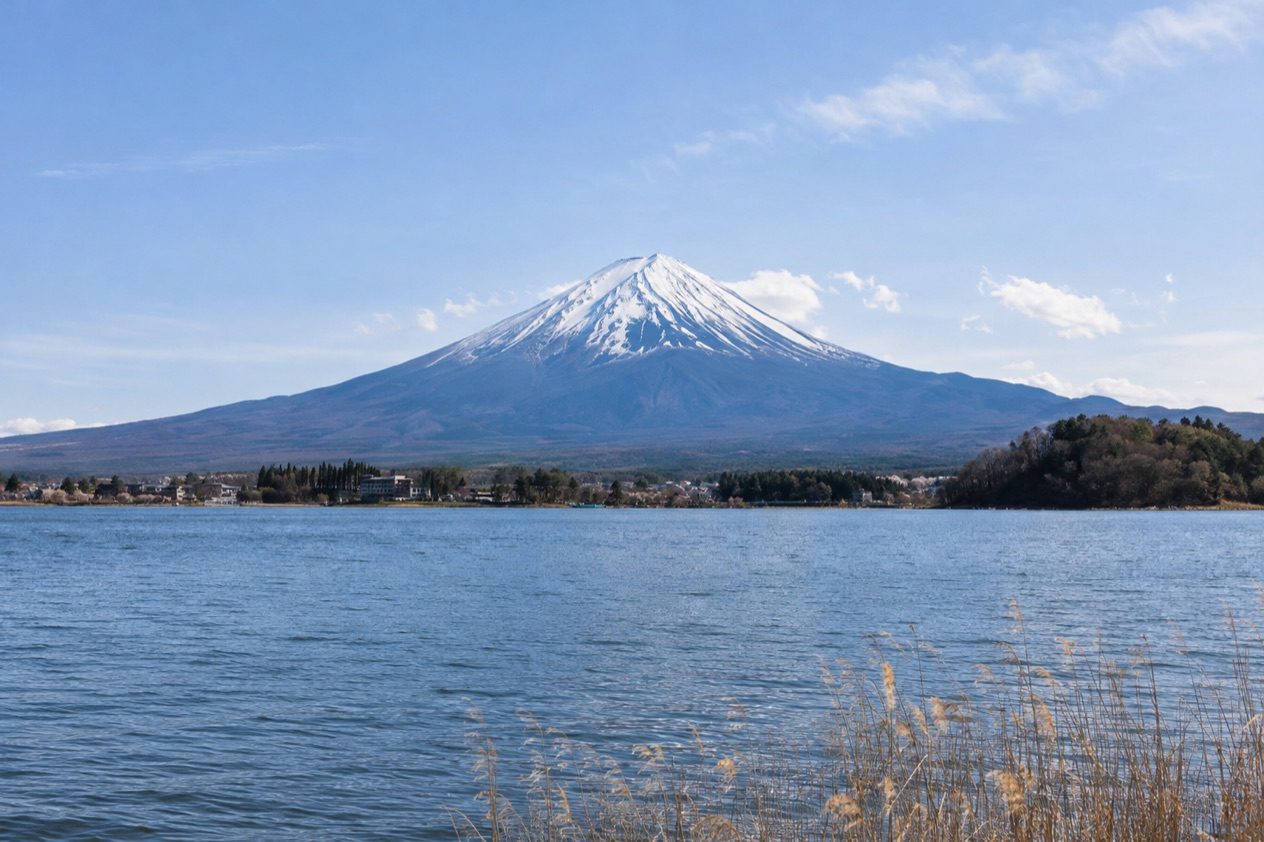
On a clear morning at the Fuji Five Lakes, the mountain fills the far side of the water so completely that people stop on the lakeshore with their coffee and just look. When cloud sits on the summit, the lakes keep their own charm, with boats tied along the banks and hotel windows facing the slopes. This is the area at the foot of Mount Fuji where you come to see the mountain from several shores, spend a night or two beside a lake and add a forest walk or a theme park.
Is visiting the Fuji Five Lakes worth it?
Yes, if you want to see Mount Fuji from close by rather than as a shape on the horizon, and especially if you like to slow down beside water with a big view. Visitors who can see the mountain from Tokyo only in the distance often come here to stand at its base, in the Yamanashi Prefecture, and to look at it from a lake.
What sets the Five Lakes apart from other places around the mountain is the arrangement. The five lakes sit in an arc around the northern half of Mount Fuji, and they were created by earlier eruptions of the volcano.
Each one has a different character: one with hotels and boat rides, one that is the largest and highest, one that is deep, one that is small. You can treat the area as a single outing or as a string of different shorelines, and a stay of a night or more lets you take in more than one.
It also offers more than lake views. A forest, the starting point of mountain promenades and an amusement park are all nearby, so the area suits couples, friends, families with older children and anyone who likes to mix a quiet lakeside morning with something livelier in the afternoon. The plateau sits about 3,300 feet above sea level, which gives it a cooler, mountain feel that changes with each season.
What to see at the Fuji Five Lakes
The lakes are the heart of the visit, and each rewards a different mood. Around them are a forest, the mountain itself and a park built for thrill-seekers.
Lake Kawaguchi
Lake Kawaguchi is the lake with the most going on along its banks. A large number of hotels line the shore, and local operators offer boat rides to visitors. It is also the only one of the five with an island, a small detail that gives the water a focal point when you look across it.
This is the lake to choose if you want a base with lodging within sight of the water. Walk the shoreline, watch the boats, and look for the mountain rising behind the opposite bank.
Lake Yamanaka
Lake Yamanaka is the easternmost of the five and the largest. It is also the third highest lake in Japan, standing at 3,220 feet above sea level, so the air by the water carries a real mountain chill outside of summer.
Because of its size, the lake has long open shorelines rather than one cluster of buildings. It suits a day when you would rather look at wide water and the slopes of Fuji than visit things. Bring a layer even when the sky is bright, since the altitude cools the evenings.
Lake Motosu, Lake Shoji and Lake Saiko
Lake Motosu is the ninth deepest lake in Japan, at 460 feet. That depth, in a lake formed by past eruptions of the volcano, gives the water a dark, serious look when you stand at its edge. Lake Shoji is the smallest of the five, and its smaller scale makes it feel like a modest, close-in corner of the region.
Lake Saiko completes the group. Together these three lakes are good for visitors who have seen Kawaguchi and want to see how different the same mountain can feel from a smaller or deeper shore. They give you a reason to keep circling the arc instead of staying in one place.
Aokigahara Jukai Forest
Aokigahara Jukai Forest is another point of interest in the Five Lakes area. A forest like this is a different kind of outing from the lakes: you trade open water and sky for a canopy overhead and a hush that muffles ordinary sounds.
It pairs well with a lake morning, as a change of scenery rather than a destination of its own. Look at the moss, the trunks and the way the light drops through the trees.
How to get to the Fuji Five Lakes
The Fuji Five Lakes lie in the Yamanashi Prefecture, at the base of Mount Fuji, and the lakes are spread in an arc around the northern half of the mountain. That layout is the most useful thing to know when you plan the approach, because it tells you that the lakes are separate shorelines rather than one town.
Many travelers start from Tokyo, where Mount Fuji can be seen in the distance, which is the first hint of where you are heading. Shizuoka also lies at the foot of the mountain, so the mountain is reachable as a destination from more than one side, and the Five Lakes are the part that wraps its northern half.
Once you arrive, Lake Kawaguchi is the lake where hotels crowd the banks, so it is the one that works as a base for staying overnight. Lake Yamanaka marks the eastern end of the arc, while Motosu, Shoji and Saiko fill in the remaining shorelines. Think of the area as a circuit to explore from a lakeside base, with the mountain as the constant point on the horizon.
The mountain itself has four hiking trails, named Yoshida, Subashiri, Gotemba and Fujinomiya. Promenades also depart from the fifth station of Mount Fuji, which makes a walk on the mountain part of the wider area. Anyone planning to climb is strongly advised to check the latest information on the Official Website for Mt. Fuji Climbing.
When to visit the Fuji Five Lakes
The lakes have a different face in each season, so the right month depends on what you want from the mountain air.
| Month | Average high (°F) | Average low (°F) | Rain days | Precipitation (in) | Sunshine (hours) |
|---|---|---|---|---|---|
| January | 41.9 | 21.7 | 4.9 | 2.40 | 212 |
| April | 61.0 | 38.7 | 8.5 | 4.18 | 186 |
| July | 81.0 | 64.4 | 11.7 | 7.02 | 148 |
| October | 64.9 | 47.7 | 10.1 | 9.06 | 134 |
January is cold and bright, with a lot of sunshine and snow falling on a number of days. Pack for a deep chill, since lows fall well below freezing. April is cool, with a chance of a last snow flurry, and it brings more rain than winter.
July is warm and humid, with showers on many days and fewer hours of sun. October, the month of this visit, is mild by day and cool at night, but it is the wettest of the four months in the table, so expect damp days and plan for rain gear. A gray day still has its charm at a lake, though the mountain may hide behind cloud.
The climbing season on Mount Fuji ends on September 10th, so in October the trails are no longer part of an open season. During winter the Yoshida, Subashiri and Gotemba trails are closed from the fifth station to the summit, while the Fujinomiya trail is closed from the sixth station to the summit.
The summit is far colder than the lakes: in October its average high is about 33°F, and its average low is near 23°F. Mountain weather is a reason to look up the latest word on the official climbing website before you go.
Tips for your visit
Dress in layers, because the plateau sits high and the temperature changes between a bright afternoon and a cold evening. A waterproof jacket earns its place in the bag in most seasons, with October and July the wettest months in the table. In winter, add warm gloves and a hat, since snow falls on a good share of January days.
Pair a lake with something else rather than rushing between all five. A morning beside Lake Kawaguchi could be followed by a forest walk in Aokigahara, and another day could go to Lake Yamanaka or the smaller lakes. The mountain promenades that depart from the fifth station are another way to spend a day close to Fuji.
Fuji-Q Highland
Fuji-Q Highland is an amusement park near the Fuji Five Lakes, and it features one of the world’s highest roller coasters. It is the obvious addition for anyone traveling with teenagers or friends who want thrills after a day of looking at water.
It changes the pace of a trip completely, trading lakeside stillness for screams and speed. If your group is split between those who want views and those who want rides, the two sit near each other, so everyone can have a day to their taste.
Viewpoints and planning
The Japan National Tourism Organization’s Mount Fuji guide covers 30 viewpoints for admiring the mountain, a reminder that the Five Lakes are only one way to see it. Using several shores gives you several angles, which helps when cloud hides the peak from one spot.
Allow a night at a lake if you can, so that you wake beside the water and see how the light shifts. Families with young children and travelers who prefer a gentler pace may like to stay in a single lakeside base and take the other lakes one at a time.
Good to know before you go
The mountain is a protected landscape and a UNESCO World Heritage site, so treat the trails, lakeshores and forest with care. Mountain weather changes quickly, and conditions at the summit are far harsher than at the lakes, which is why anyone planning a climb is asked to consult the official climbing website for the latest information.
October brings steady rain at the lakes, so build slack into the days. Carry a little cash and a card for the lakeside hotels and shops, and bring a warm layer for the evening chill.
Sources
- Japan National Tourism Organization, Mount Fuji guide (https://www.japan.travel/en/fuji-guide/), checked October 11, 2026
- Wikipedia, Fuji Five Lakes (https://en.wikipedia.org/wiki/Fuji_Five_Lakes), checked October 11, 2026
- Official website for Mt. Fuji climbing, about the climb (https://www.fujisan-climb.jp/en/about/), checked October 11, 2026
- Japan Meteorological Agency (JMA), Normal values 1991-2020, monthly (https://www.data.jma.go.jp/stats/etrn/view/nml_sfc_ym.php?prec_no=49&block_no=47640), station Kawaguchiko, elevation 860 m, checked October 11, 2026
- Japan Meteorological Agency (JMA), Normal values 1991-2020, monthly (https://www.data.jma.go.jp/stats/etrn/view/nml_sfc_ym.php?prec_no=49&block_no=47639), station Fujisan, elevation 3,775 m, checked October 11, 2026
To plan your stay
- Best Time to Visit Japan: Cherry Blossoms, Autumn Colors, Weather and Festivals
- Where to Stay in Japan: Ryokan, Temple Stays, Capsule Hotels and the Best Cities to Base In
- Sending Luggage from the Airport in Japan: Hands-Free Travel, Hotel Delivery and Coin Lockers
- Know Before You Go to Japan: Entry, Money, Etiquette and Getting Around