
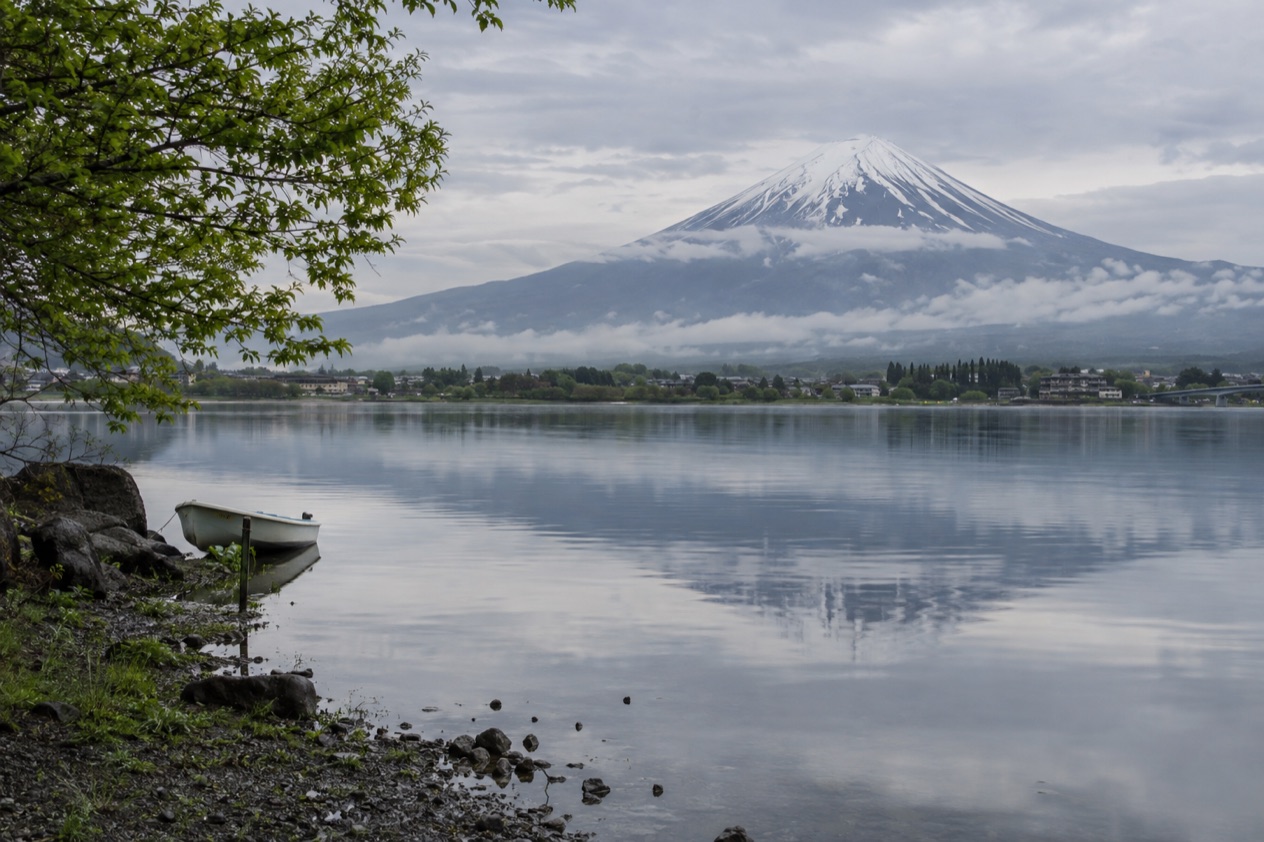
In June, cloud drifts across the slopes of Mount Fuji until the cone appears and disappears in the time it takes to finish a bowl of hoto, the thick miso noodle stew of Yamanashi. Along Lake Kawaguchi the grass is a deep wet green, hydrangeas open beside the paths, and the mountain is something you wait for rather than something you simply see. It is a month of lakeside walks, hot food and soft light, just before the official climbing season begins.
What is the weather like in Mount Fuji and Lake Kawaguchi in June?
June at Lake Kawaguchi is mild by day, cool at night and clearly wetter and grayer than May, with rain falling on roughly every third day. The lake sits at 860 meters, which is why the air stays fresher here than it does in the lowland cities.
| Month | Average high (°F) | Average low (°F) | Precipitation (in) | Days with 1 mm or more of precipitation | Hours of sunshine | Daylight on the 15th |
|---|---|---|---|---|---|---|
| May | 69.1 | 48.0 | 4.85 | 9.4 | 181 | 14 h 01 min |
| June | 73.4 | 56.7 | 6.19 | 11.5 | 123 | 14 h 32 min |
| July | 81.0 | 64.4 | 7.02 | 11.7 | 148 | 14 h 21 min |
What this means in practice: afternoons are comfortable in a light shirt, and evenings call for a sweater or a thin jacket. The nights have lost the chill of May, but they are still far from the warmth of July. Humidity sits around 80 percent, so the air feels damp even on days when it does not rain, and clothes dry slowly.
The sun shows itself much less than in May. Gray skies are the rule more often than the exception, and the mountain spends many hours behind cloud. When the clouds do lift, the views are crisp and the greens look washed. Daylight is long, the longest of the three months in the table, so a day of walking by the lake does not feel rushed.
Higher up the mountain the picture is very different. At the summit, June averages hover around freezing, which is one reason the climbing season has not yet started. Down at the lake, bring a compact umbrella or a light rain jacket, shoes that can take wet paths, and one warm layer you can take off.
What to do in Mount Fuji and Lake Kawaguchi in June
June is a month for the things that suit damp, soft weather: walking the lakeshore, looking at flowers, eating something hot and sitting in a hot spring while rain taps on the roof. The summit climb belongs to another season, because the climbing season typically runs from the beginning of July to about the first week of September, and the official site gives its end date as September 10th.
Climbing outside the season is described as extremely dangerous, since first-aid centers and mountain huts are closed, cell phone service is lost and the weather turns severe. Anyone set on the climb should read the latest information on the Official Website for Mt. Fuji Climbing.
What June gives you in exchange is the mountain as a presence. Mount Fuji is the highest mountain in Japan and a UNESCO World Heritage site, added to the list as a cultural site on June 22, 2013, honored as a sacred place and a source of artistic inspiration. On clear days it can be seen from Tokyo, and from the lake its shape fills the sky when the cloud allows.
Walking and looking around Lake Kawaguchi
The lake is the natural base for a June visit, a stretch of water edged by paths, small museums, cafés and guesthouses. The pleasure here is slow. You walk a section of the shore, stop where the view opens, and wait a little. Reflections of the mountain on the water are a famous image, but in June they come and go with the cloud, so treat each glimpse as a gift rather than a promise.
Rain is part of the scene, not an interruption. Wet leaves shine, mist lies on the hills across the water, and the lake takes on a gray-green tone that photographs well even without the summit in the frame. A small museum or a gallery makes a good stop when a heavier shower arrives, and the Itchiku Kubota Art Museum, devoted to kimono art, is the kind of place that suits a gray afternoon.
Bring waterproof shoes, because the paths can be muddy after rain. This outing suits anyone who likes to wander without a fixed plan and who is content to let the weather set the pace.
Hydrangeas and the flowers of the rainy season
In Japan, hydrangeas are the flower people associate with the damp months of early summer, and the species is native to the country, with the greatest variety found across eastern Asia. In gardens, temple grounds and along roadsides, the round blue, pink and violet flower heads are a reason to go outdoors even when the sky is gray. Rain makes the colors deeper, and a wet petal is one of the better subjects for a June photograph.
There is a small cultural footnote worth knowing. In Japan, ama-cha, meaning sweet tea, is an herbal tea made from the leaves of Hydrangea serrata, which develop a sweet taste thanks to a compound called phyllodulcin. If you see ama-cha on a menu, it is a way to taste the flower of the season, and it makes a gentle contrast with the heavier food of the area.
Hot bowls, noodles and a day indoors
Cool, damp days are the right weather for hoto, the wide, flat noodles simmered in miso broth with pumpkin and vegetables that Yamanashi is known for. It arrives bubbling in an iron pot, and a bowl is a full meal. Alongside it you might find simmered mountain vegetables, grilled river fish and local sweets, all of which fit the mood of a gray afternoon better than a salad ever could.
A hot spring bath is the natural companion to a rainy day. Many inns around the lake offer onsen bathing, and soaking while the rain falls outside is one of the quiet pleasures of the season.
As a general habit, bathers wash before entering the water, and the rules of each inn are posted at the entrance. Ending a day with a bath, a hot meal and a view of the lake, clouded or not, is a good summary of June here.
A two-day itinerary for Mount Fuji and Lake Kawaguchi in June
Day 1 belongs to the lake itself. Start the morning with a slow walk along the shore, jacket on and umbrella in the bag, and keep an eye on the mountain, which may appear at any moment. Lunch is a pot of hoto in a local noodle restaurant, a hot, filling meal that suits damp weather. With daylight lasting into the evening, there is no hurry to cover everything in one afternoon.
In the afternoon, visit a museum or a gallery by the water and then look for hydrangeas in gardens and along the paths. Stop at a café for a cup of tea, perhaps the sweet ama-cha. In the evening, settle in at your inn for a hot spring soak and a dinner of local dishes, and let the gray sky do what it likes outside the window.
Day 2 widens the view. Start with the lakeside cable car known as the Kachi Kachi Ropeway if the cloud looks like it might lift, since a ride up the hillside gives a different angle on the water and, with luck, on the mountain. If the cloud sits low, spend the morning on foot around another corner of the lake, or on the water itself with a sightseeing boat.
Lunch can be a lighter meal of noodles or a set meal at a lakeside café. The rain card for the afternoon is a visit to an indoor museum, a ceramics or craft shop, or a long soak in an onsen. If the weather is clear, take the camera back to the water and watch the mountain come out of the cloud before you leave.
Is Mount Fuji and Lake Kawaguchi busy in June?
June is the stretch between the spring flower season and the summer climbing period, and it sits just before the busiest time on the mountain. The most popular period to hike up Mount Fuji is from July to August, when the huts and facilities are operating and the weather is warmest, so June comes before that rush rather than during it.
The wet weather shapes the month as much as the calendar does. Gray skies and frequent rain mean that many people see the lake under cloud, and the mood is that of a place waiting for summer. Walkers share the paths with people who have come for the flowers, the hot springs and the food, and no one is there for the summit.
For a visitor, the pace of June is slower than in the weeks that follow. The days are long, the air is cool and damp, and the main decision is how to arrange a day around the clouds. Anyone who wants the summit hike will need to come in the climbing season, while anyone who wants the lake, the food and the hydrangeas will find June well suited to them.
What to pack for Mount Fuji and Lake Kawaguchi in June
June here asks for layers and for rain gear, because days are mild, nights are cool and rain falls often. These are the items that earn their place in the bag.
- A light rain jacket or a compact umbrella, since rain falls on about every third day.
- Waterproof shoes with good grip, for muddy lakeside paths after rain.
- A sweater or thin fleece, because evenings are cool at the lake.
- Breathable short-sleeved shirts, for mild, damp afternoons.
- A small towel or quick-dry cloth, handy after a shower or a bath.
- A camera with a protective cover, for misty views and wet flowers.
Good to know before you go
June comes before the climbing season, so the mountain trails are not set up for hiking. The Official Website for Mt. Fuji Climbing is the place to read the latest information, and it states that climbing outside the season is extremely dangerous. For a June trip, plan around the lake, the food and the hot springs, and treat any view of the summit as a bonus.
Humid air and frequent rain are the main facts of the month, so build in slack and indoor options. Daylight lasts well into the evening, which gives you time to wait for a break in the cloud.
Mount Fuji and Lake Kawaguchi in June vs May and July
Moving four weeks earlier, to May, brings drier, brighter days, with far more sunshine and fewer rainy days. Nights are noticeably cooler, so a warmer layer matters more. The lake feels fresher and the sky is more open, which makes the mountain easier to see. If the view of Fuji is your priority, May gives you better odds.
Moving four weeks later, to July, brings warmer air and the start of the climbing season, which typically opens at the beginning of the month. Rain stays about as frequent as in June and falls in greater amounts, and the heat and humidity rise. July suits anyone who wants to climb the mountain, because the huts and facilities are running and the weather is warmest.
Choose May for the clearest views and cooler walking, June for hydrangeas, hot food and a damp, moody lake, and July for the climb and for summer warmth. If you want the mountain itself underfoot, shift to July. If you want the lake without the summit rush, stay with June.
Is June a good time to visit Mount Fuji and Lake Kawaguchi?
Yes, for travelers who enjoy soft, gray weather, lakeside walks and a meal in a warm room, and who are not counting on a perfect view of the summit. June suits slow travel, photographers who like mist and wet leaves, and anyone who wants the lake before the summer climbers arrive.
It is a poorer choice for anyone whose trip depends on a clear mountain or on climbing, since the sky is often covered and the trails are not yet in season. Those travelers will be happier in another month.
On arrival, head straight for the water, walk a stretch of the shore and see what the cloud allows. Then settle into a bowl of hoto and plan the rest of the day around the sky. What is special about June here is the way the mountain is half hidden: the shape comes and goes behind the rain, and a single clear glimpse over the lake feels earned.
Sources
- Japan Meteorological Agency (JMA), Normal values 1991-2020, monthly (https://www.data.jma.go.jp/stats/etrn/view/nml_sfc_ym.php?prec_no=49&block_no=47640), station Kawaguchiko, elevation 860 m, checked October 11, 2026
- Japan Meteorological Agency (JMA), Normal values 1991-2020, monthly (https://www.data.jma.go.jp/stats/etrn/view/nml_sfc_ym.php?prec_no=49&block_no=47639), station Fujisan, elevation 3,775 m, checked October 11, 2026
- Computed from the date and the latitude of the place (sunrise equation, solar elevation -0.833 degrees), October 11, 2026
- Japan National Tourism Organization, weather and seasons in Japan (https://www.japan.travel/en/plan/weather/), checked October 11, 2026
- Wikipedia, Climate of Japan (https://en.wikipedia.org/wiki/Climate_of_Japan), checked October 11, 2026
- Japan National Tourism Organization, flowers by season: cherry blossom, plum, wisteria, hydrangea, where and when (https://www.japan.travel/en/see-and-do/flowers/), checked October 11, 2026
- Wikipedia, Hydrangea (https://en.wikipedia.org/wiki/Hydrangea), checked October 11, 2026
- Japan National Tourism Organization, summer in Japan (https://www.japan.travel/en/guide/summer-guide/), checked October 11, 2026
- Japan National Tourism Organization, Mount Fuji guide (https://www.japan.travel/en/fuji-guide/), checked October 11, 2026
- Official website for Mt. Fuji climbing, about the climb (https://www.fujisan-climb.jp/en/about/), checked October 11, 2026
- Official website for Mt. Fuji climbing, information (https://www.fujisan-climb.jp/en/info/), checked October 11, 2026
- Wikipedia, Mount Fuji (https://en.wikipedia.org/wiki/Mount_Fuji), checked October 11, 2026
- Wikivoyage, Mount Fuji (https://en.wikivoyage.org/wiki/Mount_Fuji), checked October 11, 2026
To plan your stay
- Things to Do in Mount Fuji and Lake Kawaguchi: Lakeside Views, Fuji-Q Highland, Hiking Season and Local Food
- Where to Stay in Mount Fuji and Lake Kawaguchi: Lakeshore Hotels, Fujiyoshida, Mountain Lodges and Ryokan
- Mount Fuji and Lake Kawaguchi from Tokyo: Fuji Excursion, the Fujikyuko Line and Climbing Season
- Best Views of Mount Fuji: Five Lakes, Fifth Station Promenades and When to Go