
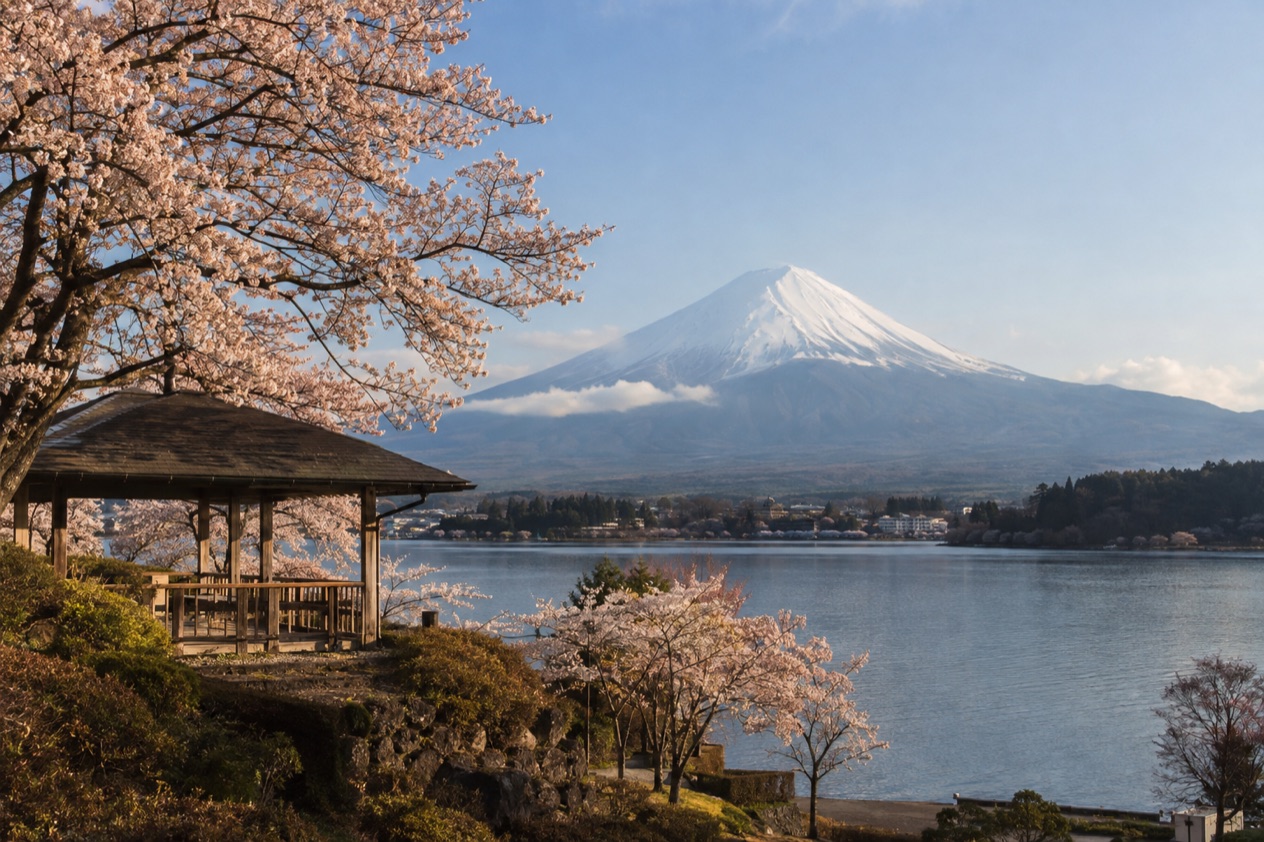
Along the shore at Lake Kawaguchi, the water goes still and the cone of Mount Fuji sits on the far side of it, upside down in the surface when the air allows. Cyclists roll past, anglers stand with their lines out, and the cool air carries a hint of pine and lake mud. This is a mountain lake town in Yamanashi Prefecture, built for slow days outdoors, for travelers who want Fuji as a neighbor rather than a checkmark.
Where is Lake Kawaguchi and what is it like?
Lake Kawaguchi lies in the town of Fujikawaguchiko, in southern Yamanashi Prefecture, in the foothills on the north side of Mount Fuji. It is one of the Fuji Five Lakes, and it sits inside the Fuji-Hakone-Izu National Park. This is a lake resort, not a seaside town and not a city: a ring of water with a mountain behind it, and small towns, inns and museums spread along the shore.
The five lakes run from east to west as Yamanaka, Kawaguchi, Sai, Shoji and Motosu. Three of them, Kawaguchi, Sai and Shoji, belong to the same town of Fujikawaguchiko. That gives the area a loose, spread-out feel, with each lake having its own mood. Sai is known for its birdsong, which the Ministry of the Environment named among the 100 Soundscapes of Japan, so a morning there is as much about listening as looking.
The pace is set by the altitude and the water. The lake sits at roughly 800 meters (about 2,600 feet), which gives it cool summers and winters that are often icy.
Days here tend to be built around a walk, a boat or bike ride, a meal, and a long look at the mountain. Travelers who like being outdoors and don’t need nightlife will feel at home. Those who want a dense city evening of neon and late-night izakaya will find the town quiet by comparison.
The lake has one curious detail in its history. It has no natural outlet, and flooding was a real problem until a canal opened in 1914 to link it to a tributary of the Sagami River. It is a small reminder that this calm stretch of water has always been shaped by people living beside it.
What is there to do in Lake Kawaguchi?
The reasons to come here are simple and they overlap: Fuji itself, the water, the neighboring lakes, and the mountain air. The Fujikyuko Line reaches Kawaguchiko, making the lake accessible by rail.
Looking at Mount Fuji from the shore
The north shore of the lake faces the mountain, so the simplest plan is also the best one: walk or cycle along the water and stop whenever the view opens. Reflections, wisps of cloud around the summit and the shape of the cone changing through the day are the real show. Cafés and small museums along the shore give you somewhere warm to sit when the wind comes off the lake.
Fuji does not always show itself. Cloud can hide it for a whole day, so it helps to treat the view as a bonus and to leave time in the plan. A second morning often changes everything.
Fishing and time on the water
Japanese white crucian carp and wakasagi, a small freshwater smelt, were introduced to the lake in the Meiji period, and sports fishing is popular here. Even if you never pick up a rod, watching the anglers along the banks is part of the lake’s rhythm. The shoreline also invites a slow circuit on foot or by bike, with benches placed where the mountain looks best.
Pair a lake morning with a long lunch of hoto, the thick miso noodle stew of Yamanashi, and the day takes care of itself.
The other lakes: Sai and Shoji
Lake Sai and Lake Shoji are in the same town, so they fit naturally into a stay. Sai is the one for birdsong and quiet shoreline walking. Shoji is the smallest of the group and rewards anyone who likes a more tucked-away corner of the Fuji Five Lakes.
Lake Yamanaka lies to the east and Lake Motosu to the west, so a longer stay can stitch together several of the five with a different view of the mountain at each stop. Each lake frames Fuji a little differently, and that variety is the point of the area.
How many days do you need in Lake Kawaguchi?
Two days and one night is a good short stay, and three days lets the place breathe. With one night you can arrive, walk the shore, have dinner by the lake and wake up for a second look at the mountain. That second morning matters, because Fuji is often clearer or more dramatic on a different day than on the first.
A day trip from Tokyo is possible, since direct trains and a highway bus reach Kawaguchiko from Shinjuku. It will give you the shoreline and a meal, but it leaves little room for the lake to settle into your day. If you love hiking, cycling or photography, a single day will feel hurried.
With three days, the extra time goes to the neighboring lakes. One day can go to Lake Sai and its birdsong, another to Lake Shoji or a loop that takes in several of the five lakes. Slow days with a long lunch, a museum stop and an evening at an inn with a bath suit the place well.
A longer stay of four days or more suits travelers who want to read, walk, fish or simply wait for the clouds to clear. In that case the area works best as a quiet pause inside a wider Japan trip, a counterweight to a few busy days in Tokyo or Kyoto. Rain or heavy cloud is the moment for indoor time: a café, a museum, a hot bath, a book.
Where to stay in Lake Kawaguchi
The choice comes down to the shore versus the station area. Staying along the lake itself puts the water and the view of Fuji at your door, and it suits travelers who want to wake up to the mountain, walk the shoreline before breakfast and settle into an inn for the evening. Lakeside lodgings are the classic way to experience the place, with the bath, the meal and the view making up the evening.
The area around Kawaguchiko station suits those who arrive by train or bus and want to keep movement simple. The Fujikyuko Line terminates at Kawaguchiko Station, in the town of Fujikawaguchiko. It works well for a short stay of one or two nights and for people who prefer to eat out rather than at an inn.
Staying near Lake Sai or Lake Shoji, both in the same town, gives a quieter, more rural feel. These are the choices for people who want birdsong and a small-scale setting more than shops and restaurants. They fit travelers on a longer stay who already know they want to spend most of the day outdoors.
Since the lake sits at a cool altitude, with icy winters, a warm bath and a heated room are part of what makes the stay good in colder months. In summer the cooler air is a welcome change from the lowland heat.
How do you get to Lake Kawaguchi and get around?
From Tokyo, the usual approach is from Shinjuku, by rail or by highway bus. The Fuji Excursion limited express has run between Shinjuku and Kawaguchiko since 2019, with two roundtrips daily on weekdays and three direct roundtrips on weekends and holidays. The highway bus from Shinjuku station to Kawaguchiko or Yamanakako takes approximately 1 hour 45 minutes.
Within the area, the Fujikyuko Line serves the town of Fujikawaguchiko, with stations at Fujikyu-Highland and Kawaguchiko. Once you are at the lake, the shoreline itself is the main route for walking and for cycling, and the pace of the place suits both. For reaching Lake Sai, Lake Shoji or farther lakes, plan on local transport suited to the distance, since the five lakes are spread along the north side of the mountain.
Because the lakes run in a line from east to west, it helps to think of them as stops on one broad arc around the mountain. Yamanaka lies at the eastern end and Motosu at the western end, with Kawaguchi, Sai and Shoji between them.
When is the best time to visit Lake Kawaguchi?
The lake’s altitude shapes every season. Summers are relatively cool and winters are frequently icy, so the right month depends on whether you want mild lake days or a crisp, cold edge. Spring and autumn bring in-between weather that suits walking and cycling the shoreline, while summer offers a cooler escape from lowland heat.
Winter brings the cold, and with it a clean, sharp look to the mountain when the sky clears. It is a season for inns, baths and short outdoor stints rather than long days outside. Pack for real cold if you come between the colder months, since the lake sits high and the air bites.
Views of Mount Fuji depend on the weather. Outside of the weather, the shoreline is the draw at every time of year, and the town quiets down into a gentle rhythm when the visitors leave.
Good to know before you go
Lake Kawaguchi sits inside the Fuji-Hakone-Izu National Park, and the altitude means the air is cooler than in Tokyo, so bring a layer even when you leave a warm city. The lake is a place for slow, outdoor days: shoes for walking, a jacket for the wind off the water and patience for the mountain to appear are the three things that matter most.
Sources
- Wikipedia, Fujikawaguchiko, Yamanashi (https://en.wikipedia.org/wiki/Fujikawaguchiko,_Yamanashi), checked October 11, 2026
- Wikipedia, Lake Kawaguchi (https://en.wikipedia.org/wiki/Lake_Kawaguchi), checked October 11, 2026
- Wikivoyage, Fuji Five Lakes (https://en.wikivoyage.org/wiki/Fuji_Five_Lakes), checked October 11, 2026