
In October, the mornings at Lake Kawaguchi smell of damp earth and woodsmoke, and the first chill sits on the water until the sun lifts it.
What is the weather like in Mount Fuji and Lake Kawaguchi in October?
October at Lake Kawaguchi is cool and crisp, with pleasant afternoons, cold nights and a fair amount of rain that tapers off as the month goes on.
| Month | Average high (°F) | Average low (°F) | Precipitation (in) | Days with 1 mm or more of precipitation | Hours of sunshine | Daylight on the 15th |
|---|---|---|---|---|---|---|
| September | 74.8 | 58.6 | 10.42 | 11.1 | 122 | 12 h 27 min |
| October | 64.9 | 47.7 | 9.06 | 10.1 | 134 | 11 h 21 min |
| November | 56.8 | 36.0 | 2.99 | 6.7 | 166 | 10 h 20 min |
Afternoons in October suit a light sweater or a fleece, and you can walk around the lake for hours without overheating. Once the sun drops, the air turns sharply cold, so a warmer layer for the evening matters more than anything else you bring. The nights are cold enough that a hot bath at an onsen inn feels like part of the plan.
Rain is still a regular visitor, and humidity stays high, so a gray, damp day is as likely as a bright one. A packable rain jacket earns its place in the bag. The sunshine hours creep up from September, which means more clear spells and a better chance of seeing the cone of Fuji reflected in the lake.
Days are noticeably shorter than in early autumn, so plan the lakeside walks and lookouts for the daylight hours and leave dinner for after dark. Up on the summit it is far colder than at the lake, with temperatures that hover around freezing even at the warmest moment of the day.
What to do in Mount Fuji and Lake Kawaguchi in October
The first thing October gives you is a quieter mountain. The official climbing season is over by now, and the most popular period to hike Fuji runs from July to August, when the huts and facilities are open. For visitors who want to see Fuji rather than climb it, autumn is the time to do it from below: from the lake shores, from viewpoints in the surrounding hills and from the windows of a warm room.
The leaves are the other draw, though they come a little later than the first cold. In October you catch the early turn on the higher ground, with the first reds and golds appearing against the dark evergreens, and the real show still ahead.
Walking and cycling around Lake Kawaguchi
Lake Kawaguchi is the lake people choose as a base, and the shoreline offers plenty of room to wander. You can follow the water on foot, stopping at small cafés, craft shops and lookout points where Fuji fills the frame on clear days.
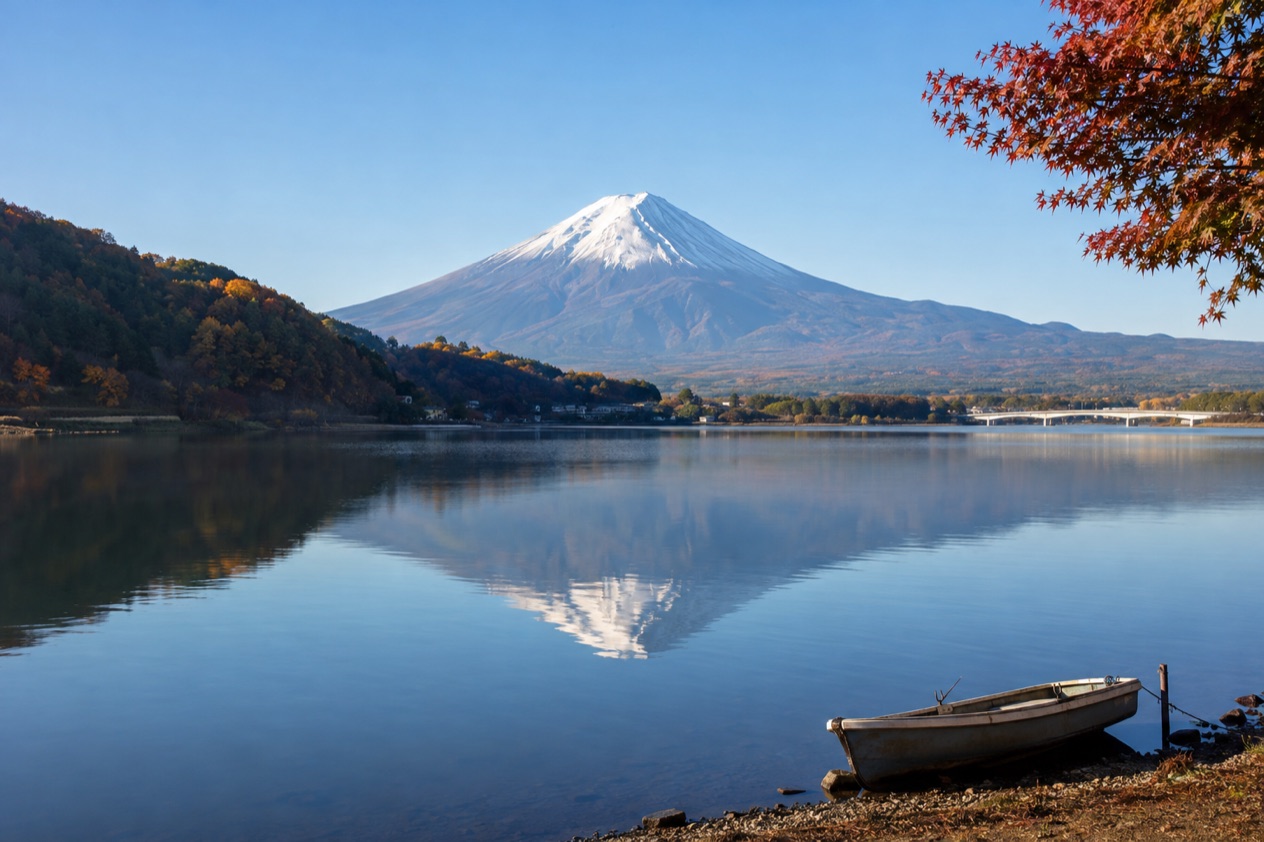
On a clear day, the lake becomes a mirror, and the reflection of the mountain is what photographers hope for. On a cloudy one, the mood shifts to something softer, with mist on the water and the hills disappearing into gray. Both versions are worth the walk, and a day with no view at all can be spent in a museum, a café or a bath.
Fuji from a distance, and the question of the summit
Fuji is Japan’s highest mountain, standing at 3776 meters on the border of Shizuoka and Yamanashi prefectures, and it is a UNESCO World Heritage site. It sits in Fuji-Hakone-Izu National Park, and in October the upper slopes are in full winter conditions, with summit temperatures averaging around freezing at best and well below it at night. Anyone considering the climb is strongly advised to check the latest information on the Official Website for Mt. Fuji Climbing.
For most October visitors, the plan is simply to look. Seen from the north shore of a lake, from a hillside shrine or from a hotel window, the mountain changes by the hour.
Matsuri season and the autumn table
October is a festival month across Japan, a country with a vast number of matsuri, the traditional celebrations built around dance, music and processions. Whether you build a trip around a festival like that or simply stumble on a local shrine fair, the autumn calendar rewards curiosity.
At the table, the cold nights call for hot food. Hoto, the thick wheat noodle stew cooked with pumpkin and vegetables in a miso broth, is the dish of the Fuji area, and it tastes best on a damp evening. Mushrooms, chestnuts and sweet potatoes show up in season, and a warm cup of tea or sake makes a fitting end to a day outside.
If a day turns wet, the area has enough indoor options to fill it: museums, hot springs and the long, slow lunch that a rainy day is made for. The lake does not require clear skies to be worth the trip.
A two-day itinerary for Mount Fuji and Lake Kawaguchi in October
Day 1 starts at the lake. Early morning is cold, so begin with a hot drink and a slow walk along the shore, looking for Fuji across the water.
Give the middle of the day to the lakeside villages and shops, with lunch at a restaurant serving hoto, the noodle stew of the region. With daylight lasting a little over eleven hours, keep the best of the afternoon for an unhurried loop around the water, when the low sun warms the autumn colors.
As the light fades and the air turns cold, head to your inn. An evening bath in an onsen, if your lodging has one, fits the season, followed by a quiet dinner of local dishes.
Day 2 moves away from the water. Spend the morning at a viewpoint or a shrine in the hills, looking at Fuji from a different angle and watching for the first reds in the maples. Lunch can be a simple noodle shop or a café with a window facing the mountain.
In the afternoon, choose something indoors or in the woods, depending on the sky. Finish with an early dinner and a last look at the mountain before dark.
Is Mount Fuji and Lake Kawaguchi busy in October?
October is calmer than the height of summer, because the peak climbing period of July and August is behind you and the huts on the mountain have closed for the year.
The lakeside is at its leisurely pace, with visitors who come for the views, the autumn air and the baths rather than for the climb. The weather shapes the crowds more than any calendar, and a clear, sunny weekend will draw more people to the shore than a gray weekday.
Leaf-viewing is the other force that changes the pace, and it builds toward November, when the colors reach their height in the lower areas. In October you are ahead of that wave, catching the beginning of the color rather than the full season.
For the traveler, the result is a month with room to breathe. Walks along the lake feel unhurried, the cafés have tables, and a view of Fuji, when it shows itself, is more likely to be yours to enjoy slowly.
What to pack for Mount Fuji and Lake Kawaguchi in October
Pack for a day that starts cold, warms into the afternoon and turns cold again after dark, with some chance of rain.
- A warm fleece or sweater, for the cold mornings and evenings by the water.
- A rain jacket, since showers come often and the humidity stays high.
- Comfortable walking shoes for the lakeside paths and the hill trails.
- A scarf and light gloves, because the evening air bites once the sun is down.
- A camera or a phone with a good lens, for Fuji and its reflection.
- A small day bag, to carry layers you shed in the afternoon.
Good to know before you go
October sits after the main climbing season, so the mountain itself is not the goal for visitors, and anyone thinking of going up is strongly advised to check the latest information on the Official Website for Mt. Fuji Climbing. The Japan Meteorological Agency runs an Emergency Warning System, in place since 2013, to alert people to catastrophes linked to natural phenomena of extraordinary magnitude.
The Japan National Tourism Organization keeps a Japan Safe Travel Information page with safety tips and government information for travelers. Weather around the lake changes quickly in autumn, so a flexible plan that leaves room for a view on one day and a bath on another serves you well.
Mount Fuji and Lake Kawaguchi in October vs September and November
Going four weeks earlier means September, which is warmer and wetter, with the highest rainfall of the three months and more hours of daylight. The air is still mild enough for light clothes, but the leaves have not turned and the mountain is more often wrapped in cloud.
Going four weeks later means November, which is much drier, sunnier and colder. The maples reach their color in the lower areas around the end of that month, nights drop close to freezing, and a trace of snow is possible. Daylight shrinks to around ten hours, so days feel shorter.
October sits between the two. If you want mild afternoons and the first hints of color, stay in October. If you want the best chance of clear skies and full autumn leaves, shift toward November. If you prefer warmer air and do not mind more rain, September is the choice.
Is October a good time to visit Mount Fuji and Lake Kawaguchi?
Yes, for travelers who like cool air, quiet shores and the early signs of autumn, and who are happy to look at Fuji rather than climb it.
October suits walkers, photographers and anyone who enjoys a hot bath after a chilly afternoon. It is a weaker choice for those who want to hike the summit or who need guaranteed clear views, since cloud and showers are part of the month.
On arrival, start with the lake. Walk the shore, find a spot with a view across the water and see what the mountain is doing that day. Then build the rest of your plan around the sky. What stays with you from October here is the in-between feeling: the summer crowds gone, the full color still to come, and Fuji appearing and disappearing over cold, still water.
Sources
- Japan Meteorological Agency (JMA), Normal values 1991-2020, monthly (https://www.data.jma.go.jp/stats/etrn/view/nml_sfc_ym.php?prec_no=49&block_no=47640), station Kawaguchiko, elevation 860 m, checked October 11, 2026
- Japan Meteorological Agency (JMA), Normal values 1991-2020, monthly (https://www.data.jma.go.jp/stats/etrn/view/nml_sfc_ym.php?prec_no=49&block_no=47639), station Fujisan, elevation 3,775 m, checked October 11, 2026
- Computed from the date and the latitude of the place (sunrise equation, solar elevation -0.833 degrees), October 11, 2026
- Japan Meteorological Agency, Emergency Warnings (https://www.jma.go.jp/jma/en/Emergency_Warning/ew_index.html), checked October 11, 2026
- Japan National Tourism Organization, safety information (https://www.japan.travel/en/japan-safe-travel-information/), checked October 11, 2026
- Japan National Tourism Organization, weather and seasons in Japan (https://www.japan.travel/en/plan/weather/), checked October 11, 2026
- Japan Meteorological Agency, maple color-change dates 2025-2026 with difference from the 1991-2020 normal (https://www.data.jma.go.jp/sakura/data/phn_014.html), checked October 11, 2026
- Japan Meteorological Agency, kaede2020.pdf (https://www.data.jma.go.jp/sakura/data/kaede2020.pdf), checked October 11, 2026
- Japan National Tourism Organization, festivals and events (https://www.japan.travel/en/see-and-do/festivals-and-events/), checked October 11, 2026
- Wikipedia, Matsuri (https://en.wikipedia.org/wiki/Matsuri), checked October 11, 2026
- Wikipedia, Takayama Festival (https://en.wikipedia.org/wiki/Takayama_Festival), checked October 11, 2026
- Japan Meteorological Agency, biological season observations (https://www.data.jma.go.jp/sakura/data/index.html)
- Official website for Mt. Fuji climbing, information (https://www.fujisan-climb.jp/en/info/), checked October 11, 2026
- Wikipedia, Mount Fuji (https://en.wikipedia.org/wiki/Mount_Fuji), checked October 11, 2026
- Wikivoyage, Mount Fuji (https://en.wikivoyage.org/wiki/Mount_Fuji), checked October 11, 2026
- Japan National Tourism Organization, Mount Fuji guide (https://www.japan.travel/en/fuji-guide/), checked October 11, 2026
- Official website for Mt. Fuji climbing, about the climb (https://www.fujisan-climb.jp/en/about/), checked October 11, 2026
To plan your stay
- Things to Do in Mount Fuji and Lake Kawaguchi: Lakeside Views, Fuji-Q Highland, Hiking Season and Local Food
- Where to Stay in Mount Fuji and Lake Kawaguchi: Lakeshore Hotels, Fujiyoshida, Mountain Lodges and Ryokan
- Mount Fuji and Lake Kawaguchi from Tokyo: Fuji Excursion, the Fujikyuko Line and Climbing Season
- Best Views of Mount Fuji: Five Lakes, Fifth Station Promenades and When to Go