
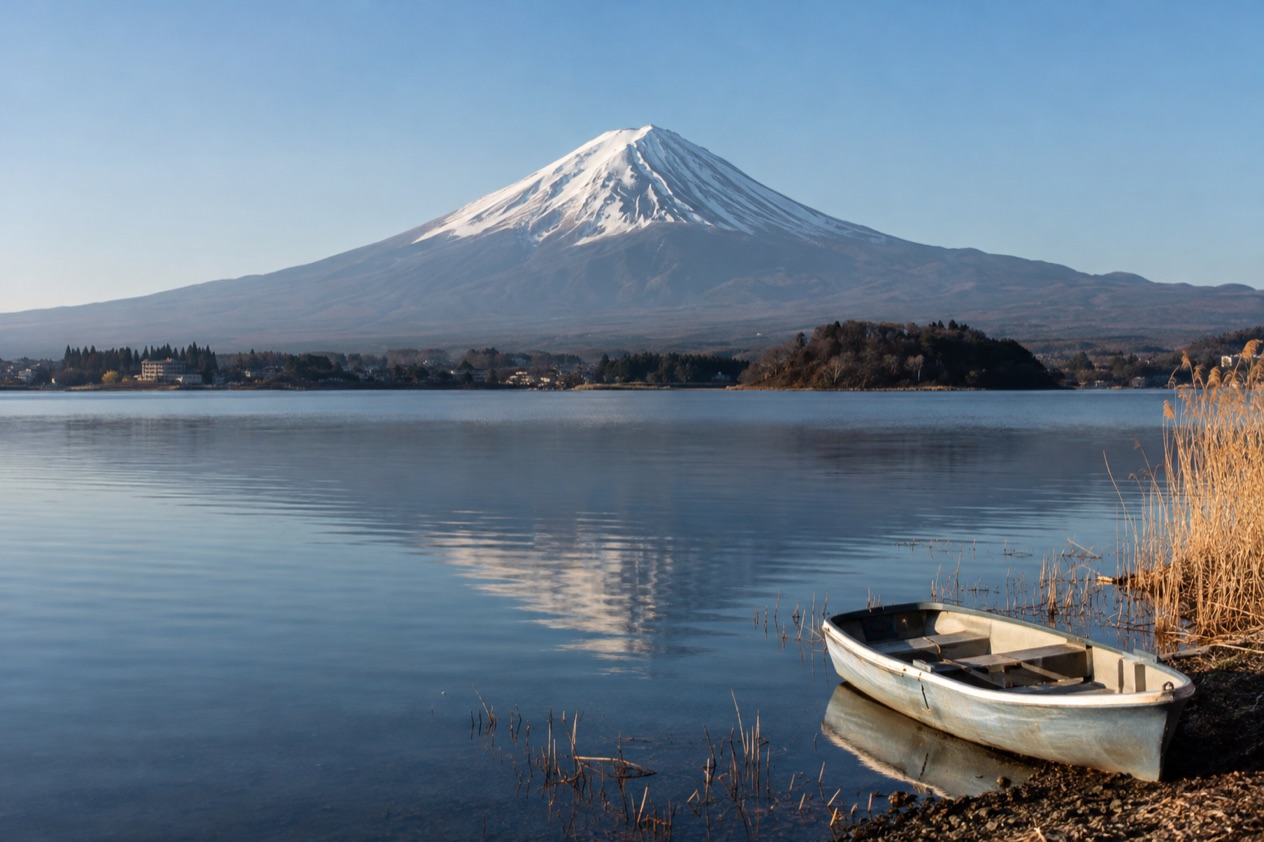
Around Lake Kawaguchi the year turns on the mountain. In winter the cone stands white above a lakeshore with frost on the reeds, in the rainy months it disappears behind cloud for days, and in autumn the maples along the water go red while the peak waits behind them.
Summer brings green hills, warm afternoons and long evenings, spring brings blossom, and the cold months bring the long, bright days that people come for. Mount Fuji and Lake Kawaguchi reward almost any month, and each one asks you to plan around something different.
When is the best time to visit Mount Fuji and Lake Kawaguchi?
The best months for travelers are April, May, October and November, with the cold, bright stretch from December to February as a close rival for anyone who loves a snowy mountain.
Winter days are short, though, and the lake sits near freezing at night.
Spring has a softer light, a little more cloud and the pleasure of cherry blossoms framing the cone. Summer is green and warm, yet June to September is also the wetter, hazier half of the year, and the mountain is often hidden.
For food and nature, the cooler months suit the local table: hot hoto, the thick miso noodle stew of Yamanashi, is made for a chilly lakeside evening, and autumn brings mushrooms, persimmons and grapes from the valleys nearby. Walkers and cyclists around the lake do best from late spring to early autumn, when mornings are mild. Anyone who wants to climb Fuji itself should look at the Official Website for Mt. Fuji Climbing, which the Japan National Tourism Organization points visitors to for the latest information.
Families often like May, early summer and October, when the days are warm enough for the shore and the museums, caves and gardens around the lake. Travelers who want fewer holiday crowds and open rooms will find the best fit in the weeks between the big Japanese travel holidays, such as early June, late January and the end of November.
Mount Fuji and Lake Kawaguchi weather by month
At Kawaguchiko, on the shore of Lake Kawaguchi at 860 meters, the year runs from deep cold in January to warm, damp summers, with the heaviest rain arriving in September.
| Month | Average high (°F) | Average low (°F) | Precipitation (in) | Days with 1 mm or more of precipitation | Hours of sunshine | Daylight on the 15th |
|---|---|---|---|---|---|---|
| January | 41.9 | 21.7 | 2.40 | 4.9 | 212 | 10 h 00 min |
| February | 43.9 | 23.4 | 2.18 | 5.1 | 191 | 10 h 53 min |
| March | 50.9 | 29.7 | 4.24 | 9.1 | 186 | 11 h 54 min |
| April | 61.0 | 38.7 | 4.18 | 8.5 | 186 | 13 h 03 min |
| May | 69.1 | 48.0 | 4.85 | 9.4 | 181 | 14 h 01 min |
| June | 73.4 | 56.7 | 6.19 | 11.5 | 123 | 14 h 32 min |
| July | 81.0 | 64.4 | 7.02 | 11.7 | 148 | 14 h 21 min |
| August | 82.6 | 65.3 | 6.96 | 10.1 | 165 | 13 h 32 min |
| September | 74.8 | 58.6 | 10.42 | 11.1 | 122 | 12 h 27 min |
| October | 64.9 | 47.7 | 9.06 | 10.1 | 134 | 11 h 21 min |
| November | 56.8 | 36.0 | 2.99 | 6.7 | 166 | 10 h 20 min |
| December | 47.3 | 26.8 | 1.96 | 4.6 | 200 | 9 h 47 min |
The shape of the year is easy to read. December to February are the driest and sunniest months, with few days of rain but plenty of snow and sleet, and nights well below freezing, so a real winter coat, gloves and a hat are part of the plan.
March and April are in between: some days feel like spring and some like winter, and layers do the work. From June to October the rain days climb and the sunshine drops, with September and October the wettest months by far, so a light rain jacket belongs in the bag even when the forecast looks fair.
Summer is warm without being extreme at the lake, which sits high enough to feel cooler than the cities below, and the humidity is what you notice. On the summit itself the air stays cold all year, with July highs still under 50°F. Daylight matters too: summer days start early and stretch late, which gives long evenings by the water, while winter gives a short working day for sightseeing, so plan the main outings for the middle of it.
What is there to do in Mount Fuji and Lake Kawaguchi in each season?
Spring and the rainy months
Spring is when the lakeshore wakes up. Cherry trees bloom along the water in a season that shifts a little from one year to the next, and the snowline pulls back up the mountain. Days are cool enough in April for long walks along the shore, and May warms up while staying fresh in the morning. Snow and sleet still turn up in March, so spring arrives in stages here.
June and early July bring the rainy season, when low cloud can wipe out the view and the days are damp. It is a time for indoor stops, such as museums, hot springs and long meals of hoto noodles, and for the green of the forests around the lake, which is at its deepest in the wet weather. The mountain shows itself between the showers, but no day is guaranteed.
Summer and autumn leaves
July and August are warm days and mild nights at the lake, with cycling, boating and picnics on the shore. For those planning to climb Mount Fuji itself, the climbing season has its own dates, and the Official Website for Mt. Fuji Climbing carries the latest information. On the summit the air is far colder than on the shore even in midsummer.
Autumn leaves gather around Lake Kawaguchi in November, when maples along the north shore and in the nearby gardens turn red and orange. The days are clear and cool, and the lake shows the colors back. September and October are the wettest months in the table, so the leaves are better left to November, with a chance of a snow-capped Fuji behind them.
Winter and snow
The cold months are the lake’s sunniest. December and January bring clear days, and the cone is capped in white. Snow falls most in January and February, with snow or sleet on most days of February, but the sunshine hours stay high, so the view often has the sky to match. Hot springs and a bowl of hot noodles suit the season, and the winter evening air is sharp.
Winter is a poor time to expect long lakeside rides or boat outings, so spend the days on viewpoints, ropeway rides, museums, caves and the lakeside towns, and leave the swim and the cycling tours for the warm months.
When is Mount Fuji and Lake Kawaguchi least crowded?
The quietest stretches of the year tend to fall between the great Japanese travel weeks, and the first sentence of any plan is to avoid those weeks if rooms and open space matter to you. Golden Week at the turn of April and May, the Obon holiday in mid-August and the New Year break are the times when people in Japan are traveling, so rooms near the lake and the roads and trains toward it are in demand.
The cherry blossom weeks in spring and the maple weeks in November are the other big draws, because the views are what visitors come for. If you want the colors but not the peak of the rush, aim for the edges of those seasons, or choose a weekday over a weekend.
Quieter windows are early June before the rains settle in, the weeks after New Year, and the colder months of January and February, when the lake belongs to people who came for the snow and the clear air. The wet stretch of September and October is also less of a draw for sightseers, though it asks for rain gear and patience with the cloud.
In a quieter week, rooms are easier to find, the lakeside paths feel open, and the viewpoints are less likely to have a line. The trade-off is weather: winter is cold, and the rainy months bring cloud over the mountain.
Which months should you avoid in Mount Fuji and Lake Kawaguchi?
No month is off limits, but September and October are the hardest for a view of the mountain, and the depth of winter is the hardest for comfort. The two months carry the heaviest rainfall of the year in the table, on more than ten days each, and the hours of sunshine are among the lowest. Rain comes in long gray spells and in heavy downpours, so the cone is often covered, and a trip planned only around a clear Fuji can disappoint.
June and July bring the rainy season, with damp air and many wet days, and humidity above eighty percent. The lake is green and the temperatures are comfortable, so the weather is more a matter of cloud than of heat. August is the warmest month, with highs in the low 80s, and it is humid. If you are going to climb Fuji, check the climbing information before you plan.
January and February are the coldest, with lows well below freezing, snow on many days and a short working day for sightseeing. If you come, pack warm layers and plan around the daylight. Spring is changeable in March, when snow and sleet can still arrive, and the cherry blossoms and autumn leaves each come on their own schedule from one year to the next, so a trip timed to them is a chance, not a promise.
Festivals and events in Mount Fuji and Lake Kawaguchi through the year
Winter: New Year and the clear days
New Year is the biggest holiday of the Japanese year, and around Mount Fuji it carries a special meaning. People go out to see the first sunrise of the year, hatsuhinode, and a clear Fuji at that hour is a favorite sight. Shrines in the area fill with visitors making the first visit of the year, hatsumode, with fortune slips and warm sweet sake served in the cold.
The cold months also bring winter illuminations in the lakeside towns, usually through the darkest weeks, when the long nights show off the lights. It is a good season for hot springs and for the soft glow of the evenings, and the mountain, white and clear, is often the star.
Spring and early summer: blossom and moss pink
Hanami, the custom of picnicking beneath the cherry blossoms, is the spring event. Families, friends and co-workers spread tarps beneath the trees and share food and drink while the petals fall. Around the lake the blossoms frame the cone, and the timing moves from one year to the next, so the exact weeks are never fixed.
In late spring, fields of shibazakura, or moss phlox, spread pink carpets on the slopes below the mountain, and a festival usually runs while they bloom. In early summer the rainy season brings hydrangeas to temple gardens, and the damp weather suits their color. Golden Week at the start of May is a national holiday stretch when people travel.
Summer and autumn: fireworks and maples
Summer in Japan means matsuri, the local festivals, with fireworks, food stalls and cotton yukata robes. Around Lake Kawaguchi the lake gives fireworks a second showing in its water. Obon in mid-August is the season when families return to their home towns to honor their ancestors, and the dances and lanterns that go with it shape the week.
In November the maples along Lake Kawaguchi are the draw, and a leaf festival with evening lighting usually marks the season. The red and orange trees and the lake make a pair, and the mountain stands behind. Autumn is also the season of the harvest, with grapes, persimmons and mushrooms on the local menus.
Sources
- Japan Meteorological Agency (JMA), Normal values 1991-2020, monthly (https://www.data.jma.go.jp/stats/etrn/view/nml_sfc_ym.php?prec_no=49&block_no=47640), station Kawaguchiko, elevation 860 m, checked October 11, 2026
- Japan Meteorological Agency (JMA), Normal values 1991-2020, monthly (https://www.data.jma.go.jp/stats/etrn/view/nml_sfc_ym.php?prec_no=49&block_no=47639), station Fujisan, elevation 3,775 m, checked October 11, 2026
- Computed from the date and the latitude of the place (sunrise equation, solar elevation -0.833 degrees), October 11, 2026
- Japan National Tourism Organization, Mount Fuji guide (https://www.japan.travel/en/fuji-guide/), checked October 11, 2026
- Official website for Mt. Fuji climbing, about the climb (https://www.fujisan-climb.jp/en/about/), checked October 11, 2026
To plan your stay
- Things to Do in Mount Fuji and Lake Kawaguchi: Lakeside Views, Fuji-Q Highland, Hiking Season and Local Food
- Where to Stay in Mount Fuji and Lake Kawaguchi: Lakeshore Hotels, Fujiyoshida, Mountain Lodges and Ryokan
- Mount Fuji and Lake Kawaguchi from Tokyo: Fuji Excursion, the Fujikyuko Line and Climbing Season
- Best Views of Mount Fuji: Five Lakes, Fifth Station Promenades and When to Go