
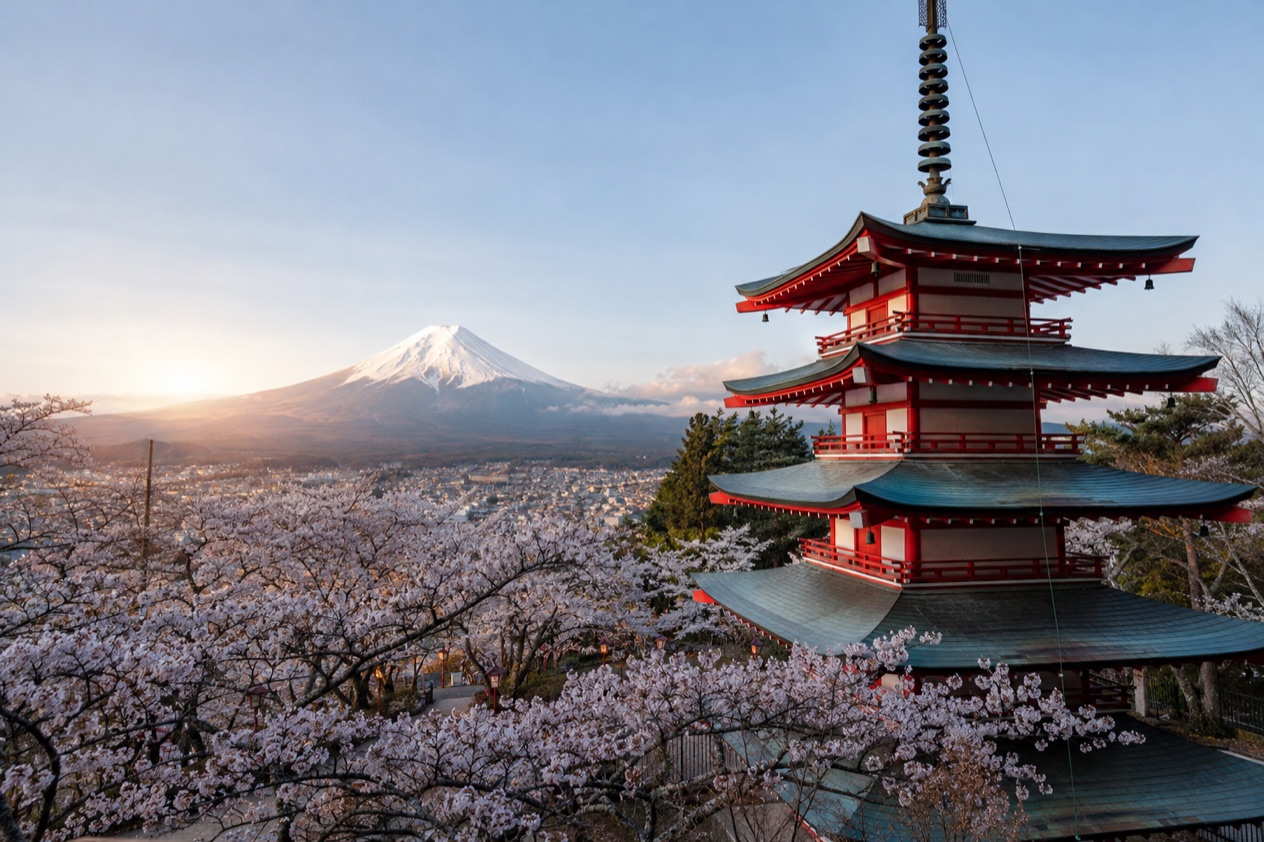
A red five-story pagoda sits among dark trees on a hillside in Fujiyoshida, and when the weather allows, Mount Fuji fills the sky behind its tiers. Chureito Pagoda is a visit built around a single view, in a hillside park with its own history, its own trees and a clear sense of what it asks of visitors.
Is visiting Chureito Pagoda worth it?
Yes, if you want to stand in front of one of the most photographed arrangements of Japanese architecture and Mount Fuji, and it suits photographers, cherry blossom lovers and anyone who likes a place with a story behind it. The pagoda stands in Arakurayama Sengen Park in Fujiyoshida, Yamanashi Prefecture, and the park was ranked 10th among the 100 Views with Mount Fuji announced by the Japanese Ministry of the Environment. It also earned two ratings in the Michelin Green Guide Japan, which says something about how the view has been treated by people who judge places for a living.
What sets it apart from other Fuji lookouts around the lakes is that the mountain is not alone in the frame. You get a built landmark in the foreground, a hillside of trees around it and the mountain as a backdrop, so the picture has a front, a middle and a far distance.
A lakeshore view gives you water and a cone. Here you also get wood, roof lines and a sense of scale, which is why so people arrive with a camera already in hand.
The pagoda is not a temple in the usual sense, and that changes how you look at it. It is a memorial tower for the war dead, which gives the visit a quieter note than a simple viewpoint would.
It is also a place where the weather decides a great deal, since Fuji hides as easily as it shows itself. If you can accept a view that sometimes stays behind cloud, it is a rewarding stop.
What to see at Chureito Pagoda
The pagoda itself
The five-story pagoda is the center of the park. It is a memorial tower for the war dead and not a stupa, the kind of structure that holds relics. Its name, Chureito, is usually understood as a tower for loyal spirits, and the building reads that way, solemn in its proportions and simple in its detail.
Look at the tiered roofs with their upturned corners and at how the red of the structure stands out against the surrounding trees. The color shifts with the light and the season, glowing in sun and deepening under cloud. Up close you can see the woodwork and the way each level steps in from the one below, which is what gives the tower its tall, narrow silhouette.
Mount Fuji behind the tower
Mount Fuji is the highest mountain in Japan and a UNESCO World Heritage site, and here it is the reason visitors come. When it appears, it rises directly behind the pagoda, and the two together are what the park’s ranking among the 100 Views with Mount Fuji rests on. The mountain can disappear behind cloud for hours, so what you see on a given day is a matter of chance.
The shooting and viewing point is on private land next to the park, with a cliff of about sixteen feet between it and the park proper. That detail matters, because it explains why the classic photograph is taken from a particular spot and why the surrounding land is treated with care. Even when the summit is hidden, the pagoda among its trees is worth looking at.
The cherry trees
About 650 cherry blossom trees grow in Arakurayama Sengen Park, and in blossom they frame the pagoda in pink. Cherry blossoms in Japan are a seasonal ritual, and families, friends and photographers gather beneath the trees to mark the moment. Here the blossom adds a third color to the red tower and the white mountain.
The park held its first Cherry Blossom Festival in April 2016. During the festival, conversation cards in English, Thai and Chinese were handed out to store owners so that visitors from abroad could be helped more easily. It shows how much of the park’s identity has grown around the blossom and the people who travel to see it.
The park and its history
Arakurayama Sengen Park was installed in October 1959 and sits at Arakura in Fujiyoshida. It is a hillside green space of modest size, laid out around the pagoda and the paths that lead to it. The name Sengen refers to the Shinto tradition tied to Mount Fuji, which is a reminder that the mountain has long been a sacred presence in the region.
The park has also had its moments of change. From early September to December 2015, Fujiyoshida City built fences and prohibited photography and viewing from certain points. The fences came out of the pressure that a much-photographed view can place on a small hillside, and they are part of why the park is managed with such attention today.
Hours, tickets and rules
Chureito Pagoda is part of a public hillside park, and the main thing to know about the rules is where you may stand. That distinction is the core of how visits here are organized.
The history of the place shows why this matters. In 2015, Fujiyoshida City put up fences and prohibited photography and viewing from certain points, which is a clear sign that where you stand is not left entirely to personal choice. The park has also hosted a cherry blossom festival since April 2016, with language cards for store owners, so the surrounding community has built a welcome around the visitors it receives.
Photograph from the places that are open to visitors, keep to the park side of the cliff and treat the private land as private. The memorial character of the pagoda is another reason to keep a low voice and a measured pace near the tower.
When to visit Chureito Pagoda
Spring brings the cherry blossoms, summer brings green hillsides and humidity, autumn brings cooler air and a lot of rain, and winter brings snow and the longest sunshine hours of the four.
| Month | Average high (°F) | Average low (°F) | Precipitation (inches) | Rain days | Sunshine (hours) |
|---|---|---|---|---|---|
| January | 41.9 | 21.7 | 2.40 | 4.9 | 212 |
| April | 61.0 | 38.7 | 4.18 | 8.5 | 186 |
| July | 81.0 | 64.4 | 7.02 | 11.7 | 148 |
| October | 64.9 | 47.7 | 9.06 | 10.1 | 134 |
January is cold, with snow or sleet on nearly nine days of the month and the sunniest skies of the four months. That sunshine gives Fuji a good chance of showing itself, and a snowy hillside under a cold sky can look striking. April is cool and mild at once, with some snow still possible early on, and it is the month in which the park held its first Cherry Blossom Festival in 2016.
July is warm and humid, with rain on a good share of the days and the fewest hours of sunshine after October. The mountain often sits behind cloud, and the hillside is thick with green.
October is the wettest of the four months in the table, with air that is cool but not cold, so layers and a rain jacket fit the weather. Whatever the month, the view of Fuji is a chance and never a promise.
The festival in April is the clearest marker of spring at the park.
Tips for your visit
Dress for the month, because the climate around Mount Fuji shifts a great deal from season to season. A warm coat and gloves suit January, light layers suit April, and a rain jacket is sensible in October, when it rains on about one day in three. In July the air is warm and sticky, so lighter clothes and water make sense.
Bring a camera, since the view is the reason for the visit, and expect the weather to decide what you can photograph. Cloud over the mountain does not ruin the stop, because the pagoda among the trees is a picture in its own right. Take your time at the tower and notice the details of the roofs, the color against the trees and the setting.
Mount Fuji itself can be part of a longer plan in the region. The climbing season for Mt. Fuji ends on September 10th, so in October the climbing trails are past their season, and in winter the Yoshida, Subashiri and Gotemba trails are closed from the 5th station to the summit, while the Fujinomiya Trail is closed from the 6th station. Anyone who plans to climb is strongly advised to consult the Official Website for Mt. Fuji Climbing, which provides information for climbers to ensure a safe climb and return.
Respect the private land beside the park and stay on the park side of the cliff. The language cards in English, Thai and Chinese that were given to store owners during the festival show that the neighborhood expects visitors from abroad. A visit to the pagoda sits comfortably beside the wider Fuji area, with its lakes and mountain views.
Good to know before you go
The weather around Mount Fuji turns quickly, and the wetter months bring rain on many days, so a light waterproof layer is useful. The pagoda is a memorial, and visitors tend to behave with the calm that suits a place of remembrance. Fuji appears on its own schedule, so go with a flexible mind and enjoy the tower, the trees and the hillside whatever the mountain decides to do.
Sources
- Wikipedia, Arakurayama Sengen Park (https://en.wikipedia.org/wiki/Arakurayama_Sengen_Park), checked October 11, 2026
- Japan National Tourism Organization, Mount Fuji guide (https://www.japan.travel/en/fuji-guide/), checked October 11, 2026
- Official website for Mt. Fuji climbing, about the climb (https://www.fujisan-climb.jp/en/about/), checked October 11, 2026
- Japan Meteorological Agency (JMA), Normal values 1991-2020, monthly (https://www.data.jma.go.jp/stats/etrn/view/nml_sfc_ym.php?prec_no=49&block_no=47640), station Kawaguchiko, elevation 860 m, checked October 11, 2026
- Japan Meteorological Agency (JMA), Normal values 1991-2020, monthly (https://www.data.jma.go.jp/stats/etrn/view/nml_sfc_ym.php?prec_no=49&block_no=47639), station Fujisan, elevation 3,775 m, checked October 11, 2026
To plan your stay
- Best Time to Visit Japan: Cherry Blossoms, Autumn Colors, Weather and Festivals
- Where to Stay in Japan: Ryokan, Temple Stays, Capsule Hotels and the Best Cities to Base In
- Sending Luggage from the Airport in Japan: Hands-Free Travel, Hotel Delivery and Coin Lockers
- Know Before You Go to Japan: Entry, Money, Etiquette and Getting Around