
From a train window in Tokyo, Fuji often shows up as a pale, flat-topped shape on the horizon, and from the Five Lakes it fills the whole sky. Climbers come for something else: the cinder trail under their boots, the lamps of other hikers strung up the slope in the dark, the hut lights flickering above.
Is visiting climbing Mount Fuji worth it?
Yes, if you want to stand on the highest mountain in Japan and are ready to plan around a short summer window. It also suits travelers who would rather not climb at all, because the mountain gives plenty back from its foot and from the promenades that start at the fifth station.
Fuji is a UNESCO World Heritage site, and that status shows in how people talk about it. It is a sacred mountain in the Shinto tradition, a subject painters and printmakers have returned to again and again, and the most recognizable shape in the country. Climbing it is part pilgrimage, part endurance outing, part simple curiosity about what is up there.
What sets it apart from other walks near Tokyo is how many ways there are to meet it. You can climb one of four named trails, stroll from the fifth station, circle the Five Lakes at its foot, or simply look from a distance. Even people who never lace up boots leave with a clear picture of why the mountain matters to so many.
The honest caveat is that the climbing season is short and the mountain is serious outside it.
What to see at climbing Mount Fuji
The four climbing trails
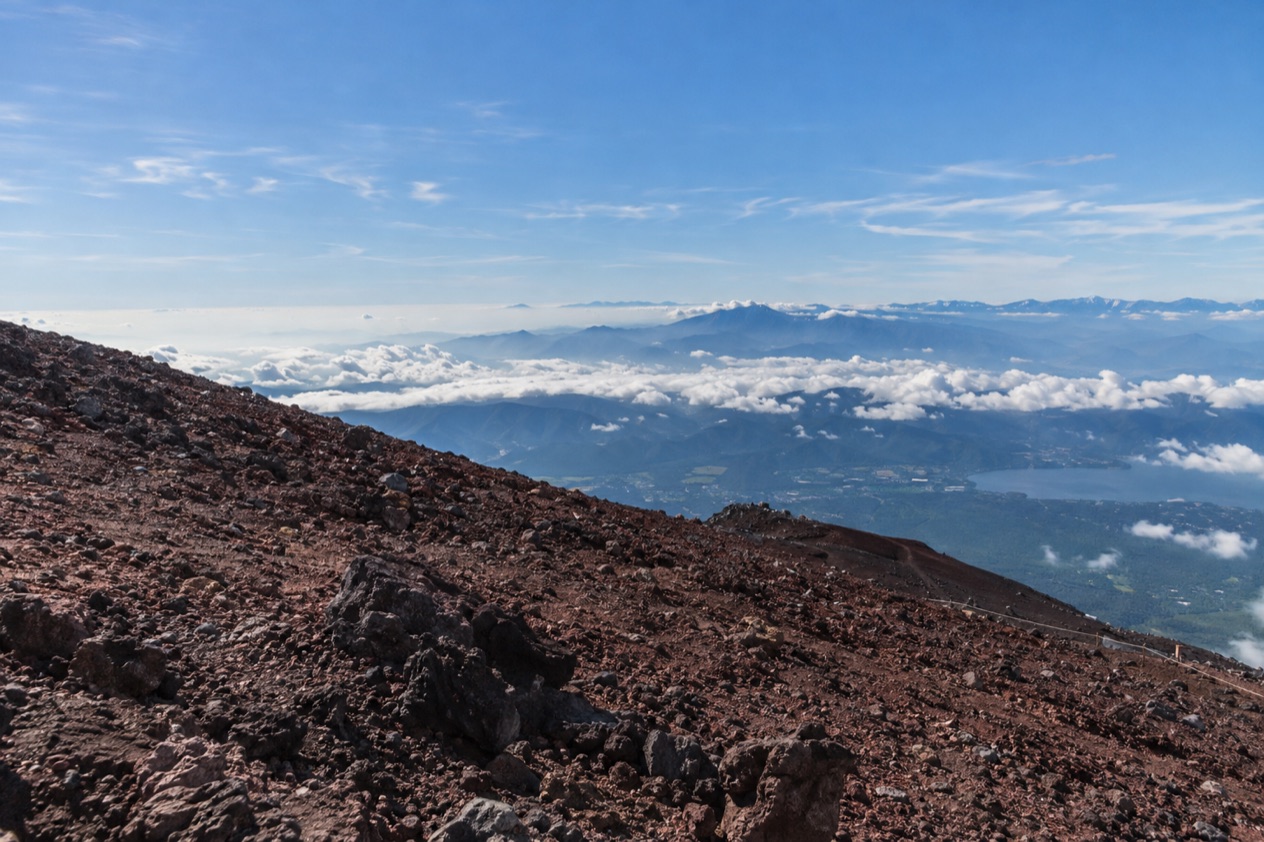
Four trails lead up the mountain: Yoshida, Subashiri, Gotemba and Fujinomiya. Each is named for the town or area it rises from, and each climbs through a different slice of the mountain’s landscape. Lower slopes tend to be forest and scrub, then the vegetation thins into volcanic scree, red-brown cinder and rock as you rise.
The Yoshida trail has a guided-tour option on the day, which suits people who prefer to climb with someone who knows the mountain. The others are known by name and reputation among hikers, and each has its own character, so it is worth looking at the official climbing website before picking one. What they share is the goal: the summit and, for many climbers, the sunrise from above the clouds.
The fifth station and its promenades
The fifth station is the usual starting point on the mountain, and promenades depart from it for people who want to walk on Fuji without going to the top. These paths give you the cinder underfoot, the thin air, and a long view out over the forest and lakes, with the summit slope rising above you.
If you are traveling with someone who will not climb, this is where you can share a piece of the mountain. The walk is about the setting more than the distance: stop often, look back down the slope, and watch the clouds form and break below you.
The Five Lakes region
The Five Lakes region sits at the foot of Fuji and is the classic place to see the mountain reflected in water. Cafés, small museums and lakeside paths make a day around the water a pleasant complement to, or a substitute for, the climb.
Shizuoka also lies at the foot of Mount Fuji, so you can approach the mountain from more than one prefecture. Each side frames it differently, and seeing it from two sides makes it feel like a real landmass rather than a postcard.
Fuji from a distance
On a clear day you can see Mount Fuji from Tokyo in the distance, and the Japan National Tourism Organization’s Fuji guide lists 30 viewpoints for admiring it. Travelers who cannot climb, or who arrive outside the season, can build a trip entirely around those views. A clear sky is never guaranteed, so a flexible plan helps.
Hours, tickets and rules
The trails are open to climbers only in summer, and the season for Mt. Fuji climbing ended on September 10th. With the winter closures now in place, the upper mountain is closed to climbers until the next season opens. The official website for Mt. Fuji climbing is the source for the current dates and the information every climber needs for a safe climb and return.
| Trail | Closed in winter |
|---|---|
| Yoshida | 5th station to the summit |
| Subashiri | 5th station to the summit |
| Gotemba | 5th station to the summit |
| Fujinomiya | 6th station to the summit |
Climbing outside the season is extremely dangerous. First-aid centers and mountain huts are closed, cell phone service is lost, and the weather can turn severe. On the Yoshida and Subashiri trails, the summit rim trail known as Ohachimeguri is closed from July 1st to 10th for people planning to hike those routes. On-the-Day Nature Guided Tours are available on the Yoshida trail.
How to get to climbing Mount Fuji
You reach the mountain by choosing one of the four trails and the base that goes with it: the Yoshida, Subashiri, Gotemba and Fujinomiya routes each start from their own fifth station or lower. Which one you choose shapes where you sleep the night before, and the surrounding region offers several bases.
The Five Lakes region lies at the foot of the mountain, and Lake Kawaguchi is one of the lakes in that group. Visitors treat the lakeside towns as the place to stay while they plan a climb or a day of views. Shizuoka also lies at the foot of Fuji, which gives travelers a second side from which to approach the mountain.
From Tokyo, Fuji can be seen in the distance, which gives a sense of where you are heading before you leave the city. For the specific transport options, schedules and times, the official climbing website and the Japan National Tourism Organization’s Fuji guide are the places to confirm them for your chosen trail.
A good approach is to decide first whether you want the summit or just the mountain. If it is the summit, pick the trail, then the base. If it is the views, the Five Lakes and the fifth station promenades give the most for the least commitment.
When to visit climbing Mount Fuji
Summer is the time for the climb, because the trails are open then and the huts and first-aid centers operate. Outside the season the upper trails close, so the rest of the year is for looking at Fuji, walking around its foot and enjoying the lakes.
| Month | Kawaguchiko high (°F) | Kawaguchiko low (°F) | Rain days at Kawaguchiko | Summit high (°F) | Summit low (°F) |
|---|---|---|---|---|---|
| January | 41.9 | 21.7 | 4.9 | 4.5 | -6.5 |
| April | 61.0 | 38.7 | 8.5 | 21.4 | 10.0 |
| July | 81.0 | 64.4 | 11.7 | 46.4 | 37.0 |
| October | 64.9 | 47.7 | 10.1 | 33.3 | 22.8 |
In July, the lakeshore is warm and humid, with rain falling on a good share of days and fewer hours of sun than in winter. At the summit it stays cold even then, which is why climbers carry warm layers up a mountain that feels like summer at the base. January is cold at the lake, with real snow and plenty of sunshine, and the summit sits far below freezing.
April brings milder days at the lake with a touch of snow, while the summit is still deep in winter. October is wetter at the lakeshore, with humid air and fewer hours of sun, and by then the climbing season is over. A trip then is about the lakes, the autumn air and Fuji whenever the clouds part.
Tips for your visit
Begin with the official website for Mt. Fuji climbing, which Japan’s tourism organization also tells climbers to check for the latest information. It is the single source for current conditions and the details every climber needs before setting out.
Think of the mountain as having two climates. The lakes below are mild in summer, but the summit stays cold in every month on the table, so the clothes you wear at the base are not the clothes you need above. Rain and cloud can arrive at any point of the year, so the view from the top is a chance, not a promise.
Lake Kawaguchi gives you the water and the views, while the promenades give you the cinder slopes and the feel of being on Fuji itself. Shizuoka offers a second approach for travelers who want to see the mountain from another side.
Families and travelers with limited mobility can plan around the viewpoints and the lakes instead of the trails. The Japan National Tourism Organization’s Fuji guide lists 30 viewpoints, so there are many ways to enjoy the mountain without climbing it. Pair a lakeside day with a view of Fuji from Tokyo, and the mountain becomes part of the trip even if the summit is out of reach.
Good to know before you go
The most important habit on Fuji is respect for the season. Climbing outside it is extremely dangerous, with the huts and first-aid centers closed and no cell phone service on the upper slopes. Weather at the lakes is wetter in autumn, so a rain layer fits the lakeside walks, while the summit stays far colder than the town below. Check the official climbing website before any trip up the mountain.
Sources
- Japan National Tourism Organization, Mount Fuji guide (https://www.japan.travel/en/fuji-guide/), checked October 11, 2026
- Official website for Mt. Fuji climbing, about the climb (https://www.fujisan-climb.jp/en/about/), checked October 11, 2026
- Official website for Mt. Fuji climbing, information (https://www.fujisan-climb.jp/en/info/), checked October 11, 2026
- Japan Meteorological Agency (JMA), Normal values 1991-2020, monthly (https://www.data.jma.go.jp/stats/etrn/view/nml_sfc_ym.php?prec_no=49&block_no=47640), station Kawaguchiko, elevation 860 m, checked October 11, 2026
- Japan Meteorological Agency (JMA), Normal values 1991-2020, monthly (https://www.data.jma.go.jp/stats/etrn/view/nml_sfc_ym.php?prec_no=49&block_no=47639), station Fujisan, elevation 3,775 m, checked October 11, 2026
To plan your stay
- Best Time to Visit Japan: Cherry Blossoms, Autumn Colors, Weather and Festivals
- Where to Stay in Japan: Ryokan, Temple Stays, Capsule Hotels and the Best Cities to Base In
- Sending Luggage from the Airport in Japan: Hands-Free Travel, Hotel Delivery and Coin Lockers
- Know Before You Go to Japan: Entry, Money, Etiquette and Getting Around