
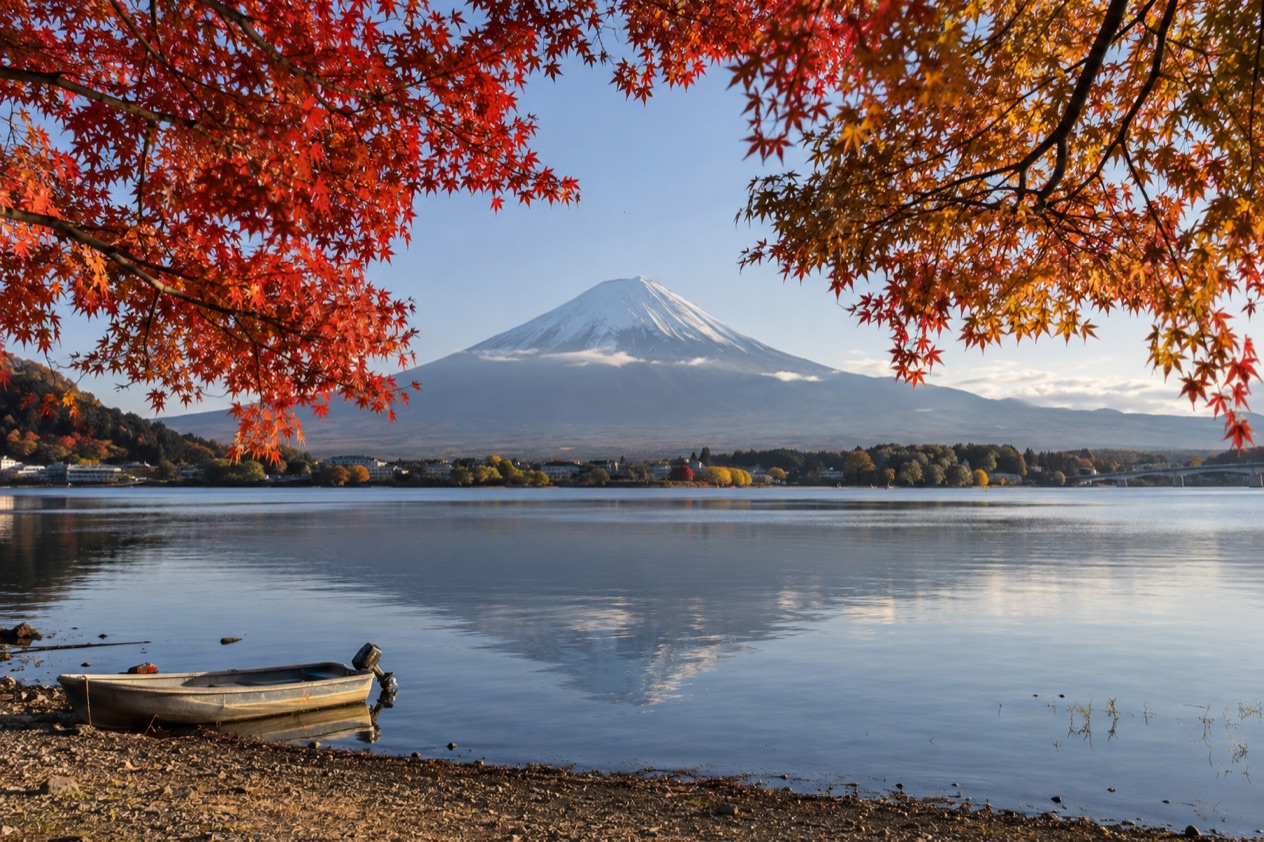
In November, the maples around Lake Kawaguchi turn red and orange while the lake gives back the shape of Mount Fuji, and the first cold breath of winter shows in the steam rising from onsen baths and bowls of noodle stew. The mountain itself has gone quiet, its climbing trails closed and its upper slopes wintry. For travelers who come to look, soak and eat rather than climb, this is a month of crisp air, leaf color and long lingering lunches.
What is the weather like in Mount Fuji and Lake Kawaguchi in November?
November at Lake Kawaguchi is cool and drier than October, with chilly mornings, mild middays and a first hint of winter in the air.
| Month | Average high (°F) | Average low (°F) | Precipitation (in) | Days with 1 mm or more of precipitation | Hours of sunshine | Daylight on the 15th |
|---|---|---|---|---|---|---|
| October | 64.9 | 47.7 | 9.06 | 10.1 | 134 | 11 h 21 min |
| November | 56.8 | 36.0 | 2.99 | 6.7 | 166 | 10 h 20 min |
| December | 47.3 | 26.8 | 1.96 | 4.6 | 200 | 9 h 47 min |
Afternoons are cool rather than cold, which suits walking along the water in a sweater and a medium jacket. Mornings and evenings are another matter, since lows sit just above freezing, so a warm layer, a scarf and gloves earn their place in the daypack.
The rain has eased a great deal since October, which brought the last of the wet season’s heavy days. November rain tends to come in short spells, and snow is only a passing visitor at the lake, a trace of about 0.4 inches over the whole month.
Sunshine grows, and with the sun lower in the sky the light turns softer and more golden on the water. The days are short, though, so plan outdoor stops with the early dusk in mind.
Higher up the picture is very different. At the summit of Mount Fuji, highs average only about 21°F in November and lows fall to roughly 11°F. That gap between the lakeshore and the top explains the snow you may see on the peak while you walk in autumn leaves below. A rain shell is worth carrying, but the real clothing question is warmth, because the cold arrives as soon as you stop moving.
What to do in Mount Fuji and Lake Kawaguchi in November
The big event of the month is the leaf color. Across Japan, trees show their reds, yellows and oranges from mid-November into early December, and around the Fuji lakes that is when the maples are the draw.
For a reference point, in Kofu, the regional city used to track the maples, the color change usually falls around the end of November. Lake Kawaguchi has its own rhythm, so the color can arrive earlier or later from one autumn to the next.
Food fits the cold. Yamanashi Prefecture, where Lake Kawaguchi sits, is known for hoto, thick flat wheat noodles simmered with pumpkin, mushrooms and vegetables in a miso broth, served bubbling in an iron pot. It is a dish made for a chilly evening. Local fruit and wine from the prefecture’s vineyards also belong to the season, and an onsen soak after a day outdoors rounds things off.
Walking the shore of Lake Kawaguchi
Lake Kawaguchi is the most developed of the Fuji lakes, with a lakeside path, small museums, cafés and ryokan along its edge. In November the trees along the water are the main attraction, and the shore turns into a slow walk with the mountain as a backdrop whenever the clouds part. When Fuji is visible, its reflection on a still lake is one of the images people travel here for.
The cool weather suits walking better than summer’s humidity ever could. Wear layers you can remove, because stretches in the sun feel mild while shaded corners hold the cold. A thermos of something hot from a café is a pleasant companion, and the lakeside ryokan make a natural place to end the day with a soak in an onsen, the volcanic hot spring baths that the region is known for.
Arakurayama Sengen Park in Fujiyoshida
Arakurayama Sengen Park lies in Fujiyoshida, Yamanashi Prefecture, and it is the spot where a red pagoda, cherry trees and Mount Fuji line up in the photographs that circulate every spring. In November the same composition takes on autumn colors, with maples and a snow-dusted peak in place of the blossoms.
Visibility depends on cloud, and the mountain does not always show itself, which is why a flexible plan helps. If Fuji stays hidden, the pagoda and the red leaves around it still make the stop worthwhile.
The mountain in its winter closure
The climbing season ended on September 10, and in winter the Yoshida, Subashiri and Gotemba trails are closed from the 5th station to the summit. The Fujinomiya Trail is closed from the 6th station upward. In November, then, you admire Fuji instead of climbing it, and you do it from below, from the lake, from a park or from the window of your room.
That is not a loss. The summit’s cold is severe, and the white upper slopes that appear in November are part of what makes the mountain look the way it does in the postcards. Anyone who wants the climb itself belongs to the summer months, when the huts and facilities are open and the weather is warmest.
A two-day itinerary for Mount Fuji and Lake Kawaguchi in November
Day 1 belongs to the lake. Start the morning with a walk along the shore at Lake Kawaguchi, where the maples and the mountain share the view whenever the cloud allows. Spend the middle of the day in a café or one of the small museums on the lakeside, then use the afternoon for a longer stretch of the shoreline, since daylight lasts barely ten hours and dusk comes early.
In the evening, settle into a bowl of hoto at a noodle restaurant in town, then finish with an onsen soak if your ryokan or hotel has one. The sequence works because the cold evening makes the hot noodles and the hot bath the right ending to a day outdoors.
Day 2 moves to Fujiyoshida and Arakurayama Sengen Park. Go for the pagoda, the autumn leaves and the view of the mountain, then spend the middle of the day in town over a lunch of noodles or a set meal at a local restaurant. The afternoon is left open for a second look at the lake or a stop at a winery or fruit stand, depending on where you want to end up.
If the weather turns gray, spend the day indoors at a museum, a café with lake windows or the baths of your ryokan. Rain falls on only a handful of days this month, but when clouds hide Fuji, the indoor plan keeps the day full.
Is Mount Fuji and Lake Kawaguchi busy in November?
November is an autumn-color month around the Fuji lakes, so the area draws visitors who come for the maples and the mountain views, especially as the leaves reach their color from mid-November toward early December.
The pace of the place changes with the leaves. Early in the month the trees are still turning, and the lakeside moves at a gentle rhythm. As the color builds, the popular viewpoints such as Arakurayama Sengen Park draw more people with cameras, and cafés near the water fill with those warming up between walks.
The climbing crowds of July and August are gone entirely. The mountain is closed above the stations, so the foot traffic of summer has no place here, and the town’s attention turns to leaf-viewers, onsen guests and photographers. That shift gives the month its own mood, one of coats, steaming bowls and long looks at a white-capped peak.
With the cold coming, the early dusk shapes everyone’s day. Outdoor stops cluster in the middle hours, and evenings move indoors to restaurants and baths, which makes the late afternoon a good time to head for dinner.
What to pack for Mount Fuji and Lake Kawaguchi in November
Pack for cool days and cold mornings, with layers you can add and remove through the day.
- A warm mid-weight jacket, because lows sit just above freezing and the lakeshore feels it.
- Sweaters or fleece to layer, since afternoons are mild in the sun and cool in the shade.
- A scarf and gloves for early starts and evenings by the water.
- A light rain shell, because some days bring a short spell of rain.
- Comfortable walking shoes for the lakeside path and park stairs.
- A small towel for the onsen, if your lodging has baths.
Good to know before you go
November falls after the climbing season and before the deep winter, so the mountain trails are closed above the 5th station on three routes and above the 6th on the Fujinomiya route. Anyone drawn to the summit should look to the official climbing website for the latest information.
In the lake area, the cold arrives with the early dusk, and a trace of snow is possible, so keep a warm layer within reach. Mount Fuji lies about 62 miles southwest of Tokyo.
Mount Fuji and Lake Kawaguchi in November vs October and December
Moving the trip four weeks earlier brings milder days, with afternoons in the mid-60s, but October also brings the wettest weather of the three months, with rain on about every third day. The maples are less likely to have turned yet, and clouds hide the mountain more often. The autumn color usually lands later, so an October visit trades the leaves for warmth.
Four weeks later, in December, the air is colder, the days shorter and snow becomes more regular, with several days of snow or sleet through the month. Skies are sunnier, though, and rain is lighter, which can mean more open views of the mountain. The leaf season has mostly ended, and the lakeside turns bare and wintry.
November suits travelers who want leaf color and mild-to-cool weather without the wet of October or the deep cold of December. Choose October for the warmest walking, and December for the coldest, clearest winter feel.
Is November a good time to visit Mount Fuji and Lake Kawaguchi?
Yes, for travelers who want autumn color, cool walking weather and hot food, and who are happy to view Fuji from below.
It will suit leaf-watchers, photographers, onsen lovers and anyone who enjoys a slow walk by a lake. It is not the month for the summit climb, since the trails are closed above the stations. Anyone who needs warm weather or long daylight should pick another time of year.
On arrival, head first to the lakeshore for a look at the maples and the mountain while the daylight lasts, then settle into hoto and a hot bath in the evening. What is special about November here is the contrast itself, red leaves at your feet, a white-capped peak overhead and steam rising from the bowl in front of you.
Sources
- Japan Meteorological Agency (JMA), Normal values 1991-2020, monthly (https://www.data.jma.go.jp/stats/etrn/view/nml_sfc_ym.php?prec_no=49&block_no=47640), station Kawaguchiko, elevation 860 m, checked October 11, 2026
- Japan Meteorological Agency (JMA), Normal values 1991-2020, monthly (https://www.data.jma.go.jp/stats/etrn/view/nml_sfc_ym.php?prec_no=49&block_no=47639), station Fujisan, elevation 3,775 m, checked October 11, 2026
- Computed from the date and the latitude of the place (sunrise equation, solar elevation -0.833 degrees), October 11, 2026
- Japan Meteorological Agency, maple color-change dates 2025-2026 with difference from the 1991-2020 normal (https://www.data.jma.go.jp/sakura/data/phn_014.html), checked October 11, 2026
- Japan Meteorological Agency, kaede2020.pdf (https://www.data.jma.go.jp/sakura/data/kaede2020.pdf), checked October 11, 2026
- Japan National Tourism Organization, winter in Japan (https://www.japan.travel/en/guide/winter-guide/), checked October 11, 2026
- Japan National Tourism Organization, autumn in Japan (https://www.japan.travel/en/guide/autumn-guide/), checked October 11, 2026
- Japan National Tourism Organization, spring in Japan (https://www.japan.travel/en/guide/spring-guide/), checked October 11, 2026
- Japan National Tourism Organization, summer in Japan (https://www.japan.travel/en/guide/summer-guide/), checked October 11, 2026
- Japan Meteorological Agency, biological season observations (https://www.data.jma.go.jp/sakura/data/index.html)
- Official website for Mt. Fuji climbing (https://www.fujisan-climb.jp/en/), checked October 11, 2026
- Wikipedia, Mount Fuji (https://en.wikipedia.org/wiki/Mount_Fuji), checked October 11, 2026
- Wikivoyage, Mount Fuji (https://en.wikivoyage.org/wiki/Mount_Fuji), checked October 11, 2026
- Japan National Tourism Organization, Mount Fuji guide (https://www.japan.travel/en/fuji-guide/), checked October 11, 2026
- Wikipedia, Arakurayama Sengen Park (https://en.wikipedia.org/wiki/Arakurayama_Sengen_Park), checked October 11, 2026
To plan your stay
- Things to Do in Mount Fuji and Lake Kawaguchi: Lakeside Views, Fuji-Q Highland, Hiking Season and Local Food
- Where to Stay in Mount Fuji and Lake Kawaguchi: Lakeshore Hotels, Fujiyoshida, Mountain Lodges and Ryokan
- Mount Fuji and Lake Kawaguchi from Tokyo: Fuji Excursion, the Fujikyuko Line and Climbing Season
- Best Views of Mount Fuji: Five Lakes, Fifth Station Promenades and When to Go