
In September the air around Lake Kawaguchi smells of wet cedar and ripe grapes, and the roadside fruit stands in Yamanashi pile up with the last of the summer’s peaches beside the first clusters of the season. The mountain shows itself in pieces, a white-gray shoulder through a gap in the cloud, then gone again. This is the month when the high summer rush is over, the lake towns slow down, and the slopes start turning toward autumn.
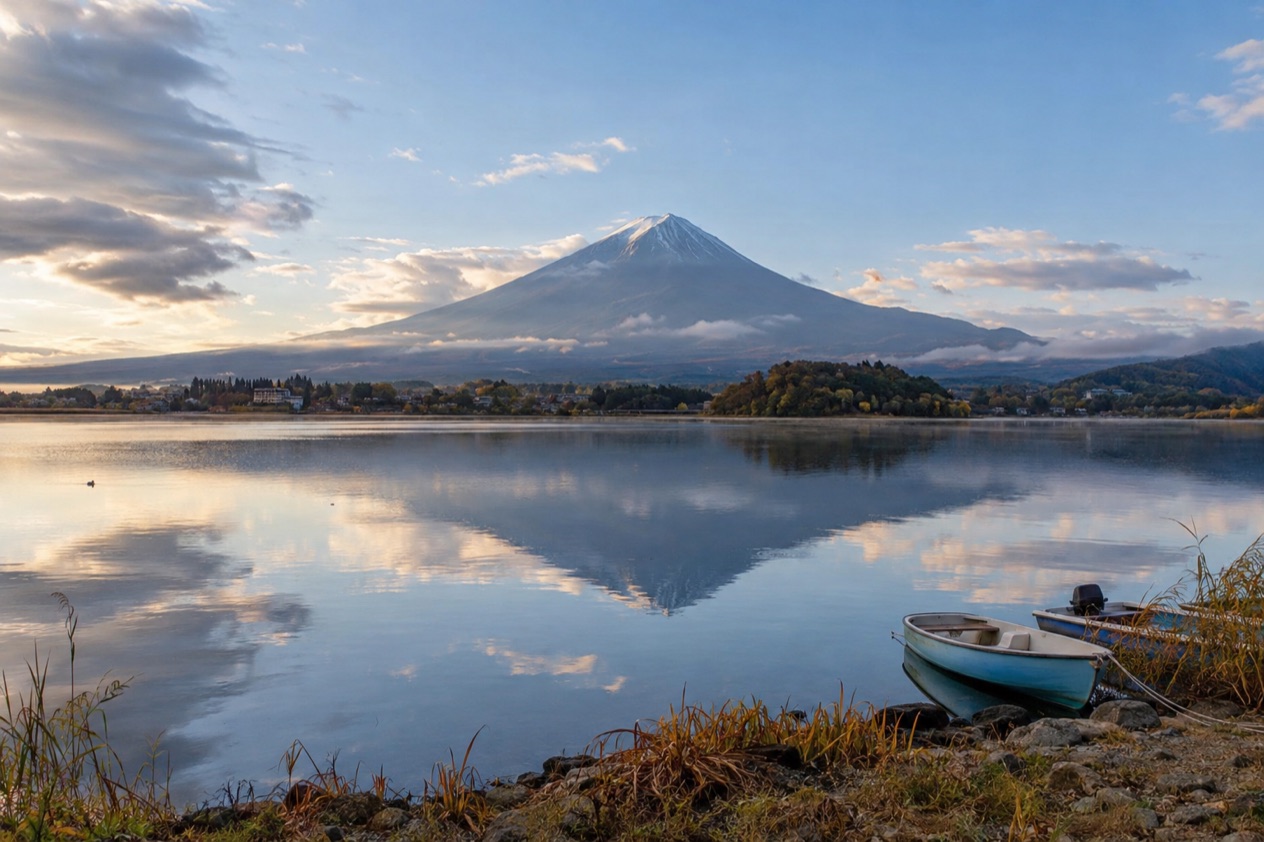
What is the weather like in Mount Fuji and Lake Kawaguchi in September?
September at Lake Kawaguchi is mild and damp, with pleasant afternoons, cool nights and the wettest weather of the three months in the table. At Kawaguchiko, on the lakeshore, summer’s heat has eased but the rain has not.
| Month | Average high (°F) | Average low (°F) | Precipitation (in) | Days with 1 mm or more of precipitation | Hours of sunshine | Daylight on the 15th |
|---|---|---|---|---|---|---|
| August | 82.6 | 65.3 | 6.96 | 10.1 | 165 | 13 h 32 min |
| September | 74.8 | 58.6 | 10.42 | 11.1 | 122 | 12 h 27 min |
| October | 64.9 | 47.7 | 9.06 | 10.1 | 134 | 11 h 21 min |
Rain in September tends to come in long, soft gray spells rather than a single burst, and humidity stays high. Plan the days with a rain shell in the bag and treat a cloudy hour as part of the trip. Some days the lake stays under a lid of cloud, and others break open without warning.
Evenings by the water are cool enough for a sweater, and mornings call for a light layer too. Sunshine is noticeably thinner than in August, so the light turns softer and flatter, which suits the lake and the pine edges. Days are shortening, and dusk arrives earlier than it did a month ago.
Up on the mountain it is another climate. The summit’s average highs stay in the low 40s, and nights drop to around freezing, so anyone heading above the lakeshore is dealing with winter-like cold in what feels like a late-summer month below.
What to do in Mount Fuji and Lake Kawaguchi in September
The defining event of the month is the end of the climbing season. The official climbing website gives September 10th as the closing date, and after that the huts and first-aid centers on the slopes are closed. Climbing outside the season is described as extremely dangerous, so September is a month for looking at Fuji rather than going up it.
What replaces the climb is a slower, lower-altitude kind of trip. Mount Fuji sits about 62 miles southwest of Tokyo, straddling the border between Shizuoka and Yamanashi prefectures, and Lake Kawaguchi is one of the places where people come to sit and watch it. It is a UNESCO World Heritage site, listed as a sacred place and a source of artistic inspiration, and that second part is easy to feel on a lake walk, where every bend frames the cone a little differently.
Lake Kawaguchi and the lakeshore
The shoreline is where a September day naturally centers. You can walk along the water, stop in cafés with big windows turned toward the mountain, and let the weather decide how much of Fuji you get. The lake itself reflects whatever the sky is doing, from steel gray to pale blue, and that changing surface is much of the pleasure.
September also brings fruit. Yamanashi is known for grapes and peaches, and stands and dessert counters around the lake often feature them in season, from plain fruit to parfaits. After a damp walk, a bowl of hoto, the thick miso noodle-and-vegetable stew of the Yamanashi mountains, is a fitting reward and suits the cooler evenings very well.
Arakurayama Sengen Park
Arakurayama Sengen Park stands in Fujiyoshida, in Yamanashi Prefecture, and is a place built for looking at Fuji with a pagoda in the foreground. The composition is one you have probably seen on postcards, and standing in it is a different thing from seeing the picture.
In September the clouds decide how much you get, so go with patience rather than a fixed expectation. A clear hour is a bonus, and a misty one still gives you the pagoda, the trees and the hush that comes with damp air. It pairs well with a meal of Yoshida-style noodles afterward in Fujiyoshida.
The mountain after the climbing season
The Yoshida trail is one of the hiking routes on Mount Fuji, and early in the month it is still in its season. After the closing date the official advice is the one worth following: check the latest information on the official climbing website before any plan that touches the slopes. Trails are closed from the fifth station upward on the Yoshida, Subashiri and Gotemba routes over the winter, and from the sixth station on the Fujinomiya route.
For most visitors this month, that means enjoying the mountain from below. Plenty of the pleasure of Fuji is in its presence over the lakes and fields, and September’s changing cloud makes that presence feel less like a postcard and more like a living thing. Moon viewing, tsukimi, also falls in the early autumn, and a clear night over the lake is a good moment to think of it.
A two-day itinerary for Mount Fuji and Lake Kawaguchi in September
Day 1 belongs to the lake. Start with a walk along the shore after breakfast, with a rain jacket in the bag, and see what the mountain is doing. Spend the late morning in a lakeside café or a small museum-style stop, then have lunch at a noodle restaurant serving hoto, which suits a gray day.
Afternoon is for fruit and a slow stroll through the lake towns, with a stop at a stand for grapes or peaches. As daylight shortens through the month, plan to be back near the water before dusk, then settle in for a soak at an onsen, a hot-spring bath, which is a good way to warm up on a cool September evening.
Day 2 moves to Fujiyoshida. Go to Arakurayama Sengen Park in the morning for the pagoda and the mountain beyond it, and take as long as the cloud demands. Then eat lunch in the town, in a small noodle shop or a family-run diner, and spend the afternoon wandering its streets.
If the weather turns, the rain card is simple: swap the viewpoint for a long meal, a museum or gallery stop, and another onsen soak. September’s soft rain makes the indoor hours feel part of the trip rather than a compromise. Finish with a bowl of noodles and an early night.
Is Mount Fuji and Lake Kawaguchi busy in September?
September is the month after the busy mountain season, and the mood shifts accordingly. The most popular period for hiking Mount Fuji runs from July to August, when huts and facilities are open and the weather is warmest, so by September that peak has passed.
The climbing season ends on September 10th, which means the flow of people heading up the trails stops early in the month. What remains is the lakeside side of Fuji, with its cafés, fruit stands, walking paths and viewpoints. The pace becomes that of an autumn visit rather than a summit rush.
It is also a month of damp weather, with the highest rainfall of the three months in the table and the least sunshine. That shapes the mood as much as anything, because the area feels softer, with mist on the water and low cloud over the trees. For many travelers that gray calm is the point of coming now, and the lakeside towns suit it well.
The autumn colors that Japan’s travel board places from mid-November to early December are still ahead, so September is a month of green hillsides with only the first hints of change. If you want brilliant foliage you will want a later trip, and if you want quiet water and fruit stands, you are in the right month.
What to pack for Mount Fuji and Lake Kawaguchi in September
Pack for mild days, cool evenings and a good chance of rain, with a few extra layers if you plan to be anywhere high.
- A light rain jacket, since September is the wettest of the three months here.
- A sweater or fleece for the lakeshore evenings, which turn cool.
- Waterproof walking shoes for damp paths and park trails.
- A small umbrella for the gray, drizzly spells.
- A warm layer and a hat if you go anywhere near the mountain’s upper slopes, where average temperatures hover around freezing at night.
- A camera or phone cover that copes with mist, as cloud and drizzle are part of the lake’s mood.
Good to know before you go
The climbing season on Mount Fuji ends on September 10th, and the official climbing website is the place to check the latest information before any plan involving the slopes. Outside the season, huts and first-aid centers close, phone service is lost in places and the weather turns severe, which is why climbing then is described as extremely dangerous.
The Japan Meteorological Agency issues Emergency Warnings to alert people to the likelihood of catastrophes tied to natural phenomena of extraordinary magnitude, and the Japan National Tourism Organization keeps a Japan Safe Travel Information page with safety tips and government information for visitors. Both are worth knowing about when weather turns in a wet month.
Mount Fuji and Lake Kawaguchi in September vs August and October
Moving the trip four weeks earlier brings you to August, which is warmer and sunnier, with longer days and the most popular period for hiking Mount Fuji, when huts and facilities are open. It is the month for the climb itself, and also for a more summery lakeside, with the cold nights of September still ahead.
Moving four weeks later brings October, which is clearly cooler, with lows well below those of September and a bit less rain. Days are shorter, and the summit’s average highs sit around freezing. The autumn colors are still on their way, since leaf color in Japan is placed from mid-November to early December, but the air feels crisper and the season has turned.
Choose August if you want to climb or to enjoy the warmest weather. Choose September if you would rather see Fuji from below, with fruit in season and softer light. Choose October if you prefer cooler air for walking and are happy to arrive just before the foliage.
Is September a good time to visit Mount Fuji and Lake Kawaguchi?
Yes, for travelers who like a gentle, misty, lakeside trip and are content to look at the mountain rather than climb it. Those who want the summit climb itself, or guaranteed sunshine, should pick a different month.
September rewards slow walking, long meals and patience with the weather. It suits people who enjoy hoto on a gray afternoon, grapes and peaches from a roadside stand, a hot-spring bath at night and a pagoda framed by cloud at Arakurayama Sengen Park.
On arrival, go straight to the lakeshore and see what the mountain is doing, then plan the rest of the day around it. The month’s particular charm is the way Fuji comes and goes behind the cloud, so that every glimpse feels earned.
Sources
- Japan Meteorological Agency (JMA), Normal values 1991-2020, monthly (https://www.data.jma.go.jp/stats/etrn/view/nml_sfc_ym.php?prec_no=49&block_no=47640), station Kawaguchiko, elevation 860 m, checked October 11, 2026
- Japan Meteorological Agency (JMA), Normal values 1991-2020, monthly (https://www.data.jma.go.jp/stats/etrn/view/nml_sfc_ym.php?prec_no=49&block_no=47639), station Fujisan, elevation 3,775 m, checked October 11, 2026
- Computed from the date and the latitude of the place (sunrise equation, solar elevation -0.833 degrees), October 11, 2026
- Japan Meteorological Agency, Emergency Warnings (https://www.jma.go.jp/jma/en/Emergency_Warning/ew_index.html), checked October 11, 2026
- Japan National Tourism Organization, safety information (https://www.japan.travel/en/japan-safe-travel-information/), checked October 11, 2026
- Japan National Tourism Organization, weather and seasons in Japan (https://www.japan.travel/en/plan/weather/), checked October 11, 2026
- Japan National Tourism Organization, summer in Japan (https://www.japan.travel/en/guide/summer-guide/), checked October 11, 2026
- Wikipedia, Climate of Japan (https://en.wikipedia.org/wiki/Climate_of_Japan), checked October 11, 2026
- Japan Meteorological Agency, maple color-change dates 2025-2026 with difference from the 1991-2020 normal (https://www.data.jma.go.jp/sakura/data/phn_014.html), checked October 11, 2026
- Japan Meteorological Agency, kaede2020.pdf (https://www.data.jma.go.jp/sakura/data/kaede2020.pdf), checked October 11, 2026
- Japan National Tourism Organization, autumn in Japan (https://www.japan.travel/en/guide/autumn-guide/), checked October 11, 2026
- Japan National Tourism Organization, spring in Japan (https://www.japan.travel/en/guide/spring-guide/), checked October 11, 2026
- Japan National Tourism Organization, Mount Fuji guide (https://www.japan.travel/en/fuji-guide/), checked October 11, 2026
- Official website for Mt. Fuji climbing, about the climb (https://www.fujisan-climb.jp/en/about/), checked October 11, 2026
- Wikipedia, Mount Fuji (https://en.wikipedia.org/wiki/Mount_Fuji), checked October 11, 2026
- Wikivoyage, Mount Fuji (https://en.wikivoyage.org/wiki/Mount_Fuji), checked October 11, 2026
- Official website for Mt. Fuji climbing, information (https://www.fujisan-climb.jp/en/info/), checked October 11, 2026
- Wikipedia, Arakurayama Sengen Park (https://en.wikipedia.org/wiki/Arakurayama_Sengen_Park), checked October 11, 2026
To plan your stay
- Things to Do in Mount Fuji and Lake Kawaguchi: Lakeside Views, Fuji-Q Highland, Hiking Season and Local Food
- Where to Stay in Mount Fuji and Lake Kawaguchi: Lakeshore Hotels, Fujiyoshida, Mountain Lodges and Ryokan
- Mount Fuji and Lake Kawaguchi from Tokyo: Fuji Excursion, the Fujikyuko Line and Climbing Season
- Best Views of Mount Fuji: Five Lakes, Fifth Station Promenades and When to Go