
TAVIRA · THE 12-MONTH VERDICT · 37.1° N
Most people book the Algarve for water and sun, then land in a month when the sea sits at 61°F. Tavira, on the eastern stretch of the coast, runs a bone-dry summer and a wet, short-day winter, and the gap between the two ends of the year is wider than the brochure photos let on: July days average 84.9°F, December days 62.8°F with 3.54 inches of rain.
The verdict first: September, when days average 79.5°F, rain falls on 1.9 days, and the water holds 65.4°F, within 2°F of its October peak. May is the alternative for anyone who came to walk rather than swim. Flights land at Faro, a short hop west along the same coast, and three or four nights is the minimum that makes the trip worth the airfare.
THE YEAR AT A GLANCE · TAVIRA
September is Tavira’s month, with 79.5°F days, rain on 1.9 days and water at 65.4°F, while October keeps the warmest sea of the year at 67.3°F and pays for it with 2.20 inches of rain.
BEST: SEPTEMBER · WARMEST SEA: OCTOBER, 67.3°F · WETTEST: DECEMBER, 3.54 IN · NORMALS MEASURED AT FARO
Go for: the long dry ramp from May to September (1.03 inches of rain in May, 0.04 in July), warm evenings by the river, and a sea that tops out at 67.3°F in October.
Think twice before: booking December for beach days: 3.54 inches of rain over 7.0 days at 1 mm or more, and 9 hours 41 minutes of daylight on the 15th.
Air and rain: IPMA 1991-2020, station 554 Faro · Sea: Open-Meteo Marine, 2015-2024 · full sources at the end
On this page
- Best month overall for TaviraSeptember: 79.5°F days, 1.9 rain days
- Sea temperature month by monthThe water peaks at 67.3°F in October
- Highs, lows, rain and sea for all twelve monthsThe full table
- When the town is quietestDecember to February, short days included
- The month to skip if heat bothers youAugust: 84.6°F days, 67.8°F nights
- May or October for a shoulder tripHow the two months compare
One caveat worth having in hand before you book. The weather figures for Tavira are measured just down the coast at Faro, and the town’s low season is a calendar fact, not a price we can quote: no Tavira price series exists in our sources, so quiet here means quiet, not cheap.
Tavira weather month by month: highs, lows, rain and sea
| Month | Avg high | Avg low | Rain | Days ≥ 1 mm | Sea |
|---|---|---|---|---|---|
| January | 61.3°F | 46.9°F | 1.94 in | 6.0 | 62.0°F |
| February | 62.6°F | 47.8°F | 1.65 in | 5.4 | 61.3°F |
| March | 66.0°F | 51.4°F | 1.84 in | 5.6 | 60.9°F |
| April | 69.3°F | 54.3°F | 1.54 in | 5.3 | 63.5°F |
| May | 74.3°F | 59.0°F | 1.03 in | 3.8 | 63.4°F |
| June | 80.2°F | 64.0°F | 0.20 in | 0.8 | 66.9°F |
| July | 84.9°F | 67.3°F | 0.04 in | 0.2 | 66.8°F |
| August | 84.6°F | 67.8°F | 0.12 in | 0.2 | 66.8°F |
| September | 79.5°F | 64.9°F | 0.85 in | 1.9 | 65.4°F |
| October | 73.9°F | 60.4°F | 2.20 in | 6.0 | 67.3°F |
| November | 67.3°F | 53.4°F | 2.97 in | 6.6 | 65.3°F |
| December | 62.8°F | 49.5°F | 3.54 in | 7.0 | 63.4°F |
Tavira’s year has one long dry ramp and one short wet season. Rain collapses from 1.84 inches in March to 0.20 in June and 0.04 in July, then comes back hard: 2.20 inches in October, 2.97 in November, 3.54 in December. Air temperature moves on a gentler curve, from 61.3°F days in January to 84.9°F in July, a spread of 23.6°F between the coldest and hottest month.
May and October are where the year turns. May adds 5.0°F to April’s days, 74.3°F against 69.3°F, and cuts rain days from 5.3 to 3.8. October runs the same trade backward: days fall 5.6°F from September’s 79.5°F, and rain days jump from 1.9 to 6.0, the identical count January carries.
December is the hardest month for anyone who came for sand. It is the wettest of the twelve, 3.54 inches of it, falling on 7.0 days at 1 mm or more and 3.2 days at 10 mm or more, and daylight on the 15th runs 9 hours 41 minutes, with the sun down by 5:17 p.m. local time. A walker in a rain shell still gets 62.8°F afternoons out of the deal.
Every air and rain figure here comes from the national weather service’s 1991-2020 normals at station 554, Faro, a real thermometer at 5 m, just west of Tavira on the same sheltered eastern stretch. It does not describe the hills inland, which are colder and wetter. The rain-day counts use the Portuguese thresholds, 1 mm (0.04 inch) and 10 mm (0.39 inch), not the 0.10-inch line American tables use, so the two sets of counts are not interchangeable. Sea readings come from a marine dataset averaged over 2015-2024.
When is the best time to visit Tavira?
Go in September. Days average 79.5°F and nights 64.9°F, rain totals 0.85 inches across 1.9 days, and the water sits at 65.4°F, warmer than any month from November through May. Daylight on the 15th runs 12 hours 27 minutes, sunrise at 7:13 a.m. and sunset at 7:40 p.m. local time, which is enough evening for the river-front tables without the 84°F afternoons that make midday a write-off.
October has the better sea, 67.3°F against September’s 65.4°F, and that is the only column it wins. Rain more than doubles, from 0.85 inches to 2.20, spread over 6.0 days instead of 1.9, days cool 5.6°F to 73.9°F, and daylight drops to 11 hours 18 minutes. August is drier still at 0.12 inches, but it is also the year’s warmest at 84.6°F by day and the month every European school is off.
We have no month-by-month pages for Tavira yet, so the detail lives here: book the September week early, since the whole coast has worked this out, and read the wider case in our Portugal calendar. For what to do with the days, see the Algarve guide, and for the arrival, Faro, where the same thermometer takes these readings.
When can you swim in Tavira? Sea temperature month by month
No month off Tavira averages 70°F. The warmest water of the twelve months is October’s, 67.3°F, followed by June at 66.9°F and July and August level at 66.8°F. Six months hold 65°F or better: June through November, with September at 65.4°F and November at 65.3°F. The floor is March, coldest of the year at 60.9°F, which makes late winter the odd trap, since January’s 62.0°F water is warmer than March’s.
Read those numbers as the mean of daily maxima over 2015-2024, not a 24-hour average: they describe the warmest reading of the day, a shade above what a 7 a.m. swimmer meets. Air adds its own bias in spring, when 74.3°F May afternoons sit over 63.4°F water. Americans used to Gulf or Caribbean swimming should expect the Atlantic here to feel bracing on entry in any month.
When is Tavira quietest?
The quiet stretch is set by the calendar: December through February, after the New Year holidays clear and before Easter pulls the first coach tours back down the coast. Those are also the three shortest months, 9 hours 41 minutes of daylight on December 15, 9 hours 57 on January 15, 10 hours 53 on February 15.
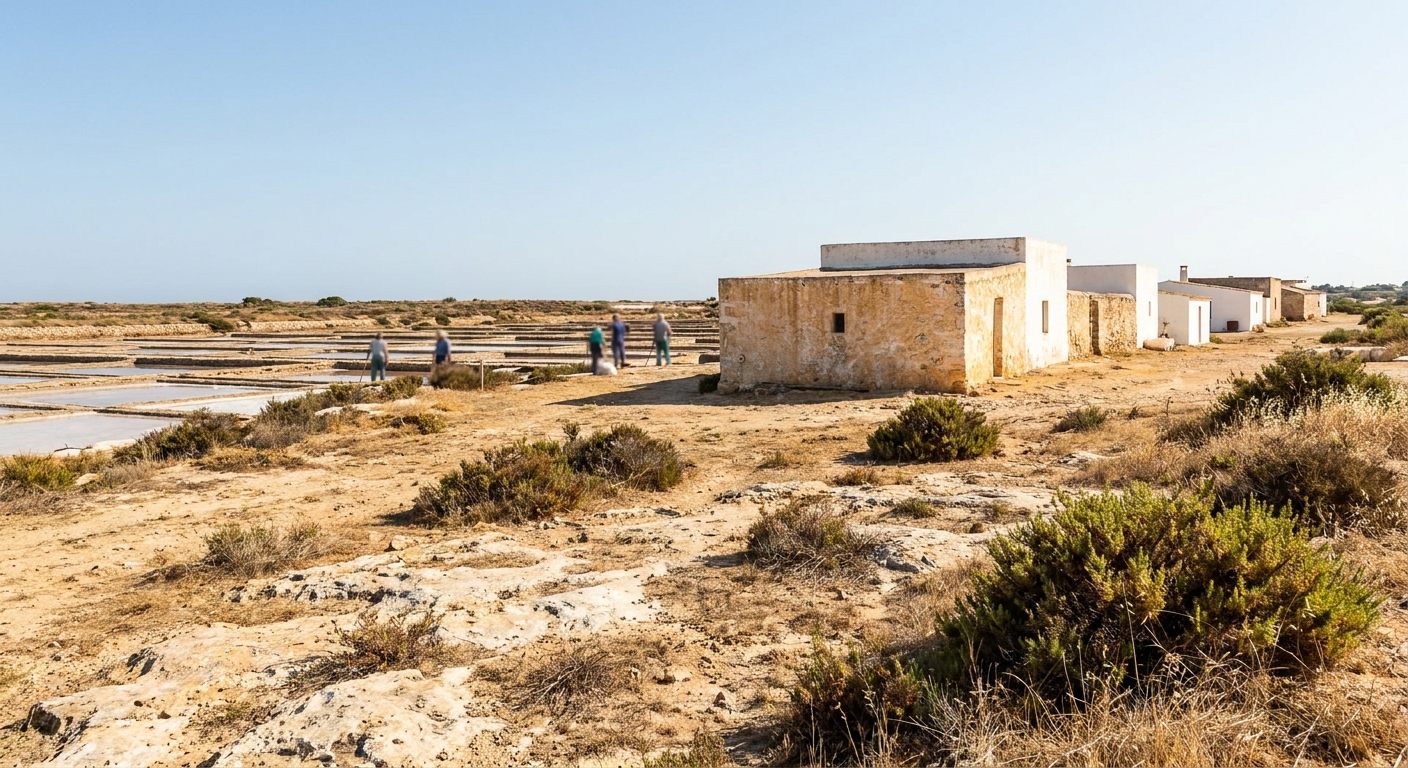
What you gain is a working town rather than a resort, at 61.3°F to 62.8°F by day, mild enough for the salt pans, the market and the bridge over the Gilão in a fleece. February is the driest of the five cool months at 1.65 inches, less than half December’s 3.54, and its 5.4 rain days are the fewest between October and April.
What you lose is the beach half of the trip. The sea runs 61.3°F to 63.4°F in those three months, the sun is gone by 5:17 p.m. in mid-December, and low season means fewer of the beach-side places keeping full hours, so check before you build a day around one. Rain days at 10 mm or more peak here too, 3.2 of them in December against 0.2 in June.
Which month should you avoid in Tavira?
August, if heat and company bother you. Days average 84.6°F and nights 67.8°F, the warmest nights of the twelve months, and rain is a rounding error at 0.12 inches over 0.2 days, so nothing breaks the run. It is also the peak European holiday month, which loads the town and the island ferries at exactly the hours the light is best. For a family chasing warm water, it is no bargain either: the sea reads 66.8°F, half a degree below October’s 67.3°F.
What redeems it is the day’s length and its reliability. On August 15 the sun rises at 6:47 a.m. and sets at 8:24 p.m. local time, 13 hours 37 minutes, so the plan becomes early beach, long shaded lunch, evening back out. Anyone traveling on school dates has no choice anyway, and August’s near-zero rain means not one day of the vacation gets rewritten by weather.
Is the shoulder season worth it in Tavira?
The shoulders are May and October, and both sit about ten degrees under the peak. May averages 74.3°F against July’s 84.9°F, a gap of 10.6°F. October averages 73.9°F against August’s 84.6°F, 10.7°F. Nights drop further still, to 59.0°F in May and 60.4°F in October.
May gives back almost nothing in daylight: 14 hours 13 minutes on the 15th, only 17 minutes short of July’s 14 hours 30, for walking weather the middle of summer cannot offer. October’s argument is the water, 67.3°F, the warmest reading of the year and 0.5°F above August’s, in a month when the beaches have emptied.
The cost is measurable on both sides. October brings 2.20 inches of rain over 6.0 days against August’s 0.12 inches over 0.2 days, and 11 hours 18 minutes of daylight, 2 hours 19 minutes less than August. May’s sea is the weak link at 63.4°F, 3.4°F below July’s 66.8°F, and it is a hair cooler than April’s 63.5°F.
So the split is clean. Come in October if swimming is the point and you can absorb a wet day or two in a week. Come in May if the trip is built on the salt pans, the market and the hill villages inland, where the coastal normals stop applying and the rain comes harder. Both beat July on comfort, and neither beats September.
The last word
Move your dates to September if the calendar allows it, and take October with a rain shell if it does not. One spring figure worth carrying if you are choosing between April and May: the water averages 63.5°F in April and 63.4°F in May, so a month of waiting buys 5.0°F of warmer air and no warmer sea at all. The compensation is the evening. By mid-June the sun over Tavira sets at 8:54 p.m. local time, and dinner starts when the heat finally lets go.
Sources & data for this guide
- Monthly highs, lows, precipitation and rain-day counts (1 mm and 10 mm thresholds) · IPMA climatological normals 1991-2020, station 554 Faro, altitude 5.0 m · checked Sep 12, 2026
- Scope caveat: the station is at Faro, just west of Tavira on the same sheltered eastern stretch, and does not describe the inland hills · IPMA · checked Sep 12, 2026
- Sea surface temperatures, given as the mean of daily maxima · Open-Meteo Marine API, 2015-2024 average · checked Sep 12, 2026
- Daylight length, sunrise and sunset on the 15th of each month, converted from UTC to local time · sunrise-sunset.org · checked Sep 12, 2026
- Editorial admission: we hold no price series for Tavira, so the low season is described by the calendar and never ranked by cost · seasonal opening hours are editorial and change, so confirm with operators when you book.