
FARO · FEBRUARY · STATION 554 · 5 M
February hands Faro a thin, bright kind of warmth. The 1991-2020 normal for the city is a 62.6°F afternoon, a 47.8°F night and 1.65 inches of rain spread across the month. That buys shirt-sleeve walking by noon inside the old walls, and a jacket by the time dinner ends. It is a real winter month on the Atlantic, not a warm one pretending to be cold.
What the date takes away is the water and the light. The sea off the city sits at 61.3°F, and February 15 gives 10 hours 53 minutes of daylight, with the sun gone by 18:12. Book this trip for the lagoon, the walled town and the drive east to Tavira, and the month over-delivers. Book it for beach days and it will not.
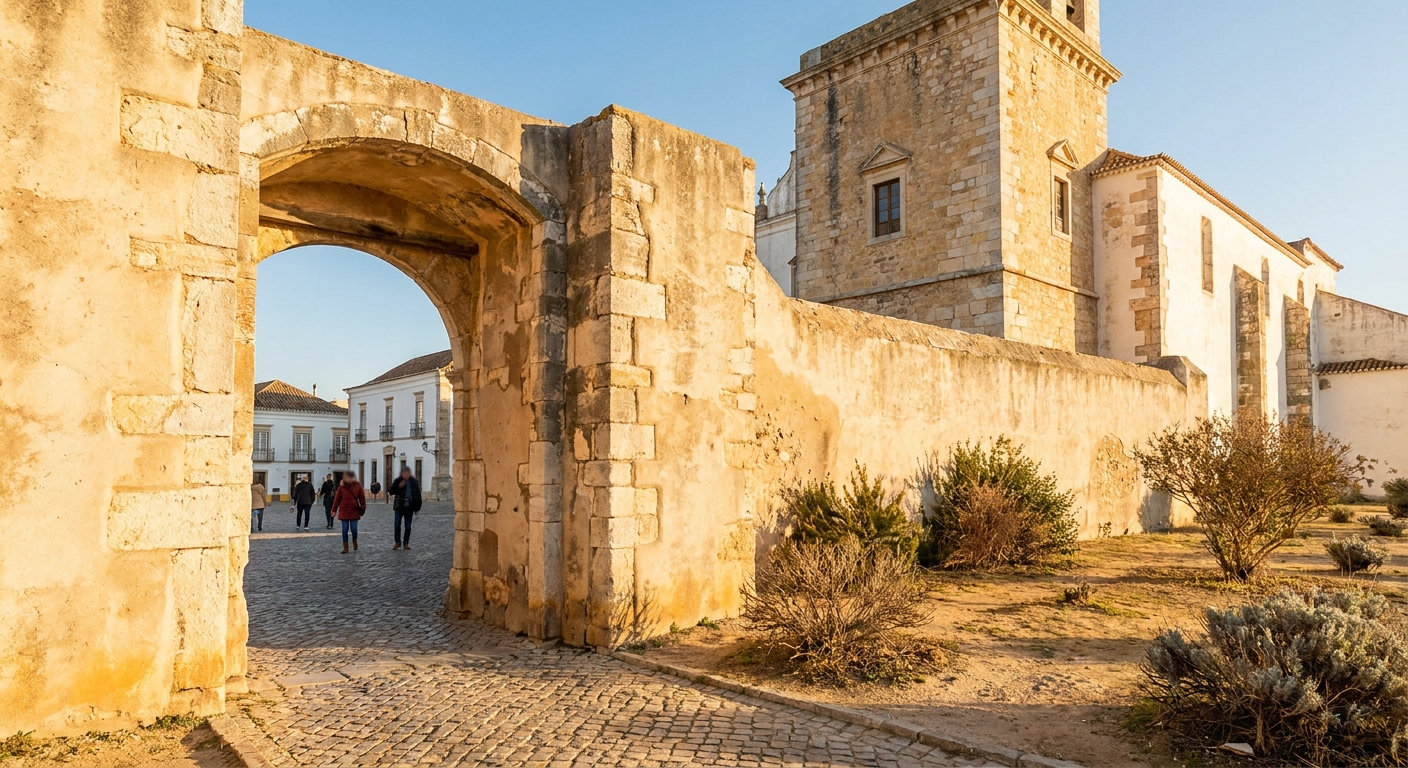
THE MONTH AT A GLANCE · FARO · FEBRUARY
February gives Faro 62.6°F walking days, 5.4 wet days and a town running at winter size, but the sea stays at 61.3°F, so come for the old town and the Ria Formosa rather than for swimming.
AVG HIGH 62.6°F · AVG LOW 47.8°F · 1.65 IN OF RAIN · SEA 61.3°F · 10H53M OF DAYLIGHT
Go for: the walled town without summer heat, the Ria Formosa in its quiet season, long lunches, and a rental car that turns a wet afternoon into a drive along the eastern Algarve.
Think twice before: planning a swimming trip or a full beach week. At 61.3°F water and 62.6°F air, the sand is for walking.
Normals: IPMA station 554, 1991-2020 · Sea: Open-Meteo Marine, 2015-2024 · full sources at the end
On this page
- Average highs, lows and rain days62.6°F days, 5.4 wet days
- Swimming in FebruaryThe sea at 61.3°F, and what that means in the water
- Crowds, hotel prices and flight costsLow season, and the figures we could not verify
- Things to do in Faro in FebruaryThe Cidade Velha, the Ria Formosa boats, Praia de Faro
- A two-day plan around 10h53m of daylightDay one and day two, hour by hour
- February against January and MarchHow the three months compare, in figures
- Is February a good month for this trip?Who should come, and who should wait
One caveat before the figures. Every number here was measured at Faro itself, 5 meters above the sea on the eastern Algarve coast, and it does not describe the whole region. Inland hills are colder and considerably wetter, and the western end of the coast runs its own weather. Pack for a mountain walk on a coastal reading and you will be wrong by more than a layer. Our Algarve guide covers the geography of that spread.
Faro weather in February: average highs, lows and rain days
| February at Faro | 1991-2020 normal |
|---|---|
| Average high | 62.6°F |
| Average low | 47.8°F |
| Precipitation | 1.65 in |
| Days with 0.04 in or more | 5.4 |
| Days with 0.39 in or more | 1.4 |
| Daylight on Feb 15 | 10h 53m |
| Sea surface (2015-2024) | 61.3°F |
These normals come from IPMA, the Portuguese institute for the sea and the atmosphere, and specifically from its station 554 in Faro, a thermometer standing 5.0 meters above sea level rather than a modeled grid cell. Over the 1991-2020 period it reports a 62.6°F average high, a 47.8°F average low and 1.65 inches of rain for the month. If a reanalysis table on another site shows you a different February, that is why. The two are not measuring the same thing.
Rain falls on 5.4 days in the average February, counting any day that records at least 0.04 inch, which works out at roughly one day in five or six. Of those, 1.4 days reach 0.39 inch or more, the volume that ends a boardwalk walk rather than dampening it. Note the thresholds: IPMA counts to its own marks, not the 0.10-inch line used by US monthly tables, so wet-day counts from the two sources cannot be laid side by side.
Day and night are 14.8°F apart, and stone lanes hold that difference well after dark. In practice a February day in Faro wants a light layer for the 62.6°F middle hours and a real jacket for the walk back from dinner, plus shoes that tolerate wet cobbles on one or two mornings. Our packing guide has the full winter list.
On February 15 the sun rises at 07:19 and sets at 18:12, Portugal holding UTC through the winter, for 10 hours 53 minutes between the two. That sunset governs the whole itinerary. A boat out into the lagoon, an afternoon in Tavira or a drive west all have to be back-timed from 18:12, because the last hour of usable light is gone by five-thirty.
Can you swim in Faro in February? Sea temperature and what it feels like
The sea surface off Faro averages 61.3°F in February, from Open-Meteo’s marine series averaged over 2015 to 2024. Read the number with its definition attached: it is the mean of daily maxima, the warmest point of each day, so it runs a shade above what a straight 24-hour average would give you. The true figure for an eight in the morning swim is a little under 61.3°F, not a little over.
In the water, that is cold rather than bracing. Swimmers who train in cold water will get their twenty minutes and enjoy them. Everyone else will get a fast dip, and the air gives no reward for coming out, since 62.6°F at best means you dry off in a wind. A wetsuit changes the answer completely, and surf and paddle schools along this coast rent them. Trunks and a towel do not.
We could not verify a February wind or wave record for the water off Faro, so we give no figure for swell height or gust speed and no claim about how often the crossings are canceled. What holds regardless is the shape of the coast: the barrier islands take the Atlantic first, and the lagoon channels behind them are the sheltered side of any windy day.
How busy is Faro in February? Crowds, hotel prices and flight costs
February sits well outside the Algarve’s summer season, and that is a calendar fact rather than a price claim. We found no monthly occupancy series and no monthly room-rate series for Faro, so we crown no month cheapest and quote no discount. What winter visibly changes is the mix: a smaller share of the beach-side businesses trading, restaurant tables available at eight on a Friday, and a working city rather than a resort.
On flights, we verified no February fare data, so no dollar figure belongs in this section. US itineraries usually reach the Algarve with a connection, and our flights guide lays out the routings. The booking advice that survives without price data is simple: take refundable hotel rates where the gap is small, because a month with 5.4 wet days and 1.4 soaking ones rearranges plans, and a nonrefundable beach hotel is a bet on the weather.
We could not verify a municipal lodging tax rate for Faro, so we give no percentage and no per-night amount. Ask at check-in whether a city tax applies and whether your booking total already carries it, then budget the answer rather than a number we did not read. Broader costs for a Portugal trip sit in our cost guide.
There is one line where paying more genuinely changes the month, and it is the rental car. With 10 hours 53 minutes of light, time spent waiting for a bus is taken out of the warm part of the day, and a car converts a wet morning into a drive east through the saltpan towns. Second on that list is a room with proper heating, because 47.8°F nights find every badly insulated apartment on the coast.
Things to do in Faro in February
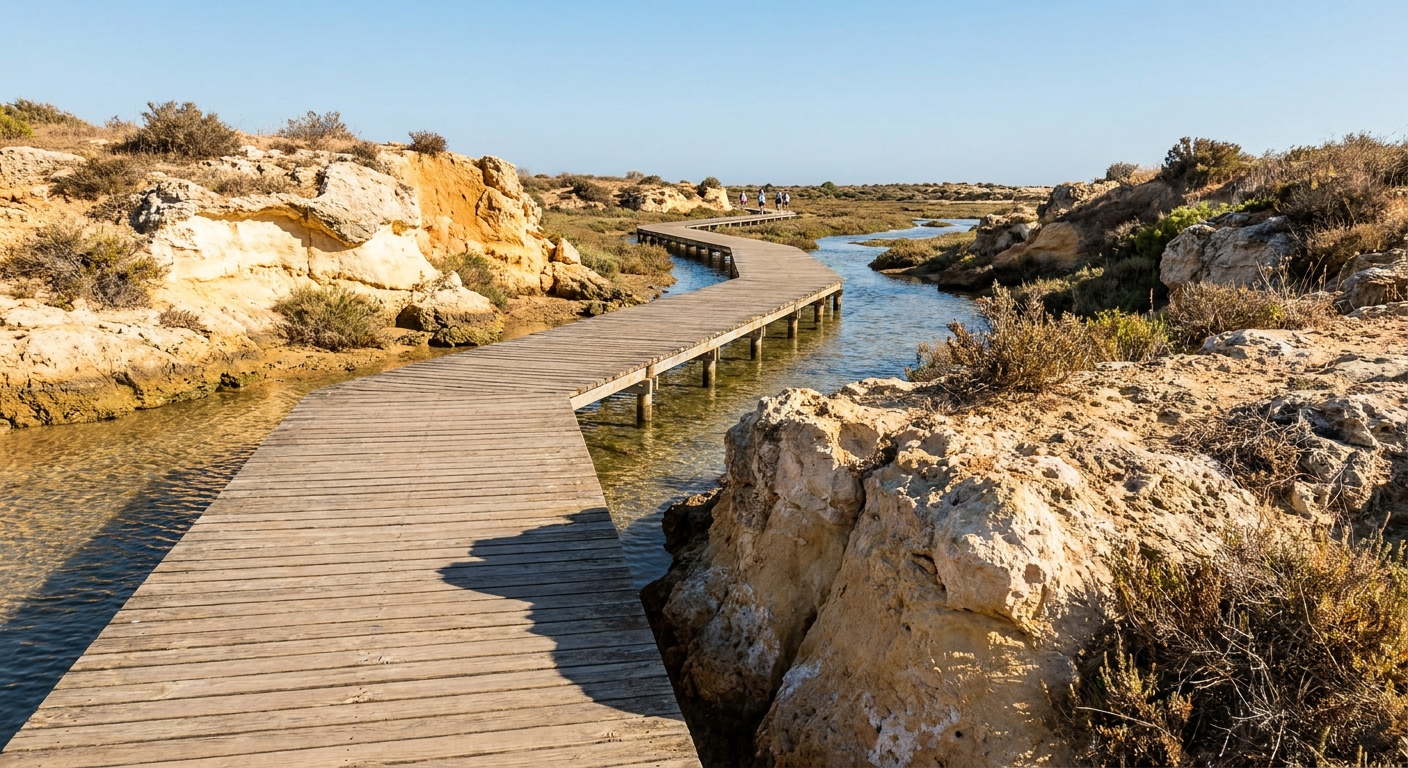
February opens the door July closes. Walking the walled town at 62.6°F is a different activity from walking it in a summer afternoon, and the lagoon is at its quietest and most birdy, mudflats and saltpans working through the winter with waders on them. Lunch outdoors is a gamble worth taking on four days out of five, and every table on the square is available when it pays off.
The named targets are close together. Inside the walls, the Cidade Velha is a small grid of lanes reached through the Arco da Vila, with the cathedral square, the Museu Municipal in its old convent, and the bone chapel at the Igreja do Carmo a few streets north. From the quays by the marina, boats cross to Ilha Deserta and Ilha do Farol. We could not verify February timetables, crossing fares or museum hours, so none appear here: confirm with the operator the morning you go.
What the date changes at those places is the air, not the water. The sea barely shifts across the winter, 62.0°F in January, 61.3°F in February, 60.9°F in March. The air climbs: 61.3°F, then 62.6°F, then 66.0°F. So Praia de Faro in February is a long sand walk with the wind at your back one way, and the islands are a boat trip with a coat, at the same water temperature you would find in high summer’s opposite.
Free in February: the lanes inside the walls, the waterfront by the marina, and the sand at Praia de Faro, reached along the causeway road across the lagoon. We could not verify winter admission prices for the museums or the chapel, so nothing paid is described here as cheap, and nothing free is invented to fill the gap.
Faro in February: a two-day itinerary
Day one runs between 07:19 and 18:12. Coffee at eight, the Cidade Velha from nine while the lanes are still empty, the cathedral square and the museum by eleven. Take a midday boat into the lagoon, when the 62.6°F peak and the strongest light overlap, and eat late on the way back. Save the last daylight hour for the marina front, then walk to dinner in the dark. Nothing after 17:30 needs a view.
Day two goes outward: the train or the car east to Tavira and the saltpan coast, or the causeway to Praia de Faro for a long beach walk. If the day turns into one of the month’s 1.4 heavy ones, swap it inside: the market, the museum you skipped, a two-hour lunch, and the beach walk moved to the following afternoon rather than canceled.
Faro in February vs January and March
| January | February | March | |
|---|---|---|---|
| Average high | 61.3°F | 62.6°F | 66.0°F |
| Average low | 46.9°F | 47.8°F | 51.4°F |
| Precipitation | 1.94 in | 1.65 in | 1.84 in |
| Days with 0.04 in or more | 6.0 | 5.4 | 5.6 |
| Sea surface | 62.0°F | 61.3°F | 60.9°F |
Set the three side by side and February is the driest of them, 1.65 inches across 5.4 wet days against January’s 1.94 inches across 6.0 and March’s 1.84 across 5.6. Afternoons climb steadily through the window, 61.3°F, 62.6°F, 66.0°F. The sea moves the other way and cools while the air warms, 62.0°F in January down to 60.9°F in March, which is the lag every Atlantic coast carries into spring.
Shift four weeks later and you gain 3.4°F of afternoon and 3.6°F of night, and you pay for it with 0.19 inch more rain and 0.4°F less sea. Shift four weeks earlier into January and you lose 1.3°F of daytime warmth and take 0.29 inch more rain across 0.6 more wet days, while the water is 0.7°F warmer than it will be all spring.
Is February a good time to visit Faro?
Yes for a city-and-lagoon trip. Walkers, birdwatchers, food travelers and anyone building a short winter break around a car and the eastern Algarve get a good month: 62.6°F afternoons, the driest rainfall total of the winter window, and a town that has room for visitors. No for a beach holiday, a swimming trip or anyone whose plan needs seven dependable outdoor days in a row. The 1.4 heavy rain days land where they want.
If that verdict lands on the wrong side, March is the next step up the same staircase, 66.0°F by day and 51.4°F at night for 0.19 inch more rain. It does not solve the water, which is 60.9°F and still falling in March. For a swimming trip, the decision belongs several months later, and our month-by-month verdict for Portugal sets out where that line falls.
The thing February alone gives, across these three months, is dryness: 1.65 inches and 5.4 wet days, the lowest of the winter window, under afternoons already past 62°F.
The last word
Decide this one on daylight and heating, not on the beach. February’s nights are only 0.9°F above January’s, at 47.8°F, so the month’s gain over the one before it belongs entirely to the daytime, and it disappears the moment the sun goes at 18:12. Book a room where the heating is real, take the car, start moving by nine, and let the walled town have the warm hours. The water at 61.3°F will still be there in March, and it will be colder.
Sources & data for this guide
- February normals, highs, lows, precipitation and rain-day counts · IPMA, climatological normals 1991-2020, station 554 Faro, altitude 5.0 m · checked Sep 23, 2026
- January and March normals used in the comparison table · IPMA, same station and same 1991-2020 period · checked Sep 23, 2026
- Sea surface 61.3°F, mean of daily maxima 2015-2024 · Open-Meteo Marine API · checked Sep 23, 2026
- Daylight of 10h 53m, sunrise 07:19 and sunset 18:12 on February 15 · sunrise-sunset.org, converted to Europe/Lisbon · checked Sep 23, 2026
- Reserves: we could not verify ferry timetables or fares to Ilha Deserta and Ilha do Farol, museum and chapel opening hours and admission prices, a municipal lodging tax rate, monthly hotel rates or February airfares, so no figures for any of those appear here.
- Rain-day thresholds are IPMA’s own (0.04 in and 0.39 in) and are not interchangeable with the 0.10-inch threshold used in US monthly tables.