
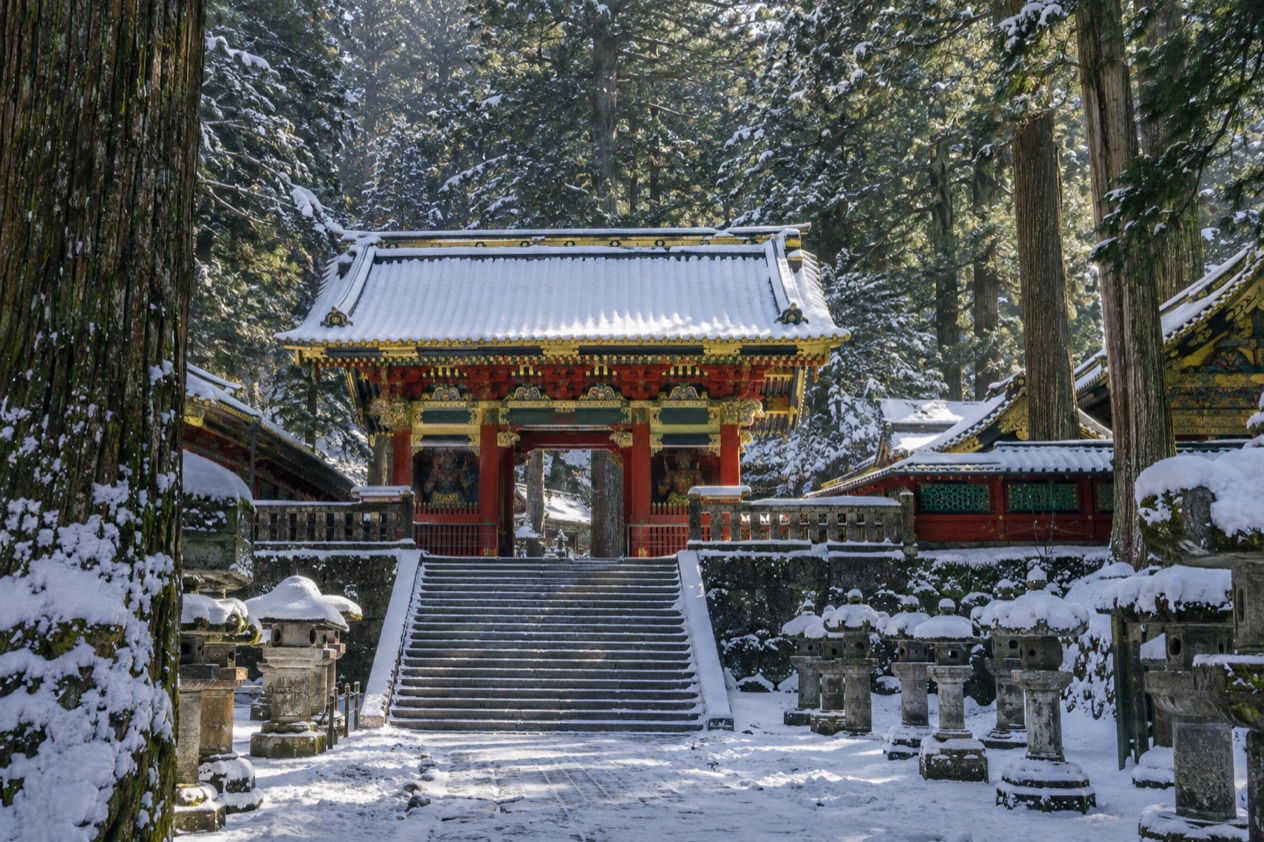
In December, snow settles on the cedar avenues around Nikko’s shrines, and the red, black and gold of the carved gates stands out against bare branches. Steam rises from bowls of yuba, the soft tofu skin that is a local specialty, and wooden inns light their stoves early. It is a month for temples, hot food and a first taste of real winter in the mountains of Tochigi Prefecture, once the maple color has gone.
What is the weather like in Nikko in December?
December is cold and snowy: at Oku-Nikko, near Lake Chuzenji, highs stay in the 30s and nights fall well below freezing, so the month feels like deep winter rather than late autumn.
| Month | Average high (°F) | Average low (°F) | Precipitation (in) | Days with 1 mm or more of precipitation | Snowfall (in) | Hours of sunshine | Daylight on the 15th |
|---|---|---|---|---|---|---|---|
| November | 47.5 | 32.4 | 3.84 | 6.7 | 1.2 | 152 | 10 h 15 min |
| December | 37.0 | 23.2 | 2.30 | 6.2 | 13.0 | 153 | 9 h 40 min |
| January | 31.5 | 17.8 | 2.26 | 6.4 | 24.8 | 165 | 9 h 54 min |
What this means in practice is snow, not rain. Snow or sleet falls on 21 days of the month, so the precipitation is mostly white, and the ground around the lake and the higher trails is likely to be covered. Waterproof boots with a real grip matter more here than an umbrella. Humidity is moderate, and the air feels dry and sharp rather than damp.
Layers do the work. A warm base layer, a fleece or wool sweater and an insulated coat that blocks wind cover most days, with a hat and gloves for anyone standing still at a viewpoint. Indoors, temple halls and old inns can be as cold as the courtyards, so a thin extra layer stays useful even after you step inside.
The light is short. Daylight lasts well under ten hours, and the sun shows itself for a fair share of the month, which gives the snow and the lacquered gates a clean, bright look when the clouds open. Plan the day around the daylight and the shrine closing times, because lamps and darkness arrive early in the valley.
What to do in Nikko in December
December in Nikko is for walking among shrines under bare trees, eating something hot afterward and watching snow settle on the higher ground. The big autumn color of the maples belongs to the weeks before, so the forest now shows dark cedar trunks, pale snow and the strong colors of the buildings themselves.
Christmas is not a national holiday in Japan, though gifts are sometimes exchanged, so Christmas Day in Nikko feels like any other winter day with a few lights in the windows. The real turn of the month is the approach of the New Year.
Japan celebrates it on January 1, with osechi, a selection of small dishes eaten for the occasion. Late in the month, in the run up to the New Year holidays, many restaurants and attractions across Japan are closed, so it pays to keep the last days of December loose.
Winter also reshapes the rhythm of a day. Shops in rural areas often close earlier, sometimes as early as 6:00 p.m., so dinner and any errands belong in the afternoon and early evening. Mornings are for the sights, and the evening is for a hot bath and a long meal.
Toshogu and Taiyuin-byo in winter
The shrine complex is the reason most people come to Nikko, and winter suits it. Toshogu is a spread of gates, storehouses and halls covered in carving and gold leaf, set among tall cedars. In December the snow on the roofs and the stone lanterns brings out the colors. You walk from gate to gate along paths that can be wet or icy, so slow steps and good soles help.
Taiyuin-byo, the mausoleum of the third shogun, Iemitsu, sits among the same trees and has its own gates, guardian figures and a smaller, darker scale. Seeing both takes a good part of the day, and the winter closing time is earlier than in summer, so start with Toshogu while the day is fresh and finish at Taiyuin-byo before the gates shut.
| Site | Open |
|---|---|
| Toshogu Shrine | 8:00 a.m. to 3:30 p.m. (November to March) |
| Taiyuin-byo | 8:00 a.m. to 3:30 p.m. (November to March) |
Lake Chuzenji and the Oku-Nikko highlands
The high country around Lake Chuzenji is where December turns properly wintry. The shore is a place for a coat and a slow walk, with steam from your breath and the mountains pale at the edges.
It suits travelers who like winter scenery more than a checklist of temples, and who are happy to have the weather decide how long they stay outside. Dress for the kind of cold that sits near the water, bring warm gloves and keep the time you spend there flexible. Hot drinks at a lakeside café, or a hot spring bath at an inn afterward, are the natural way to finish.
Yuba and winter tables
Yuba is the dish to look for in Nikko. It is the skin that forms on heated soy milk, lifted off in sheets and served rolled, simmered, fried or in a hot pot. In cold weather it arrives in warm broth, soft and rich, often as part of a set meal with rice, pickles and small side dishes. Shops also sell it in forms you can carry, such as dried sheets.
Soba noodles in hot broth, grilled skewers and sweet red bean treats at small tea shops round out a December table. Because rural shops often close early, lunch is the meal to take seriously, and an evening bowl of noodles near your inn fits the short days well.
A two-day itinerary for Nikko in December
Day 1 belongs to the shrines, because their gates close in mid-afternoon in winter. Arrive in the morning, since Tobu-Nikko Station is about 2 hours from Asakusa and Shinjuku in Tokyo, and head straight to Toshogu. Walk the whole complex at an unhurried pace, stopping where the carvings and gold leaf catch you, and leave the cedar paths for last.
Have lunch at a yuba restaurant in town, then spend the early afternoon at Taiyuin-byo, which closes at the same hour as Toshogu. By late afternoon the light is already fading with the short winter day, so the evening is for a hot meal, a bath at your inn and an early night. If the weather turns to heavy snow, shorten the outdoor walking and linger over a long lunch, a teahouse or the covered corridors of the buildings.
Day 2 goes to the high ground near Lake Chuzenji, where winter is deeper. Dress in your warmest layers and give yourself time on the shore, with a hot drink at a lakeside café as the reward for the cold. Walks here depend on snow and ice, so let the conditions set the length.
Return to town with the light going and keep the evening simple: soba or a grilled dinner, then a soak in a hot spring bath if your lodging has one. If the weather closes in, the rain card is indoors: a long meal, a visit to a craft shop, a bath and an early night while the snow falls outside.
Is Nikko busy in December?
December sits in the quiet stretch after the autumn color season and before the New Year holidays, so the pace in Nikko is set by short days and cold weather more than by any single event.
The maple color that draws visitors in autumn has passed, and in Japan the ski season generally opens in December, so winter travelers have a reason to head to the mountains of other regions. For Nikko itself, the shape of the month comes from the calendar. Christmas is not a national holiday, and the New Year holidays at the end of the month close many restaurants and attractions across Japan.
For visitors, that means the days are short and shrine gates close at mid-afternoon, so most sightseeing fits into the morning and early afternoon. Evenings are for hot food and baths rather than late wandering, and rural shops often close as early as 6:00 p.m. Plan the first part of the month for the most flexibility, and check which places are shut before arranging a trip that falls in the final days of December.
What to pack for Nikko in December
Pack for real winter, with snow underfoot and cold that does not lift, and keep layers easy to add and remove between cold courtyards and heated rooms.
- Waterproof boots with good grip, for snow and ice on shrine paths and lakeshore trails.
- An insulated, windproof coat, because the air near the lake stays well below freezing.
- Thermal base layers and a wool sweater, for long days outside and cold temple halls.
- Hat, gloves and a scarf, for standing still at viewpoints.
- Warm socks, easy to slip off, since shoes come off at the entrance of many inns and halls.
- A small daypack for layers, since the day moves between cold outdoors and warm rooms.
Good to know before you go
Winter shapes everything in Nikko this month. Snow, not rain, is the main weather, and Toshogu and Taiyuin-byo keep their shorter winter hours, with closing in mid-afternoon.
The New Year holidays bring closures at many restaurants and attractions across Japan, so the last days of December need extra flexibility. In rural areas shops often close earlier than in cities, sometimes as early as 6:00 p.m., while city shops are generally open from 10:00 a.m. to 8:00 p.m. every day.
Nikko in December vs November and January
Moving the trip four weeks earlier brings milder air, longer daylight and far less snow at Oku-Nikko. November is wetter and the days are longer, which gives more time at the shrines before closing. The autumn color season sits closer to November, while December feels more like winter proper.
Moving four weeks later brings a deeper freeze, much more snow and slightly longer light than in December. The New Year holidays also fall at the turn of the month, when many restaurants and attractions across Japan are closed.
Travelers who want milder air and a few extra hours of daylight should lean toward November. Those who want a full snowy winter, with the heaviest snow, should lean toward January. December suits people who want snow beginning to settle, the shrines in winter dress and a midpoint between the two.
Is December a good time to visit Nikko?
Yes, for travelers who like winter and who plan around short days: December suits those who want snow on cedar-lined shrines and a hot bowl of yuba at midday.
It is a good month for people who enjoy cold-weather walking, hot springs and slow meals, and who are happy to finish sightseeing by mid-afternoon. Travelers who need mild air, long daylight or time to explore the high country without snow underfoot should choose an earlier month instead.
On arrival, go to Toshogu first, while the gates are open until their early winter closing, and keep Taiyuin-byo for the afternoon. What is special about December in Nikko is the contrast: carved gold and red lacquer against snow-dusted cedars, with steam rising from a bowl of yuba afterward.
Sources
- Japan Meteorological Agency (JMA), Normal values 1991-2020, monthly (https://www.data.jma.go.jp/stats/etrn/view/nml_sfc_ym.php?prec_no=41&block_no=47690), station Okunikko, elevation 1292 m, checked October 11, 2026
- Computed from the date and the latitude of the place (sunrise equation, solar elevation -0.833 degrees), October 11, 2026
- Japan National Tourism Organization, winter in Japan (https://www.japan.travel/en/guide/winter-guide/), checked October 11, 2026
- Wikipedia, Christmas in Japan (https://en.wikipedia.org/wiki/Christmas_in_Japan), checked October 11, 2026
- Japan National Tourism Organization, shop and attraction hours, national holidays (https://www.japan.travel/en/plan/business-hours-and-holidays/), checked October 11, 2026
- Wikipedia, Japanese New Year (https://en.wikipedia.org/wiki/Japanese_New_Year), checked October 11, 2026
- Wikipedia, Public holidays in Japan (https://en.wikipedia.org/wiki/Public_holidays_in_Japan), checked October 11, 2026
- Japan National Tourism Organization, skiing guide (https://www.japan.travel/en/guide/skiing/), checked October 11, 2026
- Japan National Tourism Organization, skiing and snowboarding in Japan: regions, resorts, seasons (https://www.japan.travel/en/sports/snow/), checked October 11, 2026
- Wikipedia, List of ski areas and resorts in Japan (https://en.wikipedia.org/wiki/List_of_ski_areas_and_resorts_in_Japan), checked October 11, 2026
- Wikipedia, Climate of Japan (https://en.wikipedia.org/wiki/Climate_of_Japan), checked October 11, 2026
- Japan Meteorological Agency, maple color-change dates 2025-2026 with difference from the 1991-2020 normal (https://www.data.jma.go.jp/sakura/data/phn_014.html), checked October 11, 2026
- Japan Meteorological Agency, biological season observations (https://www.data.jma.go.jp/sakura/data/index.html)
- Wikipedia, Nikkō, Tochigi (https://en.wikipedia.org/wiki/Nikk%C5%8D,_Tochigi), checked October 11, 2026
- Wikivoyage, Nikko (https://en.wikivoyage.org/wiki/Nikko), checked October 11, 2026
- Japan National Tourism Organization, Nikko (https://www.japan.travel/en/destinations/kanto/tochigi/nikko-area/), checked October 11, 2026
To plan your stay
- Things to Do in Nikko: Toshogu Shrine, Lake Chuzenji, Kegon Falls and Kinugawa Onsen
- Where to Stay in Nikko: Station Side, Shrine Precinct, Ryokan Stays and Heritage Stays
- Nikko from Tokyo: Tobu Railway Trains, Limited Express Names and a Day in Nikko
- Know Before You Go to Nikko: Entry, Getting There, Weather and Etiquette