
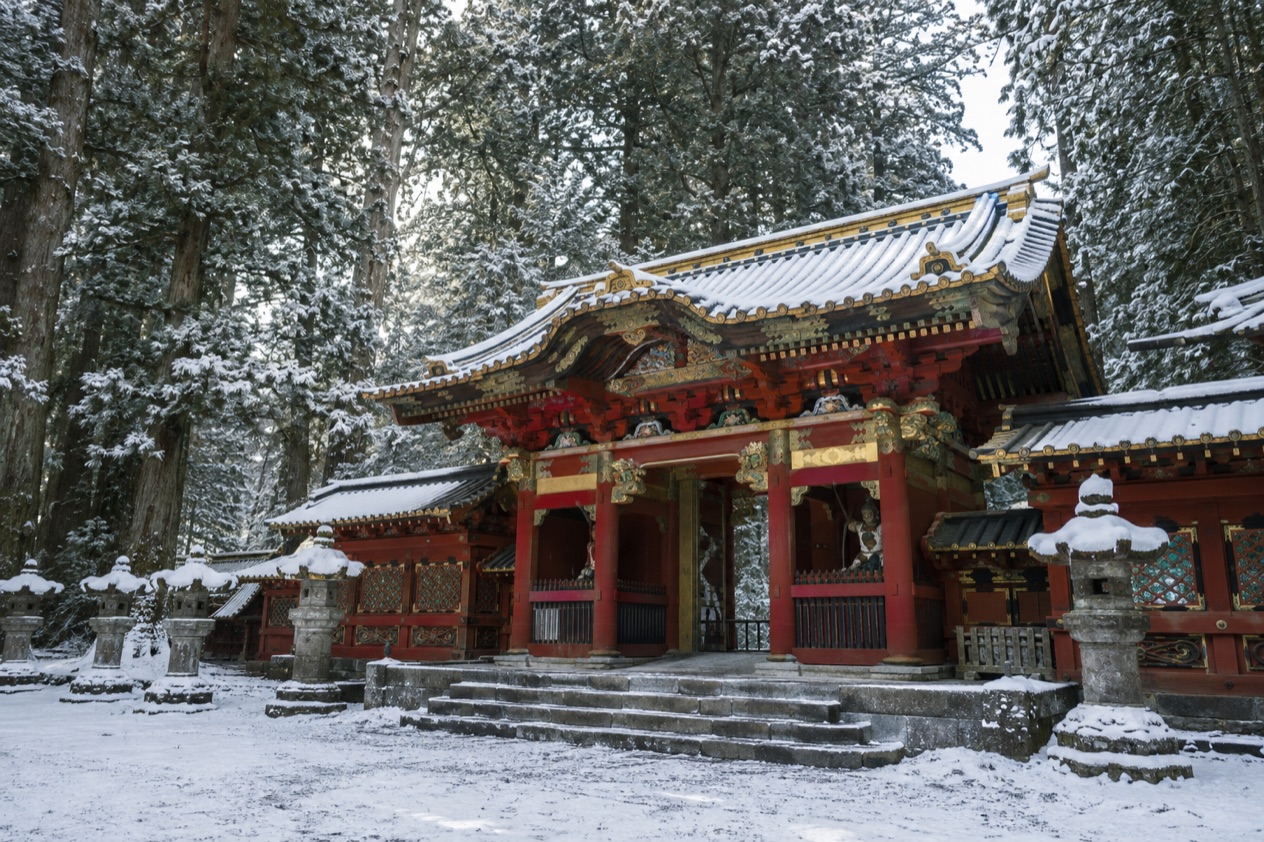
On the first days of the year, families in coats and scarves climb the stone steps of Nikko’s shrines for the year’s first visit, called hatsumode, and the cedar trunks around them are dark against the snow. Plates of osechi, the lacquered New Year dishes, are still on tables in the town. January in Nikko is a month of snowy mountains, steaming bowls and wood-carved shrine gates under white roofs, and it suits travelers who like their sightseeing cold and clear-edged.
What is the weather like in Nikko in January?
January in the Nikko highlands is properly wintry: below freezing even at midday, with snow falling on most days of the month and the deepest snowfall of the winter. Around Lake Chuzenji the cold is the kind you plan for from the first morning.
| Month | Average high (°F) | Average low (°F) | Precipitation (in) | Days with 1 mm or more of precipitation | Hours of sunshine | Daylight on the 15th | Snowfall (in) |
|---|---|---|---|---|---|---|---|
| December | 37.0 | 23.2 | 2.30 | 6.2 | 153 | 9 h 40 min | 13.0 |
| January | 31.5 | 17.8 | 2.26 | 6.4 | 165 | 9 h 54 min | 24.8 |
| February | 33.1 | 18.0 | 1.91 | 6.6 | 167 | 10 h 50 min | 22.0 |
The precipitation arrives mostly as snow or sleet, and the number of snowy days far outweighs the number of days with measurable rain. Waterproof boots matter more than an umbrella.
Layers do the work here: a warm base, a fleece or light down jacket, then a windproof shell, plus a hat and gloves you can keep on while using a phone. Boots with grip are worth more than any extra sweater, because shrine steps and lakeside paths hold snow and ice.
The light is short but generous with sun. January has plenty of sunshine hours for the mountains, and daylight lasts just under ten hours, so the plan has to fit between a late sunrise and an early dusk. Low winter sun on snow makes sunglasses useful.
What to do in Nikko in January
The month opens with the New Year. January 1 is the official Japanese New Year, celebrated on the Gregorian calendar, and the first days are given to family meals of osechi and visits to shrines.
Many restaurants and attractions close during the New Year holidays, so the first days of the month have a slower, more domestic rhythm than the rest of January. After that, the town returns to normal life and the snow takes over as the main event.
Nikko is in Tochigi Prefecture, in the Kanto region, and the mountains here get the winter that Tokyo does not. Japan’s winter guide notes that heavy snow regularly covers the mountains while most major cities rarely see it, and Nikko sits on the mountain side of that line. The pleasures of the month are shrines in snow, a frozen-edge lake, hot bowls of noodles and a hot bath at the end of the day.
Toshogu and the shrine precinct in snow
Nikko Toshogu is a Shinto shrine, and in January its gates, pagodas and carved panels are seen against bare branches and dark cedars. The carvings are the draw: animals, birds, flowers and the famous three monkeys covering their eyes, ears and mouth, painted in reds, golds and whites. Snow on the roofs softens the colors without hiding them.
Winter hours apply from November to March, and the gates close earlier than in summer. That shapes the day: the shrine belongs in the first part of it, with enough time to walk slowly and stop at each building. Stone steps and gravel paths can be icy, so shorter steps and boots with grip help.
Taiyuin, the mausoleum of the third shogun, keeps the same winter hours as Toshogu, and the two fit naturally into one outing. Taiyuin is more intimate, with a gate guarded by fierce statues and a sequence of halls in dark lacquer and gold, and snow gives the courtyards a hushed look.
| Site | Open |
|---|---|
| Toshogu Shrine | 8:00 to 15:30 (November to March) |
| Taiyuin | 8:00 to 15:30 (November to March) |
Lake Chuzenji and Kegon Falls
Lake Chuzenji lies in Nikko National Park, and Kegon Falls drops from its outlet. January’s cold is the reason to go: the lakeshore is bordered by snow, bare trees and mountain slopes in white, and the falls, depending on the cold, may carry ice at the edges. It is a chance, not a promise, so treat any frozen curtain as a bonus.
This is the coldest ground of the Nikko area, and the figures in the weather table come from here. Wear the full set of layers, bring a hat, and keep a warm drink in mind for afterward. Food, coffee and sweet shops near the lake make natural stops to warm up between viewpoints.
Winter food and the hot bath
Nikko is known for yuba, the delicate skin that forms on heated soy milk, served in simmered dishes, in soup, rolled or fried. Hot soba and udon, tofu in broth and grilled river fish are the kind of meals this weather asks for. A kaiseki dinner, a multi-course meal of small seasonal dishes, is one way to end a cold day.
Hot springs fit the month naturally. An onsen soak after hours in the snow is a Japanese winter habit, and a ryokan, a traditional inn, usually combines it with dinner and tatami rooms. Shoes come off at the entrance, and guests often wear a yukata, a light cotton robe, around the inn.
Shops in rural areas often close earlier than those in cities, sometimes as early as 6:00 p.m., so souvenirs and snacks are best picked up before dusk. In cities, shops generally stay open until 8:00 p.m., but Nikko’s outskirts follow the earlier pattern.
The train from Tokyo reaches Tobu-Nikko Station in about two hours from Asakusa or Shinjuku, which puts Nikko about 87 miles north of the capital. The buses from Oze to Nikko run only between mid-spring and mid-autumn, so they do not belong to a January plan.
A two-day itinerary for Nikko in January
Day 1 is for the shrines, because the winter closing time of 15:30 sets the schedule. Arrive in the early morning and go straight to Toshogu when the gates open at 8:00, spending the first hours on the carvings, the pagodas and the long approach under the cedars. Taiyuin, with the same hours, follows in the late morning while the light is strongest.
Lunch is a bowl of yuba or soba in a small restaurant in town. With the shrines closed by mid-afternoon, the rest of the day moves to walking Nikko’s streets, looking into craft and sweet shops before they close, and crossing the red Shinkyo bridge over the river. Dusk comes early with under ten hours of daylight, so the evening is for a hot bath and dinner.
Day 2 goes up to Lake Chuzenji and Kegon Falls. Dress in every layer, since this is the coldest ground of the trip, and spend the morning at the water’s edge and at the falls, looking for ice on the rock face. Lunch is a hot meal near the lake, and the afternoon is for slow viewpoints and a warm drink before heading down.
If heavy snow turns the day, the rain card is indoors: a long lunch, a tea or coffee stop, shops in town, and an onsen bath. Plans are flexible except the shrine hours, which stay fixed, so Day 1 should not be moved to the end of the trip.
Is Nikko busy in January?
January in Nikko is a winter month, and its pace is shaped by cold, snow and the calendar more than by a rush of visitors. The first days belong to the New Year holidays, when many restaurants and attractions are closed and families visit shrines. After that the town settles into a steadier winter rhythm.
Japan’s ski season generally runs from December to April, with peak snowfall in January and February in Hokkaido and the high mountains of Nagano.
Public holidays can also change the pattern of a week. When a national holiday falls on a Sunday, the next working day becomes a holiday, and a day sandwiched between two holidays becomes one too. A January calendar with a holiday weekend can feel different from an ordinary one, so check the dates against your plan.
On the ground, the main effect of the season is the early dusk. Shrine gates close at 15:30, and shops outside the cities may shut as early as 6:00 p.m. That gives January a daytime rhythm: sightseeing in the bright hours, then a warm evening indoors.
What to pack for Nikko in January
Pack for snow and for cold that does not lift above freezing in the highlands, with a few extras for the evenings in a ryokan.
- Insulated, waterproof boots with good grip, for icy shrine steps and lakeside paths.
- A warm base layer and a fleece or light down jacket, for the cold at the lake.
- A windproof, waterproof shell, because precipitation falls mostly as snow or sleet.
- A hat, gloves and a scarf, for standing outdoors at the falls.
- Sunglasses, for sun on snow in a month with plenty of sunshine.
- Warm socks that are easy to take off, since shoes come off at ryokan entrances.
Good to know before you go
The calendar matters more than the sky this month. Many restaurants and attractions close during the New Year holidays, so the first days of January call for flexible plans, and a meal may be an osechi spread at your inn rather than a restaurant. Toshogu and Taiyuin close at 15:30 in winter, and rural shops sometimes close as early as 6:00 p.m., so errands and souvenirs are best done in daylight.
Snow and ice are the practical concerns, not storms. Paths near the shrines and the lake can hold ice, and the mountain air is colder than the figures at lower ground might suggest, so leave margin for slower walking.
Nikko in January vs December and February
Moving the trip back to December means less snow on the ground: snowfall is roughly half of January’s, though snowy days are already frequent. Daylight is at its shortest, about a quarter hour less than in January, and the New Year closures begin to loom at the end of the month. December suits travelers who want shrines in a lighter dusting of winter and are happy to be done before the holiday pause.
Moving it later to February gives a little more light, with the day stretching to nearly eleven hours, and a touch less precipitation. Snow is still deep, and the cold is similar, so the landscape is very much the same winter, with fewer holiday closures. February suits travelers who want the same white scenery with a more generous stretch of daylight.
January is the month for the deepest snow of the three, plus the New Year atmosphere of the early days. Choose it for the whitest shrines and the lake in full winter, choose December for the lightest snow, and choose February for longer days.
Is January a good time to visit Nikko?
Yes, for travelers who want Nikko as a winter place: snow on shrine roofs, a cold lakeshore, hot noodles and a bath that feels earned. It rewards anyone happy to dress in layers and plan around short days.
It is a poorer fit for anyone who dislikes the cold or ice underfoot, or who wants long evenings outdoors. The early closing of the shrines and the early dusk make it a month of tight daytime schedules. Those who prefer warmth and long daylight will do better in another season.
On arrival, put the shrines first. Toshogu and Taiyuin close at 15:30, so the carvings, gates and snowy courtyards come before anything else, and the lake and the falls follow the next day. What January gives Nikko is the contrast: red-and-gold lacquer and carved animals against dark cedars and fresh snow, then a long soak in a hot spring once the light is gone.
Sources
- Japan Meteorological Agency (JMA), Normal values 1991-2020, monthly (https://www.data.jma.go.jp/stats/etrn/view/nml_sfc_ym.php?prec_no=41&block_no=47690), station Okunikko, elevation 1292 m, checked October 11, 2026
- Computed from the date and the latitude of the place (sunrise equation, solar elevation -0.833 degrees), October 11, 2026
- Japan National Tourism Organization, shop and attraction hours, national holidays (https://www.japan.travel/en/plan/business-hours-and-holidays/), checked October 11, 2026
- Wikipedia, Japanese New Year (https://en.wikipedia.org/wiki/Japanese_New_Year), checked October 11, 2026
- Wikipedia, Public holidays in Japan (https://en.wikipedia.org/wiki/Public_holidays_in_Japan), checked October 11, 2026
- Japan National Tourism Organization, winter in Japan (https://www.japan.travel/en/guide/winter-guide/), checked October 11, 2026
- Japan National Tourism Organization, skiing and snowboarding in Japan: regions, resorts, seasons (https://www.japan.travel/en/sports/snow/), checked October 11, 2026
- Wikipedia, Climate of Japan (https://en.wikipedia.org/wiki/Climate_of_Japan), checked October 11, 2026
- Japan National Tourism Organization, weather and seasons in Japan (https://www.japan.travel/en/plan/weather/), checked October 11, 2026
- Japan National Tourism Organization, skiing guide (https://www.japan.travel/en/guide/skiing/), checked October 11, 2026
- Wikipedia, List of ski areas and resorts in Japan (https://en.wikipedia.org/wiki/List_of_ski_areas_and_resorts_in_Japan), checked October 11, 2026
- Japan National Tourism Organization, flowers by season: cherry blossom, plum, wisteria, hydrangea, where and when (https://www.japan.travel/en/see-and-do/flowers/), checked October 11, 2026
- Wikipedia, Prunus mume (https://en.wikipedia.org/wiki/Prunus_mume), checked October 11, 2026
- Japan National Tourism Organization, Nikko (https://www.japan.travel/en/destinations/kanto/tochigi/nikko-area/), checked October 11, 2026
- Wikipedia, Nikkō, Tochigi (https://en.wikipedia.org/wiki/Nikk%C5%8D,_Tochigi), checked October 11, 2026
- Wikivoyage, Nikko (https://en.wikivoyage.org/wiki/Nikko), checked October 11, 2026
- Wikipedia, Nikkō Tōshō-gū (https://en.wikipedia.org/wiki/Nikk%C5%8D_T%C5%8Dsh%C5%8D-g%C5%AB), checked October 11, 2026
- Wikipedia, Kegon Falls (https://en.wikipedia.org/wiki/Kegon_Falls), checked October 11, 2026
- Wikipedia, Lake Chūzenji (https://en.wikipedia.org/wiki/Lake_Ch%C5%ABzenji), checked October 11, 2026
To plan your stay
- Things to Do in Nikko: Toshogu Shrine, Lake Chuzenji, Kegon Falls and Kinugawa Onsen
- Where to Stay in Nikko: Station Side, Shrine Precinct, Ryokan Stays and Heritage Stays
- Nikko from Tokyo: Tobu Railway Trains, Limited Express Names and a Day in Nikko
- Know Before You Go to Nikko: Entry, Getting There, Weather and Etiquette