
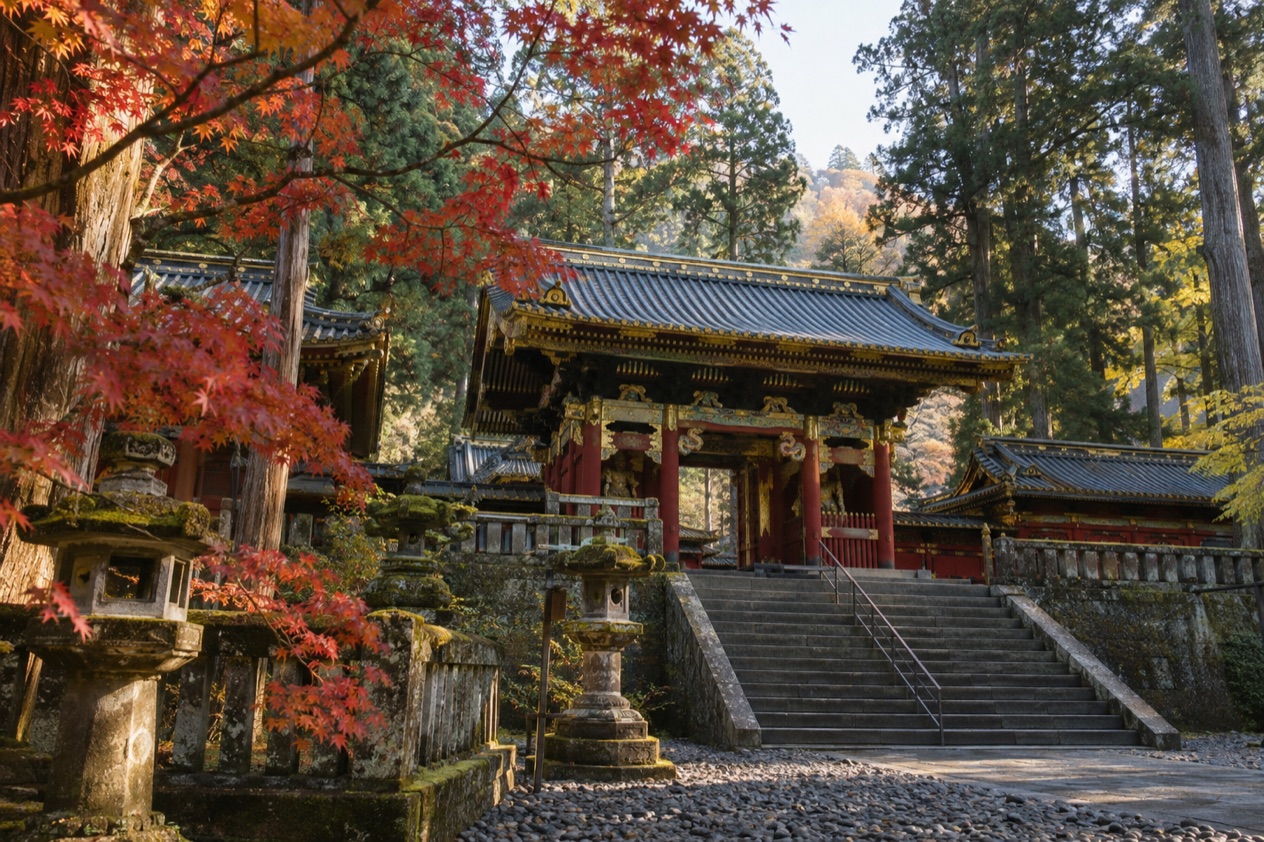
In November, steam rises from bowls of hot soba in Nikko, and the cedar avenues around the shrines hold a cold, clean smell of damp bark and wood smoke. Red and orange maples stand against dark green trunks, and the first dusting of snow sometimes lands on the higher ground near Lake Chuzenji. This is Nikko in its late-autumn mood, a month for walking among carved shrine gates, standing at a roaring waterfall and warming up over a long lunch.
What is the weather like in Nikko in November?
November in Nikko is cold and fairly dry, with crisp days, freezing nights and the first flakes of snow.
| Month | Average high (°F) | Average low (°F) | Precipitation (in) | Days with 1 mm or more of precipitation | Hours of sunshine | Daylight on the 15th |
|---|---|---|---|---|---|---|
| October | 56.7 | 42.3 | 9.48 | 11.1 | 123 | 11 h 19 min |
| November | 47.5 | 32.4 | 3.84 | 6.7 | 152 | 10 h 15 min |
| December | 37.0 | 23.2 | 2.30 | 6.2 | 153 | 9 h 40 min |
Afternoons are cool enough for a proper coat, and nights drop to the freezing mark, so layers matter more than any single heavy garment. A fleece under a windproof jacket, a scarf and gloves cover most of what the month asks. Frost on the ground and on railings is normal, and snow or sleet shows up on a good number of days at this elevation, though it is light in November compared with what December brings.
Rain comes less often than in October. When it falls, it tends to arrive as gray, drizzly spells and as cold showers that can turn to sleet around the lake. A waterproof shell with a hood is more useful than an umbrella on shrine paths and lakeside trails. Shoes with a grippy sole help on wet stone steps and on leaves that have turned slick.
The light is shorter than in early autumn, and the sun has a low, slanting quality that picks out the red of the maples and the gold of the larches. Sunshine hours are healthy for a mountain month, which means clear stretches between the clouds. Plan outdoor stops with the early dusk in mind, since the days end well before dinner.
What to do in Nikko in November
November is the month of autumn color in much of Japan, and Nikko fits into that calendar. Across the country, maple leaves redden from north to south, and the Kanto region reaches its color change around the end of the month.
For reference, the nearest city with a Japan Meteorological Agency maple record is Utsunomiya, where the usual date falls around November 20. Nikko has no record of its own, so treat that as a guide to the season rather than a date for the shrines. The Japan National Tourism Organization describes trees showing reds, yellows and oranges from mid-November to early December.
Nikko is a town in Tochigi Prefecture, in the Kanto region, and its great draw is a cluster of shrines and temples set among tall trees, with Nikko National Park spreading behind it. November suits that mix well. The cold air keeps you walking, the leaves add color to the stone lanterns and carved gates, and the lake and the falls look dramatic in the damp light.
Toshogu and Taiyuin
Nikko Toshogu is a Shinto shrine, and walking into it means passing under a torii, climbing stone steps and entering a courtyard crowded with buildings covered in painted, gilded carving. Look for the animals, the flowers and the mythical beasts worked into beams and panels, and for the stone lanterns set along the paths. Cedar trunks tower over the whole compound, and in November a few red maples soften the dark wood.
Taiyuin, a mausoleum temple, sits close by and has its own gates, guardian statues and steep approach lined with lanterns. It is a quieter-feeling place to pair with Toshogu because the scale is smaller and the details are more intimate. Both sites change their closing time from November, so the visit works best planned around the shorter hours.
| Site | Open |
|---|---|
| Toshogu Shrine | 08:00-15:30 (November to March) |
| Taiyuin | 08:00-15:30 (November to March) |
Lake Chuzenji and Kegon Falls
Lake Chuzenji lies inside Nikko National Park, and Kegon Falls drops into the gorge at the lake’s edge. In November the area has a colder edge than the town, with bare branches, early frost and the chance of sleet or a light snowfall on the higher ground. The lake is a place for slow lakeside walks and long looks at the mountains, and the falls are a loud, white contrast to the muted shoreline.
Dress for the elevation, which brings the coldest readings of any Nikko stop. Gloves and a hat are not optional here in a way they are not at the shrines. The lake pairs well with a hot drink afterward, and it makes a good counterweight to a day spent among carved wood and gilding.
Yuba and a warm table
Nikko is known for yuba, the delicate skin that forms on heated soy milk, served fresh, simmered in broth, rolled around fillings or tucked into a bowl of soba. It is a gentle, creamy food that suits a cold afternoon. Around town you also find grilled skewers, noodle shops and teahouses that serve sweets with green tea, all of them cozy places to wait out a shower.
Hot sake, miso soup and a simmering pot of something are the natural answer to the November cold. Look for small restaurants where a set meal arrives on a tray with pickles and rice, and for ryokan, the traditional inns, where a hot bath and a multi-course dinner are part of the stay. The evening rhythm of the month is early and indoors.
A two-day itinerary for Nikko in November
Day 1 belongs to the shrines because their closing time moves earlier in November. Start at Toshogu as soon as it opens at 08:00, walking through the courtyards while the frost is still on the stone. Move on to Taiyuin before the doors close at 15:30, with a break between them for a bowl of hot soba or a yuba lunch in town.
With the shrine hours behind you, use the last light for a walk among the cedar trees and the stone lanterns, then settle into the evening. Dark falls early, with only about ten hours of daylight in the middle of the month. A hot bath at the ryokan and a slow dinner fit the pace.
Day 2 goes up to Lake Chuzenji and Kegon Falls. Spend the morning at the falls and along the lakeshore, with the cold air and the bare branches as your company, and bring gloves and a hat. After a late lunch, use the afternoon for a second look at the lake or a warm teahouse stop.
If the weather turns, a rainy day is a day for indoor corners. Linger over a long yuba lunch, take tea and sweets in a café and let the shrine courtyards wait for a drier break. Sleet can show up on some days at this elevation, so keep that plan loose.
Is Nikko busy in November?
November gives Nikko a reason to be visited, because it sits inside the autumn color season that runs from mid-November into early December. Leaves are turning across the region, and the shrines and the lake make a natural setting for that.
What changes more clearly is the pace of the day. The shrines close at 15:30, the dusk comes early and the evening belongs to restaurants and the ryokan. Mornings start with cold air and frost, and by midday the town warms a little, if the sun is out.
Snow adds a second layer to the season. Light flakes can fall in November, mostly higher up, and the mountains around Nikko are where Japan’s winter snow regularly arrives later in the season.
What to pack for Nikko in November
Think in layers for cold mornings, damp stone steps and a lake that is colder than the town.
- A warm coat or insulated jacket, for freezing nights and cold afternoons at the lake.
- A waterproof shell with a hood, since showers can turn to sleet.
- A fleece or wool layer, to add under the shell at Kegon Falls.
- Gloves, a hat and a scarf, because the cold bites at the lakeshore.
- Shoes with grip, for wet stone steps and slick fallen leaves at the shrines.
- Easy slip-on footwear or clean socks, since shoes come off at the entrance of a ryokan.
Good to know before you go
The main November detail is the shrine schedule. Toshogu and Taiyuin both run on their shorter winter hours from November, with the doors closing at 15:30. The weather can also shift quickly, from damp and gray to clear to snowy, so keep a rain plan for the lake and the shrines. Heavy snow is part of Japan’s winter in the mountains, and December brings far more of it than November does.
The New Year holidays bring closures at many restaurants and attractions, but that falls after this month. In November, the practical question is simply fitting your outings into the shorter day.
Nikko in November vs October and December
Moving the trip four weeks earlier brings milder days and longer light, with about an hour more of daylight. October is also much wetter, with more rainy days and heavy totals, and snow is rare.
The shrines keep their longer hours then, closing at 16:30 instead of 15:30, which gives a more relaxed day among the buildings. The color season is a little earlier too, so it is a better fit for anyone who wants the leaves to be just beginning.
Four weeks later, the picture changes sharply. December is colder, with highs near freezing, and snow or sleet fall on most days, with a heavy accumulation. The light is shortest of the three months. The drier air brings more sunshine than October, but the landscape is much more wintry, and the shrine hours stay at the shorter winter schedule.
Pick October if you want mild weather and long days, even with more rain. Stay with November if you want a cold, fairly dry month with the leaf season under way and only a light dusting of snow. Move to December if you want a real winter backdrop and are comfortable with deep cold and heavy snow.
Is November a good time to visit Nikko?
Yes, for travelers who enjoy cold, clear days and a landscape in transition, and who are happy to trade warmth for atmosphere. November has fewer rainy days than October, a good share of sunshine and only light snow, so it suits shrine-goers, photographers who like autumn color and anyone who loves a hot bowl of soba after a chilly walk.
It is a weaker fit for anyone who wants warm weather, long evenings or the full snow of winter. The cold at Lake Chuzenji is real, and the early dusk limits what you can fit into a day. Travelers who dislike layers, gloves and sleet might prefer October.
On arrival, start with the shrines, since Toshogu and Taiyuin close at 15:30, and leave the lake for the following day. Then let the town set the rhythm, with yuba, tea and a hot bath at the end of the day. What makes November in Nikko memorable is the combination of carved shrine gates, red maples on dark cedar trunks and the first cold bite of winter in the mountain air.
Sources
- Japan Meteorological Agency (JMA), Normal values 1991-2020, monthly (https://www.data.jma.go.jp/stats/etrn/view/nml_sfc_ym.php?prec_no=41&block_no=47690), station Okunikko, elevation 1292 m, checked October 11, 2026
- Computed from the date and the latitude of the place (sunrise equation, solar elevation -0.833 degrees), October 11, 2026
- Japan Meteorological Agency, maple color-change dates 2025-2026 with difference from the 1991-2020 normal (https://www.data.jma.go.jp/sakura/data/phn_014.html), checked October 11, 2026
- Japan Meteorological Agency, kaede2020.pdf (https://www.data.jma.go.jp/sakura/data/kaede2020.pdf), checked October 11, 2026
- Japan National Tourism Organization, winter in Japan (https://www.japan.travel/en/guide/winter-guide/), checked October 11, 2026
- Japan National Tourism Organization, autumn in Japan (https://www.japan.travel/en/guide/autumn-guide/), checked October 11, 2026
- Japan National Tourism Organization, spring in Japan (https://www.japan.travel/en/guide/spring-guide/), checked October 11, 2026
- Japan National Tourism Organization, summer in Japan (https://www.japan.travel/en/guide/summer-guide/), checked October 11, 2026
- Japan Meteorological Agency, biological season observations (https://www.data.jma.go.jp/sakura/data/index.html)
- Wikivoyage, Nikko (https://en.wikivoyage.org/wiki/Nikko), checked October 11, 2026
- Japan National Tourism Organization, Nikko (https://www.japan.travel/en/destinations/kanto/tochigi/nikko-area/), checked October 11, 2026
- Wikipedia, Nikkō, Tochigi (https://en.wikipedia.org/wiki/Nikk%C5%8D,_Tochigi), checked October 11, 2026
- Wikipedia, Nikkō Tōshō-gū (https://en.wikipedia.org/wiki/Nikk%C5%8D_T%C5%8Dsh%C5%8D-g%C5%AB), checked October 11, 2026
- Wikipedia, Kegon Falls (https://en.wikipedia.org/wiki/Kegon_Falls), checked October 11, 2026
- Wikipedia, Lake Chūzenji (https://en.wikipedia.org/wiki/Lake_Ch%C5%ABzenji), checked October 11, 2026
To plan your stay
- Things to Do in Nikko: Toshogu Shrine, Lake Chuzenji, Kegon Falls and Kinugawa Onsen
- Where to Stay in Nikko: Station Side, Shrine Precinct, Ryokan Stays and Heritage Stays
- Nikko from Tokyo: Tobu Railway Trains, Limited Express Names and a Day in Nikko
- Know Before You Go to Nikko: Entry, Getting There, Weather and Etiquette