
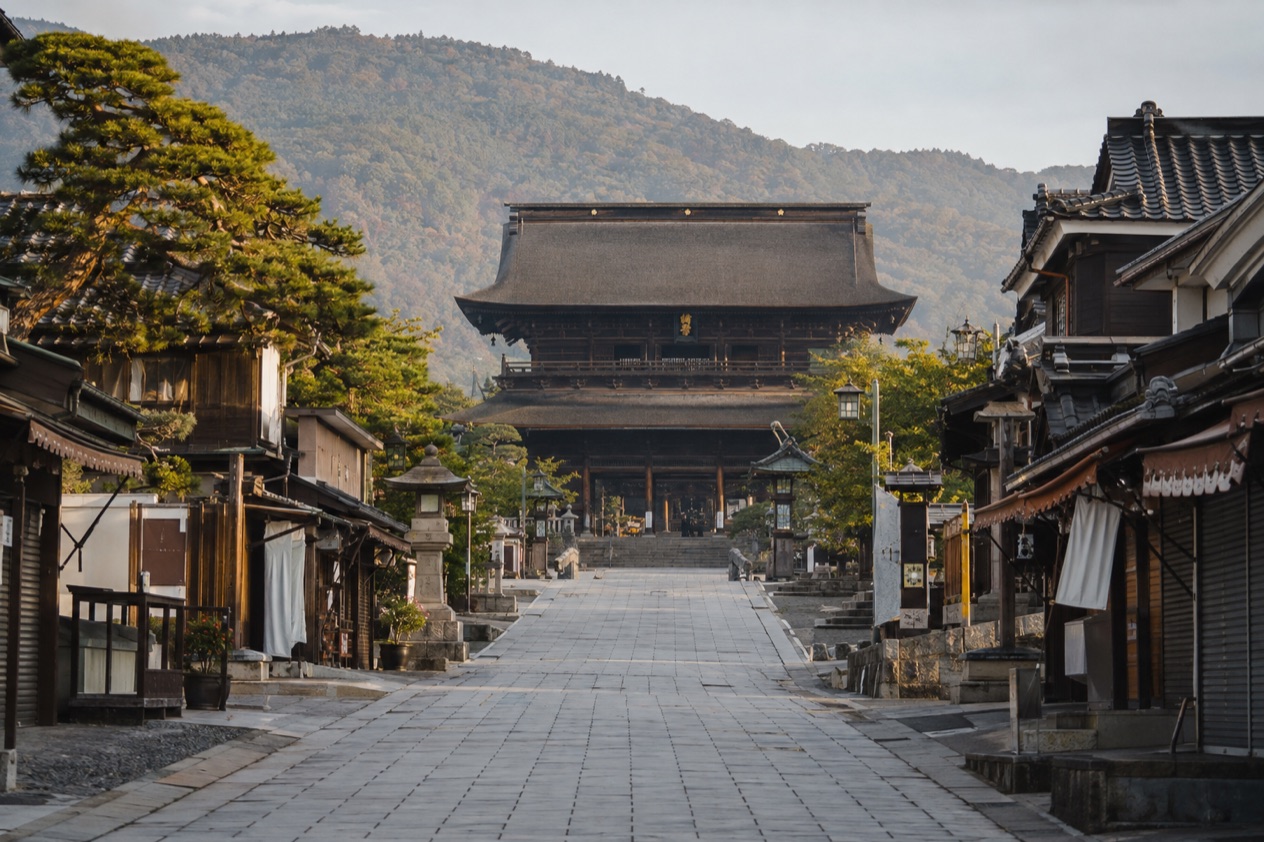
Pilgrims climb the approach to Zenkoji beneath the dark eaves of its great hall, past shops selling soba, roasted nuts and sweet buns still warm from the steamer. A temple bell sounds over the rooftops, and beyond the town the mountains stand close on every side. Nagano is a prefectural capital with a temple at its heart and a ring of alpine country around it, and it suits travelers who like to pair a few slow days in town with an excursion into the hills.
Where is Nagano and what is it like?
Nagano sits in the central Chubu region of Japan, in a mountain basin far from the sea, and it is the capital of Nagano Prefecture. It is also the largest city in the prefecture, with nearly 375,000 inhabitants, which makes it a real town with offices, schools, department stores and a working market life rather than a village.
Its height says something too. You notice the landscape constantly, framed at the end of a shopping arcade or above the roof of a temple gate.
The pace is that of a regional city. Mornings begin early around the temple, where locals stop to pray on their way to work, and the evenings are given over to small restaurants and izakaya (casual pubs serving food) near the station.
Visitors who want neon, nightlife and endless shopping will find more of it in Tokyo or Osaka. Those who want a town built around a single great temple, with mountains for company and a short list of well-chosen sights, tend to love it.
Nagano is also a place that carries a memory of the Winter Olympics. The city and the communities around it hosted the Games in 1998, and many of the venues are still open, including the M-Wave speedskating arena and the Aqua-Wing arena. The result is a town whose history reaches from the seventh century to the age of the Shinkansen, and you can feel both layers on a single afternoon.
What is there to do in Nagano?
There are three big reasons to come: the temple at the center of town, the snow monkeys of the hills nearby, and the Olympic legacy. Nagano differs from its neighbors because it combines a pilgrimage town with mountain excursions and a sports history, all within one stay and one rail hub.
Zenkoji Temple
Zenkoji stands near Nagano Station and is the heart of the city. It has a history of about 1,400 years, and its main hall is the largest wooden structure in eastern Japan. The temple was established at its current location in 642 AD and is listed as a National Treasure. The approach is lined with shops, lanterns and stone markers, and it leads up to a vast roof of dark timber.
Walk slowly up the approach and look at the small details: the incense smoke drifting from the large burner in front of the hall, the offering boxes, the worshippers clapping and bowing. Shoes come off at some temple entrances, so wear socks you do not mind showing.
Zenkoji is Buddhist, and it is a working temple, not a museum, so voices tend to drop as you near the hall. Leave time for the shops on the way back, where regional snacks and crafts are sold.
Jigokudani Monkey Park
Jigokudani Monkey Park lies in Yamanouchi, in Nagano Prefecture, about 3.5 hours from Tokyo. It is where wild Japanese macaques are seen soaking in hot spring pools, an image that has become tied to Nagano in the minds of travelers. Winter is when the scene is most often photographed, with snow on the ground and steam rising off the water, though the monkeys live in the valley through the other seasons too.
You walk in toward the pools, and the monkeys go about their business, grooming, squabbling and bathing, largely unbothered by the people. Bring warm clothing and sturdy shoes for a winter visit, and keep to the paths. Watching the animals is the whole point, and it rewards patience.
The Olympic legacy
The 1998 Winter Olympics ran from February 7 to February 22, and the Paralympics followed from March 5 to March 14. Nagano and the surrounding communities shared the events, and the M-Wave speedskating arena and Aqua-Wing arena remain open today. For sports fans, seeing the buildings that once held an Olympic crowd is a quiet pleasure, and for everyone else they are a way to understand how the city saw itself on the world stage.
Pair this with the Shinkansen story. The Hokuriku Shinkansen opened in 1997, just ahead of the Games, and it changed how the city connects to the capital.
How many days do you need in Nagano?
A long weekend is enough to see the city well, and a few extra days let you add the mountains. With two days you can spend a full morning at Zenkoji, wander the streets around the station, and fit in one of the Olympic venues. The temple is the anchor, and the rest of the day can be unhurried: a bowl of soba, a stroll through the shopping streets, a coffee near the approach.
With three days, the monkey park becomes realistic. It lies in Yamanouchi, and the journey from Tokyo takes about 3.5 hours, so from Nagano you should plan a dedicated outing and keep the rest of that day light. Winter visitors will want to dress for cold and wet ground, while in the warmer seasons the valley is green and the walk in feels like a country excursion.
A longer stay of four or five days suits travelers who like to explore slowly. You can return to Zenkoji at a different hour to see how the mood changes, take in more of the Olympic sites, and let the mountain scenery shape a day or two. Nagano is also a rail hub, so it works as a base for other parts of the prefecture without needing to change hotels every night.
If Nagano is one stop on a longer Japan trip, it fits naturally between Tokyo and the cities of the west. From Tokyo the Hokuriku Shinkansen takes 1 hour 20 minutes without stopping, so a single night is possible, though you would see only the temple. Two nights give the city room, and three let you reach the monkeys.
Where to stay in Nagano
The most practical area is around Nagano Station, because Zenkoji stands near it and the trains arrive there. Staying close puts the temple within reach on foot in the morning, and it keeps you near the restaurants, shops and the rail connections you will use for excursions. This is the base for visitors who want to arrive, drop their bags and begin exploring without planning transport.
The streets along the temple approach have their own appeal. Lodging here puts you at the heart of the pilgrimage atmosphere, with lanterns, shop fronts and the sound of the bell close at hand. It suits travelers who want to feel the town’s older side, who like to wake early and see the temple as it opens its day, and who do not mind that it is a place of worship as well as a destination.
If the Olympic sites are your focus, the neighborhoods around the venues give you more room and a different feel from the center. They are a better fit for sports enthusiasts and for those who prefer a quieter edge of town. Remember, though, that the station area remains the place where the transport and meals are concentrated.
Another approach is to stay near the mountains of Yamanouchi, where the monkey park is located, and treat Nagano city as a day visit. This reverses the usual plan and suits travelers who are chiefly there for the wildlife and the hills. Whichever you choose, Nagano is the capital and the hub, and it is the place where most routes into the prefecture begin.
How do you get to Nagano and get around?
The usual way in is the Hokuriku Shinkansen from Tokyo, which takes 1 hour 20 minutes without stopping. The line opened in 1997 and brought the capital and the mountain city much closer together. For travelers based in Tokyo, it means Nagano can be a day trip or a comfortable overnight, and for those arriving in Japan it is a short rail leg from the capital.
From Osaka or Kyoto, the route is the high-speed train to Nagoya, then the JR Wide View Shinano express train on to Nagano. This takes you across the middle of the country, with the mountains growing closer as you go. Seats on the express look out over the valleys, and it makes a pleasant day of travel for people who enjoy watching the landscape change.
Once you are in the city, the station is the center of everything. Zenkoji is near Nagano Station, so the temple is the first thing visitors reach, and the streets around it are a good way to get oriented.
Beyond that, the specifics of local buses, taxis and rental cars vary, and the best approach is to look at the options when you arrive. The rail hub makes Nagano a convenient starting point, and its role as the northernmost transportation hub of its prefecture means that connections radiate from the station in several directions.
When is the best time to visit Nagano?
Winter and autumn are the two seasons that give Nagano its strongest images. In winter, the snow monkeys of Jigokudani soak in their hot pools, steam rising into cold air, and the Olympic history of the region feels most present, since the 1998 Games were held in February and March. If your trip is built around the monkeys, December through February is the time travelers aim for, with a warm coat, waterproof shoes and gloves.
Autumn brings color to the hills around the city, and October and November are the months when the leaves turn. Zenkoji looks especially fine with maples nearby, and the mountain views widen as the foliage deepens. It is a good season for long walks and for sitting outdoors with a hot drink.
Spring and summer are greener and more open, and the valley feels fresh. Spring is a season of new leaf and mild days for walking between the temple and the town, while summer suits travelers who want to head into the mountains.
Because Nagano is high for a Japanese capital, the air can feel cooler than in the lowland cities, so a light layer is useful in the evenings. In every season, the temple draws its steady stream of worshippers, and festivals come and go through the calendar, so it is worth asking at your lodging what is on during your dates.
Good to know before you go
Prices in Japan are written in yen, and it helps to think in yen as you shop and eat rather than converting each item. Temples such as Zenkoji are places of worship, so a quiet voice and respectful manners suit the setting, and shoes come off where the entrance calls for it.
Nagano is high for a prefectural capital, and mountain weather can change, so pack a layer even when the day starts fine. For the monkey park, wear footwear you do not mind getting wet or muddy.
Sources
- Japan National Tourism Organization, Nagano (https://www.japan.travel/en/destinations/hokuriku-shinetsu/nagano/nagano-and-around/), checked October 11, 2026
- Wikipedia, Nagano (city) (https://en.wikipedia.org/wiki/Nagano_(city)), checked October 11, 2026
- Wikivoyage, Nagano (https://en.wikivoyage.org/wiki/Nagano), checked October 11, 2026
- Wikipedia, Jigokudani Monkey Park (https://en.wikipedia.org/wiki/Jigokudani_Monkey_Park), checked October 11, 2026
- Wikipedia, Zenkō-ji (https://en.wikipedia.org/wiki/Zenk%C5%8D-ji), checked October 11, 2026