
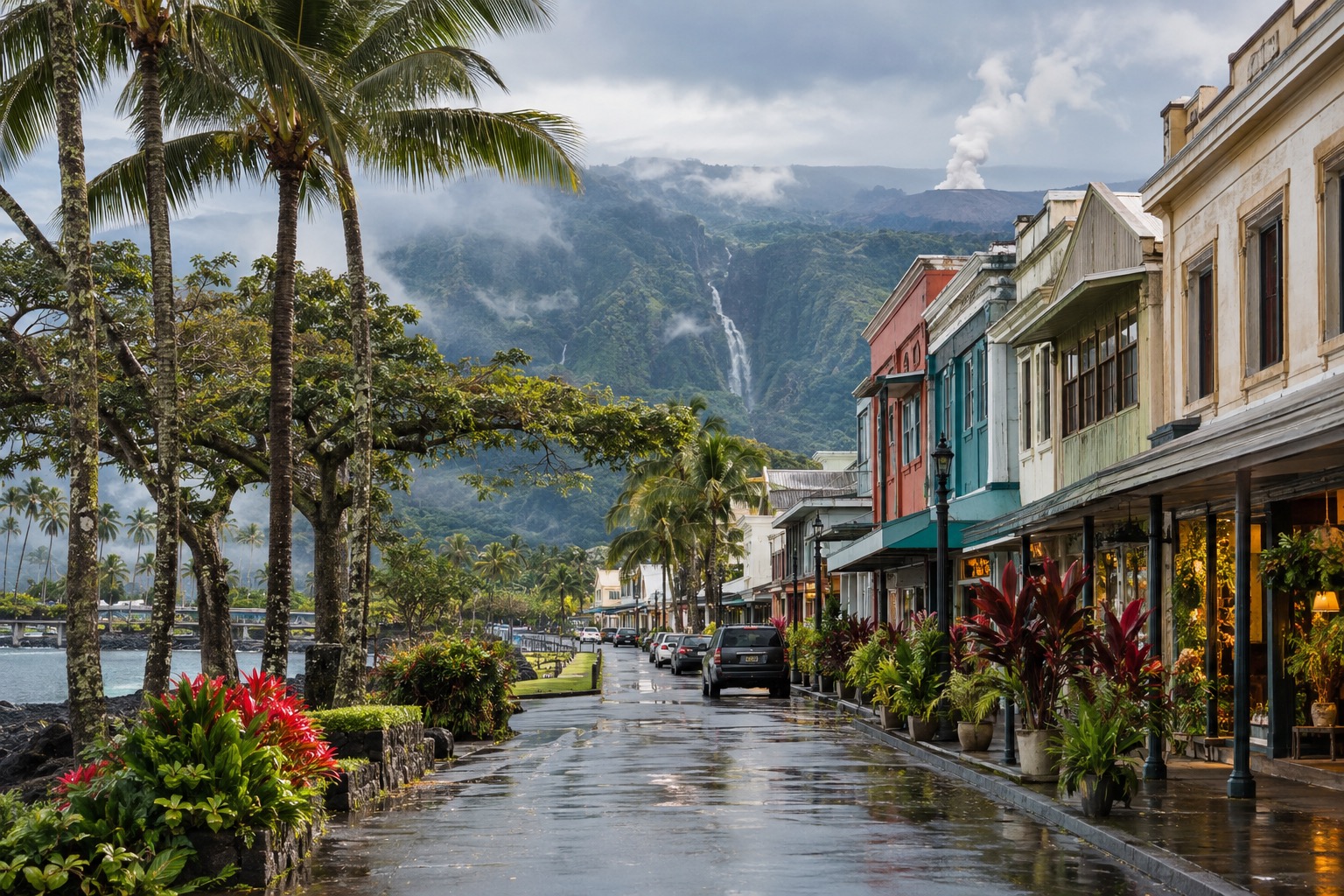
Early in the morning in Hilo, the farmers market on Mamo Street is already loud with vendors stacking papayas, apple bananas and orchids, while a soft rain drifts in from Hilo Bay and a rainbow shows up over the Wailuku River. This place reveals the Big Island’s lush, rainy, easygoing face, a historic town of timber storefronts, gardens and cascades. It suits travelers who like to wander, eat well and use the town as a base for volcanoes and mountains.
What are the best things to do in Hilo?
The best things to do in Hilo are the ones that celebrate its rain-fed landscape: waterfalls, gardens, a lively market and an easy drive to a volcano.
- Rainbow Falls and the Boiling Pots, a quick stop right in town where mist often draws a rainbow.
- The Saturday and Wednesday farmers market downtown, the best place to taste the island’s fruit.
- Liliuokalani Gardens, a Japanese-style park on the bay for a slow morning stroll.
- Imiloa Astronomy Center, where Hawaiian navigation and the night sky meet.
- Hawaii Volcanoes National Park, the big day out from town.
- Akaka Falls, a short rainforest walk to a tall, thin cascade.
- A bowl of saimin or a plate of fresh poke at a neighborhood counter.
- A drive up Saddle Road toward Maunakea and its stargazing.
Sights and landmarks in Hilo
Rainbow Falls and the Boiling Pots
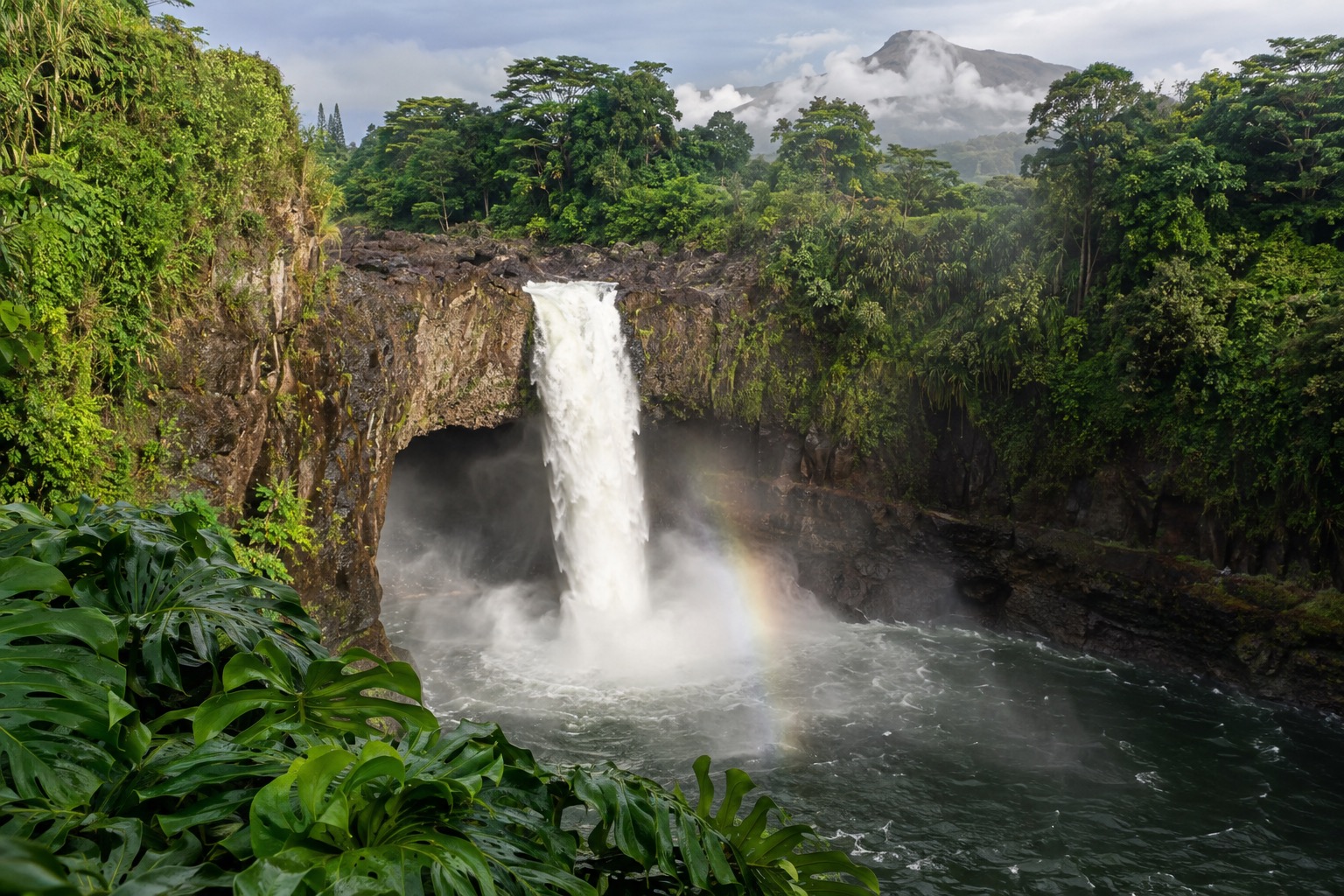
Rainbow Falls is only minutes from downtown, which makes it an easy first stop. The Wailuku River spills over a lava ledge into a round pool, and on many mornings the mist catches the sun and throws up a rainbow. A viewing area sits right above the falls, and a big banyan tree nearby adds to the scene.
A little farther upstream, the Boiling Pots are a series of basins where the river churns and foams after heavy rain. You look from the overlooks, and the roar tells you why the river here deserves respect. Morning light is the best for the rainbow, and the same entry covers both stops.
| Site | Admission (non-Hawaii residents) |
|---|---|
| Rainbow Falls and Boiling Pots (Wailuku River State Park) | $5.00 per person, plus $10 per vehicle for parking |
Imiloa Astronomy Center
Imiloa, a unit within the University of Hawaii at Hilo, blends exhibits and a planetarium with a powerful thread of Hawaiian culture. It tells how Polynesian voyagers crossed the Pacific guided by stars, and how the same skies now draw telescopes to Maunakea.
It is a good pick for a gray or drizzly afternoon, and it works well as preparation before a night on the mountain. The building sits on the hillside above town, so you get a wide view over the bay as a bonus.
| Site | Open |
|---|---|
| Imiloa Astronomy Center | Tuesday to Sunday, 9:00 a.m. to 4:30 p.m. (closed Mondays) |
Downtown, the bay and the gardens
Downtown Hilo is a walkable grid of historic storefronts housing bookshops, galleries, bakeries and small museums. The farmers market spreads along Mamo Street and is busiest on Saturday mornings, with a smaller version midweek. Across the bay, Liliuokalani Gardens offers stone lanterns, arched bridges and a view of the water, with Maunakea sometimes showing on clear days.
The town carries the memory of the tsunamis that have struck the bay, notably in 1960, and the Pacific Tsunami Museum downtown tells that story through survivors’ accounts. It is a thoughtful stop that explains why the waterfront looks the way it does, with open parkland where buildings once stood.
Beaches and outdoor things to do in Hilo
Hilo is not a sunbathing town, because its coast is lava rock and its sky is often soft and cloudy, but the outdoors here is lush and varied.
Black sand, tide pools and the Hilo coast
Along the bay, Richardson Ocean Park has a small black sand beach, tide pools and green turtles that often rest on the rocks or in the shallows. At the beach entrance, posted signs plus the day’s surf and currents tell you what to expect, so read them before you go in, and if you swim, stay near a lifeguard only where one is on duty.
Farther along the shore, Onekahakaha and Carlsmith offer sheltered pools that suit families, and Lili’uokalani Gardens has rock-lined edges for a stroll rather than a swim. Wear water shoes, because the lava is sharp and slippery, and keep a respectful distance from turtles, which are protected.
Rainforest walks and gardens
With a wet climate, Hilo grows tropical gardens as few places do. Botanical gardens along the Hamakua coast and in the hills around town show off orchids, bromeliads, gingers and towering palms. Wooded paths drop to streams and little cascades, and the air smells of earth and flowers.
Rain can arrive at any hour, usually in short bursts that pass quickly, so a light rain jacket and shoes with grip matter more than sunscreen. Trails turn muddy, which is part of the charm for those who like to walk.
Day trips from Hilo
Hawaii Volcanoes National Park
The park lies a 45 minute drive southwest on Highway 11, about 30 miles from town. You stand on the rim of Kilauea’s caldera, walk through a lava tube beneath ferns, and follow the road down toward the coast where old flows meet the sea. Steam vents and wide crater views give the place a primeval feel.
The park sits high, so it is noticeably cooler and often rainy or misty, and a jacket helps. Late afternoon into dusk is a favorite time, when any glow from the crater stands out against the dark. The $30.00 private vehicle pass admits its holder and as many as 14 passengers.
Maunakea and Saddle Road
The Daniel K. At 9,200 feet, the Visitor Information Station welcomes visitors every day between 9:00 a.m. and 9:00 p.m. Stopping there for at least 30 minutes helps you adjust to the altitude and get a weather update. To continue past it, you need four-wheel drive, because two-wheel-drive vehicles are barred above the station. Sunset and the stars that follow are the main draw.
Akaka Falls and the Hamakua coast
Heading north along the old coastal road, you pass sea cliffs, small farming villages and gulches draped in vines. The falls are the star: a thin ribbon dropping 442 feet into a green gorge, reached by a short paved loop through bamboo, ginger and tree ferns.
Go early, before tour buses and when the light is soft. The loop is easy for most walkers, though steps and wet pavement call for decent shoes. Non-Hawaii-resident visitors pay $5.00 per person plus $10 per vehicle for parking.
What to eat in Hilo
Eating in Hilo means local Hawaii comfort food and fruit picked nearby. Saimin, a noodle soup with a light broth, green onion and slices of fish cake or pork, is the town’s everyday bowl. Plate lunches pair rice, macaroni salad and kalua pork, chicken katsu or laulau.
Poke, made from fresh ahi with sesame, onion and sea salt, is sold by the pound at local counters. Bakeries turn out malasadas and manju, and shave ice comes in bright syrups over a scoop of ice cream. At the farmers market, look for apple bananas, papayas, rambutan, avocados and sweet pineapple, plus local honey and Big Island coffee.
Things to do in Hilo at night
Evenings in Hilo are quiet and local. Downtown restaurants fill with families and friends, and some spots host live ukulele, slack key guitar or a small band. A few bars pour craft beer and island cocktails, but nobody expects a late night.
The real nightlife is the sky. With little city glow and a mountain full of telescopes nearby, a clear night is made for stargazing, and the planetarium at Imiloa gives a good introduction on any evening when it is open. Rain is frequent, so keep a flexible plan.
Things to do in Hilo with kids
Children usually enjoy Hilo for its small-scale adventures. Panaewa Rainforest Zoo is a relaxed, shaded place to see tropical animals, and the tide pools and turtles at the bay hold their attention. Waterfalls make a good short outing, and the Boiling Pots look dramatic from the overlook.
Imiloa’s planetarium and exhibits suit curious kids on a wet day. Keep in mind the rain, slippery rocks and strong sun between showers, and keep children well back from stream edges and the ocean. At altitude on Maunakea or the volcano, cooler air and thinner oxygen can tire little ones fast.
Good to know before you go
Hilo is easiest with a rental car, since the waterfalls, the volcano and Saddle Road are spread out and no passport or visa is needed for this U.S. destination. Flights arrive at Hilo International Airport, a small, easygoing terminal. The Central Pacific hurricane season runs from June 1 to November 30, and Hilo’s wet windward side means a rain layer is useful in any month.
| Fee | Amount | Who pays |
|---|---|---|
| State transient accommodations tax | 11.00% | Guests, on lodging |
| County of Hawaii transient accommodations tax | 3% | Guests, on lodging |
| General excise tax pass-on (County of Hawaii, maximum) | 4.7120% | Customers, when a business passes it on |
Sources
- Hawaii Department of Taxation, Tax Announcement No. 2025-03 (Transient Accommodations Tax Law Changes from 2025 Legislative Session), files.hawaii.gov/tax/news/announce/ann25-03.pdf, checked September 24, 2026
- County of Hawaii, Department of Finance, Transient Accommodations Tax (TAT) page, hawaiicounty.gov/departments/finance/transient-accommodations-tax-tat (live returned HTTP 403 on request, read via Internet Archive Wayback Machine snapshot dated August 14, 2026, same official content), checked September 25, 2026
- Hawaii Department of Taxation, County Surcharge on General Excise and Use Tax page, tax.hawaii.gov/geninfo/countysurcharge/, checked September 25, 2026
- Federal Aviation Administration, CY2024 Commercial Service Enplanements (xlsx), faa.gov/airports/planning_capacity/passenger_allcargo_stats/passenger/arp-cy2024-commercial-service-enplanements.xlsx, checked September 24, 2026
- Hawaiʻi Department of Land and Natural Resources, Division of State Parks, "Wailuku River State Park", dlnr.hawaii.gov/dsp/parks/hawaii/wailuku-river-state-park/, read September 25, 2026
- Hawaiʻi Department of Land and Natural Resources, Division of State Parks, "ʻAkaka Falls State Park", dlnr.hawaii.gov/dsp/parks/hawaii/akaka-falls-state-park/, read September 25, 2026
- University of Hawaiʻi at Hilo, Center for Maunakea Stewardship, "Important Things to Know", hilo.hawaii.edu/maunakea/visitor-information/important-things-to-know, read September 25, 2026
- University of Hawaiʻi at Hilo, Center for Maunakea Stewardship, "Maunakea Visitor Information Station", hilo.hawaii.edu/maunakea/visitor-information/station, read September 25, 2026
- National Park Service, "Fees & Passes", nps.gov/havo/planyourvisit/fees.htm, read September 25, 2026
- Imiloa Astronomy Center, University of Hawaii at Hilo, About Imiloa, https://imiloahawaii.org/aboutimiloa, checked September 25, 2026
- Imiloa Astronomy Center, University of Hawaii at Hilo, homepage, https://imiloahawaii.org/, checked September 25, 2026
- NOAA National Centers for Environmental Information, Recent/Significant Tsunami Events, https://www.ncei.noaa.gov/products/natural-hazards/tsunamis-earthquakes-volcanoes/tsunamis/recent-significant-events, checked September 25, 2026
- National Weather Service, International Tsunami Information Center, Hawaii Tsunamis, https://weather.gov/itic-car/hawaii_tsunamis, checked September 25, 2026
- USGS, November 27-December 10, 2022 Eruption of Mauna Loa, https://www.usgs.gov/volcanoes/mauna-loa/science/november-27-december-10-2022-eruption-mauna-loa, checked September 25, 2026
- NPS, Directions, https://www.nps.gov/havo/planyourvisit/directions.htm, checked September 25, 2026
- Hawaii Department of Transportation, New phase of Daniel K. Inouye Highway opens Oct. 10 2017, https://hidot.hawaii.gov/highways/new-phase-of-daniel-k-inouye-highway-opens-oct-10-2017/, checked September 25, 2026
- NOAA NCEI, monthly normals 1991-2020, station USW00021504
- NOAA NCEI, monthly normals 1991-2020, station USW00021510
- NOAA NCEI, monthly normals 1991-2020, station USC00511303
- NWS Honolulu / Central Pacific Hurricane Center, « 2026 Central Pacific Hurricane Season Outlook », weather.gov/hfo/hurricaneOutlook2026, checked September 24, 2026