
On Molokai, the afternoon traffic in Kaunakakai is a pickup truck rolling slowly past a roadside stand, and the driver lifts two fingers off the wheel to wave. There is no stoplight to wait at and no high-rise to look up at. This is the quiet Hawaiian island, a place of long empty shores, deep sea cliffs and small-town habits, for travelers who would rather slow down than be entertained.
Where is Molokai and what is it like?
Molokai sits between Oahu and Maui, a long, narrow island in Maui County that you can see from both on a clear day. It is a rural, lightly visited island, and the land area is modest at about 260 square miles, though the roads are quiet enough that it feels bigger.
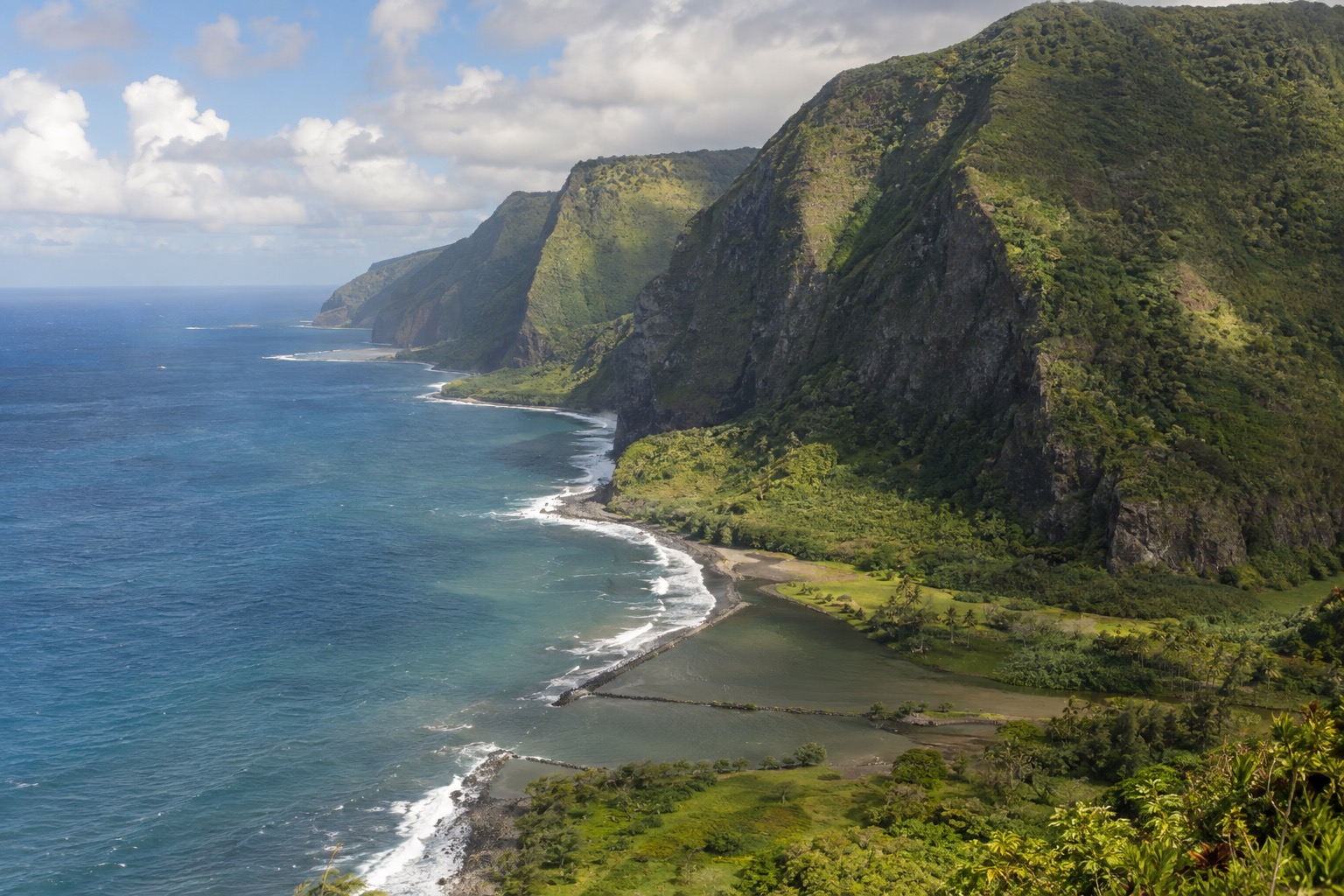
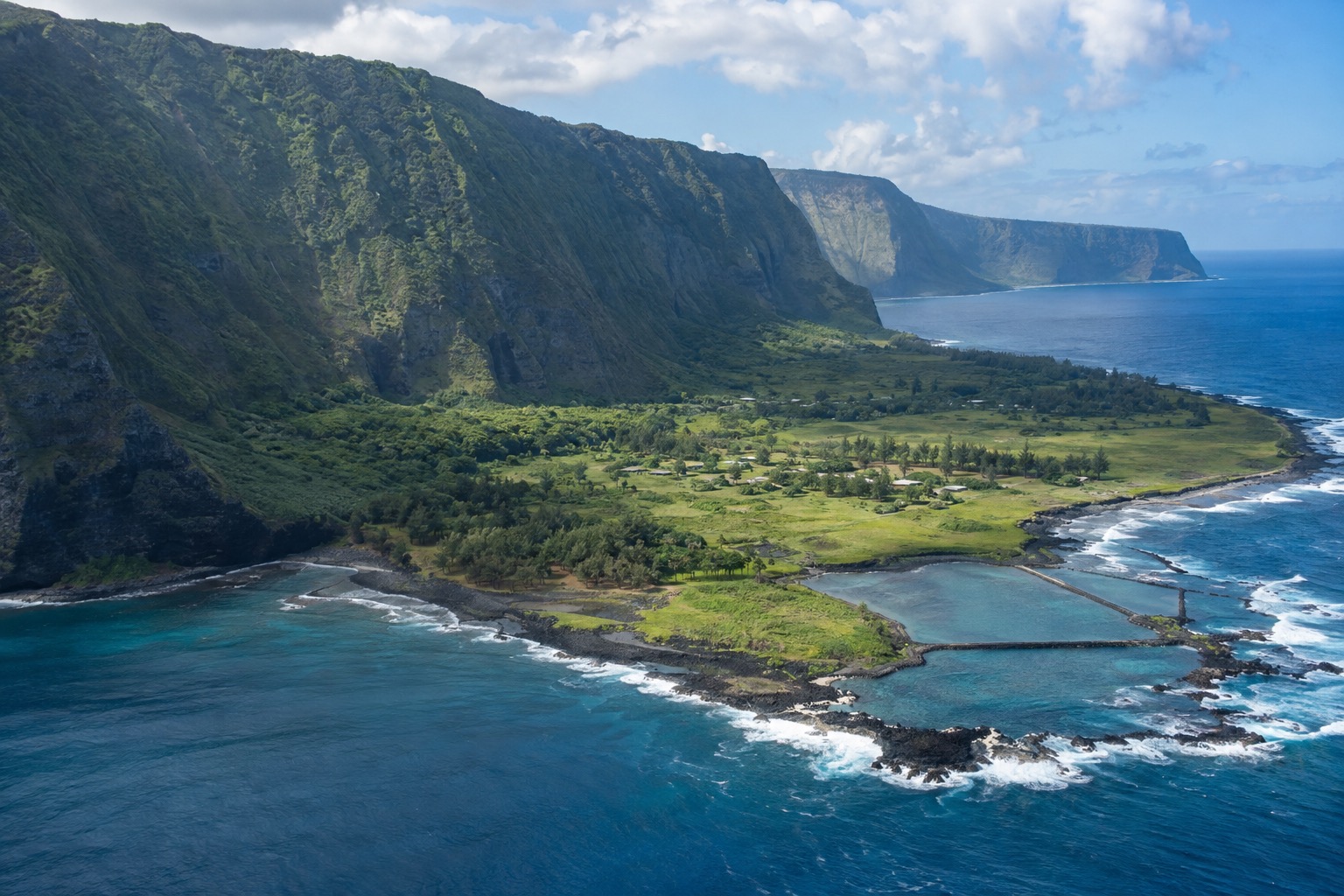
The main town is Kaunakakai, a short stretch of low wooden storefronts, a wharf and a few places for plate lunches and fresh bread. The west end is dry and open, the central plain is sunny and breezy, and the northern coast ends in some of the tallest sea cliffs in the islands, with valleys that can only be reached on foot or by sea.
People who love Molokai love it for what is missing: resorts, crowds, nightlife. Visitors who want a pool bar, a long list of tours or a busy beach scene will find it too quiet. The island rewards respect, since much of it is deeply tied to Native Hawaiian community life, and locals appreciate guests who greet people, drive slowly and ask before wandering onto private land.
What is there to do in Molokai?
Most visitors come for the history of Kalaupapa, the high viewpoints, the empty beaches and the small-town rhythm. What sets Molokai apart from Maui and Oahu is how little is arranged for visitors. You make your own days, and they tend to be better for it.
Kalaupapa National Historical Park
Kalaupapa is the peninsula at the foot of the northern cliffs where people with leprosy were sent from 1865 until the policy ended in 1969. More than 8,000 people died there. It is a place of memory and a working community, and it is the reason many travelers make the trip to Molokai at all.
The park has resumed public tours, offered on Thursdays and Saturdays. It is an all-day, ranger-led hike with a steep change in elevation, and participants must be at least 16 years old. Reservations are required and the park caps the number of visitors each day, so plan the rest of your stay around the tour day.
| Experience | Details | Cost |
|---|---|---|
| Kalaupapa ranger-led tour | Thursdays and Saturdays, all-day hike of up to 8 miles | $20 per person plus $1 non-refundable ticket fee |
Palaau State Park and the overlook
If you cannot join the hike, or want a first look before you do, Palaau State Park has an overlook where you can view the Kalaupapa Peninsula from high above. The sight of the green peninsula far below, with the surf breaking along the cliffs, tends to quiet a group fast.
The park is open daily and is easy to pair with a slow morning drive up from the central plain. It also has a campground, which suits travelers who like cool, forested air and simple sleeping arrangements.
| Site | Open | Admission |
|---|---|---|
| Palaau State Park | Daily, 7:00 a.m. to 7:00 p.m. | Camping $20 per night per site for residents, $30 for non-residents |
Beaches, small towns and slow days
Beyond the headline sights, Molokai is about unhurried days. Walk the wharf at Kaunakakai, buy something from a bakery or a roadside stand, and drive out along the south shore where the road runs beside the reef and fishponds that Native Hawaiians built long ago.
The west end has long, open beaches with few people on them. Swimming conditions change with the season and the swell, so go by the signs and by what the locals tell you, and keep off the reef and away from any sacred sites you come across.
How many days do you need in Molokai?
A long weekend covers the essentials, and a week lets the island’s pace settle in. With a few days you can reach the Palaau overlook, spend a day on the Kalaupapa tour if it fits a Thursday or Saturday, and explore Kaunakakai and the south shore at an easy speed.
With more time, add camping or a quiet cabin stay, long beach days on the west end and slow drives across the island. Many travelers also pair Molokai with a few nights on Maui or Oahu, since both are close and well connected by air.
Where to stay in Molokai
Kaunakakai is the practical base, with the island’s shops, restaurants and the harbor close at hand, and it suits visitors who want to walk to dinner and not drive. Stays on the east and west ends are quieter and more remote, better for people who want the sound of the ocean and little else.
Camping at Palaau State Park is another option, cooler and greener than the coast. Lodging is limited on a small island, and room rates carry the state accommodations tax at 11.00% plus the Maui County surcharge of 0.5% on the general excise tax.
How do you get to Molokai and get around?
Most visitors arrive by air at Molokai Airport in Kaunakakai, a small airport with modest traffic. It handled roughly 84,000 boarding passengers in 2024, a fraction of what a busy Hawaii airport sees, which gives a good sense of how few people come through.
Once on the island, distances are short but public options are limited, so a rental car is the usual way to reach the overlook, the beaches and the far ends of the island. Kaunakakai itself is small enough to walk.
When is the best time to visit Molokai?
May through October is the sunniest stretch, with very few rain days from May to September and afternoon highs in the mid-80s. The central plain is dry for most of the year, and the airport station sees only about 22 inches of rain over twelve months, compared with well over 100 inches in wet Hilo on the Big Island.
From December through March the island is cooler and greener, with more passing showers and a handful of rain days each month. Highs stay in the upper 70s, which is still pleasant. Winter also tends to bring bigger surf to north-facing shores, so go by the signs on any beach.
April, May, October and November are good middle choices, with warm days and fewer showers than midwinter. The Central Pacific hurricane season runs from June 1 to November 30, and Molokai is quiet enough that it rarely feels crowded in any month.
Good to know before you go
There is no passport or visa to think about, and the tourist infrastructure is simple, so bring what you need for the day when you head to the far ends of the island. Show respect for local life: greet people, drive slowly and treat historic and sacred places with care.
| Fee | Amount | Who pays |
|---|---|---|
| State accommodations tax | 11.00% | Guests on lodging |
| Maui County surcharge on the general excise tax | 0.5% | Applied to taxable sales in the county |
Sources
- Hawaii Department of Taxation, Tax Announcement No. 2025-03 (Transient Accommodations Tax Law Changes from 2025 Legislative Session), files.hawaii.gov/tax/news/announce/ann25-03.pdf, checked September 24, 2026
- Hawaii Department of Taxation, County Surcharge on General Excise and Use Tax page, tax.hawaii.gov/geninfo/countysurcharge/, checked September 25, 2026
- Federal Aviation Administration, CY2024 Commercial Service Enplanements (xlsx), faa.gov/airports/planning_capacity/passenger_allcargo_stats/passenger/arp-cy2024-commercial-service-enplanements.xlsx, checked September 24, 2026
- National Park Service, "Kalaupapa National Historical Park to Offer Public Tours", nps.gov/kala/learn/news/kalaupapa-national-historical-park-to-offer-public-tours.htm, read September 25, 2026
- National Park Service, "The History of Hansen's Disease in Hawaii", nps.gov/kala/learn/historyculture/hansensdisease.htm, read September 25, 2026
- National Park Service, "Alerts & Conditions", nps.gov/kala/planyourvisit/conditions.htm, read September 25, 2026
- DLNR Division of State Parks, "Palaau State Park", dlnr.hawaii.gov/dsp/parks/molokai/palaau-state-park/, read September 25, 2026
- State of Hawaii Data Book 2024, Table 5.10 "Land Area, By Island: 2010" (source: U.S. Census Bureau 2010 Census Redistricting Data), files.hawaii.gov/dbedt/economic/databook/2024-individual/05/051024.pdf, read September 25, 2026
- NOAA NCEI, monthly normals 1991-2020, station USW00022534
- NOAA NCEI, monthly normals 1991-2020, station USW00021504
- NWS Honolulu / Central Pacific Hurricane Center, « 2026 Central Pacific Hurricane Season Outlook », weather.gov/hfo/hurricaneOutlook2026, checked September 24, 2026
All our pages
When to go
- Best Time to Visit Molokai: Weather by Month, Crowds, Swimming and Events
- Molokai in January: Weather, Winter Surf and What to Do on the Friendly Isle
- Molokai in February: Weather, Winter Seas and What to Do on the Friendly Isle
- Molokai in March: Weather, Whales, Beaches and Quiet Island Days
- Molokai in April: Weather, Beaches, Slow Island Days and a Two-Day Plan
- Molokai in May: Weather, Swimming, Things to Do and a Two-Day Plan
- Molokai in June: Weather, Beaches, Slow Island Days and a Two-Day Plan
- Molokai in July: Weather, Swimming, Things to Do and a Two-Day Plan
- Molokai in August: Weather, Swimming, Things to Do and a Two-Day Plan
- Molokai in September: Weather, Swimming and What to Do on the Quiet Island
- Molokai in October: Weather, Swimming and What to Do on the Friendly Isle
- Molokai in November: Weather, Beaches, Slow Island Days and a Two-Day Plan
- Molokai in December: Winter Surf, Whale Season, Weather and What to Do