
CASCAIS · LISBON COAST · THE END OF THE LINE
The railway from Lisbon runs out of track here. Trains from Cais do Sodré follow the Tagus until the river turns into ocean, then stop in a town where people are buying bread and school shoes. Most visitors give that an afternoon and go back. Sleeping in Cascais changes the shape of a Portugal trip: you swap a capital-city street for a bay with beaches in it, and Lisbon stays one platform away, which is the whole argument for staying.
CASCAIS · THE SHORT VERSION
Cascais holds up as a base rather than an afternoon: the coastal line keeps Lisbon within reach, the bay coves cover the calm days, and Guincho absorbs the wind.
COASTAL RAIL FROM LISBON · BAY COVES AND GUINCHO · A TOWN THAT LIVES ALL YEAR
Go for: the boats hauled up on the fishermen’s beach, the walk out to the Santa Marta lighthouse, and the moment the dunes at Guincho come into view from the coast road.
Think twice before: booking a Guincho swimming day for small children, or assuming Estoril and Cascais are the same town with two stations.
Rail fares and timetables are kept current in our getting-around guide · full sources at the end
On this page
- Things to do in Cascais on footThe Cidadela, Mercado da Vila, Boca do Inferno
- Cascais beachesThe bay coves, then Praia do Guincho
- Day trips from CascaisCabo da Roca, the serra and Sintra
- A day in CascaisMarket morning to the evening lanes
- Where to stay in CascaisOld town, Estoril front, the heights
- Getting to Cascais from LisbonThe coastal train from Cais do Sodré
What to see in Cascais on foot: the Cidadela, Mercado da Vila and Boca do Inferno
Cascais still has the shape of the fishing port it was before the royal family started summering here. The Cidadela closes the western end of the bay, its walls now holding an art district and a hotel behind the old gates. Behind the marina, pedestrian lanes carry shoe shops and pastelarias alongside the souvenir racks. The Mercado da Vila runs its fish and produce hall on market mornings, and inland the Parque Marechal Carmona gives shade, ponds and the Museu Condes de Castro Guimarães in a villa at its edge.
West of the bay the shore path leaves the buildings behind. The Farol de Santa Marta, a blue-and-white striped lighthouse with a museum in the keeper’s quarters, marks the first headland. A short walk further, Boca do Inferno is a collapsed sea cave where the swell arrives underneath the cliff and returns as noise. On the road above stands Casa das Histórias Paula Rego, its red pyramid towers visible from the coast road. Opening days shift with the season at all three, so check on the morning rather than the night before.
Estoril, two stops back toward Lisbon, is the town visitors most often merge with this one. On the ground it reads differently: a casino with formal gardens facing the water, larger hotels along the front, the Tamariz beach beneath the railway, and no old core to speak of. Cascais keeps the fishing beach, the market and the lanes. The paredão, the paved seafront promenade, joins the two, which is why the difference vanishes in photographs and reappears the moment you go looking for dinner.
Cascais beaches: the bay coves and Praia do Guincho, and how the wind picks between them
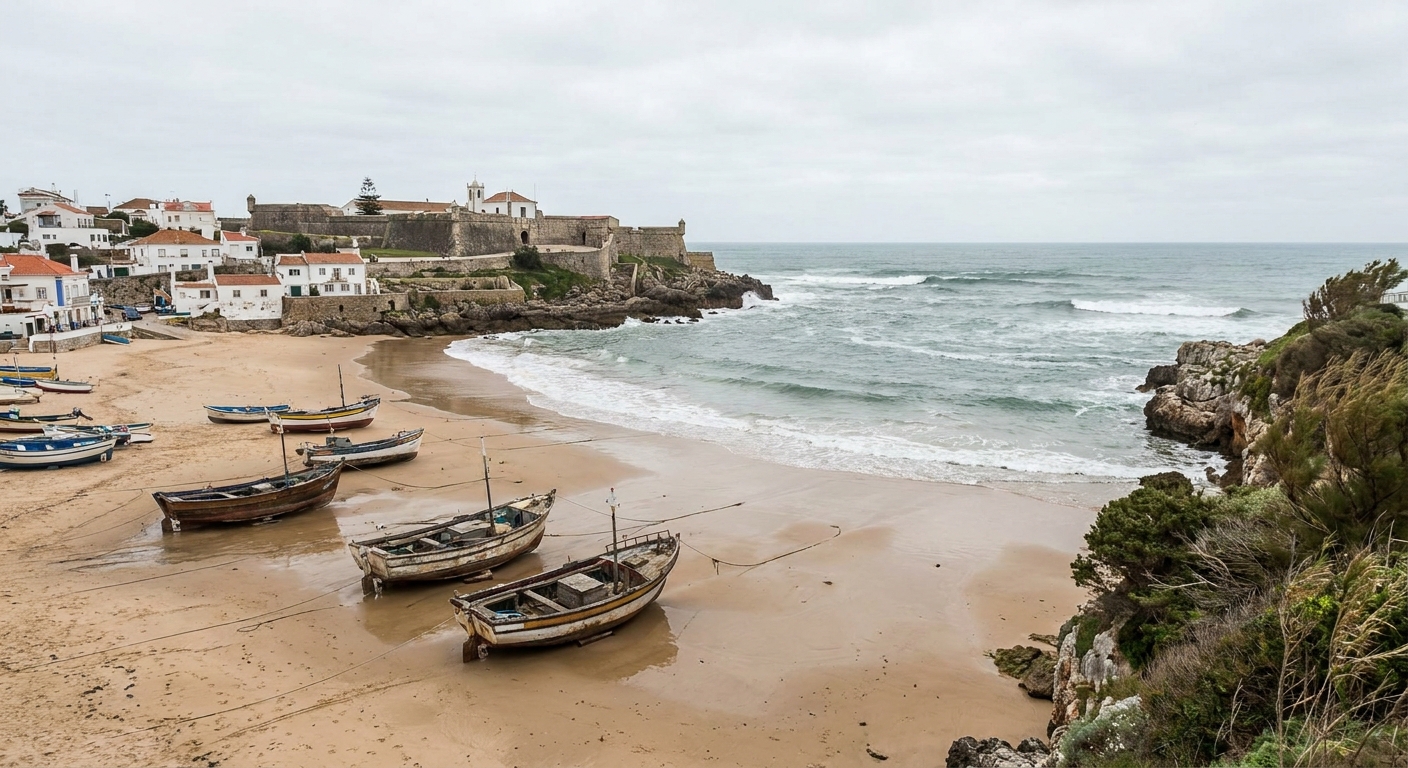
The beaches in the bay are small and sheltered by headlands rather than by anything anyone built. Praia da Ribeira, still the fishermen’s beach, has working boats pulled up on it and the town directly behind. Praia da Rainha is a pocket of sand between rocks, reached down a flight of steps. Praia da Conceição runs on into Praia da Duquesa toward Estoril, promenade above, trains behind. Through high summer the sand vanishes under towels by late morning, and the water stays flat enough for children to stand in.
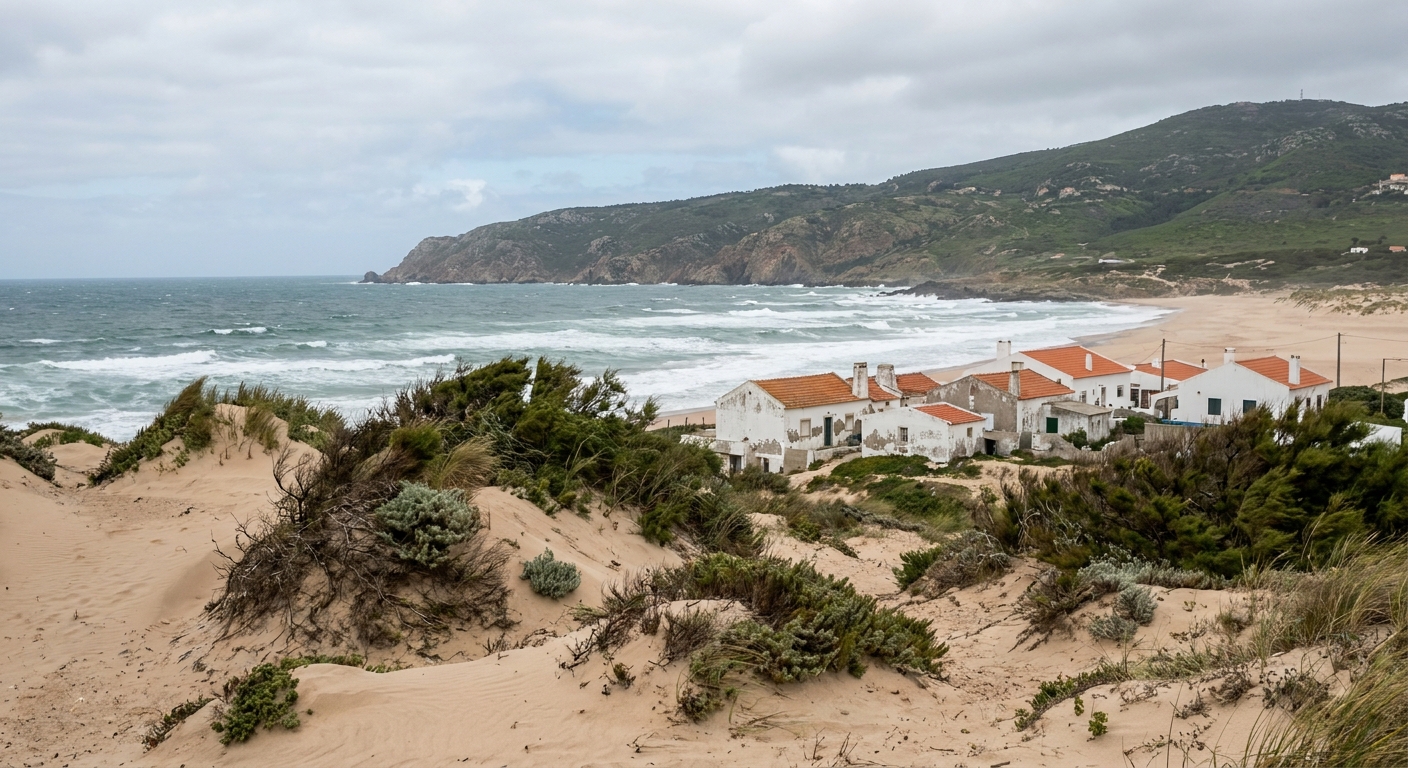
Praia do Guincho, northwest of town beneath the Serra de Sintra, offers the opposite. It faces the open Atlantic across a dune field, wind is normal here rather than exceptional, and surfers, windsurfers and kitesurfers come for exactly that. The shore break lands hard and the water pulls, so a swim here has nothing in common with a swim in the bay. The Cresmina boardwalk crosses the dunes at the southern end, and Praia do Abano sits just north of it, smaller and rougher again.
Wind picks the beach, not the calendar. When the flags on the front are snapping and the bay itself has chop in it, Guincho will be sandblasted and the coves are the answer for that day. Rip currents on the exposed coast deserve more than a warning label, and our safety guide sets out the flag system and what to do inside a current. Anyone whose priority is warm, shallow, sheltered water for small children does better on the eastern Algarve, where Tavira takes that idea to its limit.
Around Cascais: the Sintra-Cascais park, the Guincho road, Cabo da Roca and Sintra
Cascais sits inside the Parque Natural Sintra-Cascais, which explains why the built-up coast stops so abruptly once you pass the marina. The road out to Guincho runs between the ocean and the hills with a cycle path beside it for most of the way, and rented bikes are the standard way to cover that stretch without a car. Pines, dune scrub and a couple of restaurants at the far end: after the last of the town, nothing else has been allowed to happen along it.
Beyond Guincho the road climbs into the serra toward Malveira da Serra and swings over to Cabo da Roca, the westernmost point of mainland Europe, where there is a lighthouse, a stone marker and a cliff edge that takes hats off tourists. A bus line crosses the hills between Cascais, the cape and Sintra, which is what makes the whole loop possible without renting anything. If you do want wheels for the serra roads, read the car guide first.
Sintra lies on the far side of the same ridge, close in kilometers and slow in traffic, reached over the hills instead of back through Lisbon. We keep the palaces, the queues and the timed tickets in our Sintra guide, with Pena handled on its own page. North along the coast, Ericeira is the surf town this stretch points toward, and further up, Nazaré takes the same Atlantic and makes a spectacle of it in winter.
A day in Cascais: a one-day itinerary from the Mercado da Vila
| Time of day | Where | Why then | Where it goes wrong |
|---|---|---|---|
| Early morning | Mercado da Vila and the streets behind it | Fish, fruit and bread bought while the town is still working | Arriving late and finding a food court rather than a market |
| Mid morning | The seafront, checking the flags and the water | The wind on the front tells you whether the day belongs to the bay or to Guincho | Committing to Guincho before looking at the sea |
| Midday | Bay coves or Praia do Guincho | Sheltered swimming in town, or dunes, surf and space northwest | Taking toddlers to Guincho for a swim it does not offer |
| Mid afternoon | Santa Marta lighthouse, Boca do Inferno, Casa das Histórias | Shade, sea noise and a museum when the sand is at its fullest | Walking out to a site whose opening day you never checked |
| Late afternoon | The paredão toward Estoril | Low sun along the promenade, joggers, and the casino gardens at the far end | Assuming Estoril has an old town waiting at the other side |
| Evening | Pedestrian lanes behind the marina | Restaurants fill after dark and the town keeps its own residents on the terraces | The seafront tables nearest the station: the most touristed row in town |
Where to stay in Cascais: the historic center, the Estoril seafront, the heights and Guincho
The historic center is the default and it works: station, market, coves and the restaurant lanes are all within a flat walk, and nothing on the itinerary needs a car. The cost is evening noise, since the streets behind the marina are where dinner happens and where it goes on. Rooms facing an interior courtyard change that entirely, and in the alleys east of the Cidadela the volume drops off within a couple of blocks.
The seafront toward Estoril is the quieter, more formal band: bigger buildings, garden frontages, the promenade at the door and the railway running behind the beaches. You are still walking distance from Cascais along the paredão, or one stop by train, which makes this the compromise for travelers who want sea views without the terrace hum. Estoril itself keeps its own beach and casino gardens, and it empties earlier at night than Cascais does.
The heights above town and the Guincho road buy views over the bay or the dunes and cost you independence: taxis, buses or a rental become part of every evening. Choose that only if the plan is surf, cycling or the serra rather than dinner in the lanes. Zone thinking for the whole country is worked through in our where-to-stay guide, and if the capital wins after all, compare districts in the Lisbon version.
Getting to Cascais by train from Lisbon, and how many nights to give it
The coastal line starts at Cais do Sodré in central Lisbon, runs along the Tagus past Belém, follows the water once the estuary opens out, calls at Estoril and finishes in Cascais. The station sits in the middle of town beside the bus terminal, a few minutes on foot from the market and the bay. That single line is why a car-free stay works here, and why the ride out counts as part of the day rather than a transfer.
Fares, ticket types and current timetables are the job of our getting-around guide, which we keep updated rather than repeating numbers that age badly. If you arrive by car, park it once: the old center is pedestrian in the parts you want, and summer parking near the bay is a contest. The useful role for a car in Cascais is the serra, Cabo da Roca and the beaches past Guincho, and almost nothing else.
Anyone still choosing between a base and a visit should read the day-trip comparison, which weighs Cascais against Sintra, Arrábida, Évora and Óbidos for people sleeping in the capital. Staying here instead means giving the town enough nights for one bay day, one wind day and one evening that ends in the lanes. Season, crowds and sea conditions belong with the month-by-month guide, and families weighing beaches against logistics will find that argument in our Portugal with kids guide.
When to go. The month-by-month case for Cascais — what the normals say, when the sea is warm enough to swim and which weeks fill up — sits on the best time to visit Cascais.
Choosing between them. Sintra or Cascais sets the two side by side on the points that decide it — the season, the cost of getting there and what each one closes off.
The last word
Sleeping in Cascais gives you the hours nobody on a day trip sees. Boats come off Praia da Ribeira early, the market bags start moving through doorways before the first train from Lisbon has left the estuary, and the paredão belongs to runners and dog walkers until mid morning. In the evening the seafront terraces empty and the lanes behind the marina fill with people who live here. A town with a February supermarket queue behaves differently from a resort, and it shows most at both ends of the day.
The loss is Lisbon after dark: fado that starts late in Alfama, a second bar in Bairro Alto, the miradouros with the river lit under them. From here the timetable ends the night, not the conversation, and dinner gets planned backwards from a departure board. Take that trade knowingly. What Cascais returns in exchange is a bay you can walk to in a towel, a dune road that ends at the edge of the continent, and a morning that starts with fishermen instead of a commute.
Sources & data for this guide
- Town layout, Cidadela, marina, Mercado da Vila, Parque Marechal Carmona and the paredão to Estoril · visitportugal.com (Turismo de Portugal) and Cascais municipal tourism information, plus ground observation · checked Sep 6, 2026
- Praia do Guincho, the Cresmina dune boardwalk and the Parque Natural Sintra-Cascais · ICNF protected-area information · checked Sep 6, 2026
- Coastal rail line from Cais do Sodré via Estoril to Cascais · CP urban network (cp.pt). We deliberately publish no fares or journey times here, since both change and are maintained in our getting-around guide · checked Sep 6, 2026
- Beach flags, lifeguard seasons and rip-current guidance on the exposed Atlantic coast · Portuguese maritime authority beach information, cross-read with our safety guide · checked Sep 6, 2026
- Cabo da Roca as the westernmost point of mainland Europe, and the bus link over the serra between Cascais, the cape and Sintra · standard geographic reference and operator route information; confirm the current operator and route before relying on it · checked Sep 6, 2026
- Editorial note: neighborhood character, evening noise levels and the local habit of letting the wind decide between bay and Guincho are our own observations, not published data