
CASCAIS · JANUARY · IPMA 1991-2020
January hands Cascais back to the people who live there. The bay still collects its low afternoon light, the promenade still runs out to Boca do Inferno, and an average January afternoon climbs to 57.9°F, which is sweater weather with a cold Atlantic breeze written into it. Nobody is queuing for a sun lounger.
The month asks for two concessions: a rain shell and a day that ends early. Measurable rain falls on 9.9 days of an average January, and on the 15th the sun is gone by 5:39 p.m. What you get in exchange is the coast of the Sintra-Cascais Natural Park, 14,583 hectares of it, in walking air rather than August air.
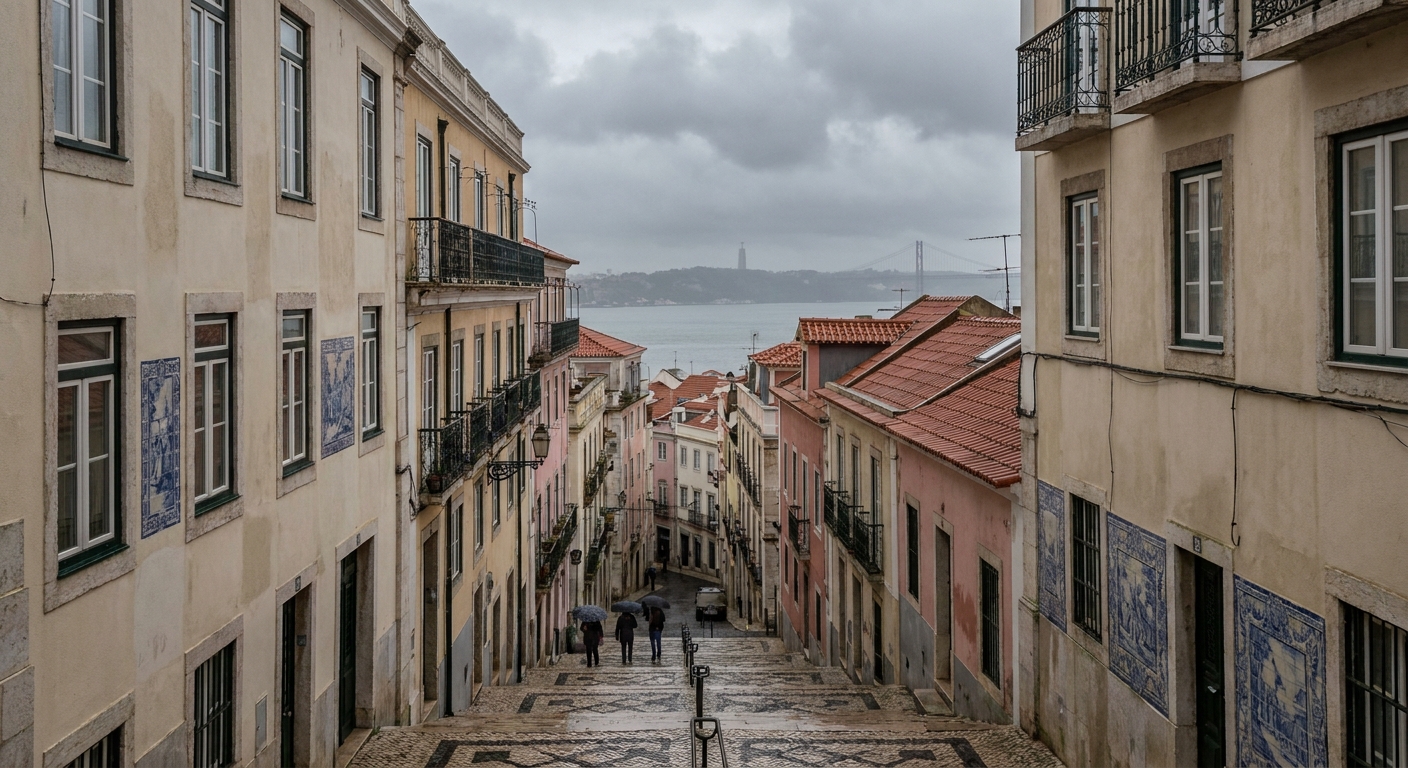
THE MONTH AT A GLANCE · CASCAIS · JANUARY
January gives you 57.9°F afternoons, a 9-hour 48-minute day and a town without its summer queues, at the price of 9.9 rain days and a 5:39 p.m. sunset.
IPMA 1991-2020 NORMALS · HIGH 57.9°F · LOW 46.0°F · 9.9 RAIN DAYS · DAY LENGTH 9 H 48 MIN
Go for: coast walking in 57.9°F air, the 14,583 hectares of the Sintra-Cascais Natural Park, and a resort town running at resident pace.
Think twice before: booking this as a beach week. Rain lands on 9.9 days of an average January, and we found no sea-temperature record for Cascais we could read.
Normals: IPMA station 579, Lisboa Gago Coutinho · Park: ICNF · Daylight: sunrise-sunset.org · full sources at the end
On this page
- Cascais weather in JanuaryThe IPMA normals: 57.9°F, 3.78 inches, 9.9 rain days
- How cold the nights getHighs, lows and the 11.9°F daily swing
- Crowds and prices in midwinterLow season, booking lead time and the lodging tax
- Things to do in Cascais in JanuaryThe natural park, Cabo Raso and the Guincho dunes
- A two-day plan for a short winter tripTwo days built around a 5:39 p.m. sunset
- January or February?How December, January and February compare
- Is January a good time to visit Cascais?Our verdict, and who should shift four weeks
Every figure here comes from one thermometer: IPMA station 579 at Lisboa Gago Coutinho, 103.9 m up (341 feet) and inland at the airport. Cascais faces the open Atlantic and runs cooler and windier than that record, and the serra behind town is colder and far wetter again. Pack for a coast, and read our packing guide before you pack for a mountain trail on a coastal reading.
Cascais weather in January: average highs, lows and rain days
| January in Cascais | Normal, 1991-2020 |
|---|---|
| Average high | 57.9°F (14.4°C) |
| Average low | 46.0°F (7.8°C) |
| Precipitation | 3.78 in |
| Days with 0.04 in (1 mm) or more | 9.9 |
| Days with 0.39 in (10 mm) or more | 3.3 |
| Daylight, January 15 | 9 h 48 min |
| Sunrise and sunset, January 15 | 7:51 a.m. · 5:39 p.m. |
Those normals belong to the Instituto Português do Mar e da Atmosfera, the national weather service, covering 1991 to 2020 at its station 579, Lisboa Gago Coutinho. It matters that this is a real instrument at a real altitude rather than a model grid cell averaged over the region: 57.9°F by day and 46.0°F by night are measurements, and the sea wind that cools Cascais below them is the part no station in town reports to us.
In a normal January, rain you can feel arrives on 9.9 days, roughly one day in three, and a genuine soaking of 0.39 inch or more on 3.3 of them. So the shape of the month is nine damp mornings out of thirty-one, three of which are indoor afternoons, and a majority of dry days that nobody mentions. One caution before you compare this with a US table: IPMA counts from 0.04 inch, not the 0.10-inch threshold American summaries use, and the two counts are not interchangeable.
Between the 46.0°F night and the 57.9°F afternoon sits an 11.9-degree swing, and it lands inside a single day rather than across a season. That is a layering problem, not a coat problem: a long-sleeve base, a mid-layer you take off by eleven, and a hooded waterproof shell that earns its space on ten days out of thirty-one. Add shoes with grip, because 3.78 inches of rain falling on fewer than ten days means wet stone underfoot.
Daylight on January 15 runs 9 hours 48 minutes, sunrise at 7:51 a.m. and sunset at 5:39 p.m. in local time, since Portugal keeps UTC through the winter. Useful light therefore starts after eight and starts leaving around half past four. Two consequences for a short trip: breakfast is not the hour to dawdle over, and a coastal walk begun at three in the afternoon finishes in the dark.
How warm is Cascais in January?
The warmest hour of an average January day reaches 57.9°F. The coldest, somewhere near dawn, sits at 46.0°F. Neither number is cold by the standards of a January anywhere north of Iberia, and neither is warm enough for the swimsuit at the top of the suitcase. Call it the temperature of an American April afternoon, delivered with Atlantic wind and a sun that never climbs very high.
In practice, the morning wants the mid-layer and the afternoon does not. Walking the seafront at ten you will be glad of the shell against the wind off the water, and by two, with the sun on the south-facing side of a street, plenty of visitors are down to one layer. Restaurant terraces work at lunch and rarely at dinner, when the thermometer is already sliding toward that 46-degree night.
We could not verify a count of frost nights for Cascais, so we give none. What the record does show is a normal low 14 degrees above freezing, which is a different winter from the one the serra gets. We also found no sea-temperature series for Cascais we could read, so no water figure appears above. If you meet one elsewhere, check how it was built: such tables often average daily maxima, which runs warmer than a 24-hour mean.
How busy is Cascais in January? Crowds, prices and the demand peak
January sits in the trough of the calendar, after the Christmas and New Year week and well before Easter. That much is a fact of dates. What we cannot do is rank it on price: we found no occupancy series and no monthly room-rate series for Cascais, so we crown no month cheapest and quote no percentage. For the wider shape of the year, our month-by-month verdict and the trip-cost guide carry what we could source.
Booking behavior changes with the season more than the budget does. Midwinter rooms in a resort town rarely need the three-month lead a July weekend demands, and two to three weeks is usually enough (est.). The flight is the part that does not care what month it is: transatlantic seats to Lisbon price on their own logic, and our flights guide explains the routes. Book the flight first, the room second.
On the municipal lodging tax we have to be plain: we could not verify a rate for Cascais, so we give no figure and no per-night amount. Ask at booking, and expect it as a line added at checkout rather than inside the nightly price. The town hall publishes an events agenda rather than data we could read, which is also why we name no January festival or concert here.
One upgrade genuinely changes the month, and it is mobility. With 9 hours 48 minutes of light and rain on a third of days, waiting forty minutes for a connection costs a real fraction of the usable day. A car puts Guincho, Cabo Raso and the serra inside one dry window. Our car guide covers the tolls and the paperwork, and the getting-around guide the train option if you would rather not drive.
Things to do in Cascais in January: the natural park, Cabo Raso and Guincho
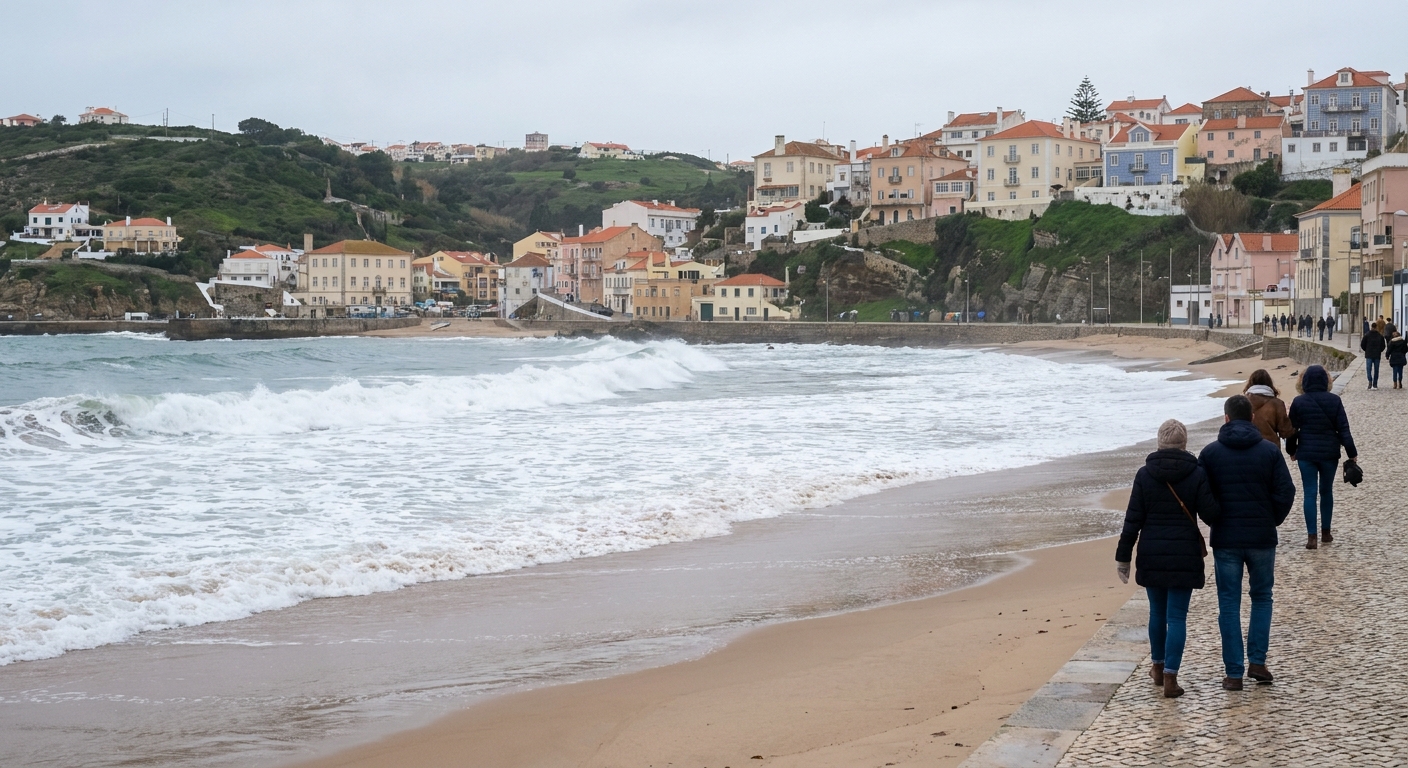
Of the three months we can measure at the same station, January is the coolest by day at 57.9°F, and that is exactly what a long uphill walk wants. The cliff paths and the serra tracks are doable at noon rather than at dawn, and the light stays low and useful all day for anyone carrying a camera. Cool air on an exposed coast is the gift here, not sunbathing.
The headline place is the Sintra-Cascais Natural Park: 14,583 hectares, about 36,000 acres, spread across the municipalities of Sintra and Cascais, protected as a landscape by Decree-Law 292/81 of October 15, 1981 and reclassified as a natural park by Regulatory Decree 8/94 of March 11, 1994. Inside it sit the coastal karst north of Cabo Raso, the Guincho-Oitavos dune system with the habitats clinging to it, and Pedra Amarela at 406 meters, or 1,332 feet, in the serra behind the coast.
Rock and dune do not change with the calendar. The air does, and so does the wind that strips an unsheltered cape, which is the whole difference between a January visit and a July one at the same spot. January also puts the park’s wildlife within reach of a patient pair of binoculars: peregrine falcon, Falco peregrinus, and Bonelli’s eagle, Hieraaetus fasciatus, both nest here, and the remnant oak woodland with its threatened holly, Ilex aquifolium, survives only in the least accessible corners of the serra.
We found no entrance fee published for the park, no trail length and no opening hour in the ICNF brochure we read, so treat daylight as the only gate and the coast road viewpoints as the free part of the day. The other thing the area grows is a shopping list: Colares keeps its internationally known wine, plus the Colares reinette apple, the rose peach, the thick-skinned lemon and the pearl pear. Our food guide has the rest of the Portuguese table.
Cascais in January: a two-day itinerary
Day one runs on the light. Coffee at eight while it gets properly bright, on the seafront by nine for the walk out past Boca do Inferno with the mid-layer still on. Reach the open coast toward Cabo Raso for the warmest stretch, roughly noon to two, when the thermometer is near its 57.9°F peak. Turn back around three, because at 4:30 the light is already going and at 5:39 it is gone. Dinner indoors, not on the terrace.
Day two goes uphill if the sky holds: the serra side of the park, with Pedra Amarela’s 406 meters as the ambition and the oak remnants as the reward. If the weather turns, and 3.3 days a month bring 0.39 inch or more, switch to rails and roofs. The train line puts Lisbon within an easy morning, and Sintra keeps its palaces indoors and its gardens dripping.
Cascais in January vs December and February
| Normal, 1991-2020 | December | January | February |
|---|---|---|---|
| Average high | 58.8°F | 57.9°F | 60.3°F |
| Average low | 47.7°F | 46.0°F | 47.1°F |
| Precipitation | 3.94 in | 3.78 in | 2.80 in |
| Days with 0.04 in or more | 9.7 | 9.9 | 7.8 |
| Sea temperature | Not verified | Not verified | Not verified |
All three columns come from the same station and the same 30-year period, so the gaps are real rather than an artifact of mixed sources. January is the coldest of the three both ways: 0.9 degrees under December by day, 2.4 under February, and 1.7 degrees under December at night. Rain barely separates December from January, 9.7 days against 9.9, while February drops to 7.8 days and 2.80 inches.
Shift four weeks forward and you buy 2.4 degrees of afternoon warmth, two fewer wet days and nearly a full inch less rain, which is the best purchase on this table. Shift four weeks back and you gain almost nothing on the thermometer while adding 0.16 inch of rain and the holiday fortnight. The arithmetic sits in our February page and our December page, month by month.
Is January a good time to visit Cascais?
Yes, if you came to walk, eat and look at the Atlantic. A 57.9°F afternoon with a park of 36,000 acres at the end of the promenade is a good trade for ten damp days, and a town at resident pace is a different pleasure from a town at capacity. No, if the plan involves swimming, a beach day with children, or a reliable run of dry mornings. We have no water figure to reassure anyone on the first two.
If that is your trip, take February over January. The numbers say it clearly: 60.3°F by day, 7.8 wet days instead of 9.9, and 2.80 inches of rain instead of 3.78. The coast, the karst and the dunes are identical in both months, and only the sky changes. Nothing in our sources suggests February prices behave differently, so we make no claim either way.
What January alone offers, among the three months measured at that one station, is the coolest air over those same 14,583 hectares, which is the version of this coast that rewards a long climb rather than a short swim.
The last word
Decide on the water, not the weather: if nobody in the party needs to get in the sea, January is a straightforward yes, and you book two to three weeks out with a waterproof shell in the bag. One last thing worth knowing about the ground you will be walking on. The park’s management plan arrived the same day as its promotion, Regulatory Decree 9/94 of March 11, 1994, and the ICNF still describes this coast as a sensitive region under heavy human pressure. In January, you get to feel a little less of that pressure yourself.
Sources & data for this guide
- January normals (high 57.9°F, low 46.0°F, 3.78 in) and rain-day counts (9.9 at 1 mm, 3.3 at 10 mm) · IPMA, climate normals 1991-2020, station 579 Lisboa Gago Coutinho, altitude 103.9 m · checked Sep 23, 2026
- December and February normals used in the comparison · same IPMA station and same 1991-2020 period, not estimates · checked Sep 23, 2026
- Daylight 9 h 48 min, sunrise 07:51 and sunset 17:39 on January 15, converted to local time · sunrise-sunset.org · checked Sep 23, 2026
- Park area (14,583 hectares), protection dates (Decree-Law 292/81; Regulatory Decrees 8/94 and 9/94), coastal karst north of Cabo Raso, Guincho-Oitavos dunes, Pedra Amarela at 406 m, raptors, holly, Colares wine and fruit varieties · ICNF brochure « Conheça o Parque Natural de Sintra-Cascais », icnf.pt · checked Sep 23, 2026
- Where we came up short: we could not verify a sea-surface temperature, a frost-night count, a beach figure, a trail length, a park opening hour or a lodging-tax rate for Cascais, and the municipal site publishes an events agenda rather than figures, so we name no January event · noted Sep 23, 2026
- The station is inland at Lisbon’s airport and 104 m up, while Cascais faces the open Atlantic and runs cooler and windier · the serra behind the coast is colder and wetter still · check operators and hours when you book.