
CASCAIS · FEBRUARY · 38.7° N
February hands Cascais back to itself. The promenade between the fishing harbor and Estoril has room on it, the bakery counters move fast, and the afternoon settles at an average 60.3°F, warm enough to eat outside in the sun and cool enough to want a jacket when you stand up. Out at Guincho the Atlantic does the talking, coming ashore over open dunes.
What the month takes is warmth and light. A February afternoon runs 4.8°F below a March one, the sun is gone by 6:14 pm on the 15th, and 2.80 inches of rain fall across the four weeks. What it gives back is a coast with space on it and the Sintra-Cascais Natural Park, 14,583 hectares of it, at walking temperature rather than August temperature. If the trip is already booked, the rest is scheduling.
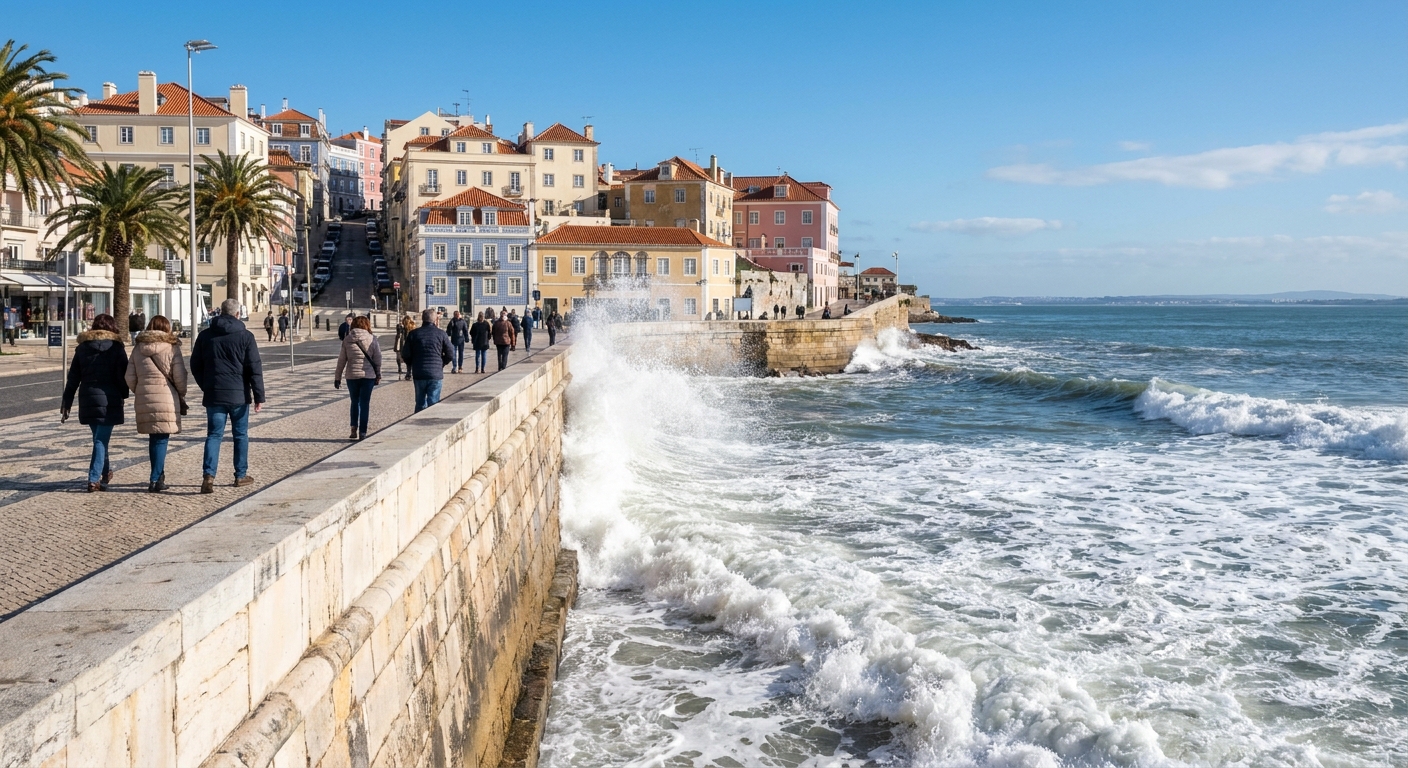
CASCAIS IN FEBRUARY · 38.7° N
February is Cascais at walking temperature: 60.3°F afternoons, 7.8 wet days, ten hours and forty-eight minutes of light on the 15th, and a natural park with room on its paths.
IPMA 1991–2020 NORMALS · STATION 579 LISBOA GAGO COUTINHO · SEA TEMPERATURE NOT VERIFIED
Go for: serra and clifftop walking at 60.3°F, a seafront you can cross at your own pace, and a park protected since 1981 with no crowd to share it with.
Think twice before: building the trip on a swim. We could not verify a sea temperature for Cascais, and 2.4 days in an average February bring 0.39 inch of rain or more.
Climate: IPMA station 579, 1991-2020 · Park: ICNF · Daylight: sunrise-sunset.org · full sources at the end
On this page
- Cascais weather in February60.3°F high, 47.1°F low, 2.80 inches
- How cold the nights get13.2°F between dawn and afternoon
- Crowds and prices in FebruaryNo rate series, no lodging-tax figure
- Things to do in Cascais in FebruarySintra-Cascais park, Cabo Raso, Guincho
- A two-day Cascais itineraryTwo days inside 10 h 48 min of light
- February vs January and MarchHow the three months compare, in numbers
- Is February a good time to visit Cascais?Yes for walkers, no for swimmers
Every figure here comes from one thermometer: IPMA's 1991-2020 normals for station 579, Lisboa Gago Coutinho, sitting 103.9 m (341 feet) up at the Lisbon airport, inland from the ocean. Cascais faces the open Atlantic and runs cooler and windier than that reading, and the serra behind it is colder and far wetter again. For the shape of a whole trip rather than one month, our Portugal timing guide takes all twelve.
Cascais weather in February: average highs, lows and rain days
| February in Cascais | Normal |
|---|---|
| Average high | 60.3°F (15.7°C) |
| Average low | 47.1°F (8.4°C) |
| Precipitation | 2.80 in |
| Days with 0.04 in (1 mm) or more | 7.8 |
| Days with 0.39 in (10 mm) or more | 2.4 |
| Daylight on Feb 15 | 10 h 48 min |
| Sunrise / sunset, Feb 15 | 7:26 am / 6:14 pm local |
IPMA, the Portuguese national weather and sea institute, puts February at an average high of 60.3°F (15.7°C), an average low of 47.1°F (8.4°C) and 2.80 inches of precipitation. Those are station normals for 1991-2020, measured by a real instrument rather than modeled from a grid cell. The catch is where the instrument stands: the airport, inland and 341 feet above the sea. Pack for a coast that is a little cooler and a good deal windier, and for high ground that is wetter than either.
7.8 days in an average February record at least 0.04 inch (1 mm), so measurable rain turns up roughly one day in four. Heavier weather is rarer: 2.4 days reach 0.39 inch (10 mm) or more, the sort of afternoon that ends a walk. Those thresholds belong to IPMA and are not the 0.10-inch line American tables use, so the two counts do not swap. In practice a wet February day here is a wet few hours rather than a washout from dawn to dusk.
Between the 47.1°F dawn and the 60.3°F afternoon sits 13.2°F. That spread is a packing instruction more than a forecast: a warm layer you can take off by eleven, a windproof shell for the headlands, and shoes that cope with wet limestone. Wool beats cotton, because the wind here finds damp fabric and keeps it. The full Portugal kit is in our packing guide.
On February 15 the sun comes up at 7:26 am and goes down at 6:14 pm local time: ten hours and forty-eight minutes of daylight. That covers a full park day and a harbor dinner, but it does not allow for casual starts. Leave a trailhead at two in the afternoon and you walk the last stretch in dusk. Dinner in February happens after dark, and the kitchens keep local hours rather than tourist ones.
How warm is Cascais in February?
The month's own range is narrow: 60.3°F at the top of the afternoon, 47.1°F at the coldest hour, 13.2°F between them. Nothing about a normal February on this coast is extreme in either direction. What moves is the wind rather than the thermometer, and the open exposure at Guincho takes the edge off a sunny 60.3°F in a way no average can show you.
Mornings want a real jacket. By midday on a clear day you carry it instead of wearing it, and the sheltered side of a seafront table is a different climate from the clifftop a mile away. The 47.1°F low belongs to the small hours, but the temperature falls quickly once the sun is down, so the layer you shed at eleven is the layer you want again at seven.
We found no frost-night count in IPMA's February normals for this station, so we give no number. The average low of 47.1°F sits fifteen degrees above freezing, and the coast is not where Portuguese cold lives in winter. The sea is the real gap in our sources: we could not verify a sea-surface temperature for Cascais at any period, so we give no water figure at all. An air normal is not a water normal, and a February swim is a decision we cannot support with a measurement.
How busy is Cascais in February? Crowds and prices
February is a winter month on a coast whose summer is the main event, and that much is calendar rather than measurement. We found no occupancy series and no monthly room-rate series for Cascais, so we crown no month cheapest and no month most expensive. Budgets across the year live in our Portugal cost guide, and the demand curve for the country sits in the timing guide.
Lead times are the other blank. No booking-window data for Cascais passed our checks, so any rule of thumb about weeks ahead would be invented here. One check does help: we verified no February event date for the town, so no festival is bidding for the rooms and tables you want. A February weekend booked two weeks out is a different exercise from the same weekend in July, and our where-to-stay guide covers the choice between bases.
We could not verify a lodging-tax rate for Cascais, so we quote no percentage and no per-night amount. Ask at check-in, and read the tax line on the confirmation before you pay a balance, since municipal charges are commonly settled at the property rather than online. The paperwork side of a Portugal trip, cards and documents included, is in our know-before-you-go guide.
One budget line genuinely changes the month: a car. The Sintra-Cascais Natural Park spreads over 14,583 hectares across the municipalities of Sintra and Cascais, and its two coastal ends, Cabo Raso and the Guincho-Oitavos dunes, sit well apart. We verified no trail length and no shuttle timetable, so plan by daylight instead of by schedule, and read our car-rental guide before taking one out for a week of winter roads.
Things to do in Cascais in February: the Sintra-Cascais park, Cabo Raso and Guincho
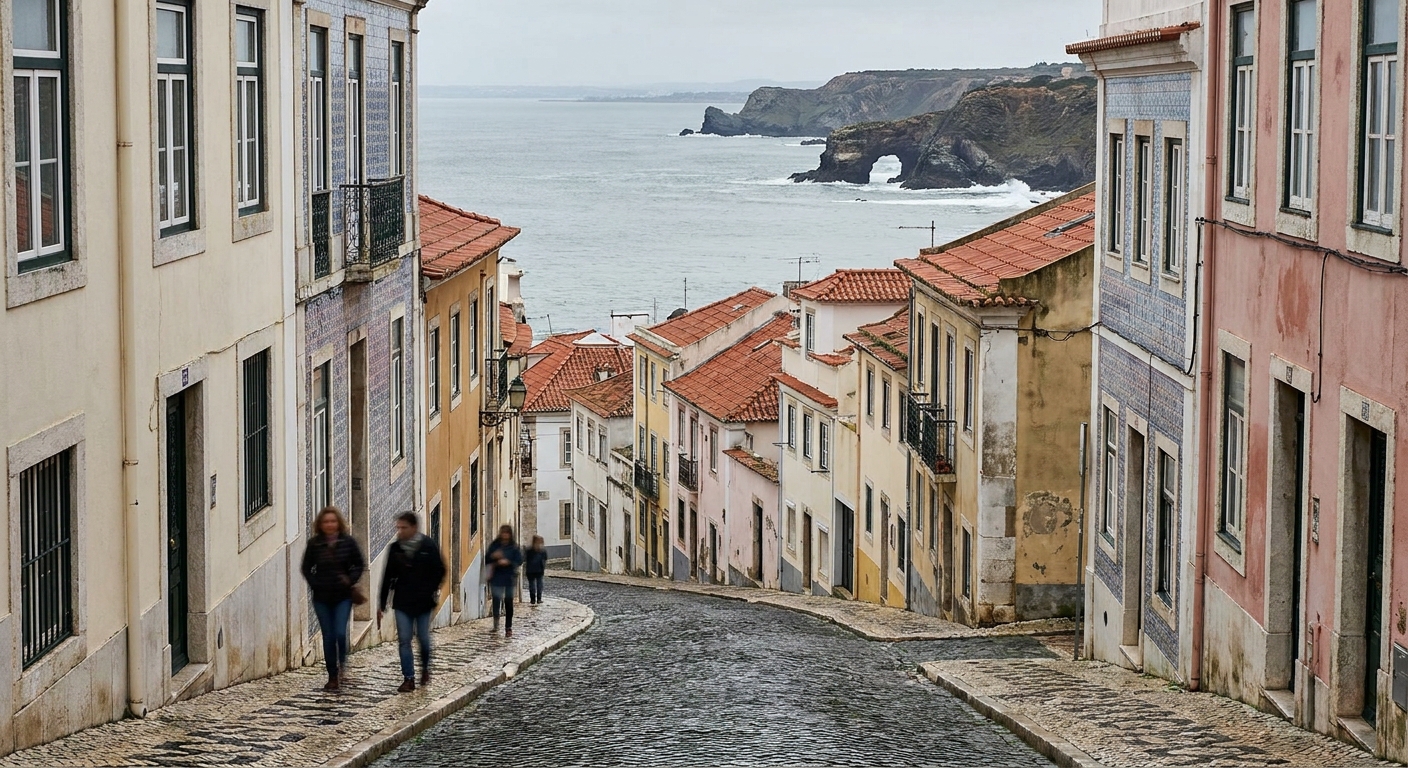
February's dividend is temperature on the trails. Pedra Amarela, the high point of the serra behind the coast at 406 meters (1,332 feet), is a straightforward half-day at 60.3°F, and the clifftop paths stay walkable from the 7:26 am sunrise to the last hour of light. The same ground in August is a heat calculation with an early alarm attached.
The park is the headline: 14,583 hectares across Sintra and Cascais, first protected as a Protected Landscape by Decree-Law 292/81 of 15 October 1981, then reclassified as a Natural Park by Regulatory Decree 8/94 of 11 March 1994, with its management plan approved by Regulatory Decree 9/94 the same day. North of Cabo Raso the shore carries rare geological forms, the coastal lapies, a karst relief; the Guincho-Oitavos dune system holds the habitats that survive on it. We verified no admission price and no gate hour for any of it.
The rock does not change with the month, the air does. Limestone lapies turn slick after any of those 7.8 wet days, and a 0.39-inch afternoon makes the karst a poor place for smooth soles. The dunes take the Atlantic wind head-on with no summer haze over the view. Remnant oak forest survives only in the least accessible corners of the serra, holly among the threatened species in it, Ilex aquifolium, and winter is when you can climb up to it without rationing water.
Free in February, as far as our checks go: the coast paths and the viewpoints. The ICNF brochure lists no admission charge and no opening hour, and we found none elsewhere, so we quote none and daylight is the only gate. The brochure is blunt about heavy human pressure on the area, so keep to the marked paths through the dunes. Colares, inside the same park, still puts its international name on wine, and those sand soils grow the Colares reinette apple, the rose peach, the thick-skinned lemon and the pearl pear.
Cascais in February: a two-day itinerary
Day one runs on the light. Coffee before the 7:26 am sunrise if a US flight has you awake anyway, then the town while it is still empty. Walk the promenade toward Estoril in the first cool hour, be back at the fishing harbor by ten, and give the middle of the day to the seafront and lunch outside, when 60.3°F is doing its best work. Keep an indoor hour for after three, once the light flattens, and put dinner after the 6:14 pm sunset.
Day two goes uphill. Pedra Amarela at 406 meters (1,332 feet) is a half-day inside 10 hours 48 minutes of daylight, with time afterward for Cabo Raso and the dunes. If one of the month's 2.4 heavy days lands on you, invert the plan: Colares and a long lunch inland, the coast road as the front clears, the climb pushed to the next clear morning. Two nights is the minimum that survives a February forecast, and three let you pick your weather.
Cascais in February vs January and March
| Measure | January | February | March |
|---|---|---|---|
| Average high | 57.9°F | 60.3°F | 65.1°F |
| Average low | 46.0°F | 47.1°F | 50.5°F |
| Precipitation | 3.78 in | 2.80 in | 2.63 in |
| Days with 0.04 in (1 mm) or more | 9.9 | 7.8 | 7.2 |
| Sea temperature | Not verified | Not verified | Not verified |
January is the wettest of the three and February the swing month: 3.78 inches and 9.9 wet days, then 2.80 inches and 7.8, then 2.63 inches and 7.2 in March. The air climbs steadily through the run, 57.9°F to 60.3°F to 65.1°F in the afternoon and 46.0°F to 47.1°F to 50.5°F at dawn. All of it comes from the same IPMA station and the same 1991-2020 period, so the three months are genuinely comparable. The sea is absent from the comparison because it is absent from our sources in all three.
Shift four weeks later and March buys 4.8°F more afternoon, 3.4°F more dawn, 0.6 fewer wet days and longer evenings. Shift four weeks earlier and January costs nearly an extra inch of rain, 3.78 against 2.80, plus two more wet days, for 2.4°F less warmth. Neither move answers the water question, since no month has a figure. The same normals, month by month, sit on the January page and the March page.
Is February a good time to visit Cascais?
Yes, if you came to walk. 60.3°F afternoons, 7.8 wet days and a park with room on it make February easier outside than January on every figure we hold. No, if the trip is built on a beach day: we have no sea temperature to offer, the exposure at Guincho is not a rumor, and 2.4 days in the month bring 0.39 inch of rain or more.
If the answer is no, March is the month to move to, and the reason sits on the same three lines: 65.1°F days, 50.5°F nights, 2.63 inches of rain over 7.2 wet days, all from the same thermometer. April we cannot weigh for you, because our normals for Cascais stop at March. Moving the trip earlier gains nothing at all.
February's own argument is the break in the rain: 0.98 inch less than January, two fewer wet days, and an afternoon only 4.8°F short of March.
The last word
Book the nights first and let the forecast choose the order of the days. February in Cascais rewards a loose two-day plan and a set of car keys more than a fixed itinerary, and it puts you on the coast path in the season when the park's two nesting raptors, the peregrine falcon and Bonelli's eagle, work the same cliffs you are walking. Keep 6:14 pm in your head, and let dinner be the last thing you schedule.
Sources & data for this guide
- February normals, rain-day counts and thresholds, station and altitude · IPMA, climate normals 1991-2020, station 579 Lisboa Gago Coutinho, 103.9 m · checked Sep 23, 2026
- January and March normals, same station and same period · IPMA, climate normals 1991-2020 · checked Sep 23, 2026
- Daylight, sunrise 07:26 and sunset 18:14 UTC on February 15, converted to local time · sunrise-sunset.org · checked Sep 23, 2026
- Park area of 14,583 hectares, Decree-Law 292/81 and Regulatory Decrees 8/94 and 9/94, coastal lapies north of Cabo Raso, Guincho-Oitavos dunes, Pedra Amarela at 406 m, peregrine falcon and Bonelli's eagle, oak and holly, Colares wine and fruit varieties · ICNF brochure "Conheca o Parque Natural de Sintra-Cascais", icnf.pt · checked Sep 23, 2026
- Our reserves: we could not verify a sea-surface temperature, a beach measurement, a trail length or an opening hour for Cascais, and we found no occupancy series, no monthly room rate, no booking-window data and no lodging-tax rate, so we give no figure for any of them · checked Sep 23, 2026
- Walking, dining and harbor notes are editorial; hours and prices change · check operators when you book.