
PORTUGAL · DOURO VALLEY VS ALENTEJO · 1991-2020 NORMALS
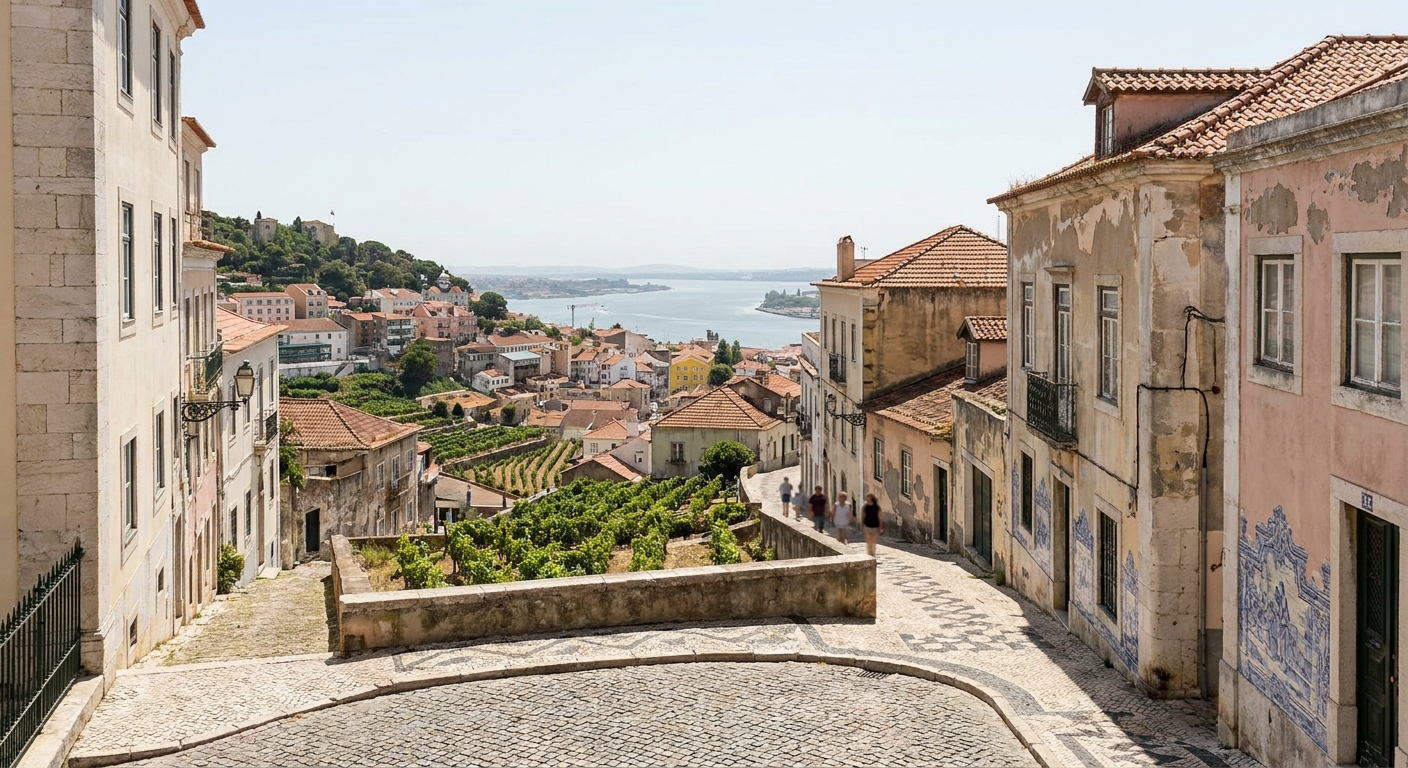
The Douro arrives as a shock of vertical farming: schist terraces stacked from the water to the ridgeline, a river you can follow by road, by rail or by boat, and quintas that have shipped port for generations. The Alentejo does the opposite. It opens out. Cork oaks, wheat, whitewash on low hills, and a horizon that stays put for an hour of driving.
Most travelers choose between them on photographs. The two figures that should decide it are how hot the afternoon runs and how many wet days sit in the month you can actually take off work, and both regions have an official thermometer standing inside them, not on a coast two hours away.
TWO REGIONS AT A GLANCE · DOURO VS ALENTEJO
Take the Douro Valley for a first trip of three or four nights, and the Alentejo if you have a week, a car and a tolerance for 92°F afternoons.
SAME 1991-2020 NORMALS · TWO STATIONS: VILA REAL 561 M & ÉVORA 248 M · NO PRICE SERIES ON EITHER SIDE
Go for: the Douro when you want the river, the terraces and a cooler summer afternoon. The Alentejo when you want dry air, distance between villages and Évora’s stonework.
Think twice before: booking either as a beach trip. Both stations sit well inland and neither record carries a sea temperature.
Normals: IPMA stations 567 and 558 · Daylight: sunrise-sunset.org · full sources at the end
On this page
- Which one for a first trip to PortugalThe verdict, and who should overrule it
- Monthly highs, lows and rain daysThe 12-month table, both regions
- Where the two weather stations standVila Real at 561 m, Évora at 248 m
- Daylight hours on the 15th of the monthSunrise and sunset, side by side
- Tourist tax and ticket pricesWhat our sources carry, and what they do not
- Things to do in each regionHarvest quintas, the river, Évora
- The month that separates them mostJune, with the figures
Both regions are wine country, both are inland, and both want a rental car. They separate at the airport: the Douro is a drive east from Porto, the Alentejo a drive east or south from Lisbon, and flights from the US reach both. They separate again on the thermometer, and by June that gap runs to 8.9°F.
Douro Valley or Alentejo
Take the Douro Valley. On three or four nights the river does the organizing for you: terraces, quintas, the boat or the valley railway, and an August that averages 84.2°F where Évora averages 92.3°F. It is the easier first trip and the one that survives a short itinerary. The Alentejo makes the better second one.
Choose the Alentejo if you are driving anyway, if you have a week rather than a long weekend, and if dry is what you came for. July there records 0.6 days with 1 mm of rain or more, against 2.3 in the Douro, and the twelve monthly normals add up to 23.47 inches a year against 37.45 (our own sum). Travelers who want Roman Évora, cork plains and long empty road are choosing it for the right reasons.
Swimming is off the table in either region, so that is not the thing dividing them. Summer nights are closer than the daytime figures suggest: in August the average low is 60.8°F at Évora and 58.8°F at Vila Real, two degrees apart, while the highs are eight. And nobody should book the Douro expecting cool: it still averages 83.8°F in July.
Before you decide, look at your month. A January in the Douro brings 11.4 rain days at 1 mm or more and 5.09 inches of precipitation, against 8.6 days and 2.70 inches at Évora. By June those counts fall to 4.0 and 1.7. October, the month most people picture when they picture vineyards, brings 4.76 inches to the Douro and 3.21 to the Alentejo.
Douro Valley vs Alentejo weather: temperature and rain
| Month | Douro high / low | Douro rain days ≥1 mm | Alentejo high / low | Alentejo rain days ≥1 mm |
|---|---|---|---|---|
| January | 49.8°F / 37.0°F | 11.4 | 57.4°F / 40.1°F | 8.6 |
| February | 54.0°F / 38.3°F | 8.5 | 60.3°F / 41.0°F | 7.0 |
| March | 60.1°F / 42.1°F | 8.8 | 65.7°F / 44.4°F | 7.5 |
| April | 63.3°F / 44.8°F | 10.3 | 69.3°F / 47.3°F | 8.0 |
| May | 70.2°F / 49.5°F | 8.5 | 77.0°F / 51.6°F | 6.0 |
| June | 77.5°F / 54.7°F | 4.0 | 86.4°F / 56.8°F | 1.7 |
| July | 83.8°F / 58.5°F | 2.3 | 91.9°F / 60.1°F | 0.6 |
| August | 84.2°F / 58.8°F | 2.3 | 92.3°F / 60.8°F | 0.7 |
| September | 77.4°F / 55.4°F | 5.2 | 85.1°F / 58.3°F | 3.6 |
| October | 66.7°F / 50.2°F | 10.0 | 75.4°F / 54.1°F | 7.7 |
| November | 55.8°F / 42.8°F | 11.2 | 63.7°F / 46.2°F | 8.8 |
| December | 50.7°F / 38.5°F | 10.5 | 58.3°F / 41.5°F | 8.7 |
Évora is the warmer of the two stations in all twelve months, and the gap never drops below 5.6°F, which happens in March (65.7°F against 60.1°F). The rain-day count leans the other way in all twelve as well, from 2.8 days apart in January down to 1.3 in March.
June is where the daytime gap opens widest: 86.4°F against 77.5°F, a difference of 8.9°F. August runs 92.3°F against 84.2°F. The nights refuse to follow that pattern, and the numbers are small: January lows of 40.1°F and 37.0°F, July lows of 60.1°F and 58.5°F. So the packing difference is a daytime one. The Alentejo asks for shade and a hat, the Douro for a layer after sunset.
Neither record carries a sea temperature. Vila Real stands at 561.5 m in the Douro country and Évora at 247.6 m in the Alentejo, both well inland, so a swimming day means a second leg of the trip: the Algarve, or the coast around Ericeira. Neither of those is described by the normals here.
Douro Valley and Alentejo weather averages
Every Douro figure here is read at IPMA station 567, Vila Real, 561.5 m. The altitude matters more in this valley than anywhere else in Portugal: the station sits in the Douro country rather than on the coast, and the valley floor runs far hotter than Porto does. Higher ground nearby is colder and considerably wetter. A number taken on the plateau is not a number taken among the terraces at river level.
Alentejo figures come from IPMA station 558, Évora, 247.6 m, standing in the region itself rather than serving as a coastal proxy, and they do not describe every corner of it either. The rain-day columns are the honest comparison here, because both sides count a day when it records at least 1 mm (0.04 inch), IPMA’s own threshold. US tables usually start counting at 0.10 inch, so these two columns compare with each other and not with a chart from home.
How long are the days in Douro Valley and Alentejo?
On June 15 the Douro gets 15 hours 12 minutes of daylight and the Alentejo 14 hours 54, an 18-minute advantage to the north. On December 15 it reverses: 9 hours 16 against 9 hours 33, 17 minutes the other way. Mid-March puts them within a minute of each other, 11:59 and 12:00.
Those minutes land at the two ends of the day. June 15 in the Douro: sunrise 5:55 a.m., sunset 9:07 p.m. local. The same date at Évora: 6:05 a.m. and 8:59 p.m. In December the pattern flips, with a Vila Real sunset at 5:04 p.m. against Évora’s 5:13 p.m., and the Alentejo also gets its light eight minutes earlier in the morning.
In practice that buys a June dinner outdoors in the Douro with light still on the terraces past nine. It also means a December day in either region is finished by five, so book cellar visits and the driving between quintas into the first half of it and let dinner be indoors. Reverse the logic in summer in the south: Évora’s morning starts ten minutes later and its August afternoon hits 92.3°F, so the walking happens before eleven.
Tourist tax and ticket prices in Douro Valley and Alentejo
| Cost item | What our two sources carry | Where to look |
|---|---|---|
| Municipal lodging tax and its cap | No figure for either region | Know before you go |
| Named ticket prices (quintas, monuments) | No figure for either region | Douro Valley · Alentejo |
| Nightly lodging rates | No price series on either side | Where to stay in Portugal |
| Car, fuel and tolls | Not carried here | Renting a car |
| A week’s total budget | Not carried here | What a week in Portugal costs |
We have not verified a municipal lodging tax, its per-person nightly rate or its cap for either the Douro or the Alentejo, and an unverified figure would be worse than none at all. Ask two questions at the moment you book: how much per person per night, and after how many nights does it stop. The second answer is the one that moves a week’s total, because the cap is what decides whether a long stay keeps paying.
No admission price reached this page either, not for the port lodges and quinta tours on the Douro side, not for Évora’s Roman temple, its cathedral or its bone chapel on the Alentejo side. Those belong on the guides that handle them: one day in Évora and the Douro harvest.
Beyond tax and tickets, neither side carries a lodging rate series here, which is why nothing above declares one region cheaper than the other. There is no drive time from Porto or Lisbon on either set of sources, and no monthly visitor count, so the crowd question stays open too. What a week in Portugal costs and getting around Portugal carry that layer at country level.
Things to do in Douro Valley vs Alentejo
The harvest is the Douro’s card, and our Alentejo guide holds no counterpart for it: a picking and treading season that turns working quintas into hosts, covered in the harvest guide. Add a river you can take three ways, by boat, by the valley railway or by the road above it, and the port lodges across the water if your trip starts in Porto.
The Alentejo answers with space and stone. Évora’s walled center packs a Roman temple, a cathedral and the bone chapel into a morning on foot, and the plains beyond hold cork oak, megaliths and villages spaced far enough apart that the driving becomes part of the day. The thermometer is the trade: at 91.9°F in July and 92.3°F in August, the region wants you out at eight and indoors by two. The Douro’s 84.2°F asks less.
Douro Valley or Alentejo by month
June splits them further than any other month. Évora averages 86.4°F against Vila Real’s 77.5°F and records 1.7 rain days against 4.0, while the Douro takes 18 more minutes of daylight on the 15th. If June is your window, the north is the cooler and longer day and also the wetter one. The twelve monthly readings for each sit on the Douro Valley guide and the Alentejo guide, and the 12-month verdict sets both against the rest of the country.
The last word
Pick the region your month can carry, then build the nights around it rather than the other way round. One figure we have kept back: April in the Douro records 10.3 rain days, more than March’s 8.8, so a spring trip to the terraces wants a jacket in the car and an indoor cellar visit held in reserve. Évora’s April, at 69.3°F, is the warmer spring of the two by exactly 6.0°F.
Sources & data for this guide
- Douro Valley monthly normals 1991-2020 · IPMA station 567, Vila Real, 561.5 m · checked Sep 13, 2026
- Alentejo monthly normals 1991-2020 · IPMA station 558, Évora, 247.6 m · checked Sep 13, 2026
- Rain-day counts use IPMA’s own 1 mm (0.04 inch) threshold on both sides, not the 0.10-inch threshold most US tables use · checked Sep 13, 2026
- Sunrise, sunset and daylight length on the 15th of each month · sunrise-sunset.org, converted to local time · checked Sep 13, 2026
- Annual precipitation totals (37.45 in and 23.47 in) are our own sum of the twelve monthly normals listed above.
- Editorial admission: we could not verify a tourist tax, a ticket price or a lodging rate for either region, so this comparison ranks neither of them on cost.