
DOURO VALLEY · FEBRUARY · VILA REAL · 561 M
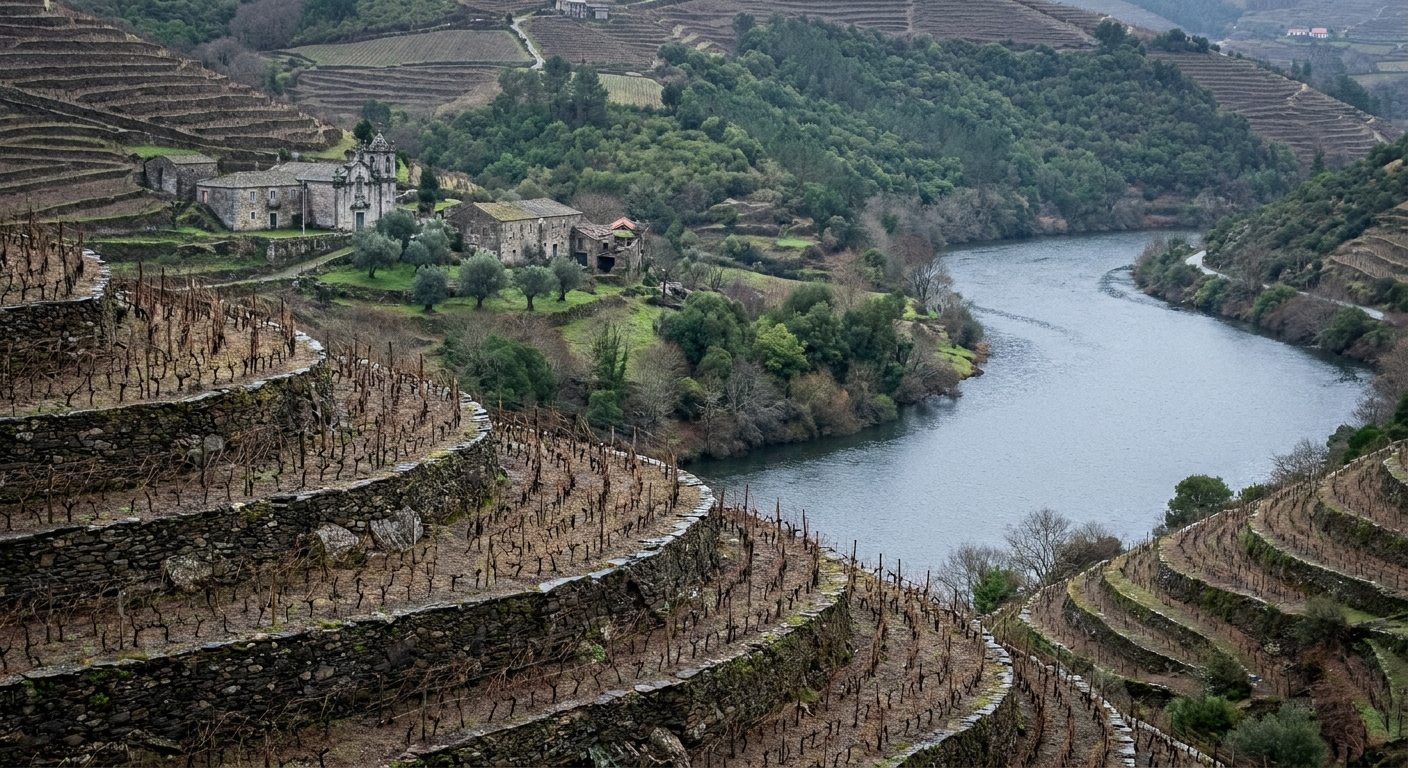
IPMA’s thermometer at Vila Real reads a February average high of 54.0°F and an average low of 38.3°F, and through those weeks the vines are bare sticks. No leaf, no fruit, no harvest traffic: what you see from the river road in February is the structure of 24,600 hectares of terraced vineyard, schist wall by schist wall.
Set against that: 3.29 inches of rain spread over 8.5 wet days, sunset at 6:05 pm on the 15th, and nights averaging 38.3°F on the high ground. If your Douro involves a long dinner on a terrace above the water, pick a later month. If it involves driving, walking and looking, you will see more of the valley’s shape than an August visitor does. Where to sleep and how many nights to give the valley sit on our Douro Valley guide.
THE MONTH AT A GLANCE · DOURO VALLEY · FEBRUARY
February buys you a legible, uncovered valley at 54.0°F by day, and charges 3.29 inches of rain and a 6:05 pm sunset for it.
AVG HIGH 54.0°F · 8.5 RAIN DAYS · 10H41 OF DAYLIGHT ON FEB 15
Go for: terrace walls visible instead of hidden under leaf, quiet river roads, indoor lunches, and the driest rain count of the three winter months.
Think twice before: planning outdoor evenings or a wine-harvest trip: the light is gone by 6:05 pm and the picking happens in late summer and early autumn.
Normals: IPMA station 567, Vila Real, 1991–2020 · Landscape: UNESCO file 1046 · full sources at the end
On this page
- Average highs, lows and rain days54.0°F by day, 8.5 wet days
- How warm it feels morning and afternoonA 15.7°F spread, and frost
- Crowds, prices and booking a quintaWhat we could and could not price
- Things to do in FebruarySocalcos, quintas, tributary valleys
- A two-day plan built around the lightFrom 7:24 am to 6:05 pm
- February vs January and March49.8°F, 54.0°F, 60.1°F
- Is February a good time to go?Yes for drivers and walkers
Every temperature and rain count below comes from IPMA’s Vila Real station, 561.5 m up and inside the Douro country, not from Porto on the coast. Harvest timing, the drive in and the hotel question belong to other pages, linked where they matter.
Douro Valley weather in February: average highs, lows and rain days
| February normal at Vila Real | Figure |
|---|---|
| Average high | 54.0°F (12.2°C) |
| Average low | 38.3°F (3.5°C) |
| Precipitation | 3.29 in |
| Days with 0.04 in or more | 8.5 |
| Days with 0.39 in or more | 3.2 |
| Daylight on February 15 | 10 h 41 min |
| Sunrise and sunset, February 15 | 7:24 am · 6:05 pm |
Every figure here comes from one instrument: IPMA station 567 at Vila Real, 561.5 m above sea level, 1991–2020 normals, a real thermometer rather than a model grid cell. The altitude matters more in the Douro than almost anywhere else in Portugal. The valley floor down by the water runs hotter than Vila Real, the high ground of the Marão and Montemuro ranges runs colder and far wetter, and no single reading covers both. Pack for the slope you actually plan to stand on.
Eight and a half days with 0.04 inch or more works out to roughly three days in ten. Of those, 3.2 reach 0.39 inch, so a proper soaking lands about one February day in nine. IPMA counts with its own thresholds, not the 0.10 inch used in American tables, so the two sets of rain-day numbers are not interchangeable. Expect a run of usable mornings broken by one or two days when the schist tracks turn slick and the river road becomes the whole itinerary.
Between 54.0°F by day and 38.3°F at night lie 15.7°F, and the gap opens fast once the sun drops behind the terraces. One fleece will not cover both ends of a February day: bring a shell for the rain, a warm mid-layer for the evening, and shoes with grip for wet stone steps. Our Portugal packing list has the rest of the kit.
February 15 gives 10 hours 41 minutes of daylight, sunrise at 7:24 am and sunset at 6:05 pm, mainland Portugal running on UTC through the winter. On steep valley sides the useful window is shorter still, because the shadow climbs the north-facing slopes well before the official sunset. Anything on a narrow road above the river belongs before 5 pm.
How warm is the Douro Valley in February?
The month’s two numbers are 54.0°F and 38.3°F, 15.7°F apart. Both are averages of daily extremes rather than readings you will personally see: plenty of February afternoons climb above 54.0°F, and the coldest hour before dawn sits well under the 38.3°F mean. Read the pair as the middle of a range, not as a forecast for your Tuesday.
Mornings ask for a coat. At 8 am on a clear day the air sits nearer the 38.3°F low than the 54.0°F high, and stone houses hold that cold well into the morning. By two in the afternoon, with sun on a south-facing terrace and the Marão range blocking the Atlantic wind, a shirt and a fleece do the work. Carry the coat anyway, because you will want it again around five.
That 38.3°F monthly mean sits 6.3°F above freezing, so cold nights are ordinary here and hard frost on the high ground is entirely plausible. We could not verify a frost-day count for Vila Real, so we give no number of nights below 32°F. We also found no water-temperature series for the Douro or its tributaries, so we give no river figure at all.
How busy is the Douro Valley in February? Crowds, prices and booking
We found no occupancy series and no monthly room rates for the Douro, so we crown no month cheap and no month expensive. The calendar carries what we do know: the valley’s set-piece, the harvest, falls in late summer and early autumn, and February sits about as far from it as the year allows. Vines are dormant, pruning crews are out on the terraces, and the quintas run as working farms rather than as a visitor season.
Booking this month turns on confirmation rather than on lead time. We verified no quinta opening hour and no tasting price in the valley, so write ahead, get a time in writing, and only then build a driving day around it. The same caution applies to river boats and the valley train: we found no February timetable or fare we could stand behind, and a closed gate at the top of a long climb is a poor use of a short day.
We could not verify a lodging-tax rate for the Douro municipalities, so we give no percentage. If a charge shows up on your bill, ask your host to quote it before you arrive. That is the only figure we would trust on this particular line.
One expense changes February more than any other, and it is the car. With 10 hours 41 minutes of daylight and rain on roughly three days in ten, a set of keys is what separates seeing the Corgo and Pinhão valleys from seeing one village and a bus stop. Our car guide covers tolls and insurance, and getting around Portugal lays out the train and bus picture.
Things to do in the Douro Valley in February
In July the canopy hides the stonework. In February you can read it, and two different kinds of terrace share these slopes. The socalcos, the oldest, predate the phylloxera of 1860: narrow, irregular, buttressed by schist walls that need constant maintenance, each carrying only one or two rows of vines. The long, regular, slightly sloping terraces came with the replanting at the end of the 19th century and the start of the 20th, wider and tilted so the vines catch more sun, their monumental walls visible from the far bank.
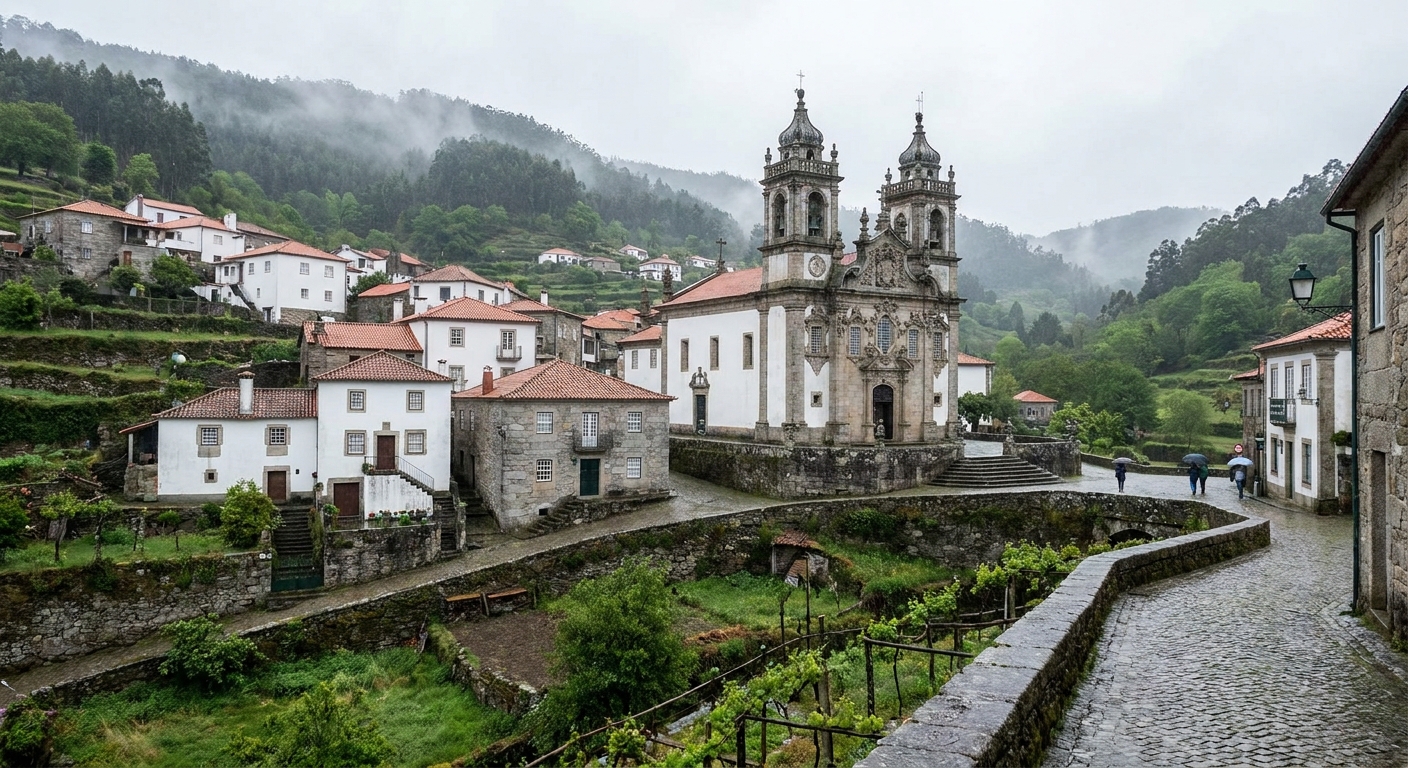
UNESCO inscribed the Alto Douro Wine Region in 2001 under criteria (iii), (iv) and (v): 24,600 hectares of terraced vineyard inside a buffer zone of 225,400 hectares, nine times the size of the property and difficult to manage by UNESCO’s own account. The landscape follows the water, the Douro and its main tributaries the Varosa, Corgo, Távora, Torto and Pinhão. Quintas, a main house with its winery and farm buildings, stand thickest in the Upper Corgo and the Upper Douro, and white-walled villages sit midway up the slopes.
None of that stonework moves with the season. The air does. The Marão and Montemuro ranges shelter the valley from the harsh Atlantic winds all year, and in February that shelter is what separates 54.0°F in the sun from a raw afternoon on the ridge above. Walled orange groves along the lower banks and the hillside watercourses keep their leaves while the vines have none, so the green you see this month is citrus, brushwood and scrub.
Nothing in the valley’s best February hour carries a ticket we were able to verify. The terraced slopes, the river roads, the village squares and the old stone channels that fed the water catchments cost nothing to look at, and the reason they still look like this is administrative: an Intermunicipal Spatial Plan approved in 2003, plus the Douro Mission, the managerial structure created in 2006 to safeguard the landscape.
The Douro Valley in February: a two-day itinerary
Day one starts with the light. Sunrise at 7:24 am, breakfast before it, wheels turning by 8:30 so the first viewpoint above the river catches the low sun. Late morning goes to a confirmed quinta appointment, the only fixed point worth building around. Lunch indoors between noon and two, when the 54.0°F average is at its most generous. Then one terrace walk on the sunny bank until about 4:30 pm, and back down the switchbacks before the 6:05 pm sunset.
Day two runs along the water: the Pinhão valley or the Corgo, a village church midway up the slope, a second quinta if you confirmed one. On a wet day, and 3.2 February days bring 0.39 inch or more, invert the plan: drive the valley floor instead of climbing to the terraces, keep walking to paved village streets, and treat wet schist steps as closed. Torrential rain in late January 2001 badly damaged terraces here, and UNESCO noted that a special effort would be needed to bring parts of the vineyards back into working order.
The Douro Valley in February vs January and March
| Measure | January | February | March |
|---|---|---|---|
| Average high | 49.8°F | 54.0°F | 60.1°F |
| Average low | 37.0°F | 38.3°F | 42.1°F |
| Precipitation | 5.09 in | 3.29 in | 3.59 in |
| Days with 0.04 in or more | 11.4 | 8.5 | 8.8 |
| Water temperature | not verified | not verified | not verified |
The three months sort neatly by warmth: 49.8°F in January, 54.0°F in February, 60.1°F in March, with nights at 37.0°F, 38.3°F and 42.1°F. Rain refuses to follow the same line. January brings 5.09 inches over 11.4 wet days, February 3.29 inches over 8.5, March 3.59 inches over 8.8, which makes February the driest of the three on both counts. No water temperature appears for any of them, because we found none for the Douro.
Shifting four weeks forward buys 6.1°F on the day, 3.8°F on the night and noticeably longer light, for 0.30 inch more rain and a third of an extra wet day. Shifting four weeks back costs 4.2°F and adds 1.80 inches of rain across nearly three more wet days. March suits anyone who wants an afternoon outdoors without a coat. February suits anyone who wants the terraces uncovered. Our Portugal calendar ranks the full twelve.
Is February a good time to visit the Douro Valley?
Yes if you came for the landscape and the cellar, no if you came for dinner on a terrace above the water. Days average 54.0°F, nights 38.3°F, and the light runs 10 hours 41 minutes on the 15th, which suits driving, looking and long indoor lunches. Walkers do well, since the terrace walls are exposed and the tracks stay cool. Families without a car should think twice: the distances here are all uphill, as our Portugal with kids guide spells out.
If that sounds like a compromise, March is the fix: 60.1°F days, 42.1°F nights, 8.8 wet days and more evening light, at the cost of 0.30 inch more rain than February. Travelers whose whole reason for coming is the picking should skip both and start with our Douro harvest guide, then pair the valley with Porto at the coast.
Among the three winter months, February is the one that pairs bare, readable terraces with the lowest rain-day count, 8.5 days at 0.04 inch or more.
The last word
Get the quinta time confirmed in writing first, then build the two days around it: with the light gone at 6:05 pm, a February day in the Douro holds one appointment and one drive, not three of each. And the bare slopes carry a longer record than the stumps suggest. Wine has been made on these terraces by traditional landholders for some 2,000 years, and port has been a defined, regulated quality since 1756, older by generations than any vine you will photograph this month.
Sources & data for this guide
- February normals, high 54.0°F, low 38.3°F, 3.29 in · IPMA, climatological normals 1991–2020, station 567 Vila Real, 561.5 m · checked Sep 23, 2026
- Rain-day counts, 8.5 days at 1 mm and 3.2 days at 10 mm, on IPMA’s own thresholds · IPMA 1991–2020, station 567 · checked Sep 23, 2026
- January and March normals used in the comparison · same IPMA station and same 1991–2020 period, not estimates · checked Sep 23, 2026
- Daylight 10 h 41 min, sunrise 07:24 and sunset 18:05 UTC on February 15 · sunrise-sunset.org · checked Sep 23, 2026
- Inscription 2001, criteria (iii)(iv)(v), 24,600 ha property and 225,400 ha buffer, socalcos and post-phylloxera terraces, quintas, tributaries, 2003 plan and 2006 Douro Mission, January 2001 rain damage, 2,000 years of winemaking and port regulated since 1756 · UNESCO World Heritage Centre, file 1046 · checked Sep 23, 2026
- Our admission: we found no quinta opening hours, no tasting prices and no boat or train fares for the Douro, so none appear here; hours and fares change, confirm with the operator before you drive · checked Sep 23, 2026
To plan your stay
- Things to Do in the Douro Valley: Quinta Tastings, the River Train, Boats and Miradouros
- Douro Valley vs Alentejo: Monthly Temperatures, Rain Days and Daylight
- Best Time to Visit the Douro Valley: Month-by-Month Weather, Harvest Season and the Quiet Months
- The Douro Valley in January: Weather, Rain Days and Bare Terraces