
DOURO VALLEY · BEST TIME TO VISIT · NORMALS FROM 561 M
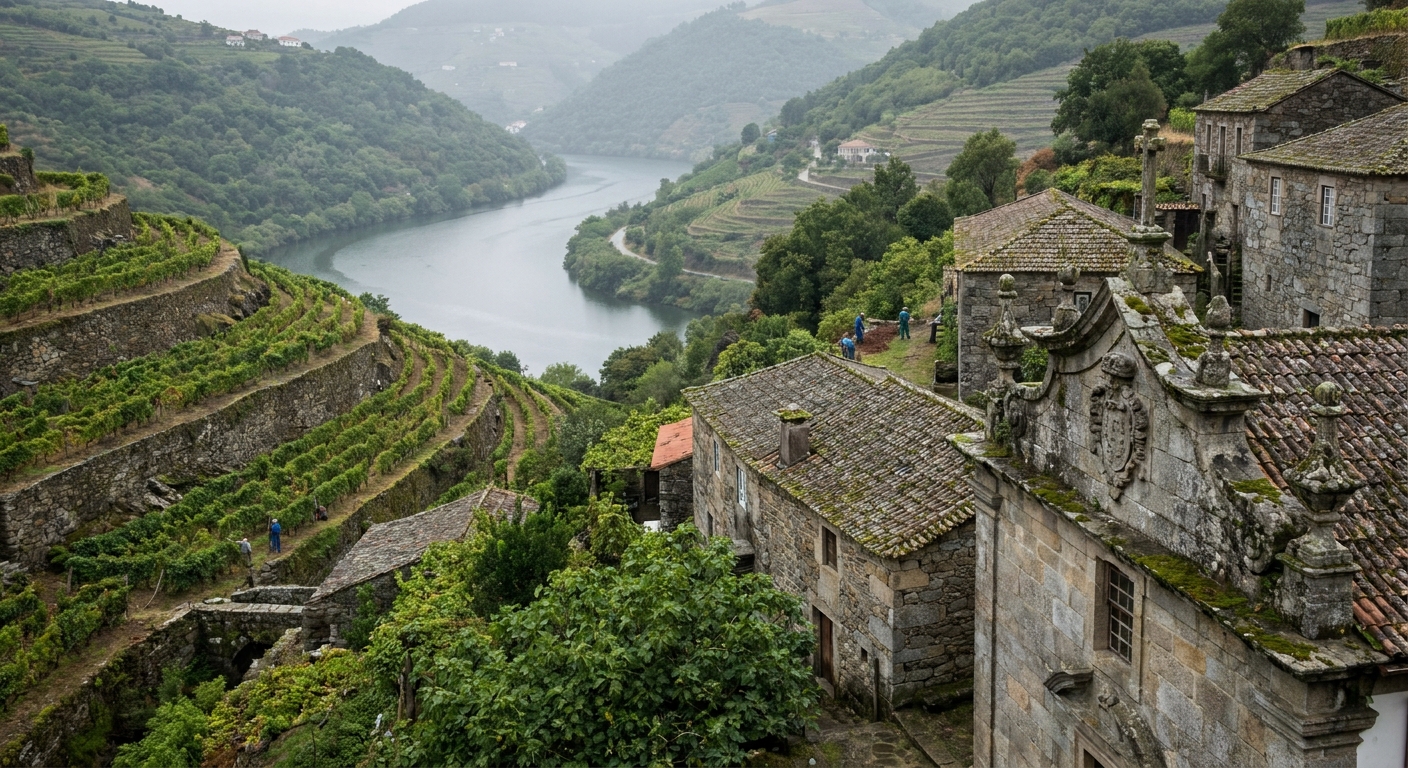
The Douro was rebuilt by hand. Schist terraces stack up both banks in a geometry that took three centuries of wall-building, the river bends below them in slow green loops, and the quintas that make port sit at the top of every ramp. The train from Porto runs along the water to Pinhão, where the station is tiled with harvest scenes, and the road above it, the N222 between Peso da Régua and Pinhão, is the drive people come for.
What the postcards never settle is when. This is inland Portugal, not the coast: the summer bakes, the winter pours, and the difference between a September afternoon on a terrace and a December one is not a matter of taste. Below are the twelve months with their numbers, then a verdict.
THE YEAR AT A GLANCE · DOURO VALLEY
September is the valley’s month: 77.4°F days, 1.93 inches of rain and the vintage underway, with May as the cooler, drier alternative for anyone who plans to walk.
BEST: SEPTEMBER · ALTERNATIVE: MAY · HOTTEST: AUGUST 84.2°F · WETTEST: DECEMBER 5.62 IN
Go for: harvest weeks on the terraces, a railway that hugs the water from Porto, and September nights that fall back to 55.4°F after an 77.4°F afternoon.
Think twice before: booking December or January, when 10.5 and 11.4 rain days meet barely nine and a half hours of daylight.
Normals: IPMA station 567, Vila Real, 1991-2020 · Daylight: sunrise-sunset.org · full sources at the end
On this page
- Douro Valley weather month by monthThe 12-month table
- The best month to goSeptember, at 77.4°F
- How hot the valley gets in July and AugustAugust at 84.2°F
- The quiet monthsDecember to February
- The month to skipDecember, and for whom
- Is May or October worth it?May 70.2°F against October 66.7°F
Most American trips reach the valley through Porto, which is where the transatlantic flights land and where the train up the river starts (the flight options are here). We’d give the Douro two or three nights rather than a day trip, and a rental car if the N222 and the hill quintas are the point (tolls and insurance, plainly). Harvest weeks are the one stretch of the year worth booking months out. Everything else on the calendar below sorts itself into a season.
Douro Valley weather month by month: highs, lows and rainfall
| Month | Avg high | Avg low | Rain | Days ≥1 mm | Daylight (15th) |
|---|---|---|---|---|---|
| January | 49.8°F | 37.0°F | 5.09 in | 11.4 | 9h34 |
| February | 54.0°F | 38.3°F | 3.29 in | 8.5 | 10h41 |
| March | 60.1°F | 42.1°F | 3.59 in | 8.8 | 11h59 |
| April | 63.3°F | 44.8°F | 3.34 in | 10.3 | 13h24 |
| May | 70.2°F | 49.5°F | 2.50 in | 8.5 | 14h34 |
| June | 77.5°F | 54.7°F | 1.15 in | 4.0 | 15h12 |
| July | 83.8°F | 58.5°F | 0.50 in | 2.3 | 14h54 |
| August | 84.2°F | 58.8°F | 0.85 in | 2.3 | 13h52 |
| September | 77.4°F | 55.4°F | 1.93 in | 5.2 | 12h31 |
| October | 66.7°F | 50.2°F | 4.76 in | 10.0 | 11h09 |
| November | 55.8°F | 42.8°F | 4.83 in | 11.2 | 9h55 |
| December | 50.7°F | 38.5°F | 5.62 in | 10.5 | 9h16 |
Two numbers hold the year apart: 0.50 inches of rain in July against 5.62 in December, more than eleven times as much. Highs run from 49.8°F in January to 84.2°F in August, and the count of days reaching 1 mm swings from 2.3 in July to 11.4 in January, close to five times over. This is a dry season and a wet one with very little in between.
The year turns twice, and both turns are quick. Between September and October the average high falls 10.7°F, rainfall goes from 1.93 to 4.76 inches, and wet days almost double, 5.2 to 10.0. Spring swings the other way: April averages 63.3°F with 10.3 wet days, May 70.2°F with 8.5 and only 2.50 inches. Anyone booking the first week of October is betting on the September side of that hinge.
December is the year at its heaviest: 5.62 inches of rain, 10.5 days reaching 1 mm, 4.4 of them reaching 10 mm, and 9 hours 16 minutes of daylight on the 15th, with the sun down at 5:04 p.m. local time. For a traveler who came to walk the terraces or to photograph the river bends, that combination removes the afternoon. For someone whose plan is a tasting room and a long lunch, it barely registers.
Every figure here comes from IPMA station 567 at Vila Real, 561.5 meters up and inside Douro country rather than on the coast. That distinction matters more in this valley than anywhere else in Portugal: the river floor, well below the station, runs far hotter than these readings, and hotter than Porto. The rain-day counts use the Portuguese service’s own thresholds, 1 mm (0.04 inch) and 10 mm (0.39 inch), not the 0.10-inch line American tables draw, so the two sets of counts are not interchangeable.
When is the best time to visit Douro Valley?
September, and it is not close. The month averages a 77.4°F high and a 55.4°F low, takes 1.93 inches of rain across 5.2 wet days, and still holds 12 hours 31 minutes of daylight on the 15th, with sunset at 7:41 p.m. local time. It is also the vintage: pickers on the terraces, grapes moving downhill, tasting rooms working rather than performing.
August is 6.8°F hotter at the station and keeps its nights at 58.8°F instead of 55.4°F. October gives up 10.7°F from September, takes two and a half times the rain (4.76 inches against 1.93) and lands roughly one wet day in three. September sits in the gap between an oven and a downpour, which is the whole reason the harvest happens then.
The vintage has its own calendar, its own booking pressure and its own etiquette in the lodges, and our harvest guide carries that detail. For how the valley fits a wider trip, the national 12-month verdict sets it against Lisbon and the Algarve, and the northern region guide handles the route in.
How hot does Douro Valley get in summer?
July and August are the two dry, hot months: average highs of 83.8°F and 84.2°F, rainfall of 0.50 and 0.85 inches, and 2.3 wet days apiece. Nights do come down, to 58.5°F and 58.8°F, but read those lows as the high-ground version of the valley, since the station sits at 561 meters and the river runs much lower. July keeps 14 hours 54 minutes of daylight, with the sun setting at 9:04 p.m. local time, so summer days are walked early and eaten late.
One limit worth stating straight: the normals we read for Vila Real cover temperature, precipitation and rain-day counts, and we could not read a humidity or heat-index series for the station, so we give none. We also found no official thermometer on the valley floor itself. Both gaps matter in August, when the schist walls hold the day’s heat and the river gorge feels heavier than a number taken 561 meters up.
When is Douro Valley quietest?
December through February is the valley’s low season, and the calendar says so before any hotel does: the vintage finished in the fall, American school breaks fall elsewhere apart from the Christmas fortnight, and the daylight is at its shortest of the year, 9 hours 16 minutes on December 15 and 9 hours 34 on January 15. Pruning, not picking, is the work going on above the road.
What that buys is the architecture. Bare vines expose the terrace walls that the leaves hide from June onward, the N222 runs without a queue of rental cars at the viewpoints, and a tasting becomes a conversation rather than a slot. February is the pick of the three: 3.29 inches of rain and 8.5 wet days, the same wet-day count as May, with a 54.0°F average high.
What it costs is time and dryness. January averages 11.4 days reaching 1 mm and 4.6 reaching 10 mm, which is the wettest-graded month of the year for heavy rain. Daylight ends before 5:30 p.m. in mid-January. Some quintas, river cruises and smaller restaurants run reduced winter schedules or close outright, so confirm opening days with each operator before you build a route around them.
Which month should you avoid in Douro Valley?
December, for the visitor with one shot at the valley and a plan built outdoors. It takes 5.62 inches of rain over 10.5 wet days, 4.4 of which reach 10 mm, and gives back 9 hours 16 minutes of daylight against June’s 15 hours 12, nearly six hours less. A 50.7°F average high is not the problem. Losing the light at 5:04 p.m. on a road whose entire point is the view is.
It does have a defense. Rain on 10.5 days leaves about twenty days in an average December that never reach 1 mm, the hills are green rather than scorched, and the river runs full under the fog. A wet afternoon also has somewhere to go: the port lodges across the water in Gaia are an indoor day, and Porto itself is an easy base when the terraces are unwalkable.
Is the shoulder season worth it in Douro Valley?
The shoulders here are May and October, with April as the ragged edge of the first one. May averages 70.2°F, a full 14.0°F below August. October averages 66.7°F, 17.5°F below it. Both sit well clear of the summer that empties the terraces between noon and five, and neither carries the vintage crowd that fills every room in September.
May is the better half of that pair and the one we’d send walkers to: 2.50 inches of rain, 8.5 wet days, and 14 hours 34 minutes of daylight on the 15th, sunset at 8:44 p.m. The vines are in flower, the hills still hold their spring green, and 70.2°F is the temperature at which a terrace climb stops being an endurance event.
October takes it back. Rainfall jumps to 4.76 inches over 10.0 wet days, 4.3 of them at 10 mm or more, and daylight drops to 11 hours 09 minutes, the sun gone by 6:51 p.m. April is the trap in the other direction: 3.34 inches spread over 10.3 wet days, more frequent rain than either February or May despite a modest total.
Our verdict: take May if you plan to be outside, and take September if the harvest is what you came for. October works only with flexible plans and a rainy-day list already written, because a third of its days will ask for one. April is a gamble that pays about seven times in ten.
The last word
Pick September for the vintage, May for the walking, and stop deliberating. If both are booked out, look at February before you look at April: it carries 3.29 inches of rain against January’s 5.09, the same 8.5 wet days as May, and the sun already sets at 6:05 p.m. on the 15th, 38 minutes later than mid-January. Two nights in the valley, a car for the N222, and the terraces will do the rest.
Sources & data for this guide
- Monthly normals 1991-2020 (highs, lows, precipitation, days ≥1 mm and ≥10 mm) · IPMA, station 567 Vila Real, altitude 561.5 m · checked Sep 12, 2026
- Daylight length and sunrise/sunset on the 15th of each month, converted from UTC to local time · sunrise-sunset.org · checked Sep 12, 2026
- Rain-day thresholds are the Portuguese service’s own, 1 mm (0.04 inch) and 10 mm (0.39 inch), and do not match the 0.10-inch threshold used by many US tables
- We could not read a humidity or heat-index series for Vila Real, and we found no official station on the valley floor itself · the summer section says so rather than estimating
- Season labels, crowd notes and quinta opening patterns are editorial · hours, cruises and harvest dates change each year · confirm with operators when you book