
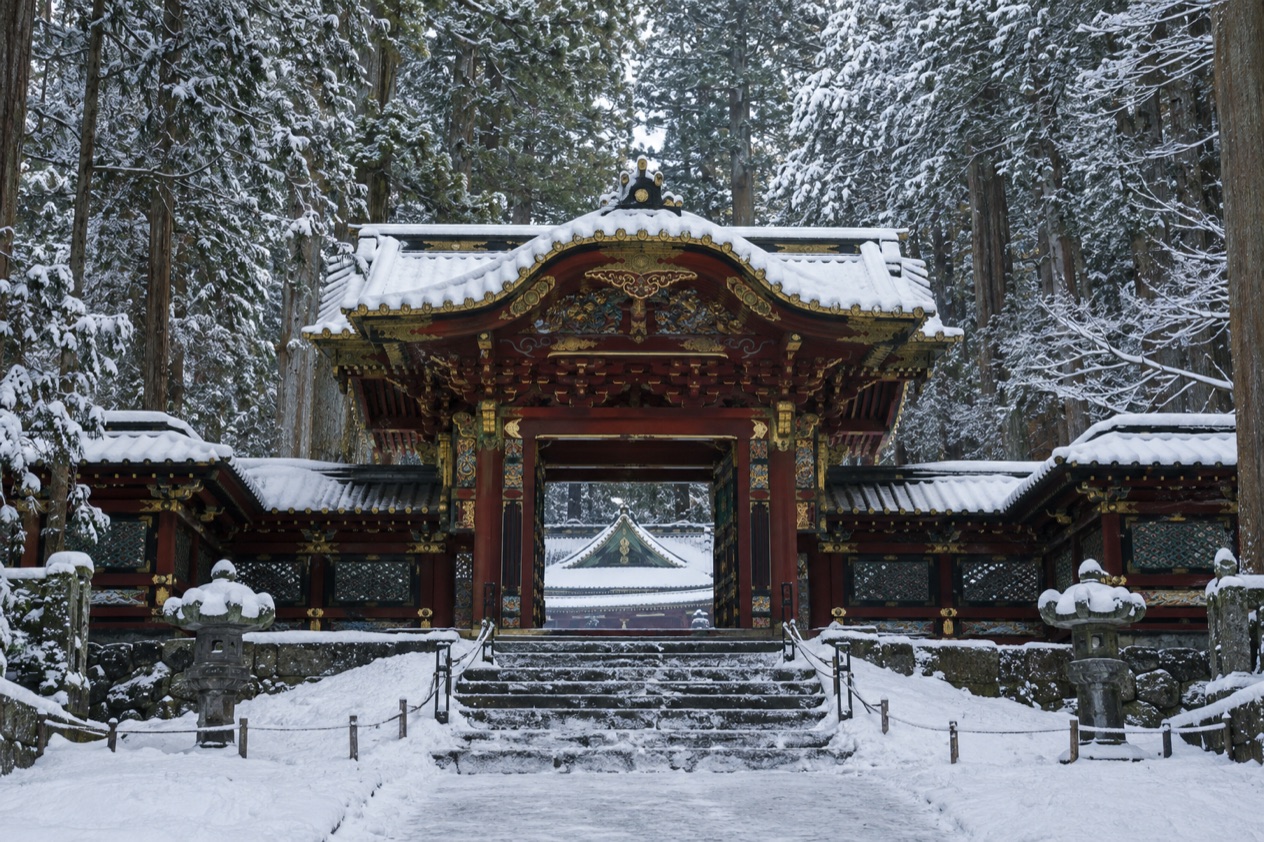
In February the cedar avenues of Nikko hold the snow on their branches, and the red and gold of the shrine gates glows against white ground. Early in the month, families throw roasted soybeans out their doors to chase away bad luck, and hot drinks steam in the doorways of the shops. This is Nikko in deep winter, a month for snowy shrine grounds, frozen-edged lakes and a long soak in an onsen (a hot spring bath) afterward.
What is the weather like in Nikko in February?
February in Nikko is a cold, snowy month, with temperatures hovering around freezing in the afternoon and well below it at night.
| Month | Average high (°F) | Average low (°F) | Precipitation (in) | Days with 1 mm or more of precipitation | Hours of sunshine | Daylight on the 15th | Snowfall (in) |
|---|---|---|---|---|---|---|---|
| January | 31.5 | 17.8 | 2.26 | 6.4 | 165 | 9 h 54 min | 24.8 |
| February | 33.1 | 18.0 | 1.91 | 6.6 | 167 | 10 h 50 min | 22.0 |
| March | 39.6 | 23.7 | 4.27 | 9.5 | 190 | 11 h 54 min | 22.4 |
Afternoons hover just above freezing, so a good coat, a hat and gloves matter more than any clever trick. Mornings and nights drop well below that, cold enough that wet snow turns to dry powder and puddles become ice. Wool layers under a windproof shell keep you comfortable on a long walk among the shrines.
Precipitation here mostly means snow. It falls on most days of the month, usually in light to moderate amounts rather than as a single big storm, and the sun still shows itself for a good part of the month. Waterproof boots with real grip are the one item that decides how the day goes, because paths turn to packed snow and slush.
The light is already stretching. Days are noticeably longer than in January, so there is time for a full outing before dusk, and the low winter sun lights up the cedar trunks and the carved gates in warm tones. Sunset still arrives early enough that dinner and the onsen fall naturally into the evening.
What to do in Nikko in February
The month opens with Setsubun, the festival that marks the eve of spring in the old calendar. The main ritual is mamemaki, in which roasted soybeans called fukumame are thrown out the front door, or at a family member wearing an oni (demon) mask, while everyone shouts “Oni wa soto!
Fuku wa uchi!” (Devils out! Fortune in!). It is a noisy, cheerful household custom, and you will see bags of beans and paper oni masks in shops around the time.
Afterward comes the eating. It is customary to eat one roasted soybean for each year of your life, plus one extra for good luck in the coming year, counting age the traditional way. Nibbling a handful of beans in your hotel room is a small, friendly way to join in, and the shops that sell them usually have a seasonal sweet or two beside the beans.
Nature adds its own marker of the month. The plum tree (Prunus mume) typically flowers from January until late February in East Asia, so a first pale blossom against the snow is possible toward the end of winter. Cherry blossoms are still weeks away, and the trees you see in Nikko in February are bare.
Toshogu and the shrine precinct under snow
Toshogu is the great shrine of Nikko, a compound of lacquered gates, gilded carvings and tall cedars. In winter the colors stand out sharply against the snow, and the stone lanterns and steps wear white caps. Because the paths are slick, you move slowly, which suits a place where the detail on every beam rewards a long look.
Taiyuin, a neighboring mausoleum complex, shares the same forested setting and the same winter hours. Between the two, the Shinkyo bridge at the edge of the precinct, Rinno-ji temple and Futarasan Shrine fill a day of walking. Warm up in the small tea and sweets shops along the approach before the next round of stone steps.
| Site | Open |
|---|---|
| Toshogu Shrine | 08:00-15:30 (November to March) |
| Taiyuin | 08:00-15:30 (November to March) |
Lake Chuzenji and Kegon Falls
The shoreline turns white, the surrounding peaks are dusted with snow, and the air is sharp and clean. This is where snow falls most heavily in the area, so the scenery changes from town to lake in a way that makes the trip feel like a second destination.
Kegon Falls drops from the lake into a gorge, and in cold spells the spray can freeze into curtains of ice along the cliff. You may see the water partly frozen, partly still falling, which is a rare winter picture. It is a good outing for those who enjoy the cold, with warm gloves and a thermos of something hot in the pocket.
Onsen, hot food and the winter table
February is when the onsen earn their reputation. Soaking in a hot spring after a day on snowy paths, with steam rising into cold air, is the natural close to a Nikko winter day. Many ryokan (traditional inns) pair the bath with a multicourse dinner of local ingredients, served in a tatami room where you change into a yukata, a light cotton robe.
In town, the cold calls for simple warming food: noodles in hot broth, grilled skewers, tofu dishes and sweet red bean treats with green tea. Nikko is known for yuba, the delicate skin that forms on heated soy milk, served in soups, simmered dishes and as a fresh sheet. A cup of hot amazake, a sweet rice drink, in a small shop is a pleasure after a cold walk.
Winter sports sit within reach of the wider region. Japan’s ski season generally runs from December to April, and January and February bring the most frequent snowfall in the north and the high mountains. For a trip centered on shrines and hot springs, though, the snow-covered temples of Nikko are usually the focus.
A two-day itinerary for Nikko in February
Day 1 begins with the train from Tokyo, where Tobu-Nikko Station is about 2 hours from Asakusa and from Shinjuku. Arrive, drop your bags and walk to the Shinkyo bridge, then climb into the shrine area. The shrines close earlier in winter than in summer, so Toshogu and Taiyuin come first, while the light is still good and the paths are fresh.
Lunch is a bowl of hot noodles or a yuba set meal in one of the small restaurants near the approach. In the afternoon, continue to Futarasan Shrine and Rinno-ji, which have their own wooden halls and gardens, and wander the stone lanes between them. By dusk you want to be indoors, so the evening goes to dinner and your first onsen soak.
Day 2 goes up to the lake country. Spend the morning at Lake Chuzenji and Kegon Falls, where snow is heaviest and the scenery is the most dramatic, and keep your layers close. Lunch is something hot lakeside, then a slow loop along the shore before heading back down.
A long lunch of local dishes and a browse through the town’s sweet and craft shops fills the rest of the day. Leave the lake for a clearer day if the snow closes in.
Is Nikko busy in February?
February is winter in Nikko, and the rhythm of the town follows the season rather than any festival crowd. The New Year closures, when many restaurants and attractions shut, are behind you by now, so doors are open again. What shapes your day more than other visitors is the weather and the short winter light.
The shrine precinct runs on winter hours from November to March, which means the sightseeing day is shorter than in summer and the visits are best sequenced early. That alone gives the day a clear shape, with shrines first, then a warm lunch, then the onsen. A snowy afternoon invites a slower pace anyway.
Elsewhere in Japan, February is peak season for snow sports and large winter festivals. January and February bring the most frequent snowfall in Hokkaido and the high mountains of Nagano, which makes them the busiest months for ski resorts. Nikko draws a different kind of winter traveler, those who come for the shrines in snow, the lake and the hot springs rather than the lifts.
The cherry blossom crowds belong to spring. At Utsunomiya, the reference city for the area, first bloom usually comes around the end of March, so the trees in Nikko are bare and the spring rush has not started.
What to pack for Nikko in February
Pack for real winter, with layers you can add and remove as you move between cold paths and heated rooms. These items earn their space:
- Waterproof boots with deep tread, because paths in the shrine precinct turn to packed snow and slush.
- A warm insulated coat plus a windproof shell, for the cold around the lake.
- Thermal base layers and wool socks, for hours outdoors in freezing air.
- A hat, gloves and a scarf, since hands and ears feel the cold first.
- A small day pack with a thermos, for hot tea on a long walk.
- Slip-off shoes or easy socks, because shoes come off at the entrance of a ryokan.
Good to know before you go
February has its own calendar. Setsubun comes early in the month, with soybean throwing at homes and in shops, and it is a good moment to see a living custom. The shrines run on their shorter winter schedule, so plan the sightseeing before the afternoon cuts in.
Snow is the main variable. The mountain side sees more of it than the town, so dress for the colder end, and expect slick steps and paths. Keep the afternoon free for an onsen or a long lunch, which turns a weather change into part of the day rather than a problem.
Nikko in February vs January and March
Moving the trip four weeks earlier brings January, slightly colder at the top and with more snow on the days that it falls. The days are shorter, and the New Year closures may still touch some restaurants and attractions in the first days. Setsubun, the early-February festival, has not yet come, so the soybean custom is a February pleasure.
Four weeks later, March is milder, with afternoons warming above freezing and more precipitation, some of it now rain and wet snow. Days are longer, and the plum blossoms have usually finished in East Asia, while the cherry trees are still waiting. The cherry season sits near the end of the month and in April at Utsunomiya, so March feels like a transition.
Choose February if the picture you want is snow on the shrines, a frozen edge on the lake and a hot bath at day’s end. Shift to March if you would rather have longer days and a bit of warmth, and accept slush as the price. Shift to January only if deep winter is the whole point.
Is February a good time to visit Nikko?
Yes, February is a good time to visit Nikko for travelers who enjoy winter, snowy landscapes and hot springs. It suits anyone happy in layers and boots, who wants the shrines in a white setting and likes the idea of ending the day in an onsen. It is less suited to those hoping for mild strolling weather, blossoms or long daylight hours.
On arrival, go straight to the shrines while the light is on your side, since the winter hours close earlier than in summer. Keep the lake and the falls for a second day, and leave the evenings for dinner and a soak. A flexible plan lets you swap days if the snow closes in. What is special about February in Nikko is the pairing of ornate lacquer and gold with a plain white winter, and a hot bath waiting after a cold walk.
Sources
- Japan Meteorological Agency (JMA), Normal values 1991-2020, monthly (https://www.data.jma.go.jp/stats/etrn/view/nml_sfc_ym.php?prec_no=41&block_no=47690), station Okunikko, elevation 1292 m, checked October 11, 2026
- Computed from the date and the latitude of the place (sunrise equation, solar elevation -0.833 degrees), October 11, 2026
- Wikipedia, Setsubun (https://en.wikipedia.org/wiki/Setsubun), checked October 11, 2026
- Japan National Tourism Organization, festivals and events (https://www.japan.travel/en/see-and-do/festivals-and-events/), checked October 11, 2026
- Sapporo Snow Festival official website (https://www.snowfes.com/english/), checked October 11, 2026
- Wikipedia, Sapporo Snow Festival (https://en.wikipedia.org/wiki/Sapporo_Snow_Festival), checked October 11, 2026
- Japan National Tourism Organization, winter in Japan (https://www.japan.travel/en/guide/winter-guide/), checked October 11, 2026
- Japan National Tourism Organization, skiing and snowboarding in Japan: regions, resorts, seasons (https://www.japan.travel/en/sports/snow/), checked October 11, 2026
- Wikipedia, Climate of Japan (https://en.wikipedia.org/wiki/Climate_of_Japan), checked October 11, 2026
- Japan National Tourism Organization, flowers by season: cherry blossom, plum, wisteria, hydrangea, where and when (https://www.japan.travel/en/see-and-do/flowers/), checked October 11, 2026
- Wikipedia, Prunus mume (https://en.wikipedia.org/wiki/Prunus_mume), checked October 11, 2026
- Japan National Tourism Organization, skiing guide (https://www.japan.travel/en/guide/skiing/), checked October 11, 2026
- Wikipedia, List of ski areas and resorts in Japan (https://en.wikipedia.org/wiki/List_of_ski_areas_and_resorts_in_Japan), checked October 11, 2026
- Japan National Tourism Organization, weather and seasons in Japan (https://www.japan.travel/en/plan/weather/), checked October 11, 2026
- Japan Meteorological Agency, cherry blossom first-bloom dates 2021-2026 and 1991-2020 normal (https://www.data.jma.go.jp/sakura/data/sakura003_07.html), checked October 11, 2026
- Japan Meteorological Agency, cherry blossom full-bloom dates 2021-2026 and 1991-2020 normal (https://www.data.jma.go.jp/sakura/data/sakura004_07.html), checked October 11, 2026
- Japan Meteorological Agency, biological season observations (https://www.data.jma.go.jp/sakura/data/index.html)
- Wikivoyage, Nikko (https://en.wikivoyage.org/wiki/Nikko), checked October 11, 2026
- Japan National Tourism Organization, Nikko (https://www.japan.travel/en/destinations/kanto/tochigi/nikko-area/), checked October 11, 2026
- Wikipedia, Nikkō, Tochigi (https://en.wikipedia.org/wiki/Nikk%C5%8D,_Tochigi), checked October 11, 2026
To plan your stay
- Things to Do in Nikko: Toshogu Shrine, Lake Chuzenji, Kegon Falls and Kinugawa Onsen
- Where to Stay in Nikko: Station Side, Shrine Precinct, Ryokan Stays and Heritage Stays
- Nikko from Tokyo: Tobu Railway Trains, Limited Express Names and a Day in Nikko
- Know Before You Go to Nikko: Entry, Getting There, Weather and Etiquette