
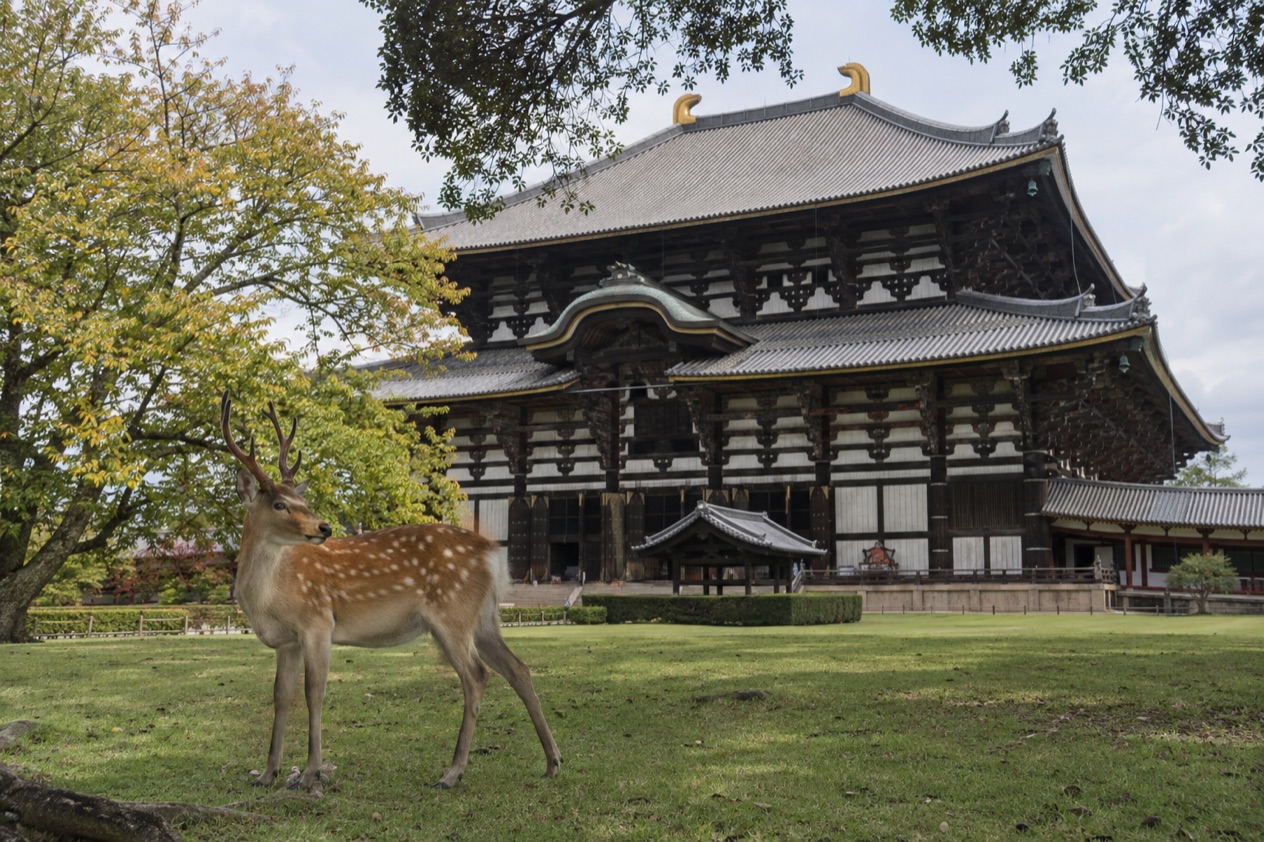
A deer waits at the edge of the path in Nara Park, stares at your hand, and then bows its head for a rice cracker. Overhead the cherry trees are in flower, or the maples have gone red, or the stone lanterns of Kasuga Taisha are wet with a winter drizzle, depending on the month. Nara changes its mood with the calendar more than most places, and the months that suit you depend on whether you want blossoms, fall color, festival fires or simply a long day among the temples at the foot of Mount Wakakusa.
When is the best time to visit Nara?
Those are the months for travelers who want to spend whole days outdoors, wandering between Todai-ji, Kasuga Taisha and the deer meadows without sweating or shivering.
For sightseeing, April and November give the most comfortable temperatures for covering a lot of ground. The days in April are long, with sunshine to spare, and in spring you can travel with a light jacket or a simple sweater. Autumn brings the same mild feel, and Japan’s national tourism office calls the season ideal for walking. Nara’s temples, pagodas and long approach paths are made for exactly that.
For food, fall is generous. Persimmons hang orange on bare branches, and the local table leans on kakinoha-zushi (sushi wrapped in persimmon leaves), narazuke (vegetables pickled in sake lees) and kudzu sweets with a soft, glassy texture. In winter, a bowl of hot tea porridge or a warm noodle dish beside the park feels exactly right. Summer calls for cold somen noodles and shaved ice.
For nature, the two big moments are the blossom and the leaves, and both are brief, so flexible dates help. If you care about quieter, cooler days with fewer rain showers, the stretch from late fall into winter has lower rainfall, though evenings turn cold. Families will find the deer a draw in any month, but the heat of July and August makes long outdoor days tiring, and spring or fall suits small walkers better.
Nara weather by month
Nara runs from cold winters through a mild spring and a hot, humid summer to a gentle fall.
| Month | Average high (°F) | Average low (°F) | Precipitation (in) | Days with 1 mm or more of precipitation | Hours of sunshine | Daylight on the 15th |
|---|---|---|---|---|---|---|
| January | 47.7 | 33.4 | 2.06 | 6.2 | 118 | 10 h 04 min |
| February | 49.8 | 33.8 | 2.48 | 6.9 | 121 | 10 h 55 min |
| March | 57.0 | 38.5 | 4.14 | 9.9 | 158 | 11 h 55 min |
| April | 67.6 | 47.7 | 3.89 | 9.6 | 173 | 13 h 01 min |
| May | 76.8 | 57.0 | 5.45 | 10.0 | 188 | 13 h 57 min |
| June | 82.6 | 65.1 | 7.25 | 11.7 | 139 | 14 h 28 min |
| July | 89.1 | 73.4 | 6.83 | 11.2 | 157 | 14 h 17 min |
| August | 92.1 | 75.4 | 5.04 | 8.0 | 203 | 13 h 30 min |
| September | 83.8 | 68.2 | 6.26 | 10.0 | 152 | 12 h 27 min |
| October | 72.7 | 56.3 | 5.30 | 9.2 | 149 | 11 h 22 min |
| November | 62.8 | 45.1 | 2.80 | 7.0 | 145 | 10 h 23 min |
| December | 52.9 | 37.4 | 2.24 | 6.6 | 133 | 9 h 51 min |
Winter is cold, with highs in the 40s and lows near freezing in January and February. Rain is only part of the picture then, because snow or sleet falls on a good share of days, even if very little of it settles. A warm coat, gloves and a hat make the temple grounds comfortable, and the short days, with daylight ending early in December, mean the sightseeing hours are limited.
Spring warms quickly. March still wants a coat, April is mild enough for a sweater, and by May the afternoons reach the mid-70s. June and July bring the wettest weather, humid and gray, with rain falling on more than ten days each month.
August has fewer rainy days and the most sunshine of the year, but it is also the hottest month, with highs in the low 90s. Light cotton clothes, a hat, water and an umbrella that works against both sun and rain all earn their place.
September still carries summer warmth along with plenty of rain, while October and November cool down into the 70s and then the 60s. Bring layers in fall, since the gap between a sunny afternoon and a chilly night grows wider as November goes on.
What is there to do in Nara in each season?
Nara rewards every season with a different walk. The same circuit of the great temples, the park and the old lanes of Naramachi feels like a new place in each one, and the deer are there throughout the year, taking crackers from visitors along the roadside.
Spring: cherry blossoms around Nara Park
In Nara, the cherry blossom first bloom usually arrives around March 28, and full bloom follows around the first days of April. From one spring to the next the dates shift by well over a week either way, so the blossoms are a plan to hold loosely. Petals fall on the grass where deer graze, and the pagoda and temple roofs show through pink branches.
Spend a day on foot in the park, from Todai-ji, where the Great Buddha sits inside one of the temple’s vast halls, to Kasuga Taisha along the lantern-lined approach. Nara has three World Heritage sites, covering ancient monuments, sacred mountain trails and some of Japan’s oldest temples and shrines, and spring light makes them a pleasure to see. May is warmer and greener, with long days and plenty of sunshine, a good month for the quieter corners beyond the park.
The rainy season and summer
June and July are the wettest stretch, with humid, gray days when temples seem softer under a drizzle. It is a season for museums, covered shopping streets in Naramachi, and lunches that last. Moss in the shrine gardens turns a deeper green, and an umbrella is part of the outfit.
August brings strong sun and the highest heat of the year. Limit long outdoor stretches, rest in shaded cafés, and enjoy the summer lantern events at Kasuga Taisha and in the park after dark.
Fall leaves and winter
In fall, colorful leaves frame temple gardens, the slopes behind Kasuga Taisha and the paths of the park, with deer walking through them. November brings cooler weather and fewer rainy days than the months before it.
Winter is for travelers who prefer bare branches, hot drinks and a quiet frame around the great halls. Snow or sleet comes on some days in January and February, and when it does the park looks entirely different. Dress warmly and plan indoor stops in between.
When is Nara least crowded?
Outside the New Year period, the cold weeks of January and February and the wet weeks of June are generally quieter for sightseeing. The blossom weeks of spring and the color weeks of late fall are the moments when people from all over Japan and abroad plan their visits, and the park, the approach to Kasuga Taisha and the main temple halls are shared with more people then.
Japan’s holiday periods are also worth knowing as you pick dates. Golden Week runs from the end of April into early May, Obon falls in mid-August, and New Year brings the custom of visiting a shrine in the first days of January.
At those moments, families travel inside Japan, and Nara, an easy day from Osaka and Kyoto by rail, sits on many itineraries. Choosing dates just outside these weeks gives the sights more room.
Midweek days outside the holidays are a way to see the main sites at a calmer rhythm, and the lanes of Naramachi, the old merchant quarter, spread visitors across more streets than the park does. If you want to be in Nara for the blossom, the leaves or the festivals, accept that you will share it, and go for the pleasure of the moment itself.
Deep winter offers the clearest contrast: short days, cold air and a mood closer to a quiet pilgrimage. A warm layer, a hot drink in a tea room and an unhurried visit to Todai-ji can be among the most memorable ways to see the city, as long as you are comfortable with the cold.
Which months should you avoid in Nara?
No month is off limits, but July and August are the hardest for outdoor sightseeing, and June is the one to prepare for with an umbrella. Nothing here is a reason to stay home, only a reason to pack and plan differently.
June and July are humid, with rain on more than ten days in each month. The showers are not constant, and the gray light flatters the temples, but a long day outdoors becomes a sequence of dashes between roofs. September stays wet too, so a September trip means keeping a flexible plan and an umbrella close.
July and August bring real heat: highs in the upper 80s and low 90s with high humidity, and August is the sunniest month of the year.
January and February are the coldest months, with snow or sleet on a good share of days and the shortest daylight. That suits travelers who dress for it, but not those hoping for long outdoor days. If you have your heart set on cherry blossoms or fall leaves, remember that both seasons are short and move from one year to the next, so even the best-timed trip may find the trees just before or just after their peak.
Festivals and events in Nara through the year
Winter and early spring: fire, lanterns and the first shrine visit
The year begins on January 1 with hatsumode, the first shrine or temple visit of the year, when families in warm coats walk the approaches of Kasuga Taisha and Todai-ji to make a wish. In late January, the grass on the slopes of Mount Wakakusa is set alight in Wakakusa Yamayaki, and the hillside glows above the city.
In the first half of March, Todai-ji holds Omizutori, a long Buddhist rite known for the large torches carried along the temple’s balcony, sending sparks into the night. Those who want to see it should plan for the cold evenings of that time of year.
Spring and summer: blossoms, holidays and lantern nights
Spring belongs to hanami, the custom of picnicking and strolling under cherry trees. In Nara Park it happens under old trees near temple roofs and deer, and groups bring snacks and sit on blue sheets on the grass. Golden Week follows at the end of April and in early May, a holiday stretch in Japan when travel is busy across the country.
In August, around Obon, when families remember their ancestors, Nara fills with lantern events. Candles and lanterns glow in the park during the Nara Tokae festival, and the lanterns of Kasuga Taisha are lit again in mid-August. Evenings are warm, and walking among the lights is a pleasure as long as you carry water and take your time.
Fall: antlers, treasures and the color season
In October, Nara holds Shika no Tsunokiri, the ceremonial cutting of deer antlers, a tradition performed at the deer enclosure on certain weekends. It is a good moment to learn how the town and its animals live together, and it comes just before the weather cools for the leaf season.
In the fall, the Nara National Museum usually holds an exhibition of treasures from the Shosoin, the repository linked to Todai-ji, which is a draw for people interested in ancient art. The color season follows, with leaves above and deer below in the park.
Sources
- Japan Meteorological Agency (JMA), Normal values 1991-2020, monthly (https://www.data.jma.go.jp/stats/etrn/view/nml_sfc_ym.php?prec_no=64&block_no=47780), station Nara, elevation 102 m, checked October 11, 2026
- Computed from the date and the latitude of the place (sunrise equation, solar elevation -0.833 degrees), October 11, 2026
- Japan National Tourism Organization, Nara (https://www.japan.travel/en/destinations/kansai/nara/), checked October 11, 2026
- Official Nara Travel Guide, getting around Nara (https://www.visitnara.jp/getting-around-nara/), checked October 11, 2026
- Official Nara Travel Guide, first-time visitors (https://www.visitnara.jp/for-first-time-visitor/), checked October 11, 2026
- Japan National Tourism Organization, autumn in Japan (https://www.japan.travel/en/guide/autumn-guide/), checked October 11, 2026
- Japan National Tourism Organization, spring in Japan (https://www.japan.travel/en/guide/spring-guide/), checked October 11, 2026
- Japan Meteorological Agency, cherry blossom first-bloom dates 2021-2026 and 1991-2020 normal (https://www.data.jma.go.jp/sakura/data/sakura003_07.html), checked October 11, 2026
- Japan Meteorological Agency, cherry blossom full-bloom dates 2021-2026 and 1991-2020 normal (https://www.data.jma.go.jp/sakura/data/sakura004_07.html), checked October 11, 2026