
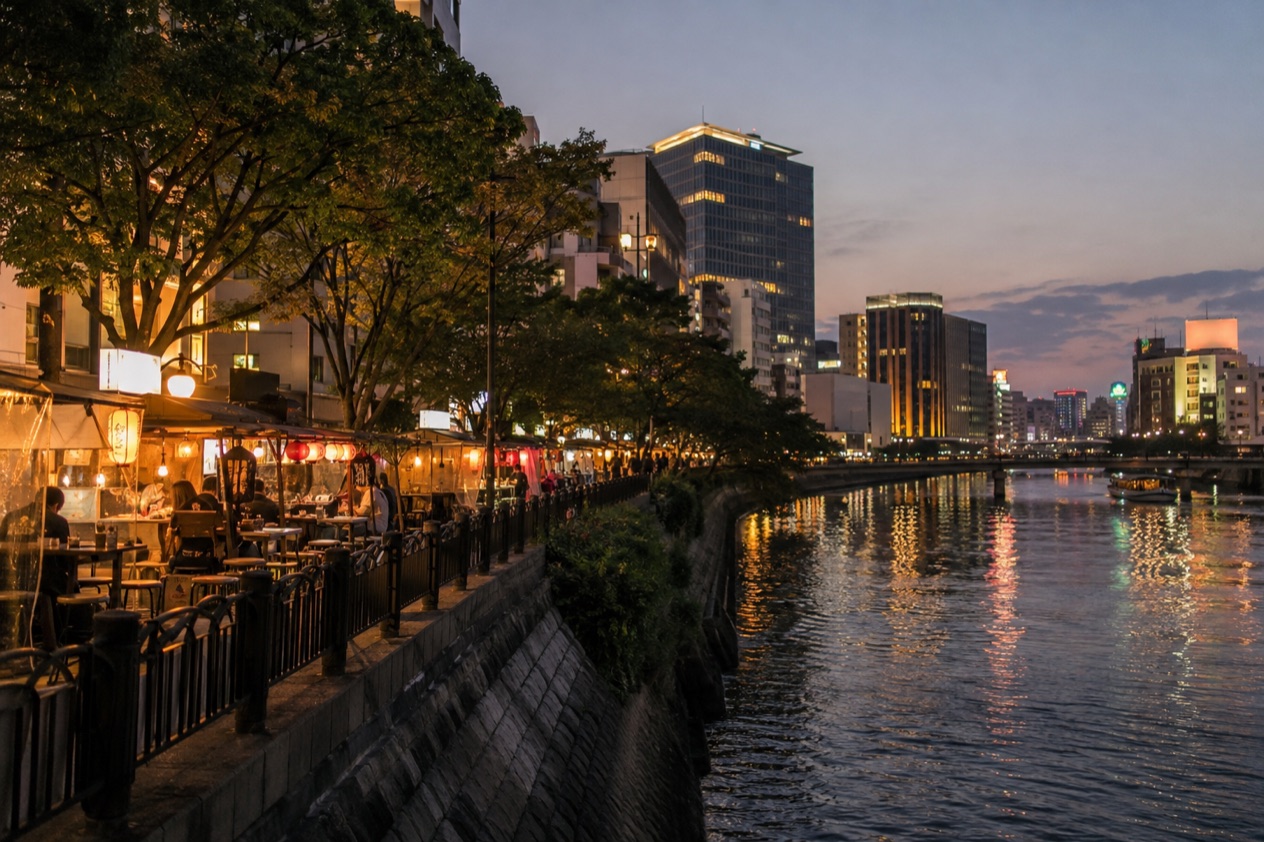
On a Fukuoka evening, the little yatai stalls roll into place along the river in Nakasu and Tenjin, lanterns switch on, and the smell of pork-bone broth drifts over the pavement. Strangers sit elbow to elbow on stools under a canvas roof, slurping noodles and passing around skewers.
This is a port city on the north coast of Kyushu that eats well, moves at an easy pace and looks out toward the Asian mainland. It suits food lovers, festival-goers and travelers who want a big city without the weight of Tokyo.
Where is Fukuoka and what is it like?
Fukuoka sits on the north coast of Kyushu, the third largest island of Japan, and it is the capital of Fukuoka prefecture and the largest city on the island. It is a port city, and its history has been shaped by that position. Because it lies so close to the Asian mainland, it has traded and traded ideas with the continent throughout its past, and you can still feel that outward-looking streak in its food, its festivals and its easygoing attitude toward visitors.
The city is actually two old halves that grew together. Hakata, around the main rail station, is the merchant and festival side, home to the ramen shops, the shrines and the big summer processions. Tenjin, the other half, is the shopping and nightlife district, with department stores, underground arcades and a lively crowd after dark. The two are linked by the subway, and between them the Naka River gives the center its yatai-lined waterfront.
The pace is relaxed for a city with this much going on. Fukuoka has the fastest population growth of any city in Japan, and you notice it in the young crowds, the new cafés and the steady stream of openings.
Lonely Planet named the city in the Food category of its Best In Travel list for 2023, and The New York Times put the Hakata yatai on its list of places to go the same year. That attention is earned at the table, and food is the reason people come.
Who will love it? Anyone who plans a trip around meals, who likes to wander without a checklist, or who wants a base for temples, parks and day trips elsewhere on Kyushu. Who may not? Travelers hunting for a dense cluster of famous castles and old wooden streets will find fewer of those here than in Kyoto.
It is also a long way from the capital. Tokyo lies 684 miles (684 mi) away, and the nearest overseas region is Busan in South Korea, about 112 miles across the water. That closeness to Korea, closer than to Tokyo in spirit if not in rail lines, explains a lot about the city’s character.
What is there to do in Fukuoka?
Beyond its food stalls, Fukuoka’s key sights include Ōhori Park, the Fukuoka Castle ruins, Kushida Shrine and the Momochi waterfront. What sets Fukuoka apart from its neighbors is how much of this happens at street level and after dark, in a city where the best experiences are often a stool, a bowl and a conversation.
Yatai stalls and Hakata ramen
A yatai is a small, mobile food stall, typically selling ramen or other food, and Fukuoka is where the tradition is most alive. Stalls serving ramen can be found in Tenjin and Nakasu most evenings, set up along the water with a handful of seats each. You sit close to the cook, watch the pot, and often end up chatting with the person next to you.
The star order is Hakata tonkotsu ramen, a cloudy pork-bone broth with thin noodles. Tonkotsu ramen originated in Kurume, elsewhere in Fukuoka Prefecture, and Hakata made it famous across Japan. In some restaurants a bowl costs no more than 280 yen. Add mentaiko, the spicy pollock roe the city is known for, and a skewer or two from the next stall over, and you have a complete evening.
Local dishes beyond ramen
Fukuoka has its own cuisine that goes well past noodles. Motsunabe is an offal hotpot, rich and garlicky, usually shared at a table in the cooler months. Goma saba is mackerel prepared as sushi or sashimi and coated in a sesame sauce, a dish the city specializes in.
These are the things people from other parts of Japan come to Fukuoka to eat, alongside mentaiko and ramen. Try one in an izakaya, a casual pub-style restaurant, where small plates arrive in sequence and the menu leans on what the kitchen does best.
Festivals: Dontaku and Yamakasa
Two events define the calendar. Hakata Dontaku takes over the streets on May 3 and 4, with costumed parades, drums and music through the center of town. Hakata Gion Yamakasa is the big summer event, held in July, and its Oiyama race of heavy festival floats takes place on July 15.
Yamakasa is the more physical of the two, with teams of men in traditional shimekomi carrying floats through the streets at speed. If your dates line up with either festival, build the trip around it.
Parks, temples and art
Ōhori Park, in Chūō-ku, is the city’s green center, and it is the location of one of Fukuoka City’s major art galleries. It makes a natural pause between meals, with paths and open space in the middle of the city.
For something more modern, teamLab Forest Fukuoka is an immersive digital art installation in the Momochi area. East of the city, the Buddhist temple Nanzoin, founded in 1899, claims to have the largest statue of a reclining Buddha in the world. Dazaifu Tenmangū is another shrine on many itineraries, though its honden is under renovation expected to take about three years.
How many days do you need in Fukuoka?
A long weekend is enough to taste the city, and four or five days lets you add day trips without rushing. Fukuoka rewards a slower rhythm, so the question is less how much you can fit in and more how many meals you want to have.
In two or three days, you can cover the essentials. Spend one evening at the yatai in Nakasu or Tenjin, another over a motsunabe hotpot, and a morning in Ōhori Park with its art gallery. Add a wander through the shopping streets of Tenjin and the Hakata side around the station, where the city’s merchant roots show. With a third day, include teamLab Forest Fukuoka, which suits rainy weather as well as clear.
With four or five days, the surrounding area opens up. Dazaifu Tenmangū is another possible excursion from Fukuoka. Nanzoin, east of the city, gives you the reclining Buddha. Because Fukuoka is Kyushu’s largest city, it also works as a base for exploring the rest of the island.
The streets change character, and the best views are from the sidewalk rather than a schedule. Leave room to simply eat again at a stall you liked the first night, which is often the best part of a stay here.
A week is more than the city itself needs, but it suits a trip that combines Fukuoka with other parts of Kyushu. Think of the city as the first and last stop, with the slow evenings of the yatai bookending the days you spend elsewhere on the island.
Where to stay in Fukuoka
The two natural bases are Hakata and Tenjin, the two old halves of the city, and both are close to the places you will want to eat. Hakata surrounds the main JR station, which makes it the practical choice for arrivals by rail, and it is the side of town tied to the festivals, shrines and ramen shops. Staying here means the Yamakasa and Dontaku crowds are on your doorstep when they come.
Tenjin is the choice if you want shopping and nightlife within a few steps. Department stores, underground arcades and late-evening restaurants cluster here, and the yatai of Tenjin and Nakasu are within reach of an evening walk. It suits travelers who like to step out of the hotel and be in the middle of things.
Nakasu, the island between the two, is where the river lights and the stalls are. Staying near it puts you beside the water, handy for a late bowl of ramen, though it is more of a place to eat and stroll than to sleep for those who want quiet.
Other areas to consider are Yakuin, which is one of the districts where teamLab Forest Fukuoka is located, and the Momochi and Sawara area, also named as a location of that installation. Ōhori Park, in Chūō-ku, makes a greener base for travelers who prefer a lakeside setting to a station neighborhood. Because the subway links these districts, you are rarely far from the center wherever you settle.
How do you get to Fukuoka and get around?
Visitors arrive at Fukuoka Airport or by rail at Hakata JR station, and the two are closely linked. The airport’s Domestic Terminal is served by the subway, just 2 stops from Hakata JR station, so you can be in the center of the city without a long transfer.
Because Tokyo is 684 miles (684 mi) away, Fukuoka is a real journey from the capital, and travelers coming from elsewhere in Japan often arrive by air or by long-distance rail. From the other direction, Busan in South Korea lies about 112 miles across the water, a reminder that the city has long been a gateway to the continent.
Once in the city, the subway is the backbone of getting around, tying together Hakata, Tenjin and the airport. The core districts are close enough that evenings at the yatai are a matter of strolling between Tenjin and Nakasu along the river.
For the places beyond the center, such as Dazaifu Tenmangū or Nanzoin east of the city, you will move out from the main stations by rail or road. The subway connects Fukuoka Airport’s Domestic Terminal with Hakata Station in two stops.
When is the best time to visit Fukuoka?
October and April are the most comfortable months, and October stands out. In October, highs average in the mid-70s and lows around 60, with only about seven days of rain and plenty of sun, which makes it ideal for long evenings outdoors at the yatai. April is milder, with highs near 68 and lows in the low 50s, though it is wetter than October, with nearly ten rain days and heavier totals.
July is the hot and wet month. Highs reach the upper 80s with lows in the mid-70s, humidity is high, and rain falls on about eleven days, often in heavy amounts. It is also the month of Hakata Gion Yamakasa, so the city is at its liveliest even as the weather turns sticky. If you come then, plan indoor stops, lighter clothes and a flexible schedule.
January is cool, with highs just above 50 and lows near 39, and it brings a surprising number of days of snow or sleet, though totals are small. It is a good month for motsunabe and hot ramen, and the city is quieter then.
| Month | Average high (°F) | Average low (°F) | Precipitation (in) | Rain days | Sunshine (hours) |
|---|---|---|---|---|---|
| January | 50.4 | 39.0 | 2.93 | 9.3 | 104 |
| April | 67.8 | 52.7 | 4.65 | 9.7 | 188 |
| July | 88.2 | 76.3 | 11.78 | 11.0 | 172 |
| October | 74.7 | 60.8 | 3.72 | 6.8 | 176 |
Good to know before you go
Food is cheap by design here, and stalls and small restaurants are where the city shines, with some bowls of tonkotsu ramen costing no more than 280 yen. Evenings are the time to be out, since the yatai set up most nights along the river in Tenjin and Nakasu. Plan for rain in the summer months.
July is hot, humid and rainy, so pack light clothing and allow for wet weather. For the festivals, Hakata Dontaku falls on May 3 and 4 and the Oiyama race of Yamakasa on July 15, so those dates are worth marking before you plan flights.
Sources
- Japan National Tourism Organization, Fukuoka (https://www.japan.travel/en/destinations/kyushu/fukuoka/fukuoka-city/), checked October 11, 2026
- Fukuoka City official tourist guide (https://yokanavi.com/en/), checked October 11, 2026
- Wikipedia, Fukuoka (https://en.wikipedia.org/wiki/Fukuoka), checked October 11, 2026
- Wikivoyage, Fukuoka (https://en.wikivoyage.org/wiki/Fukuoka), checked October 11, 2026
- Wikipedia, Dazaifu Tenmangū (https://en.wikipedia.org/wiki/Dazaifu_Tenmang%C5%AB), checked October 11, 2026
- Wikipedia, Yatai (food cart) (https://en.wikipedia.org/wiki/Yatai_(food_cart)), checked October 11, 2026
- Wikipedia, Hakata ramen (https://en.wikipedia.org/wiki/Hakata_ramen), checked October 11, 2026
- Wikipedia, Ramen (https://en.wikipedia.org/wiki/Ramen), checked October 11, 2026
- Wikipedia, Ōhori Park (https://en.wikipedia.org/wiki/%C5%8Chori_Park), checked October 11, 2026
- Japan Meteorological Agency (JMA), Normal values 1991-2020, monthly (https://www.data.jma.go.jp/stats/etrn/view/nml_sfc_ym.php?prec_no=82&block_no=47807), station Fukuoka, elevation 2 m, checked October 11, 2026
All our pages
When to go
- Best Time to Visit Fukuoka: Cherry Blossoms, Autumn Weather, Food Stalls and Festivals
- Fukuoka in January: New Year Shrines, Yatai Ramen, Plum Season and Winter Weather
- Fukuoka in February: Setsubun, Plum Blossoms, Yatai Stalls and Weather
- Fukuoka in March: Cherry Blossoms, Yatai Stalls, Weather and a Two-Day Plan
- Fukuoka in April: Cherry Blossom Afterglow, Weather, Yatai Food and a Two-Day Plan
- Fukuoka in May: Hakata Dontaku, Yatai Nights, Weather and a Two-Day Plan
- Fukuoka in June: Weather, Yatai Food Stalls and What to Do
- Fukuoka in July: Hakata Gion Yamakasa, Weather and What to Do
- Fukuoka in August: Heat, Obon, Yatai Dinners and a Two-Day Plan
- Fukuoka in September: Weather, Yatai Evenings and What to Do
- Fukuoka in October: Weather, Yatai Food Stalls, Autumn Eating and a Two-Day Plan
- Fukuoka in November: Weather, Yatai Food Stalls, Dazaifu and a Two-Day Plan
- Fukuoka in December: Weather, Yatai Stalls, Maple Leaves and a Two-Day Plan
Things to do
- Things to Do in Fukuoka: Yatai Stalls, Ohori Park, Dazaifu and Ramen
- Day Trips from Fukuoka: Nagasaki, Kumamoto, Beppu's Hot Springs and Dazaifu
- 3 Days in Fukuoka: Yatai Stalls, Ramen, Ōhori Park and Dazaifu Tenmangū
- Fukuoka Yatai Food Stalls: Nakasu, Tenjin, Ramen and Evening Hours
Where to stay
Getting there
- Fukuoka from Tokyo: Rail, Air, Bus and Arrival at Hakata Station
- Fukuoka Airport (FUK): Terminals, Airlines and Getting to Hakata and Tenjin
- Fukuoka Airport to Hakata Station: Subway, Airport Bus, Taxi and IC Cards
- Fukuoka to Beppu: The Sonic Limited Express, Rail Passes and Arriving in Hot Spring Country
- Fukuoka to Kumamoto: Kyushu Shinkansen, Rail Passes and Driving on the Left
- Fukuoka to Nagasaki: Relay Kamome, Kamome Shinkansen, the Airport Bus and Rail Passes