
You step off a flight from Tokyo, pick up your bag, and a few minutes later you are standing in the middle of Hakata, where the ramen shops are already steaming. That is the promise of Fukuoka Airport, the gateway to the island of Kyushu.
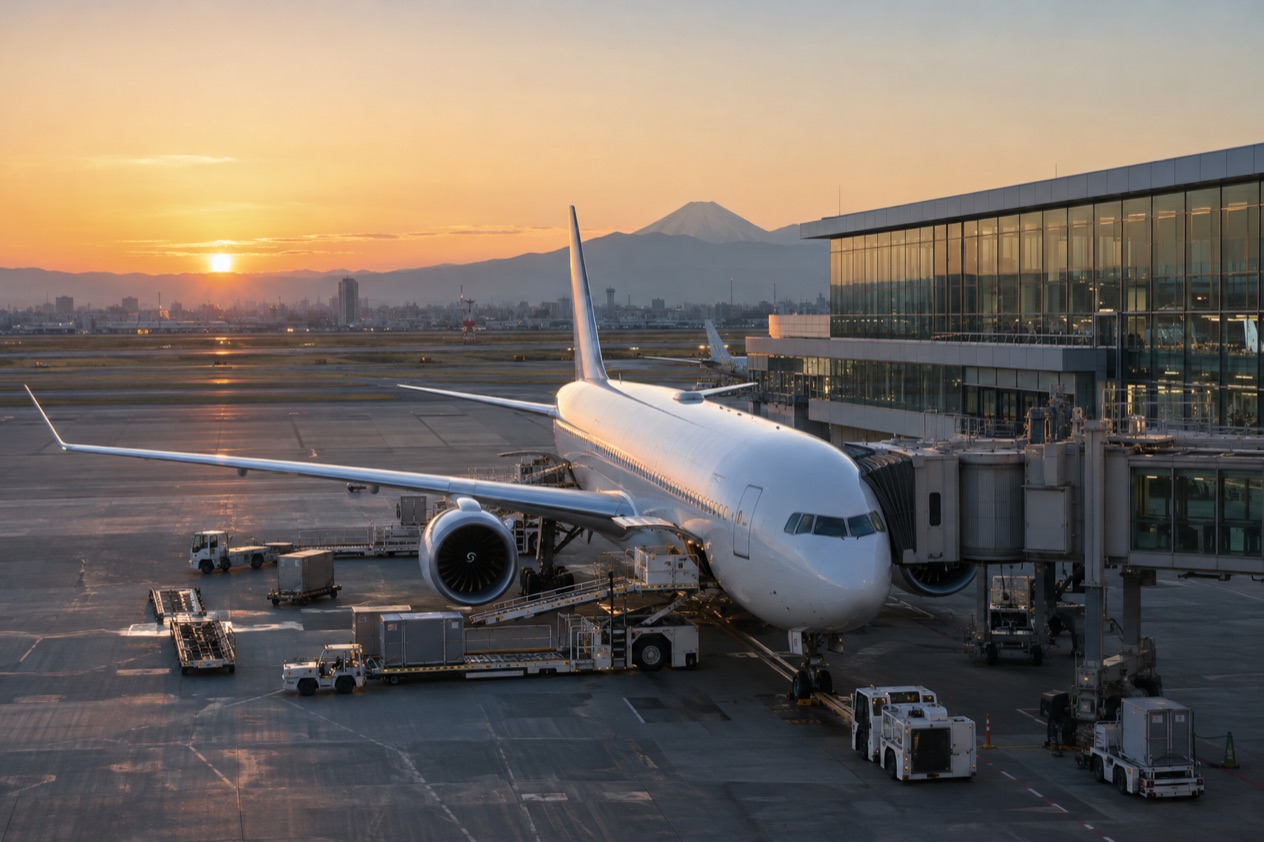
What is Fukuoka Airport?
Fukuoka Airport is the main airport of Fukuoka, in Hakata-ku ward, and it handles both domestic and international flights for the city and for Kyushu beyond it. It lies 1.8 miles east of Hakata Station, which is why Japan’s national tourism office calls it very central. After you collect your baggage, the train gets you to Hakata, in the heart of the city, in five minutes.
The airport is one of the busiest in the country. It is the fourth busiest passenger airport in Japan, and it served 25 million passengers in 2018. In Skytrax’s list of the World’s Top 100 Airports it ranked 26th for 2024. It opened in 1944 and now covers 853 acres, with a cargo terminal next to the international terminal.
The domestic terminal
The domestic terminal is the one tied to the city by rail. The Fukuoka City Subway runs to it, so passengers arriving from Tokyo, Sapporo, Naha or Nagoya can step from the arrivals hall onto a subway platform. A ride to the business district takes about ten minutes.
The airport provides boarding procedures for this terminal, laid out on its official website. The same site carries Today’s Flight Information and the schedules for tomorrow and beyond, which is handy when a morning plan depends on a particular departure. The site is available in Japanese, English, Simplified Chinese, Traditional Chinese and Korean.
The international terminal
The international terminal stands apart from the subway. It can be reached only by road, so the link to the city is by bus. Scheduled buses run to Hakata Station and to the Tenjin area, the two places visitors head for first, and there are scheduled buses to the domestic terminal and its subway station as well.
The airport has published separate boarding procedures for this terminal. Work to double its size was completed in March 2025, so travelers arriving from elsewhere in Asia now pass through a much larger building than the one older guidebooks describe. A cargo terminal sits right beside it.
Runways and the night curfew
Fukuoka Airport has a mandatory late night curfew, at the request of local residents. Nothing operates from 22:00 each night until 07:00 the next morning. That matters when you plan a late arrival or an early departure, since the airport is closed to flights between those hours.
A second runway officially opened on March 20, 2025, and it is used only for international departures. Because it lies so close to the first runway, the two cannot be used at the same time. For passengers, this means the extra capacity helps with international departures, while the daily rhythm of flights still follows the curfew.
An alternative airport
Kitakyushu Airport lies 38 miles from Fukuoka Airport and is open 24 hours a day. It is the alternative when the curfew rules out the main airport. Travelers to Fukuoka will never need it, but it is useful to know that it exists.
Which airlines fly there?
Fukuoka Airport is served by a long list of Japanese carriers, both full-service and low-cost, which fly nonstop to cities across the country. For travelers coming from the United States, the key point is that no airline offers nonstop flights from Fukuoka to any U.S. city, Honolulu included. Only Asian destinations are listed for international service, so a trip from North America here means connecting somewhere else first, often through Tokyo.
| Airline | Nonstop destinations from Fukuoka |
|---|---|
| All Nippon Airways (ANA) | Nagoya–Centrair, Naha, Sapporo–Chitose, Tokyo–Haneda |
| ANA Wings | Fukue, Komatsu, Miyazaki, Nagoya–Centrair, Naha, Osaka–Itami, Sapporo–Chitose, Tokyo–Haneda, Tsushima |
| Japan Airlines (JAL) | Izumo, Kagoshima, Kochi, Matsuyama, Miyazaki, Sapporo–Chitose, Tokushima, Tokyo–Haneda |
| Skymark Airlines | Ibaraki, Naha, Sapporo–Chitose, Shimojishima, Tokyo–Haneda |
| StarFlyer | Nagoya–Centrair, Sendai, Tokyo–Haneda |
| Fuji Dream Airlines | Hanamaki, Matsumoto, Nagoya–Komaki, Niigata, Sapporo–Chitose, Sendai, Shizuoka |
| Air Do | Sapporo–Chitose |
| Jetstar Japan | Nagoya–Centrair, Osaka–Kansai, Tokyo–Narita |
| Peach | Ishigaki, Naha, Osaka–Kansai, Sapporo–Chitose, Tokyo–Narita |
Flights to Tokyo and the big hubs
Tokyo–Haneda, the airport of Tokyo city itself, is served nonstop by ANA, ANA Wings, JAL, Skymark and StarFlyer. Haneda lets travelers arrive directly in the heart of Tokyo. Narita, the other airport serving the capital, is reached nonstop from Fukuoka by Jetstar Japan and Peach.
For the Kansai region, Jetstar Japan and Peach fly to Osaka–Kansai, the airport that makes it possible to visit Japan without going through Tokyo. ANA Wings flies to Osaka–Itami. Nagoya–Centrair, the hub for flights to and from cities in Asia and Japan, is served by ANA, ANA Wings, Jetstar Japan and StarFlyer, while Fuji Dream Airlines lands at Nagoya–Komaki.
Hokkaido, Okinawa and the islands
Sapporo–Chitose is the busiest name on the departure board, with ANA, ANA Wings, JAL, Skymark, Fuji Dream Airlines, Air Do and Peach all flying there nonstop. Chitose is where most domestic flights from the main island land in Hokkaido, in the south of the island. It is the route for travelers who want to pair Kyushu with ski country or the northern summer.
Okinawa can be reached only by air from major Japanese cities, and from Fukuoka, ANA, ANA Wings, Peach and Skymark fly to Naha. Peach also serves Ishigaki, and Skymark serves Shimojishima. ANA Wings links Fukuoka with Tsushima and Fukue, two island destinations that appear on few U.S. itineraries.
Regional cities and other routes
Beyond the large hubs, the departure board reads like a tour of provincial Japan. JAL flies to Izumo, Kagoshima, Kochi, Matsuyama and Tokushima, covering Kyushu and Shikoku, and also to Miyazaki, which ANA Wings serves too. ANA Wings adds Komatsu, close to Kanazawa’s side of the country.
Fuji Dream Airlines connects Fukuoka with Hanamaki, Matsumoto, Niigata, Sendai and Shizuoka, a mix of northern and central towns. StarFlyer also serves Sendai, and Skymark flies to Ibaraki. Most Japanese prefectures have at least one airport, and low-cost carriers make it possible to reach almost anywhere in the country at a reasonable price.
How do you get to the city?
The way into the city depends on the terminal: from the domestic terminal you take the subway, and from the international terminal you take a bus. The airport lists subway, bus, rental cars, taxis and an inter-terminal shuttle as its transport options. Airports in major Japanese cities are generally well served by express trains, buses and taxis, and most have car rental services.
By subway from the domestic terminal
The Fukuoka City Subway station is part of the domestic terminal, so the line begins almost where the baggage claim ends. The ride to the business district takes about ten minutes. Hakata Station, where the Shinkansen and local trains meet, is reachable from the airport, and so is Tenjin, the shopping and dining district.
Both areas are a good first base. Around Hakata you find the station buildings with their restaurants, and Tenjin is where the department stores, underground arcades and evening food stalls gather. From the airport, travelers can access all of Kyushu, so the same station also serves as a starting point for trips beyond the city.
By bus from the international terminal
Because the international terminal is reached only by road, buses are the main link. Scheduled buses run to Hakata Station and to the Tenjin area. Other scheduled buses connect the terminal with the domestic terminal and its subway station, so you can also switch to the subway if that suits your hotel better.
A shuttle bus connects the two terminals as well, and the airport describes it as an Inter-Terminal Shuttle. It matters when you arrive internationally but continue on a domestic flight, or when you want to change between a bus and the subway.
By taxi, rental car or your own wheels
Taxis and rental cars are listed among the airport’s transport options. A taxi is a direct way to reach a hotel with luggage, while a rental car opens up Kyushu beyond the city, from the coast to the mountains and the hot spring towns.
Fukuoka Airport also has car parking facilities, including parking for bicycles and motorcycles. For visitors, that is mostly a sign that locals use the airport as part of daily life, with the city close enough to make a short trip from home feel ordinary.
Good to know before you go
The curfew is the one thing to keep in mind when choosing flights, since the airport is closed to flights between 22:00 and 07:00. The official airport website, in English among five languages, shows today’s flights and later schedules, and it is the place to follow a delayed arrival. In the city itself, Hakata and Tenjin are the neighborhoods where you will spend most of the first evening, among the food stalls and the late dinners that Fukuoka does well.
Sources
- Japan National Tourism Organization, how to reach the city from each international airport (https://www.japan.travel/en/plan/airport-access/), checked October 11, 2026
- Wikipedia, Fukuoka Airport (https://en.wikipedia.org/wiki/Fukuoka_Airport), checked October 11, 2026
- Fukuoka Airport, Access (https://www.fukuoka-airport.jp/en/access/), checked October 11, 2026