
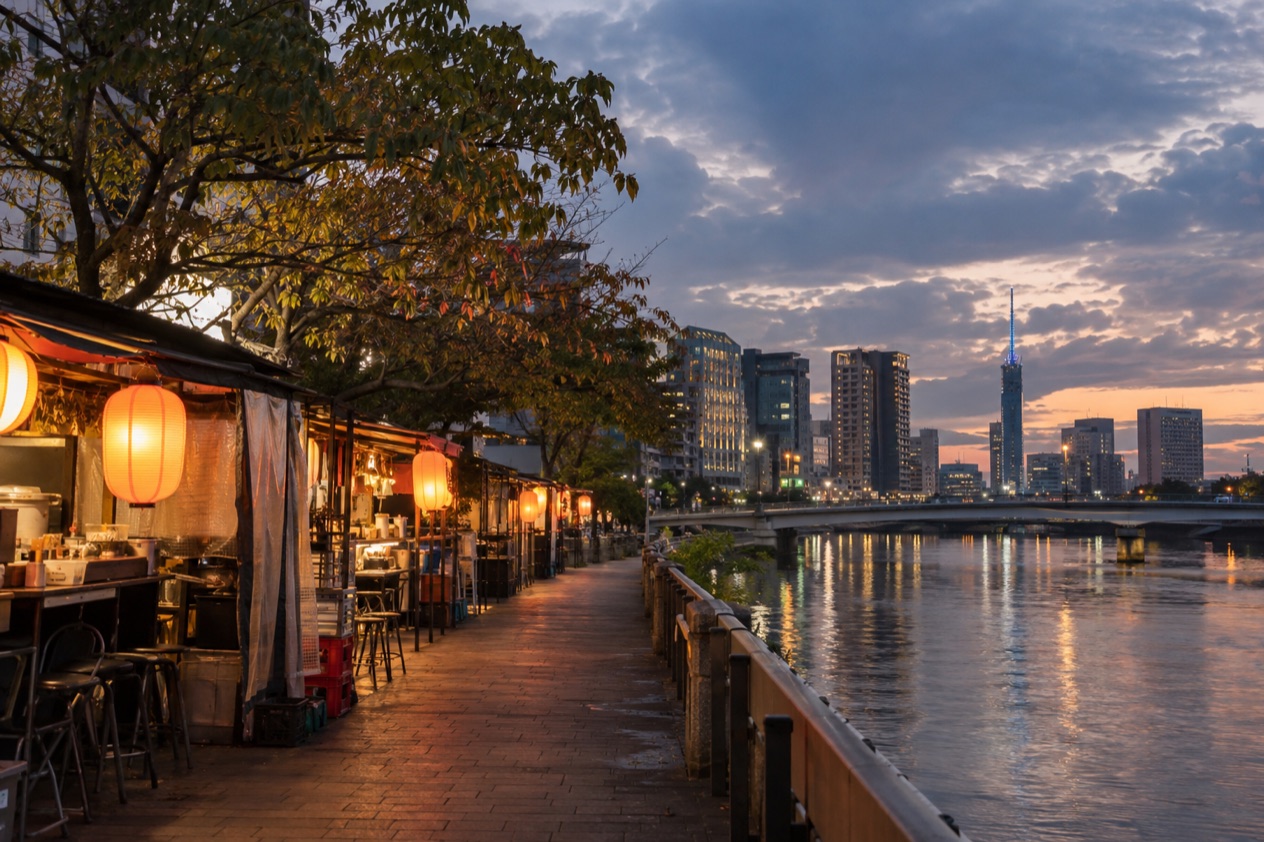
In September, the yatai (small food stalls) along the Naka river in Hakata light their lanterns while the air still carries the warmth of summer. Steam rises from bowls of tonkotsu ramen, and people linger outside rather than rushing in. Fukuoka, the port city on the north coast of Kyushu, spends this month easing out of the sultry season, with evenings made for the stalls and days for parks and shrines.
What is the weather like in Fukuoka in September?
September in Fukuoka is still summer, a little less fierce: hot and humid by day, mild enough at night to sit outdoors, with rain that arrives in real bursts.
| Month | Average high (°F) | Average low (°F) | Precipitation (in) | Days with 1 mm or more of precipitation | Hours of sunshine | Daylight on the 15th |
|---|---|---|---|---|---|---|
| August | 90.5 | 77.7 | 8.27 | 9.8 | 201 | 13 h 26 min |
| September | 83.5 | 70.9 | 6.89 | 9.7 | 165 | 12 h 26 min |
| October | 74.7 | 60.8 | 3.72 | 6.8 | 176 | 11 h 24 min |
Afternoons are warm and sticky, so lightweight, quick-drying clothes make the most sense for sightseeing. Humidity stays high through the month, which means a shirt can feel damp by the time you reach a shrine gate. Mornings and evenings are noticeably more comfortable than midday, and the nights are warm enough for a terrace dinner or a stall seat without a jacket.
Rain is a real part of the month. Close to ten days bring measurable rain, and the total is large, so expect heavy showers and the occasional gray, wet day rather than a steady drizzle. Sunshine is less generous than in August, and the light turns softer as the days shorten. Dusk comes noticeably earlier than it did a month ago, which brings the lantern-lit evenings forward.
A compact umbrella and a light layer for air-conditioned trains and cafés cover most needs. Japan’s summers on Honshu and Kyushu are described as very humid, hot and sultry, and September in Fukuoka still carries some of that feeling before autumn takes over.
What to do in Fukuoka in September
September in Fukuoka is a month for evenings outdoors. The big summer festival, Hakata Gion Yamakasa, belongs to July and the spring Hakata Dontaku to early May, so September has no headline festival to chase. What you get instead is the city at an unhurried pace, with its food culture running at full strength.
Fukuoka City was chosen in the Food category of Lonely Planet’s Best In Travel 2023, and its yatai in Hakata were picked for The New York Times’ list of places to go that same year. Both reputations come down to the same thing: eating well, cheaply and outdoors.
Yatai evenings in Hakata
A yatai is a small, mobile food stall, typically selling ramen or other food, and Fukuoka is where the form is best known. In the evening the stalls open along the river, with a counter, a few stools and a cook working in the middle. Warm September nights suit the format well, since you sit half in the open air with the steam from the pots drifting past.
Tonkotsu ramen, the pork-bone broth dish, originated in Kurume in Fukuoka Prefecture, and a bowl here is the obvious order. Many stalls also serve skewers, gyoza and other small plates, so you can graze from one to the next. Because the stalls are open to the sky, the humid evening air is part of the experience, and a rain shower can change the plan for the night.
Ohori Park and the art gallery
Ohori Park is where Fukuoka goes for a walk around the water, and it is also the site of one of the city’s major art galleries. In September, the park gives you somewhere to be outdoors in the softer hours of the day, with the gallery as a cool, dry refuge when the heat or a shower becomes too much.
The walk around the water is for the cooler ends of the day, while the gallery handles the hot middle.
Dazaifu Tenmangu
Dazaifu Tenmangu is the shrine visitors to Fukuoka add to their trip. Renovations of its honden, the main hall, are expected to take about three years, so the building you see may be partly under works. The grounds, the approach and the surrounding streets still give you a shrine visit, along with the sweets and snacks sold along the way.
With September heat and humidity, a shrine visit pairs well with a shaded stroll and a cold drink. Maple leaves here do not turn until around the start of December, so September is a green month on these grounds.
Around the city, Fukuoka’s closeness to the Asian mainland has shaped its food, its trade and its history for centuries, and you can taste that in the noodles, the broths and the seafood. Wherever you go, rain is possible, so keep an indoor alternative in mind.
A two-day itinerary for Fukuoka in September
Day 1 starts at Ohori Park in the morning, when the air is most comfortable. Walk the water’s edge, then step into the art gallery as the heat builds toward midday. Lunch can be a noodle shop or a set meal in a café near the park, with air conditioning doing some of the work.
Spend the afternoon in Hakata, wandering the station area and its shops while the day is at its hottest. Sunset falls early compared with high summer, with about twelve and a half hours of daylight in mid-month, so head to the river as the lanterns come on.
Dinner is the yatai: ramen, skewers and whatever the cook recommends. If a downpour arrives, ride it out in a covered shopping arcade and return when it eases.
Day 2 is for Dazaifu Tenmangu. Go in the morning, walk the approach, and see the grounds and whatever of the main hall is open during its renovation. Stop for sweets and a cold drink along the way, since September humidity makes breaks welcome.
Return to the city for the afternoon and keep it light. Pick a café, browse a department store or revisit a corner of Hakata you liked. For the evening, choose a different kind of place from the night before, such as an izakaya (a casual pub) with sashimi and local sake. On a wet day, swap the outdoor stops for museums, galleries and covered arcades, and keep the shrine for a drier window.
Is Fukuoka busy in September?
September in Fukuoka is a calmer month than July, when the Hakata Gion Yamakasa festival takes over the city, but it does not empty out.
Fukuoka is a city with the fastest population growth of any in Japan, so its streets, stations and food districts keep a steady rhythm all year. September has no major festival to draw a surge, and the autumn leaf season is still months away, with maple color at the Fukuoka station normally arriving around December 1.
What changes in September is the feel of the days. The heat eases from August, evenings stretch comfortably outdoors, and the yatai are an easy place to spend time. Rain is a bigger factor than crowds for planning, since a wet afternoon can reshape a day more than a busy street will.
What to pack for Fukuoka in September
Pack for warm, damp days and mild nights, with a plan for sudden rain.
- Light, breathable shirts, because humidity makes the afternoons sticky.
- A compact umbrella or rain jacket, since showers can be heavy.
- A thin layer for cooled trains, cafés and galleries.
- Comfortable shoes that dry quickly, for walks in Ohori Park and around Dazaifu.
- A small towel or handkerchief for the humid hours.
Good to know before you go
September falls in the stretch of the year when heavy rain is part of the pattern in Kyushu, so keep your plans flexible and leave an indoor option for each day. The Japan Meteorological Agency runs an Emergency Warning System, launched on 30 August 2013, which alerts people to the significant likelihood of catastrophes tied to natural phenomena of extraordinary magnitude. The Japan National Tourism Organization also keeps a Japan Safe Travel Information page with safety tips and government information for travelers.
Fukuoka Airport’s Domestic Terminal is served by the subway, just two stops from Hakata JR station, which puts the center of the city within reach of a flight arrival.
Fukuoka in September vs August and October
Moving the trip four weeks earlier puts you in August, with higher heat, more sunshine, longer days and more rain. It is the more intense, sultry version of the same city. The yatai still open, but the evenings are warmer and stickier, and a lot of the day is better spent indoors.
Four weeks later brings October, with noticeably cooler highs, much less rain and fewer wet days. Days are shorter, with a little over eleven hours of daylight in mid-month, but the walking weather improves, and Japan in autumn becomes gradually milder with temperatures well suited to strolling. Leaf color still waits until early December in Fukuoka.
Choose August if you want long days and do not mind the heat. Choose October if comfortable walking matters most. September sits between them, with some summer left, shorter days and a good deal of rain, which suits travelers who care more about food and evenings than about perfect skies.
Is September a good time to visit Fukuoka?
Yes, September is a good time for travelers who come for food, evenings outdoors and a city that is easing out of summer, and less suited to anyone who wants dry, crisp weather.
It will suit people who plan around meals: ramen at a yatai, skewers at the counter, a long lunch after a park walk. It also suits those who can adapt to a wet afternoon by moving into a gallery or an arcade. If you need reliably dry days for hiking or photography, a later month will serve you better.
On arrival, use the subway from the airport into Hakata and head to the river for your first evening bowl. September’s particular charm in Fukuoka is that warm night air, the glow of lanterns over the water and a pot of broth steaming at your elbow.
Sources
- Japan Meteorological Agency (JMA), Normal values 1991-2020, monthly (https://www.data.jma.go.jp/stats/etrn/view/nml_sfc_ym.php?prec_no=82&block_no=47807), station Fukuoka, elevation 2 m, checked October 11, 2026
- Computed from the date and the latitude of the place (sunrise equation, solar elevation -0.833 degrees), October 11, 2026
- Japan Meteorological Agency, Emergency Warnings (https://www.jma.go.jp/jma/en/Emergency_Warning/ew_index.html), checked October 11, 2026
- Japan National Tourism Organization, safety information (https://www.japan.travel/en/japan-safe-travel-information/), checked October 11, 2026
- Japan National Tourism Organization, weather and seasons in Japan (https://www.japan.travel/en/plan/weather/), checked October 11, 2026
- Japan National Tourism Organization, summer in Japan (https://www.japan.travel/en/guide/summer-guide/), checked October 11, 2026
- Wikipedia, Climate of Japan (https://en.wikipedia.org/wiki/Climate_of_Japan), checked October 11, 2026
- Japan Meteorological Agency, maple color-change dates 2025-2026 with difference from the 1991-2020 normal (https://www.data.jma.go.jp/sakura/data/phn_014.html), checked October 11, 2026
- Japan Meteorological Agency, kaede2020.pdf (https://www.data.jma.go.jp/sakura/data/kaede2020.pdf), checked October 11, 2026
- Japan National Tourism Organization, autumn in Japan (https://www.japan.travel/en/guide/autumn-guide/), checked October 11, 2026
- Japan National Tourism Organization, spring in Japan (https://www.japan.travel/en/guide/spring-guide/), checked October 11, 2026
- Japan National Tourism Organization, Fukuoka (https://www.japan.travel/en/destinations/kyushu/fukuoka/fukuoka-city/), checked October 11, 2026
- Fukuoka City official tourist guide (https://yokanavi.com/en/), checked October 11, 2026
- Wikipedia, Fukuoka (https://en.wikipedia.org/wiki/Fukuoka), checked October 11, 2026
- Wikivoyage, Fukuoka (https://en.wikivoyage.org/wiki/Fukuoka), checked October 11, 2026
- Wikipedia, Dazaifu Tenmangū (https://en.wikipedia.org/wiki/Dazaifu_Tenmang%C5%AB), checked October 11, 2026
- Wikipedia, Yatai (food cart) (https://en.wikipedia.org/wiki/Yatai_(food_cart)), checked October 11, 2026
- Wikipedia, Hakata ramen (https://en.wikipedia.org/wiki/Hakata_ramen), checked October 11, 2026
- Wikipedia, Ramen (https://en.wikipedia.org/wiki/Ramen), checked October 11, 2026